
SLIDE 1
Removing Barriers to Backyard Cottages & ADUs
February 11, 2016 Seattle Planning Commission
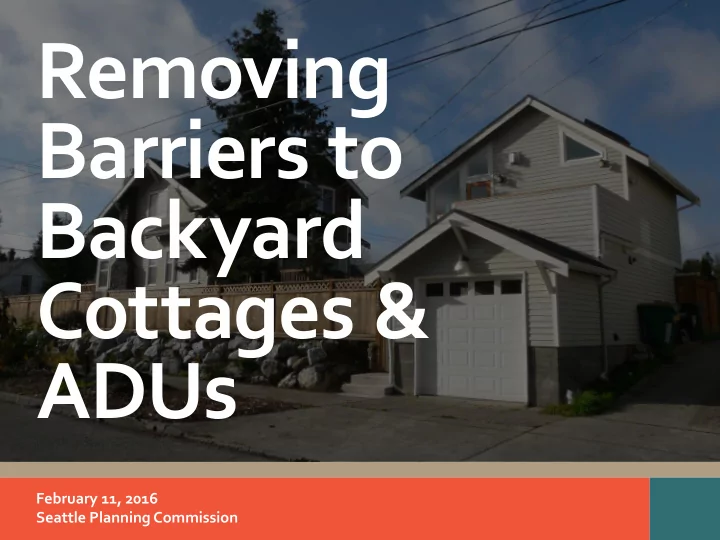
Removing Barriers to Backyard Cottages & ADUs February 11, - - PowerPoint PPT Presentation
Removing Barriers to Backyard Cottages & ADUs February 11, 2016 Seattle Planning Commission Why do we want to encourage more backyard cottages and ADUs? Many benefjts: More housing options, often in areas unafgordable to many
February 11, 2016 Seattle Planning Commission
Removing Barriers to Backyard Cottages and ADUs 2
Why do we want to encourage more backyard cottages and ADUs?
» Many benefjts:
unafgordable to many people
homeowners remain in neighborhood
land and resources
diverse household types, including families
» 75,000 single-family lots are eligible for a cottage, yet only about 220 built
Single-family zoned lots
Eligible for DADU Ineligible for DADU Removing Barriers to Backyard Cottages and ADUs 3
Removing barriers to backyard cottages and ADUs
» Reached out to homeowners, designers, and
» Identifjed several barriers:
accommodate a backyard cottage
impervious surface, and require removing vegetation
building a cottage or inhibit functional design
interested homeowners and limits fmexibility
“We live on Beacon Hill and own a rental near Columbia City which fjts all of the criteria for an ADU (setbacks, ofg street parking, lot size, etc) but we could not develop in this space because of the occupancy ruling ... There is at least one family
good job with this and be respectful to neighbors.” “I have one uncovered parking space
the area where it makes the most sense to site a DADU in order to minimize the impact to our neighbors’ privacy as well as preserve sunlight that reaches the backyard and the main house. But I would need to build a 2 car garage underneath the new unit or get rid of the remaining backyard to put in two new parking
close to having a shortage of street parking and most houses do not have parking.”
Removing Barriers to Backyard Cottages and ADUs 4
Project timeline
April 2015 City Council Lunch & Learn 1 September 2014 Council Resolution 31547 calls for removing barriers to ADUs/DADUs
Targeted outreach to DADU owners and designers December 2015 City Council Lunch & Learn 2 January 19, 2016 Community Meeting #1 Filipino Community Center February 3, 2016 Community Meeting #2 Wallingford Senior Center March 2016 Draft legislation SEPA review
PHOTO CREDIT: MATT & AMY STEVENSON PHOTO CREDIT: STEFAN HAMPDEN Removing Barriers to Backyard Cottages and ADUs 5
Potential code changes
» Should we remove the ofg-street parking requirement for ADUs and DADUs? » Should we allow an ADU and DADU on the same lot? » Should we remove the owner-occupancy requirement for ADUs and DADUs? » Should we modify development standards for DADUs?
Removing Barriers to Backyard Cottages and ADUs 6 10 20 30 40 50 60 70 80
Should we remove the
requirement? Should we allow an ADU and a DADU on the same lot? Should we remove the
requirement? Should we reduce the minimum lot size? Should we increase the max sq ft for a DADU? Should we increase the height limit for certain lots? Should we increase the rear yard coverage limit?
# of responses no maybe yes
Summary of feedback
MEETING BOARDS
Removing Barriers to Backyard Cottages and ADUs 7 10 20 30 40 50 60 70 80 90
Should we remove the
requirement? Should we allow and ADU and DADU on the same lot? Should we remove the
requirement? Should we reduce the minimum lot size? Should we increase the max sq ft for a DADU? Should we increase the height limit for certain lots? Should we increase the rear yard coverage limit?
# of responses no maybe yes
Summary of feedback
COMMENT FORMS
Removing Barriers to Backyard Cottages and ADUs 8
“I STRONGLY disagree with removing the owner
much more vested interest in their properties and the current requirement will keep developers away.
Should we remove the owner-occupancy requirement?
Absolutely not. Increasing the number of individuals with zero vested interest and removing the requirement for close owner involvement is NOT good for existing homeowners in those neighborhoods. This requirement is too restrictive. If I would like to move to a difgerent location in Seattle for 5-7 years, or to a difgerent state or country for work, but plan to move back, my main way of dealing with this issue would be to leave the ADU empty which does nothing for afgordability or housing stock. Portland doesn’t have a restriction on owner occupancy and hasn’t had an explosion of ADUs due to developers rushing in. Should it matter then if a developer as opposed to a private
I'd like a time limit so that a person has to live on the property for 4 years before they're allowed to rent out both units. People make difgerent decisions when they have to live with them than when they don't live in a place. I live in Seattle and own a 1,000 sq. ft. rental on a 9,000 sq. ft lot. There’s a cottage in the back, but it can’t be a DADU. It’s a waste of space! We are reluctant to add a DADU if we are unable to also rent out the main house. If we needed to relocate for more than six months, we would be forced to sell our house or forgo renting the DADU, which would not be feasible given the signifjcant cost of building the unit. This requirement makes adding a DADU too fjnancially risky.
Removing Barriers to Backyard Cottages and ADUs 9
» Case study: Portland, OR
Portland does not have an owner-occupancy requirement and allows both the accessory dwelling unit and the main house to be rented. Despite this, a survey of ADU owners found that 64% occupy their properties anyway. The vast majority of accessory units in Portland are built by current homeowners. Even after waiving system development charges for ADUs, Portland had only 360 permitted in 2015.
Should we remove the owner-occupancy requirement?
Removing Barriers to Backyard Cottages and ADUs 10
We have considered building a DADU in the Phinney/Greenwood neighborhood, but cannot due to the requirement that we add a second parking space, which is not feasible given the confjguration and size of our lot. Moreover, there are several nearby bus lines and a variety of amenities that make living without a car an increasingly viable option for many people in this neighborhood. The dire need for more housing in Seattle should take precedence over concerns about adequate parking. I don’t support easing parking requirements for backyard
guests can’t park near their house. I often visit family who live at 65th & Latona and 45th & Stone Way and have to park a block away from each location. The neighborhood I live in is not even close to having a shortage of street parking and most houses do not have parking. We also have good access to transit. The requirement that we add ofg-street parking in this neighborhood is at best silly and at worst harmful to the character of the neighborhood when green spaces and plants are removed to put in unnecessary parking.
Should we remove the ofg-street parking requirement?
This should depend on the street’s capacity, current density, and the allowable occupancy in the accessory
may mean in the future two car households may not be able to park their second car in front of their own home or may have to pay city parking permit or meter fees like Capitol Hill.
Removing Barriers to Backyard Cottages and ADUs 11
Should we modify development standards?
» Support for excluding garage/storage space in square footage calculation » Support for changing minimum lot size » Support for adjusting rear yard coverage limit to facilitate one-story cottage designs » General agreement overall lot coverage is a good limit on structures » Concern about privacy and shadow impacts on neighboring properties
Between 3000 and 4000 Less than 3000 or greater than 4000 Square footage of single-family zoned lots Removing Barriers to Backyard Cottages and ADUs 12
Other feedback we’ve heard
» Database of other ADU/DADU owners, reliable architects and builders » Interest in pre-approved designs/plans » Access to fjnancing could help a lot of homeowners » More fmexibility with development standards to account for wide range of lot situations » Provide incentives for green design, afgordable rents » How are my property taxes afgected? » What is allowed for existing noncomforming structures?
Removing Barriers to Backyard Cottages and ADUs 13
Other feedback we’ve heard
» “These changes will benefjt middle class households who are being priced out of Seattle.” » “Back up your afgordability claims with some facts.” » How many ADUs/DADUs are used for Airbnb? » “Please liberalize the rules so that we can have a mix of properties and structures in the same neighborhoods.” » “Make sure there are incentives for trees and rain gardens and make sure nobody’s solar panels get blocked.”
Next steps
» Early March: draft legislation based on public feedback received on policy options » SEPA review and 21-day comment period
For more information:
seattle.gov/council/obrien/ backyardcottages/ seattle.gov/DPD/cityplanning/ completeprojectslist/ backyardcottages
Contact us
Councilmember Mike O’Brien
mike.obrien@seattle.gov
Nick Welch
Offjce of Planning & Community Development
nicolas.welch@seattle.gov