Reminders Homework #3 is out Should cover proofs (including some - - PowerPoint PPT Presentation

reminders
SMART_READER_LITE
LIVE PREVIEW

Reminders Homework #3 is out Should cover proofs (including some - - PowerPoint PPT Presentation

Reminders Homework #3 is out Should cover proofs (including some from today) Due next Tuesday (September 24) Office hours Wednesday and Thursday Is this Proof Correct? Is this Proof Correct? Is this Proof Correct? CMSC 203:


slide-1
SLIDE 1

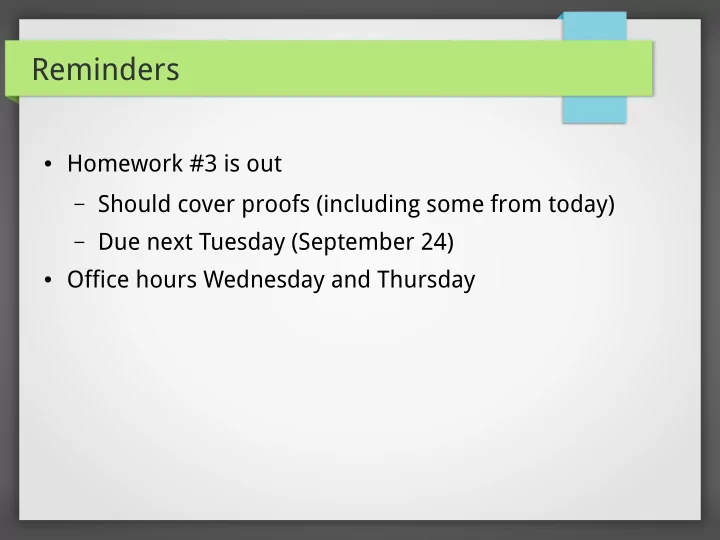
Reminders

  • Homework #3 is out

– Should cover proofs (including some from today) – Due next Tuesday (September 24)

  • Office hours Wednesday and Thursday
slide-2
SLIDE 2

Is this Proof Correct?

slide-3
SLIDE 3

Is this Proof Correct?

slide-4
SLIDE 4

Is this Proof Correct?

slide-5
SLIDE 5

CMSC 203: Lecture 6

Proof Methods and Stragies

slide-6
SLIDE 6

Existence Proof

  • Useful if theorem is of form xP(x)

  • Constructive: Prove an element a exists as a witness

– You are producing a solution – Example from book: “There exists a positive integer

that can be written as the sum of cubes of positive integers in two different ways.”

– 1729 = 103 + 93 = 123 + 13

slide-7
SLIDE 7

Existence Proof

  • Nonconstructive: Do not produce a witness

– You are proving using another proof methd – Must show that some solution must exist – Proof by contradiction, for example – Example from book: “Show that there exist irrational

numbers x and y such that x^y is rational”

slide-8
SLIDE 8

Uniqueness Proof

  • Useful if theorem asserts unique element with property

– Exactly one element in a set with property

  • Two steps

– Existence: Show an element x exists with property – Uniqueness: Show that if y ≠x, y does not have

property (and if y does have property, y = x)

  • Example from book: If a and b are real numbers and a ≠

0, then there is a unique real number r such that ar + b = 0

slide-9
SLIDE 9

Summary of Proofs

  • Direct Proof – Assume P(x) and and show Q(x) using rules of

inference (such as basic mathematical axioms)

  • Contrapositive – Assume Q(x) is false, and use rules of

inference to show P(x) is also false

  • Contradiction – Assume P(x) is false [or Q(x) in conditionals],

and use rules of inference to show any contradiction

  • Exhaustive Proof – Show every solution possible
  • Proof by Cases – Break into multiple, provable “cases”
  • Existence and Uniqueness are special problems
slide-10
SLIDE 10

Proof Strategies

  • 1. Write down your hypotheses [p and q]
  • 2. Write down all premises (assumed truths)
  • 3. Use existing proof methods, and adapt
  • 4. If conditional (p

→ q), attempt to follow rules of inference from p to reach q (direct proof) Fall-back on indirect proofs (like proof by contradiction) Know what proof you are trying to use!

  • 5. Attempt to find a counterexample, and try to prove it

(This may not solve the problem, but will be helpful)

slide-11
SLIDE 11

Some Tips

  • Write down every True statement, and every statement you

are assuming True (like in proof by contradiction)

  • Know your start point (hypothesis) and end point

(hypothesis, or contradiction)

  • Only follow known axioms, definitions, or rules of inference
  • Never start with q and try to prove p (this is begging the

question)

  • Never assume ¬p and try to show ¬q, even with a proof by

contradiction (this is denying the antecedent)

slide-12
SLIDE 12

Practice

  • Prove the sum of two odd integers is even.
  • Prove every odd integer is the difference of two squares.
  • Prove if n is an integer and n3+5 is odd, then n is even.
  • Prove max(x, y) + min(x, y) = x + y
  • Prove or disprove there is a rational number x and an

irrational number y such that x^y is irrational

  • Prove given real number x there exist unique numbers n

and e such that x = n - e, n is an integer, and 0 <= e < 1