CS340:DiscreteStructuresforEngineers Instructor: Prof. Harry Porter - - PowerPoint PPT Presentation

cs 340 discrete structures for engineers
SMART_READER_LITE
LIVE PREVIEW

CS340:DiscreteStructuresforEngineers Instructor: Prof. Harry Porter - - PowerPoint PPT Presentation

CS340:DiscreteStructuresforEngineers Instructor: Prof. Harry Porter harry@cs.pdx.edu Office: FAB 115-06 Hours: Mon 3-4, Wed 3-4, or by appointment Website: web.cecs.pdx.edu/~harry/discrete Class Mailing List:


slide-1
SLIDE 1

CS
340:
Discrete
Structures
for
Engineers


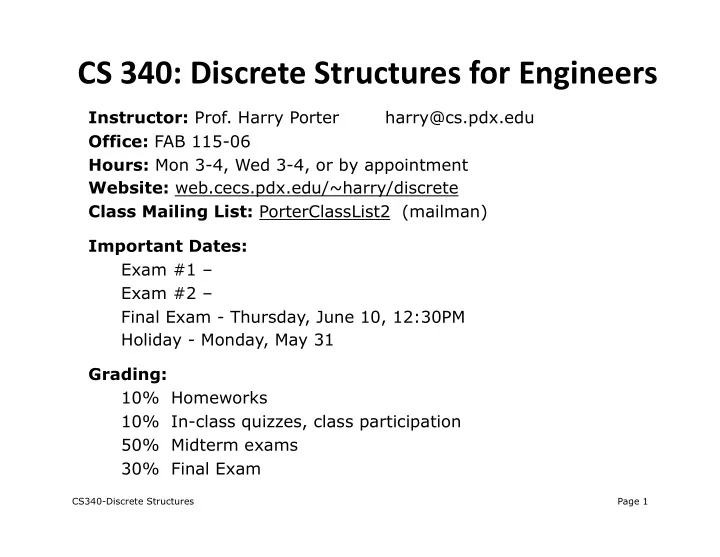
Instructor: Prof. Harry Porter harry@cs.pdx.edu Office: FAB 115-06 Hours: Mon 3-4, Wed 3-4, or by appointment Website: web.cecs.pdx.edu/~harry/discrete Class Mailing List: PorterClassList2 (mailman) Important Dates: Exam #1 – Exam #2 – Final Exam - Thursday, June 10, 12:30PM Holiday - Monday, May 31 Grading: 10% Homeworks 10% In-class quizzes, class participation 50% Midterm exams 30% Final Exam

CS340-Discrete Structures Page 1

slide-2
SLIDE 2

Section 1.1 CS340-Discrete Structures Page 2

Study Habits: Study the glossary of symbols and definitions; Get to know the “language”. Proficiency will come from doing problems. Go beyond the assigned work. Look at problems early so your subconscious has plenty of time to play with them. Review daily Read ahead, before each lecture. Don’t expect immediate success. Anything worthwhile takes time and effort.

Problem solving proficiency will be key to your success!

slide-3
SLIDE 3

Section 1.1 CS340-Discrete Structures Page 3

Slide Credits:

Chr Chris Br is Brooks

  • ks
slide-4
SLIDE 4

Section 1.1 CS340-Discrete Structures Page 4

Section 1.1: What is a Proof?

A proof is a demonstration that some statement is true. (There are other non-mathematical definitions.) A statement is “true” iff (if-and-only-if) we have a rigorous proof. We normally express proofs using English sentences mixed with symbols. We take a statement to be either true or false. If A and B are statements, not A negation – opposite in truth value from A A and B conjunction – true exactly when both A and B are true A or B disjunction – true except when both A and B are false if A then B conditional statement – A is the hypothesis, B is the conclusion Its contrapositive is “if not B then not A” Its converse is “if B then A”

slide-5
SLIDE 5

Section 1.1 CS340-Discrete Structures Page 5

Truth Tables Statements with the same truth table values are equivalent. This table shows that a conditional and its contrapositive are equivalent. A B not A A and B A or B if A then B if not B then not A T T F T T T T T F F F T F F F T T F T T T F F T F F T T

slide-6
SLIDE 6

Section 1.1 CS340-Discrete Structures Page 6

We’ll demonstrate proofs using numbers. Some definitions: integers {…, -2, -1, 0, 1, 2, …}

  • dd integers

{…, -3, -1, 1, 3, …} They have the form 2k+1 for some integer k. even integers {…, -4, -2, 0, 2, 4, …} They have the form 2k for some integer k. m | n “m divides n” if m ≠ 0 and n = km for some integer k p is prime if p>1 and its only divisors are 1 and p Characteristics of a good proof:

  • It is clear and correct.
  • It has a nice structure, like a good program.

Broken up into separate parts that define and prove intermediate steps. Pieces are decomposable, independent.

  • Easy to understand, follow, verify.

Like a good scientific experiment: easy to replicate.

slide-7
SLIDE 7

Section 1.1 CS340-Discrete Structures Page 7

Proof Approach #1: Exhaustive Checking Some statements can be proven by checking all possible cases Must be a finite number. Example: There is a prime number between 200 and 220. Proof: Check exhaustively. Find that 211 is prime. QED Example: Each of the numbers 288, 198, and 387 is divisible by 9. Proof: Check that 9 divides each number. QED

slide-8
SLIDE 8

Section 1.1 CS340-Discrete Structures Page 8

Proof Approach #2: Conditional Proof Most statements we prove are conditionals. if A then B Start by assuming the hypothesis is true. Then try to find a statement that follows from the hypothesis and/or known facts. Continue deriving new statements until we reach the conclusion. Example: If x is odd and y is even then x-y is odd. Proof: Assume x is odd and y is even. Then x=2k+1 and y=2m for some integers k and m. So we have x-y = (2k+1) – (2m) = 2(k-m) + 1 Since k-m must be an integer, 2(k-m)+1 must be odd. QED Example: If x is odd then x2 is odd. Proof: Assume x is odd. Then x=2k+1 for some integer k. So we have x2 = (2k+1)2 = 4k2 + 4k + 1 = 2(2k2+2k) + 1 Since 2k2+2k must be an integer, 2(2k2+2k)+1 must be odd. QED

slide-9
SLIDE 9

Section 1.1 CS340-Discrete Structures Page 9

Example: If x is even then x2 is even. Proof: In-class quiz Example: If x2 is odd, then x is odd. Proof: The contrapositive of this statement is: If x is even, then x2 is even which was proven in the previous example. QED Example: If x2 is even, then x is even. Proof: In-class quiz

slide-10
SLIDE 10

Section 1.1 CS340-Discrete Structures Page 10

If and Only If Proofs – iff A statement of the form “A if and only if B” means A iff B “A implies B” and “B implies A” Approach #1: Prove “A implies B”. Then prove “B implies A”. Approach #2: Create a chain of statements. A iff X1 iff X2 iff … iff Xn iff B Theorem: x is even if and only if x2-2x+1 is odd. Proof: x is even iff x = 2k for some integer k (definition) iff x-1 = 2k-1 for some integer k (algebra) iff x-1 = 2(k-1)+1 for some integer k (algebra) iff x-1 is odd (definition) iff (x-1)2 is odd (previous example) iff x2-2x+1 is odd (algebra) QED

slide-11
SLIDE 11

Section 1.1 CS340-Discrete Structures Page 11

A false statement is called a contradiction. For example, “S and not S” is a contradiction for and statement S. Proof By Contradiction A truth table shows that “if A then B” is equivalent to “A and not B implies false” To prove “if A then B”, start by assuming “A” and assuming “not B”. Then argue toward a false statement… the contradiction. If, from “A” and “not B” you can derive a statement that is false, you’ve found a “proof by contradiction”. “B” must really be true.

slide-12
SLIDE 12

Section 1.1 CS340-Discrete Structures Page 12

Theorem: If x2 is odd then x is odd. Proof: Assume that x2 is odd and x is even. Then x=2k for some integer k. So we have x2 = (2k)2 = 4k2 = 2(2k2) Since 2k2 is an integer, 2(2k2) must be even. So x2 is even. From the assumption we have x2 is odd and x2 is even This is a contradiction, proving the theorem is true! QED Theorem: if 2 | 5n then n is even. Proof: Assume that 2 | 5n and n is odd. Since 2 | 5n, we have 5n = 2d for some integer d. Since n is odd, we have n = 2k+1 for some integer k. Then we have 2d = 5n = 5(2k+1) = 10k+5 So 2d = 10k+5. Rewriting, we get 5 = 2d-10k = 2(d-5k) Since d-5k is an integer, we see that 5 is apparently a even number. False! Contradiction! So the theorem is proven. QED