EDAA40 EDAA40 Discrete Structures in Computer Science Discrete - - PDF document

edaa40 edaa40 discrete structures in computer science
SMART_READER_LITE
LIVE PREVIEW

EDAA40 EDAA40 Discrete Structures in Computer Science Discrete - - PDF document

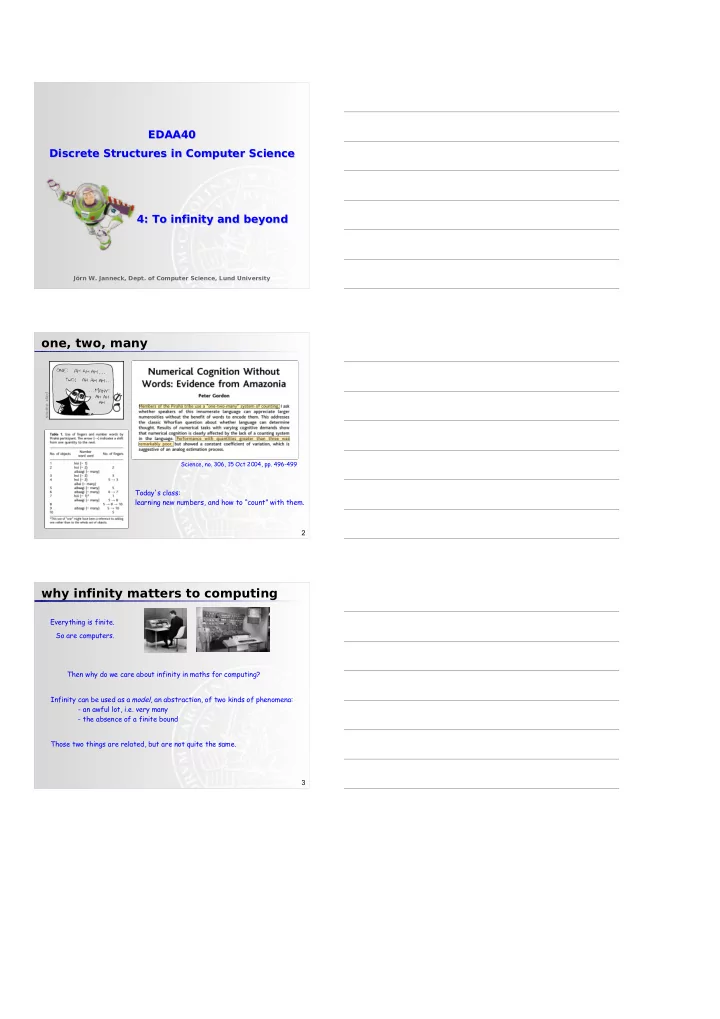
EDAA40 EDAA40 Discrete Structures in Computer Science Discrete Structures in Computer Science 4: To infinity and beyond 4: To infinity and beyond Jrn W. Janneck, Dept. of Computer Science, Lund University one, two, many source: xkcd


slide-1
SLIDE 1

EDAA40 EDAA40 Discrete Structures in Computer Science Discrete Structures in Computer Science

4: To infinity and beyond

4: To infinity and beyond

Jörn W. Janneck, Dept. of Computer Science, Lund University

2

  • ne, two, many

Science, no. 306, 15 Oct 2004, pp. 496-499

Today's class: learning new numbers, and how to “count” with them.

source: xkcd

3

why infinity matters to computing

Everything is finite. So are computers. Then why do we care about infinity in maths for computing? Infinity can be used as a model, an abstraction, of two kinds of phenomena:

  • an awful lot, i.e. very many
  • the absence of a finite bound

Those two things are related, but are not quite the same.

slide-2
SLIDE 2

4

Cantor-Schröder-Bernstein theorem

For any two sets A and B, if there are two injections and then there exists a bijection Corollary: If and then .

(Proof is a little tricky, we will omit it here. See course page for refs.)

When working with infinite stuff, this theorem makes our lives a lot easier. 5

Cantor-Schröder-Bernstein theorem

“It’s not what you know, but what you can prove.”

  • Det. Alonzo Harris, LAPD

Why do we need to prove CSB? Didn't we know this already? What property does this establish for

  • n cardinal numbers?

Note: The theorem tells us that there is a bijection. It does not tell us, what it looks like! In other words, it is non-constructive. Make sure you clearly distinguish between what is defined, and what needs to be proven. 6

infinite sets

A is infinite if it is equinumerous to a proper subset of itself. That is, there is some S such that Show that the natural numbers are an infinite set.

  • 1. Find a proper subset.
  • 2. Construct a bijection between it and the natural numbers.

Richard Dedekind 1831-1916

There are various ways to define infinite sets. This is one by Dedekind, 1888:

slide-3
SLIDE 3

7

denumerable (countable) sets

A is denumerable (countable) if it is equinumerous to the natural numbers, i.e. Denumerable sets are very important to math and CS. They are the smallest infinite sets. (We won't prove that.) The cardinality of the natural numbers (and thus all denumerable sets) has a name: is therefore the smallest transfinite cardinal number. 8

: the integers

is the set of integers. 1 2 3

  • 1
  • 2
  • 3

And this is the bijection: 8.1 Show that z is bijective. 9

products

What is the cardinality of ? 9.1 Construct a bijection 9.2 Construct a bijection Make sure you show it is, in fact, bijective in each case!

slide-4
SLIDE 4

10

: the rational numbers

Some properties:

  • 1. is dense: between any two distinct there is
  • 2. Any non-empty open interval is equinumerous to

For example: 10.1 Show that is bijective. 10.2 Show that 2. above is true for all open intervals. This is simpler than you might think.

1 2 3

  • 1
  • 2
  • 3

11

: the rational numbers

Then we define another set, this one of pairs of integers and natural numbers: Let's start with the simple stuff, i.e. Now, there is clearly (*) a bijection between and :

(*) In everyday parlance, words like “clearly”, “of course”, “obviously” etc. are used to tell you that what follows requires no further inspection or reflection. In math, think of them as technical expressions that mean just the opposite: pay EXTRA attention!

So those two sets are equinumerous. Now it's also the case that Put all this together:

12

finite sequences/strings

Let A be a finite set of n symbols . The set of all finite sequences (strings) of these symbols is The empty sequence is . What is if A is...

slide-5
SLIDE 5

13

infinite sequences

Let A be a finite set of n symbols . An infinite sequence in A is a function The set of all infinite sequences in A: As always: 14

Cantor's diagonal construction

1 2 3 4 5 6 7 8 9 1 1 1 1 1 1 1 1 1 1 1 1 2 1 1 1 1 1 3 1 1 1 1 1 4 1 1 1 1 1 5 1 1 1 1 1 1 6 1 1 1 1 7 1 1 1 8 1 1 1 1 1 1 9 1 1 1 1 1 1

... ... ... ... ...

Georg Cantor 1845-1918

  • 1. Let's start by assuming that , i.e. there must be a

bijection . Recall that a bijection is also surjective, i.e.

  • 2. Assuming an f, we can construct the

diagonal sequence D:

  • 3. Invert D:
  • 4. Note that
  • 5. This violates the assumption

that f is a bijection. Conclusion: There is no bijection 15

more than

15.1 Show 1. by constructing an injection

To summarize:

  • 1. We have
  • 2. … but we cannot construct a bijection
  • 3. Conclusion:

15.2 Show that for any finite , n > 1 (the “proposition”). Tip: Use the Cantor-Schröder-Bernstein theorem.

We discovered a new cardinal number: Proposition: It is the case that for all finite

slide-6
SLIDE 6

16

programs and functions

boolean f (BigInteger n) { … } How many programs implementing f? How many functions ? Conclusion? 17

: the real numbers

1 2 3

  • 1
  • 2
  • 3

So for the purposes of determining the cardinality of the real numbers, we can focus on non-terminating decimal sequences: Non-terminating means there is no n such that all digits after are 0. Otherwise, this would be the set of all sequences of ten symbols , with cardinality Even so, the cardinality of the real numbers still comes out to

(proof deferred)

18

power sets

Note that for , it is the case that , i.e. the set of natural numbers is strictly smaller than its powerset. This holds more generally: For any set A, For any cardinal number C,

same thing

  • 1. Obviously,
  • 2. We need to show they aren't equinumerous. Let's suppose they are, i.e.

there must be a bijection

  • 3. Construct the “diagonal set” . Note that
  • 4. f is surjective, so there must be an x such that
  • 5. If then either
  • r

Conclusion: There is no such x, so f can never be surjective thus How do we show this? What does that mean for transfinite cardinal numbers?

slide-7
SLIDE 7

19

more transfinite cardinals

So far, we have encountered two transfinite cardinals: and . As we have seen, there are infinitely many transfinite cardinals. Starting from , they are called in order Where does fit in? All we know is that , so it's at least . Such that between any two there is no other cardinal number.

Note: We assume ZFC for this discussion, i.e. Zermelo-Fraenkel set theory with the axiom of choice. Do not worry about it.

So, is ? This is the continuum hypothesis (CH). CH was shown to be independent of ZFC (Cohen, 1963). Since ZFC doesn't tell us how big those alephs are, we get beths:

Paul Cohen 1934-2007

Such that and . At least we know that

s i d e b a r

20

proof for (sketched)

20.1 Finish the proof that by constructing those two injections. Tip: Start with g. That one is really easy.

Let's show that . First, let's say every real number between 0 and 1 corresponds to a sequence in this set: Note that but Our hypothesis is that which means Constructing the bijection is very tedious. Instead, using the CSB theorem, we can simply construct two injections: (*) * Recall that , so it's the set of all decimal digits.

s i d e b a r