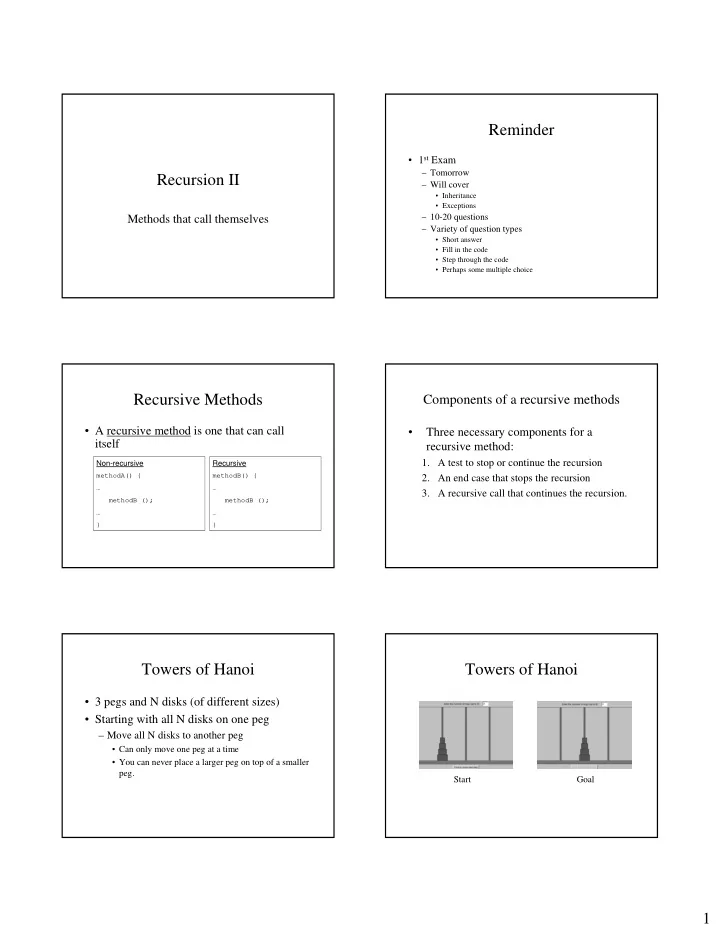
Reminder 1 st Exam Tomorrow Recursion II Will cover - - PDF document

reminder
SMART_READER_LITE
LIVE PREVIEW

Reminder 1 st Exam Tomorrow Recursion II Will cover - - PDF document

Reminder 1 st Exam Tomorrow Recursion II Will cover Inheritance Exceptions 10-20 questions Methods that call themselves Variety of question types Short answer Fill in the code Step through the code


slide-1
SLIDE 1

1

Recursion II

Methods that call themselves

Reminder

  • 1st Exam

– Tomorrow – Will cover

  • Inheritance
  • Exceptions

– 10-20 questions – Variety of question types

  • Short answer
  • Fill in the code
  • Step through the code
  • Perhaps some multiple choice

Recursive Methods

  • A recursive method is one that can call

itself

Non-recursive

methodA() { … methodB (); … }

Recursive

methodB() { … methodB (); … }

Components of a recursive methods

  • Three necessary components for a

recursive method:

  • 1. A test to stop or continue the recursion
  • 2. An end case that stops the recursion
  • 3. A recursive call that continues the recursion.

Towers of Hanoi

  • 3 pegs and N disks (of different sizes)
  • Starting with all N disks on one peg

– Move all N disks to another peg

  • Can only move one peg at a time
  • You can never place a larger peg on top of a smaller

peg.

Towers of Hanoi

Goal Start

slide-2
SLIDE 2

2

Towers of Hanoi

  • Let’s see the game in action

– Two of many Tower of Hanoi applets on the Web

– http://www.cut-the-knot.com/recurrence/hanoi.html

– http://www.stlukes.new-canaan.ct.us/faculty/kress/hanoi.html

Towers of Hanoi

  • Recursive solution

– Forget for a moment that you can only move 1 disk at a time

  • Define a source, destination, and “spare” peg
  • Move the top N-1 disks from your source peg to

your “spare” peg

  • Move the Nth disk from your source to your

destination peg

  • Move the top N-1 disks from your spare to your

destination

Towers of Hanoi

Step 1 Move N-1 disks from source to spare Step 2 Move Nth disk from source to destination Step 3 Move N-1 disks from spare to destination

Towers of Hanoi

Note that this is just a smaller version

  • f the Tower of Hanoi puzzle with N-1

disks (RECURSION!)

Towers of Hanoi

public void hanoi (int N, // number disks int src, // source int dest, // destination int spare ) // spare { // Step 1: move N-1 disks to spare hanoi (N-1, src, spare, dest); // Step 2: move Nth disk to destination moveOne (src, dest); // Step 3:move N-1 disks from spare to destination hanoi (N-1, spare, dest, src) }

Tower of Hanoi

  • But can’t recursion go on forever?
slide-3
SLIDE 3

3

Towers of Hanoi

  • The recursion stops when n = 1

– Then there’s only one disk to move, – So simply move it.

Tower of Hanoi

public void hanoi (int N, // number disks int src, // source int dest, // destination int spare ) // spare { if ( N == 1 ) moveOne (src, dest) else { // Step 1: move N-1 disks to spare hanoi (N-1, src, spare, dest); // Step 2: move Nth disk to destination moveOne (src, dest); // Step 3: move N-1 disks from spare to destination hanoi (N-1, spare, dest, src) } }

Tower of Hanoi

public void hanoi (int N, // number disks int src, // source int dest, // destination int spare ) // spare { if ( N == 1 ) moveOne (src, dest) else { // move N-1 disks to spare hanoi (N-1, src, spare, dest); // move Nth disk to destination moveOne (src, dest); // move N-1 disks from spare to destination hanoi (N-1, spare, dest, src) } }

Test Stop Continue

Towers of Hanoi

public class Hanoi { // some arrays that keep track of which // disks are on which pegs ... public Hanoi () {} public void hanoi (int n, int src, int dest, int spare) { ... } public void moveOne (int src, int dest) { ... } public static void main (String args[]) { Hanoi H = new Hanoi(); H.hanoi (nDisks, 0, 1, 2); } }

Recursion and Stacks

  • When Java calls a method, it places info

related to that method on a call stack

– When a method is called, it’s info is pushed

  • nto the call stack

– When a method is done, it’s info is popped off the call stack – The top of the stack holds info for the current method being executed.

Recursion and Stacks

Non-recursive

methodA() { … methodB (); … } methodB () { … }

methodA methodA methodB methodA

Before call to MethodB During call to MethodB After call to MethodB

slide-4
SLIDE 4

4

Recursion and Stacks

Recursive

methodB() { … methodB (); … }

methodB methodB methodB methodB

Before recursive call During recursive call After recursive call

Back to Hanoi

  • Let’s map out what happens when solving

the Tower of Hanoi with 3 disks.

– Disks will start on peg 0 – Disks will end up on peg 1 – Peg 3 will be our spare – hanoi (3, 0, 1,2)

Tower of Hanoi

hanoi(3,0,1,2) src: 0 dest:1 spare:2 Step 1: call hanoi(2,0,2,1)

(3,0,1,2) S1 (3,0,1,2) S1+ (2,0,2,1) S1

hanoi(2,0,2,1) src: 0 dest:2 spare:1 Step 1: call hanoi(1,0,1,2)

Tower of Hanoi

(3,0,1,2) S1+ (3,0,1,2) S1+ (2,0,2,1) S2

hanoi(1,0,1,2) src: 0 dest:1 spare:2 Stop: move(0,1)

(1,0,1,2) St

hanoi(2,0,2,1) src: 0 dest:2 spare:1 Step 2: move (0,2)

(2,0,2,1) S1+

Tower of Hanoi

(3,0,1,2) S1+ (3,0,1,2) S1+ (2,0,2,1) S3

hanoi(2,0,2,1) src: 0 dest:2 spare:1 Step 3: hanoi(1,1,2,0)

(2,0,2,1) S3+ (1,1,2,0) St

hanoi(1,1,2,0) src:1 dest:2 spare:0 Stop: move(1,2)

(3,0,1,2) S1+ (2,0,2,1) S3+ (3,0,1,2) S1+

Tower of Hanoi

(3,0,1,2) S2 (3,0,1,2) S3

hanoi(3,0,1,2) src: 0 dest:1 spare:2 Step 2: move(0,1) hanoi(3,0,1,2) src: 0 dest:1 spare:2 Step 3: hanoi(2,1,0,2)

slide-5
SLIDE 5

5

Tower of Hanoi

(3,0,1,2) S3+ (3,0,1,2) S3+

hanoi(2,2,1,0) src: 2 dest:1 spare:0 Step 1: hanoi(1,2,0,1)

(2,2,1,0) S1 (2,2,1,0) S1+ (1,2,0,1) St

hanoi(1,2,0,1) src: 2 dest:0 spare:1 Stop: move(2,0)

Tower of Hanoi

(3,0,1,2) S3+ (3,0,1,2) S3+

hanoi(2,2,1,0) src: 2 dest:1 spare:0 Step 2: move(2,1)

(2,2,1,0) S2 (2,2,1,0) S3

hanoi(2,2,1,0) src: 2 dest:1 spare:0 Step 3: hanoi(1,0,1,2)

Tower of Hanoi

(3,0,1,2) S3+

hanoi(1,0,1,2) src: 0 dest:1 spare:2 Stop: move(0,1)

(2,2,1,0) S3+

We are done!

(1,0,1,2) St (3,0,1,2) S3+ (2,2,1,0) S3+ (3,0,1,2) S3+

empty

Tower of Hanoi

  • Things to note

– Recursive functions can be void – Recursive functions can all operate on the same underlying data structure. – Iterative solution to Tower of Hanoi problem would be difficult to describe.

Tower of Hanoi

  • Questions?

Summary

  • Recursion – When a method calls itself
  • Components of a recursive method

– Test – Stop – Continue

  • Recursion, Method calls, and stacks
  • Tower of Hanoi.
slide-6
SLIDE 6

6

Next time

  • Exam tomorrow
  • Questions?