
SLIDE 1
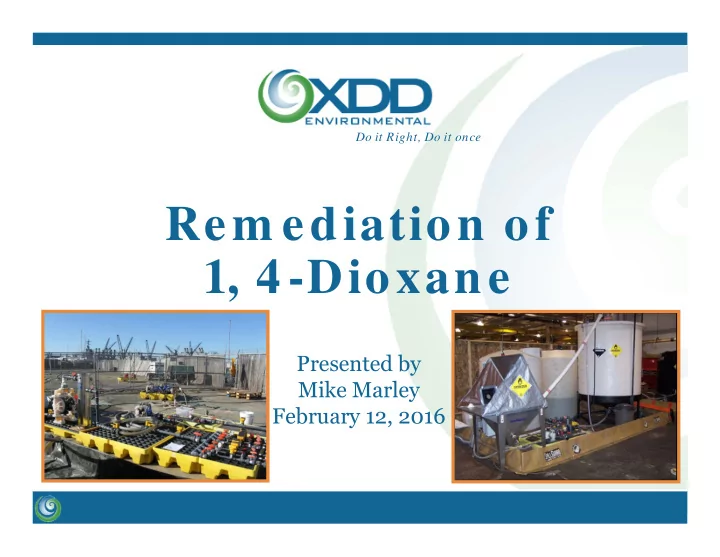
Rem ediation of 1, 4-Dioxane
Presented by Mike Marley February 12, 2016
Do it Right, Do it once
Rem ediation of 1, 4-Dioxane Presented by Mike Marley February - - PowerPoint PPT Presentation
Do it Right, Do it once Rem ediation of 1, 4-Dioxane Presented by Mike Marley February 12, 2016 Agenda Basic properties of 1,4-dioxane with respect to remediation A discussion of applicable reliable remedial technologies with case
Presented by Mike Marley February 12, 2016
Do it Right, Do it once
▪ Basic properties of 1,4-dioxane with respect to remediation ▪ A discussion of applicable reliable remedial technologies with case studies
–Ex situ ▪ Advanced oxidation ▪ Sorption –In situ ▪ In situ chemical oxidation
▪ Promising remedial technologies
–Phytoremediation –Thermally enhanced soil vapor extraction –Bioremediation
2
3
Molecular Formula: C4H8O2
1,4-dioxane is a synthetic, volatile, colorless liquid that is miscible with water, most
chlorinated solvents. 1,4-dioxane is also used as a solvent for numerous commercial products and as a wetting/dispersing agent in textile processing. Recent article on a large
plume in MI where 1,4-dioxane was used in processes for the manufacture of medical filters.
4
Compound Solubility (mg/L) Koc (cm3/g) Henry's Law Const. (unitless) Vapor Pressure (mmHg) Water Quality Criteria ug/L MtBE 51,000 7.26 0.025 245 13 PCE 200 155 0.753 24 5 Benzene 179 59 0.227 76 5 1,4-Dioxane miscible 17 0.0002 37 3*
▪ What do these properties mean?
– Volatile as a residual product – Very soluble in groundwater – When dissolved, not easily adsorbed, therefore is not readily retarded in soils – When dissolved, prefers to be in aqueous vs. vapor phase i.e. not easily stripped out of groundwater – TYPICALLY MEASURED ON LEADING EDGE OF PLUME
* = Levels may be lowered e.g. NJDEP Interim Ground Water Quality Criteria is now 0 .4 ug/ L
▪Advanced oxidation
–key is formation of radical chemistry
▪Sorption
–key is synthetic materials
5
New Jersey
▪ Landfill leachate and groundwater extraction system (50- 100 gpm) ▪ 1,4-dioxane up to 322 ug/L (has attenuated over time) ▪ Water is currently treated using powdered activated carbon/sand filtration (ZIMPRO Process) ▪ Advanced Oxidation Process (AOP) being added to address 1,4-dioxane that is not treated by ZIMPRO ▪ Bromide up to 1,300 ug/L
▪ Reaction between H2O2 and O3 produces hydroxyl free radical (•OH) – proven effective on 1, 4-dioxane ▪ Bromate (BrO3
– Formed during common water treatment process (e.g., chlorination, direct
– Naturally occurring bromide ions (Br-) in the raw ground water/surface water source is the pre-curser to bromate formation. – MCL for bromate is 10 ug/L in drinking water
▪ There is no GWQC for bromate in the New Jersey Administrative Code (NJAC 7:9C) Ground Water Quality Standard (GWQS)
▪ The molar ratio of hydrogen peroxide to ozone (H2O2:O3) can be adjusted to minimize the formation of bromate. Typically, by increasing the amount of hydrogen peroxide relative to a fixed dose of ozone (i.e., increasing molar ratio of H2O2:O3), the
peroxide, and bromate formation will be reduced ▪ However, the trade-off is that the excess hydrogen peroxide can now react with the hydroxyl radicals (i.e., termed hydroxyl radical “scavenging”), which reduces the treatment efficiency of 1,4-dioxane ▪ Could use UV instead of ozone to avoid bromate but that has its
Test Scenario Impact on 1,4-Dioxane Impact on Bromate
High Spike, 240 ug/L 1,4-dioxane O3 Dose = 5, 10, 13, 20mg/L H2O2:O3 Ratio = 1.0 (all scenarios) 7 injection nozzles except the 20 mg/L ozone dose which used 9 nozzles. O3 (mg/L) H2O2 (mg/L)
Final 1,4- dioxane (ug/L)
O3 (mg/L) H2O2 (mg/L)
Final Bromate (ug/L)
5 3.6 48 5 3.6 64 10 7.1 6.6 10 7.1 190 13 9.2 1 13 9.2 290 20 14.2 1 20 14.2 430 Result: 1,4-dioxane destruction is more effective as ozone dose is increased. Result: Bromate conc. increased significantly as ozone dose increased. Conclusions: Hydrogen peroxide/ozone molar ratio requires optimization to reduce bromate formation. Also, likely to require more nozzle injection points to reduce bromate while achieving desired 1,4-dioxane destruction (7 to 9 nozzles used in Round 1, increased to 20 and 30 in Round 2).
Test Scenario Impact on 1,4-Dioxane Impact on Bromate
High Spike, 240 ug/L 1,4-dioxane O3 Dose = 10.7 mg/L H2O2 Dose = 19.0 and 30.4 mg/L H2O2:O3 Ratio = 2.5 and 4.0 20/30 injection nozzles Molar Ratio 2.5 4.0 Molar Ratio 2.5 4.0
Final 1,4-dioxane (ug/L)
Final Bromate (ug/L) 20 3.4 10.0 20 12 3 30 7.2 21.0 30 4.9 2.2 Result: 1,4-dioxane destruction is less effective as MR increases and as no. of injection nozzles increase. Result: Bromate concentration decreases as MR increases and as
Conclusions: Increasing the molar ratio of hydrogen peroxide to ozone reduces the bromate formation and bromate was reduced to below 10 ug/L in some scenarios. However, 1,4-dioxane destruction becomes less efficient. In addition, increasing the number of injection nozzles also reduces bromate, but reduces the 1,4-dioxane destruction.
liquids, vapor or atmospheric streams and be reused indefinitely
AMBERSORBTM 560
▪ Hydrophobic ▪ Unique pore size distribution ▪ High affinity for organic compounds: (sim ple adsorption mechanism) ▪ Can achieve non-detect effluent concentration at substantial loading rates ▪ Can typically reuse (thermally regenerate in-place) indefinitely ▪ Durable structure
▪ Design Basis:
16
– Generally, key again is radical chemistry
▪ Source Area:
–30 x 60 feet area –15 feet thick –Silty sands – dual level system
▪ Located beneath active manufacturing plant ▪ Treatment Goal:
–Reduce groundwater to below 1 mg/L in source –Goal based on protection of downgradient receptor
17
Compound Historical Max. Conc. (ug/L) 1,1,1-TCA 101,000 PCE 20,000 1,4-Dioxane 3,000
▪ Selected Alkaline Activated Persulfate (AAP) for safety reasons
– Greater in-situ stability – Reduced potential for gas evolution
▪ Evaluated AAP on bench scale
– Soil buffering capacity – 2 to 4 g NaOH/Kg Soil
▪ Two injection events
18
31,000 Kg Klozur (sodium persulfate) 15,300 Kg Sodium Hydroxide (NaOH)
NaOH Mass < Soil Buffering Capacity + acid generated by persulfate reaction
▪ 2-3 Orders Magnitude Reduction from baseline ▪ Target compounds remain below 1 mg/L objective ▪ Target compounds dropped to low ug/L level and remained over number years post treatment
19
Primary ISCO Polish ISCO Primary ISCO Polish ISCO Primary ISCO Polish ISCO
20
– SERDP funded Laboratory Study
– Peroxide / ozone systems – Other catalyzed peroxide / Fenton's type systems
21
– primarily removal by transpiration
– remove water and 1,4-dioxane from vadose zone – ESTCP study
–Aerobic
▪ Few organisms use 1,4 dioxane as an energy source ▪ THF/Propane/others as energy: co-metabolic processes ▪ Activity common with monooxygenase enzymes
–Anaerobic (Nitrate, Iron, Sulfate, and Methanogenic)
▪ SERDP Study in 2007 results: no degradation?
22
▪ MNA Evaluation CA GeoTracker + Air Force Sites / Wells (ES&T, 2015, 49, 6510−6518)
–Only 30% of 193 CA sites had a statistically significant source decay term –About 23% of CA sites had order of magnitude reduction in max. vs. recent 1,4 dioxane levels, very few with higher than 2 or 3 order reduction –30% of 441 AF wells with decreasing trends, 70% with stable, no trend or increasing trend (increasing was 9%) –AF wells : attenuation correlated positively with dissolved oxygen, and negatively for CVOCs and metals –Median half-Life 20-48 months for statistically significant attenuating sites / wells
23
24
Presented by: Mike Marley Marley@xdd-llc.com 1-800-486-4411 www.xdd-llc.com Follow XDD:
States with XDD Projects