Relevant Case-Law Summaries Webinar on R ecent Important Judgements - - PDF document

relevant case law summaries
SMART_READER_LITE
LIVE PREVIEW

Relevant Case-Law Summaries Webinar on R ecent Important Judgements - - PDF document

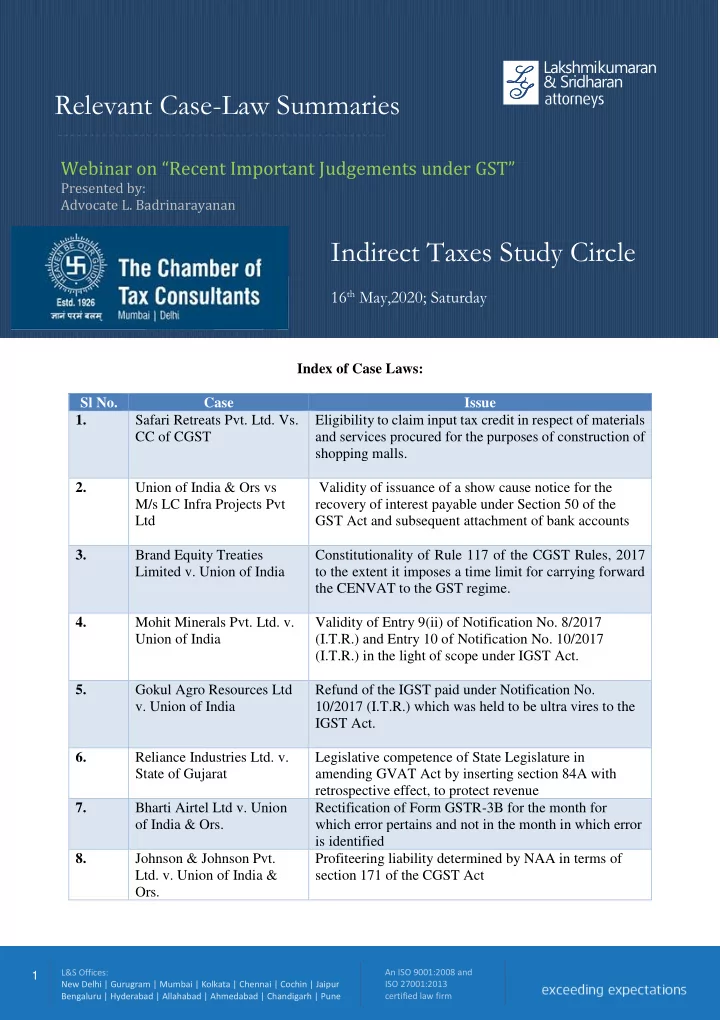
Relevant Case-Law Summaries Webinar on R ecent Important Judgements under GST Presented by: Advocate L. Badrinarayanan Indirect Taxes Study Circle 16 th May,2020; Saturday Index of Case Laws: Sl No. Case Issue 1. Safari Retreats Pvt. Ltd.


slide-1
SLIDE 1

1

L&S Offices: New Delhi | Gurugram | Mumbai | Kolkata | Chennai | Cochin | Jaipur Bengaluru | Hyderabad | Allahabad | Ahmedabad | Chandigarh | Pune An ISO 9001:2008 and ISO 27001:2013 certified law firm

Index of Case Laws: Sl No. Case Issue 1. Safari Retreats Pvt. Ltd. Vs. CC of CGST Eligibility to claim input tax credit in respect of materials and services procured for the purposes of construction of shopping malls. 2. Union of India & Ors vs M/s LC Infra Projects Pvt Ltd Validity of issuance of a show cause notice for the recovery of interest payable under Section 50 of the GST Act and subsequent attachment of bank accounts 3. Brand Equity Treaties Limited v. Union of India Constitutionality of Rule 117 of the CGST Rules, 2017 to the extent it imposes a time limit for carrying forward the CENVAT to the GST regime. 4. Mohit Minerals Pvt. Ltd. v. Union of India Validity of Entry 9(ii) of Notification No. 8/2017 (I.T.R.) and Entry 10 of Notification No. 10/2017 (I.T.R.) in the light of scope under IGST Act. 5. Gokul Agro Resources Ltd

  • v. Union of India

Refund of the IGST paid under Notification No. 10/2017 (I.T.R.) which was held to be ultra vires to the IGST Act. 6. Reliance Industries Ltd. v. State of Gujarat Legislative competence of State Legislature in amending GVAT Act by inserting section 84A with retrospective effect, to protect revenue 7. Bharti Airtel Ltd v. Union

  • f India & Ors.

Rectification of Form GSTR-3B for the month for which error pertains and not in the month in which error is identified 8. Johnson & Johnson Pvt.

  • Ltd. v. Union of India &

Ors. Profiteering liability determined by NAA in terms of section 171 of the CGST Act

Relevant Case-Law Summaries

Webinar on “Recent Important Judgements under GST”

Presented by: Advocate L. Badrinarayanan

Indirect Taxes Study Circle

16th May,2020; Saturday

slide-2
SLIDE 2

2

L&S Offices: New Delhi | Gurugram | Mumbai | Kolkata | Chennai | Cochin | Jaipur Bengaluru | Hyderabad | Allahabad | Ahmedabad | Chandigarh | Pune An ISO 9001:2008 and ISO 27001:2013 certified law firm

1. Safari Retreats Pvt. Ltd. Vs. CC of CGST dated 17.04.2019 [2019-VIL-223-ORI]

Facts:

  • The petitioner was engaged in the construction of shopping malls for the purpose of letting
  • ut the same to tenants and lessees.
  • The petitioner had purchased huge quantities of materials in the form of cement, steel, sand,

aluminium, wires etc. and services in the form of consultancy services, architectural service, legal and professional fees etc.

  • The revenue denied the input tax credit in respect of the above inputs and input services in

terms of Section 17(5)(d) of the CGST Act which states that ITC shall not be available in respect of goods and services or both received by a taxable person for construction of an immovable property (other than plant and machinery) on his own account including when such goods or services or both are used in the course or furtherance of business.

  • The petitioner contended the following before the High Court:
  • Sale of immovable property post issuance of completion certificate does not attract levy
  • f GST and hence there is a break in the tax chain. Therefore, there was full justification

for denial of ITC as, on completion of transaction, no GST would be payable and, therefore, no set-off of the ITC would be required However, the position was completely different where the immovable property is constructed for the purpose of letting out the same, because, in that event, GST is payable on the outward side.

  • The denial of ITC was unjust and contrary to the basic rationale of GST which was to

prevent the cascading effect of taxation

  • The petitioner also contended that shopping mall constructed by the assessee was neither

“intended for sale” nor “on his own account” but it was “intended for letting out”, hence will not come within the mischief of Section 17(5)(d) of the CGST and OGST Act Findings of the Court:

  • The Hon’ble High Court held that the very purpose of the Act is to make the uniform provision

for levy collection of the GST.

  • The petitioner would have paid GST if it disposed of the property after the completion

certificate is granted and in case the property is sold prior to completion certificate, he would not be required to pay GST. But here he is retaining the property and is not using for his own purpose but he is letting out the property on which he is covered under the GST, but still he has to pay huge amount of GST, to which he is not liable.

slide-3
SLIDE 3

3

L&S Offices: New Delhi | Gurugram | Mumbai | Kolkata | Chennai | Cochin | Jaipur Bengaluru | Hyderabad | Allahabad | Ahmedabad | Chandigarh | Pune An ISO 9001:2008 and ISO 27001:2013 certified law firm

  • Thus, the provision of Section 17(5)(d) is to be read down and the benefit of ITC has to be

allowed to the petitioner.

  • 2. Union of India & Ors vs M/s LC Infra Projects Pvt Ltd dated 03.03.2020

[2020-VIL-170-Kar]

Facts

  • The respondent had challenged the notice of demand for interest dated 04.03.2019 under Section

50(1) of the Act and the consequent action of the Tax authorities on 07.03.2019 of attaching the bank accounts of the respondent for non-payment of interest, before the Hon’ble High Court.

  • The Single Judge bench of the Karnataka High Court, had observed the following :-
  • The department had not issued a show cause notice to the respondent before quantifying

the interest amount and attachment of the bank account.

  • The issuance of a SCN was sine qua non to proceed with the recovery of interest payable

under Section 50 of the GST Act and penalty leviable under the provisions of the GST Act and the Rules.

  • The determination of interest payable without issuance of a SCN was in breach of the

principles of natural justice.

  • The Single Judge bench accordingly quashed the order demanding interest and attachment of the

bank account with liberty to the appellant to proceed in accordance of the law.

  • The appellant is in appeal against the said Single Judge bench decision.
  • It is contended by the appellant that the demand of interest for belated payment of self-assessed

tax, did not necessitate the issuance of a show cause notice to the respondent. This is because the demand was only as regards to the payment of interest under Section 50 (1) of the Act.

  • Further, the attachment of the bank account had been attached as a consequence of failure to pay

the interest. Findings of the Court:

  • Section 50(1) prescribed that interest can be demanded if the assessee fails to pay the tax or part

thereof within the specified period.

  • The assessee is entitled to be given an opportunity of being heard to establish as to whether there

was any delay in payment of tax based on the material on record.

  • Section 73(1) shall be applicable when any tax has not been paid or short paid, and it contemplates

that a show cause notice is to be issued to call upon an assessee to show cause as to why he should not pay the amount specified in the notice with interest.

slide-4
SLIDE 4

4

L&S Offices: New Delhi | Gurugram | Mumbai | Kolkata | Chennai | Cochin | Jaipur Bengaluru | Hyderabad | Allahabad | Ahmedabad | Chandigarh | Pune An ISO 9001:2008 and ISO 27001:2013 certified law firm

  • Even if Section 73(1) was not applicable, the principles of natural justice ought to have been

complied with before demanding interest and/or penalty.

  • The demand of interest and attachment of the bank account were set aside on the grounds of

breach of principles of natural justice.

  • The divisional bench concurred with the learned Single Judge that before recovery interest

payable in accordance with Section 50 of the GST Act, a show cause notice is required to be issued to the assessee.

  • The appeal was accordingly dismissed.

3. Brand Equity Treaties Limited v. Union of India dated 05.03.2020 [2020] 116 taxmann.com 415 (Delhi)

Facts:

  • The Petitioners had duly declared the balance of CENVAT in their service tax/central excise

returns filed for the month of June 2017 and were eligible to transition the same into the GST regime.

  • However, due to various challenges such as lack of knowledge with respect to the statutory

provisions, clerical errors as well as technical glitches, the petitioners failed to file Form GST TRAN-1 within the due date (i.e., December 27, 2017) prescribed under Rule 117 of the CGST Rules, 2017.

  • The Petitioners then filed Writ Petitions before the Delhi High Court challenging the

constitutionality of Rule 117 of the CGST Rules, 2017 on the ground that it is arbitrary, unconstitutional and violative of Article 14 of the Constitution of India, to the extent it imposes a time limit for carrying forward the CENVAT to the GST regime. Findings of the Court

  • The Delhi High Court at the outset observed that the technical glitches have been a common

feature in GST and that numerous assessees in the past have approached the High Court seeking to permit them to file GST Form TRAN 1 beyond the stipulated time period prescribed in Rule 117.

  • The Court further observed that the Government, in order to mitigate the aforesaid deficiencies,

had enacted Rule 117(1A) of CGST Rules, 2017 as a patchwork solution which conferred the power on the Commissioner to extend the due date of filing form TRAN-1 on account of technical difficulties on the common portal.

slide-5
SLIDE 5

5

L&S Offices: New Delhi | Gurugram | Mumbai | Kolkata | Chennai | Cochin | Jaipur Bengaluru | Hyderabad | Allahabad | Ahmedabad | Chandigarh | Pune An ISO 9001:2008 and ISO 27001:2013 certified law firm

  • The High Court noted that the decision of the Government to extend the time limit for filing GST

Form TRAN-1 only in case of "technical difficulties on common portal" is arbitrary, vague and unreasonable.

  • Technical difficulties cannot be restricted only to a difficulty faced on the common portal. It

would include within its purview any technical difficulties faced by the taxpayers as well. The taxpayers have faced various challenges posed by low bandwidth, lack of computer knowledge and lack of skill to operate the system. Further, the difficulties may also be offline, as a result of several other restrictive factors.

  • The purpose of Rule 117(1A) was to save and protect the rights of taxpayers to avail of the

CENVAT lying in their account and the same cannot be restricted by giving a narrow meaning to the word ‘technical glitches’.

  • The High Court further observed that once there is no statutory time limit which has been

prescribed by the Central Goods and Services Tax Act, 2017 (“CGST Act”), the right to avail the transition credit which is a vested right cannot be curtailed by the time limit prescribed under a delegated legislation. The function of the Rules is only to lay down the procedure for transition and such procedural provision cannot take away the substantive right to transition the credit prescribed in the CGST Act.

  • Consequently, in the absence of any specific provisions providing for the time limit under the

CGST Act, the High Court read down the provisions of Rule 117 as being directory in nature, insofar as it prescribes the time limit

  • 4. Mohit Minerals Pvt. Ltd. v. UOI dated 23.01.2020

[2020-VIL-36-GUJ]

Facts:

  • The writ-applicants had challenged the levy of the IGST on the estimated component of the Ocean

Freight paid for the transportation of the goods by the foreign seller as sought to be levied and collected from the writ-applicants as the importer of the goods. Findings of the Court:

  • Under Section 5(3) of the IGST Act, the person liable to pay tax can only be “the recipient” of
  • supply. The term “recipient” has to be read in the sense in which it has been defined in the CGST
  • Act. Importer cannot be said to be the recipient of the ocean freight service in the instant case

since the importer has neither availed the service of transportation of goods nor he is liable to pay consideration for such service. The foreign shipping line is engaged by foreign exporter.

slide-6
SLIDE 6

6

L&S Offices: New Delhi | Gurugram | Mumbai | Kolkata | Chennai | Cochin | Jaipur Bengaluru | Hyderabad | Allahabad | Ahmedabad | Chandigarh | Pune An ISO 9001:2008 and ISO 27001:2013 certified law firm

  • The importer cannot be made liable to pay tax on a mere premise that the importer is directly or

indirectly recipient of service.

  • It is neither an inter-state supply under Section 7 nor an intrastate supply under Section 8 of the

IGST Act as follows:

  • For Section 8, both the location of the supplier and place of supply should be in India. The

same is not applicable since location of foreign shipping line is outside India.

  • Sub-sections (1) and (2) of Section 7 are dealing with goods and not relevant.
  • For Section 7(3), both the location of the supplier and place of supply should be in India.

The same is not applicable since location of foreign shipping line is outside India.

  • Section 7(4) i.e. import of service, is not applicable since the location of recipient of

service, i.e., the foreign exporter being outside India.

  • Section 7(5)(a) is not applicable since location of foreign shipping line is outside India.
  • Section 7(5)(b) pertaining to SEZ is also not applicable.
  • A supply where both provider and recipient are outside India can be made leviable to tax is only

under Section 7(5)(c) i.e. residuary clause, provided that “supply is in taxable territory”. The same cannot be equated with “place of supply”. Supply in the taxable territory shall mean a supply, all the aspects or majority of aspects, of which takes place in taxable territory. Thus, e.g., the provision may cover cases such as a foreign tour operator conducting a tour in India for a foreign

  • tourist. Mere fact that transportation of goods terminates in India, will not make such supply of

transportation of goods as taking place in India.

  • Thus, no tax can be levied and collected from importer/petitioner.
  • In the facts at hand, the freight has already suffered IGST as a part of value of goods imported.

Dual levy of IGST cannot be imposed treating it as supply of service. Double taxation, through delegated legislation, where statute does not provide, is not permissible.

  • The Court held that no IGST is leviable on the ocean freight for the services provided by a person

located in a non-taxable territory by way of transportation of goods by a vessel from a place

  • utside India up to the customs station of clearance in India.
  • Entry 9(ii) of Notification No. 8/2017 (I.T.R.) and Entry 10 of Notification No. 10/2017 (I.T.R.)

declared as ultra vires the IGST Act due to lack of legislative competency and accordingly held to be unconstitutional.

slide-7
SLIDE 7

7

L&S Offices: New Delhi | Gurugram | Mumbai | Kolkata | Chennai | Cochin | Jaipur Bengaluru | Hyderabad | Allahabad | Ahmedabad | Chandigarh | Pune An ISO 9001:2008 and ISO 27001:2013 certified law firm

5. Gokul Agro Resources Ltd v. Union of India dated 26.02.2020 [2020] 116 taxmann.com 1 (Gujarat)

Facts:

  • In the light of the judgement and order passed in the case of Mohit Minerals (P.) Ltd. v. Union of

India [2020] 113 taxmann.com 436 (Guj.), the applicants had approached to Hon’ble court to issue a writ of mandamus directing the respondents to grant the refund of the amount of IGST. Findings of the Court:

  • As a consequence of the Notification being struck down as ultra-vires, the writ applicant is

due to get the refund of the amount paid towards the IGST.

  • However, for this purpose, it was directed that the writ applicant should prefer an

appropriate application addressed to the competent authority. If any such application is preferred for the refund of the amount, the authority concerned shall immediately look into the same and pass an appropriate order in accordance with law without raising any technical issue with regard to the claim for refund of the IGST amount.

6. Reliance Industries Ltd. Vs State of Gujarat dated 16.04.2020 [2020] 116 taxmann.com 210 (Gujarat)

Facts:

  • Section 13(b) of the Gujarat Value Added Tax Act, 2003 (GVAT Act) provided that the input

tax credit in respect of a dealer shall be reduced at 4% of turnover of purchases- (ii) of taxable goods which are used as raw materials in the manufacture of goods which are dispatched inter-State through branch transfer / consignment or agent

  • utside State

(iii) of fuels used for manufacture of goods

  • Doubt had arisen as to whether on purchase of fuels used for manufacture of goods which

are subsequently stock transferred, reversal will be required under both 13(b)(ii) and 13(b)(iii) and whether total should be 4% or 8%. The Hon’ble Supreme Court vide its judgment dated 22.09.2017 (reversing Hon’ble Gujarat High Court’s judgment dated 18.01.2013) held that retention shall be 8%

  • Department had accepted 4% reduction based on Hon’ble Gujarat High Court order in the

case of petitioner. However, based on Supreme Court judgment, Dept. issued revision notice dated u/s 75 of the GVAT Act to revise its earlier order and require reducing ITC by 8%. This notice was set aside by Gujarat High Court as being barred by limitation u/s 75 (revision allowed within 3 years from the assessment order. Order dated 30.03.2013 and limitation expired on 30.03.2016)

slide-8
SLIDE 8

8

L&S Offices: New Delhi | Gurugram | Mumbai | Kolkata | Chennai | Cochin | Jaipur Bengaluru | Hyderabad | Allahabad | Ahmedabad | Chandigarh | Pune An ISO 9001:2008 and ISO 27001:2013 certified law firm

  • State legislature amended GVAT Act retrospectively w.e.f. 01.04.2006 to insert section 84A,

which inter alia sought to exclude the time during which an issue was sub-judice for calculation of limitation u/s 75. This amendment was made vide GVAT Amendment Act, 2018 published in Gazette on 06.04.2018

  • Writ Petition was filed challenging the validity of amendment on the following primary

grounds:

  • Competence of State Legislature to enact the amendment
  • Manifest arbitrariness of section 84A and violation of Article 14

Findings of the Court:

  • Section 84A of the Gujarat VAT Act is ultra vires and beyond the legislative competence of

the State Legislature

  • State Legislature should have legislative competence to amend GVAT Act. Power to

amend GVAT Act cannot be traced to any article in the Constitution (other than for specified products). Argument of Advocate General that power to amend GVAT Act can be traced to Article 246A not accepted

  • The State Legislature can make amendments to the earlier VAT Acts, Entry Tax Acts
  • nly if such aspects can be traced to Article 246A of the Constitution.
  • Section 19 of the Constitution (One Hundred and First) Amendment Act, 2016 can

also not be a source of power to amend the State VAT laws. The power to amend under Section 19 is only for a period of one year from the commencement of the amendment act. The words used in Section 19 are that the laws inconsistent with the new provisions of Constitution ‘shall continue to be in force’.

  • Power conferred by Article 246A of the Constitution of India is to be exercised by

both, the Union and the States concurrently to ensure uniform “Goods and Services Tax” law all over the country. The Union of India or States cannot separately exercise power given by Article 246A of the Constitution of India independent of each other unlike the power given by the “Concurrent list” enumerated in the List III in the Schedule VII of the Constitution of India. Further, the objective of the 101st amendment to the Constitution of India was to bring into force a uniform law for levy

  • f tax on “Goods and Services” and not separate laws with respect to either Goods

and Services.

  • If the State legislature has the power to enact the value added tax laws under Article

246A of the Constitution of India as argued on behalf of the State, then Entry 54 of List II of the Seventh Schedule to the Constitution which was retained to the extent

  • f six products which are outside the GST regime will be rendered redundant. The

very fact that Entry 54 of List II of the Seventh Schedule was retained in so far as the six products are concerned indicates that the sales tax/value added tax enactment is not permissible under Article 246A of the Constitution of India.

slide-9
SLIDE 9

9

L&S Offices: New Delhi | Gurugram | Mumbai | Kolkata | Chennai | Cochin | Jaipur Bengaluru | Hyderabad | Allahabad | Ahmedabad | Chandigarh | Pune An ISO 9001:2008 and ISO 27001:2013 certified law firm

  • Principles of equity, morality and fairness - It is well known that motive or intention for

making an Act or issuing an ordinance is not justifiable before a court of law. In interpreting a taxing statute, the equitable considerations are entirely out of place.

  • Section 84A of the Gujarat VAT Act is manifestly arbitrary, unreasonable and therefore,

violative of the Articles 14 and 19(1)(g) of the Constitution of India.

  • If

unlimited time period is available to the Revenue for assessment/reassessment/revision in any case based on a decision rendered in the case of any other dealer the same would lead to an irreparable situation and, in such circumstances, it renders Section 84A manifestly arbitrary and unreasonable.

  • An action taken by the State cannot be so irrational and so arbitrary that it creates a

situation like the one in case on hand.

  • Hence, Section 84A of the VAT Act was struck down even on the ground of being

manifestly arbitrary, excessive, oppressive and unreasonable.

  • Section 84A of the Gujarat VAT Act is not a validating Act - Vide the Gujarat Value Added Tax

(amendment) Act, 2018 (Gujarat Act No. 10 of 2017) Section 84A has been inserted in the Gujarat Value Added Tax Act, 2003 with retrospective effect. However, the amending Act does not provide for any validation of various acts of the revenue authorities namely the assessment, re-assessment, collection etc. Accordingly, the said Act cannot be treated as a “validating Act”. The Supreme Court laid down the following tests for judging the validity of the Validating Act: (i) whether the Legislature enacting the Validating Act has competence over the subject-matter, (ii) whether by validation, the Legislature has removed the defect which the Court had found in the previous law; (iii) whether the validating law is inconsistent (sic consistent) with the provisions

  • f Part III of the Constitution.

7. Bharti Airtel Ltd. Vs Union of India [2020] 116 taxmann.com 416 (Delhi)

Facts:

  • Inadvertent errors were made in filing of Form GSTR-3B for July 2017 to September 2017

primarily due to non-existence of system-based matching and rectification in the same month (Form GSTR-2 and Form GSTR-3B non-functional). Petitioner has made excess payment of taxes in cash due to non-operationalization of Forms GSTR-2A, GSTR-2 and GSTR-3 and the system related checks which could have forewarned the petitioner about the mistake.

  • Petitioner had to avail ITC based on estimate – GST and Petitioner system not geared up to

record so many transactions (state-wise registration instead of centralized registration)

slide-10
SLIDE 10

10

L&S Offices: New Delhi | Gurugram | Mumbai | Kolkata | Chennai | Cochin | Jaipur Bengaluru | Hyderabad | Allahabad | Ahmedabad | Chandigarh | Pune An ISO 9001:2008 and ISO 27001:2013 certified law firm

  • Petitioner desired to correct its returns for the months in which mistakes occurred – Form

GSTR-3B and Circular No. 26/26/2017-GST dated 29.12.2017 preventing the Petitioner from doing so, as they require rectifications to be made in month in which discrepancy

  • noticed. This lead to accumulation of ITC without foreseeable utilization - since refund of

ITC not available, no other efficacious remedy available but to rectify return of the month to which error relates

  • Challenge to vires of rule 61(5) and validity of above circular, to the extent they do not

provide for the modification of the information to be filled in the return of the tax period to which such information relates which were otherwise envisaged by the CGST Act in the form

  • f section 37, 38 and 39.

Findings of the Court:

  • The statutory provisions (i.e. Section 37, 38 & 39), provided not just for a procedure but a

right and a facility to a registered person by which it can be ensured that the ITC availed and returns can be corrected in the very month to which they relate, and the registered person is not visited with any adverse consequences for uploading incorrect data.

  • Form GSTR-2, and 3 were not made operational, making it abundantly clear that neither the

systems of the Government were ready, nor were the systems of the suppliers all across the country geared up to handle such an elaborate electronic filing and reconciliation system introduced for the first time.

  • Form GSTR-3B is only a summary return due to non-operation of GSTR 2 & 3. Indisputably,

if the statutorily prescribed returns i.e. GSTR 2 and GSTR 3 had been operationalized by the Government, the Petitioner would have known the correct ITC amount available to it in the relevant period, and could have discharged its liability through ITC. Checks and balances prescribed in original Form GSTR 3 affected due to introduction of truncated GSTR 3B

  • The Circular No. 26/26/2017-GST, in unequivocal terms, recognizes the concept of system-

based reconciliation of ITC and output liability for the same tax period as per the statutory

  • provisions. Therefore, no cogent reasoning behind the logic for restricting rectification only

in the period in which the error is noticed and corrected, and not in the period to which it relates.

  • Petition allowed accordingly and para 4 of above circular read down to the extent it restricts

rectification of Form GSTR-3B in the period in which the error occurred.

8. Johnson and Johnson Pvt. Ltd. Vs Union of India & Ors. [W.P. NO 1780 OF 2020 before Delhi High Court, order dated 18.02.2020]

Facts:

  • The National Anti-Profiteering Authority computed profiteering against Johnson and

Johnson Pvt. Ltd. which had resulted from two separate investigations. The first matter pertained to sanitary products which became exempt under GST and the second pertained to FMCG goods wherein rate of GST on various products was reduced. Challenging the

slide-11
SLIDE 11

11

L&S Offices: New Delhi | Gurugram | Mumbai | Kolkata | Chennai | Cochin | Jaipur Bengaluru | Hyderabad | Allahabad | Ahmedabad | Chandigarh | Pune An ISO 9001:2008 and ISO 27001:2013 certified law firm

demand so imposed by the Authority, writ petitions were filed before the Hon’ble High Court of Delhi. Findings of the Court:

  • Various submissions were made before the Delhi High Court, and it was pointed out before

the Court that the DGAP and NAA have acted unreasonably, in as much as for the period prior to reduction in rate of GST from 12% to Nil w.e.f. 27.07.2018, the DGAP had computed average base. However, for the period after the GST rate became nil w.e.f. 27.07.2018, the base price has been worked out item by item

  • Further, Court’s attention was drawn to the tabulation filed by the petitioner before the

DGAP, which showed that in respect of several items sold by the petitioner, after the reduction of GST to nil, the price actually fell, however, while computing the profiteered amount; such cases were excluded from consideration.

  • Taking a note of the above submissions, the Hon’ble Court granted interim relief on the basis

that the Petitioner had made a prima facie case. The Hon’ble court stayed the operation of the order along with the penalty proceedings initiated thereto.