Relational QPs Exploiting Symmetries for Modelling and Solving QPs - - PowerPoint PPT Presentation

relational qps
SMART_READER_LITE
LIVE PREVIEW

Relational QPs Exploiting Symmetries for Modelling and Solving QPs - - PowerPoint PPT Presentation

Relational QPs Exploiting Symmetries for Modelling and Solving QPs Sriraam Amir Martin Babak Natarajan Globerson Mladenov Ahmadi U. Indiana HUJI TUD, Google PicoEgo Kristian Martin Pavel Christopher Grohe Tokmakov Kersting Re


slide-1
SLIDE 1

Kristian Kersting - Exploiting Symmetries for Modelling and Solving QPs

Exploiting Symmetries for Modelling and Solving QPs

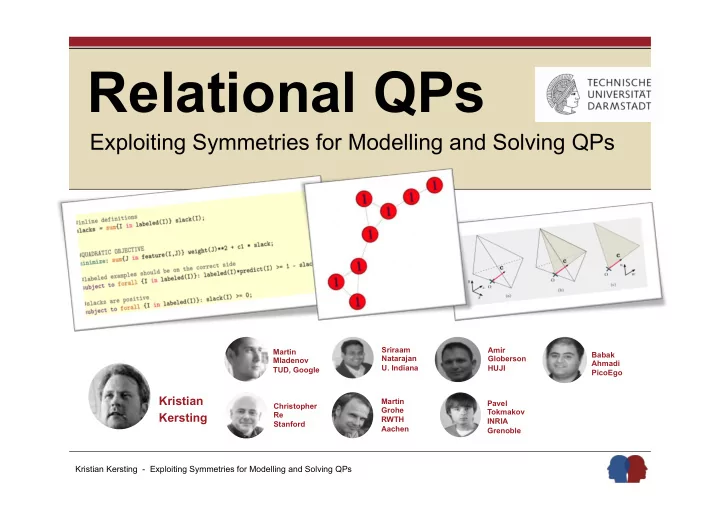
Relational QPs

Kristian Kersting

Martin Mladenov TUD, Google Babak Ahmadi PicoEgo Amir Globerson HUJI Martin Grohe RWTH Aachen Sriraam Natarajan

  • U. Indiana

Pavel Tokmakov INRIA Grenoble Christopher Re Stanford

slide-2
SLIDE 2

Kristian Kersting - Exploiting Symmetries for Modelling and Solving QPs

Statistical Machine Learning (ML) needs a crossover with data and programming abstractions

  • ML high-level languages increase the number of

people who can successfully build ML applications and make experts more effective

  • To deal with the computational complexity, we need

ways to automatically reduce the solver costs

Next Generation

Data Science High-level languages Automated reduction of computational costs

Next Generation

Machine Learning

Take-away message

slide-3
SLIDE 3

Kristian Kersting - Exploiting Symmetries for Modelling and Solving QPs

Arms race to deeply understand data

slide-4
SLIDE 4

Kristian Kersting - Exploiting Symmetries for Modelling and Solving QPs

Bottom line: Take your data spreadsheet … Features Objects

slide-5
SLIDE 5

Kristian Kersting - Exploiting Symmetries for Modelling and Solving QPs

Graphical models

… and apply machine learning

Gaussian Processes Autoencoder, Deep Learning

and many more …

t

F(t) f(t)

Diffusion Models Distillation/LUPI

Big

Model

Small

Model

teaches

Features Objects

Big Data Matrix Factorization Graph Mining Boosting

Is it really that simple?

slide-6
SLIDE 6

Kristian Kersting - Exploiting Symmetries for Modelling and Solving QPs

Kristian Kersting - Thinking Machine Learning

[Lu, Krishna, Bernstein, Fei-Fei „Visual Relationship Detection“ CVPR 2016]

Complex data networks abound

Actually, most data in the world stored in relational databases

slide-7
SLIDE 7

Kristian Kersting - Exploiting Symmetries for Modelling and Solving QPs

Punshline: Two trends that drive ML

  • 1. Arms race to deeply understand data
  • 2. Data networks of a large number of formats

Crossover of ML with data & programming abstractions

Scaling Uncertainty Databases/ Logic Data Mining

De Raedt, Kersting, Natarajan, Poole, Statistical Relational Artificial Intelligence: Logic, Probability, and Computation. Morgan and Claypool Publishers, ISBN: 9781627058414, 2016.

increases the number of people who can successfully build ML applications make the ML expert more effective

It costs considerable human effort to develop, for a given dataset and task, a good ML algorithm

slide-8
SLIDE 8

Kristian Kersting - Exploiting Symmetries for Modelling and Solving QPs

Symbolic-Numerical Solver Feature Extraction Declarative Learning Programming (Un-)Structured Data Sources External Databases

Features and Data Rules

Features and Rules

Machine Learning Database

(data, weighted rules, loops and data structures)

Representation Learning Model Rules and DomainKnowledge DM and ML Algorithms

Inference Results Feedback/AutoDM p 0.9 0.6

Graph Kernels Diffusion Processes Random Walks Decision Trees Frequent Itemsets SVMs Graphical Models Topic Models Gaussian Processes Autoencoder Matrix and Tensor Factorization Reinforcement Learning …

[Ré et al. IEEE Data Eng. Bull.’14; Natarajan, Picado, Khot, Kersting, Ré, Shavlik ILP’14; Natarajan, Soni, Wazalwar, Viswanathan, Kersting Solving Large Scale Learning Tasks’16, Mladenov, Heinrich, Kleinhans, Gonsior, Kersting DeLBP’16, …]

Thinking Machine Learning

slide-9
SLIDE 9

Kristian Kersting - Exploiting Symmetries for Modelling and Solving QPs

Kristian Kersting - Declarative Data Science Programming

This connects the CS communities

Data Mining/Machine Learning, Databases, AI, Model Checking, Software Engineering, Optimization, Knowledge Representation, Constraint Programming, Operation Research, … !

Jim Gray Turing Award 1998 “Automated Programming” Mike Stonebraker Turing Award 2014 “One size does not fit all”

slide-10
SLIDE 10

Kristian Kersting - Exploiting Symmetries for Modelling and Solving QPs

[Bratzadeh 2016; Bratzadeh, Molina, Kersting „The Machine Learning Genome“ 2017]

The ML Genome is a dataset, a knowledge base, an ongoing effort to learn and reason about ML concepts

Algorithms Compared to

The Machine Learning Genome

slide-11
SLIDE 11

Kristian Kersting - Exploiting Symmetries for Modelling and Solving QPs Guy van den Broeck UCLA

slide-12
SLIDE 12

Kristian Kersting - Exploiting Symmetries for Modelling and Solving QPs Guy van den Broeck UCLA

card (1,d2) card (1,d3) card (1,pAce) card (52,d2) card (52,d3) card

(52,pAce)

… … … …

slide-13
SLIDE 13

Kristian Kersting - Exploiting Symmetries for Modelling and Solving QPs Guy van den Broeck UCLA

card (1,d2) card (1,d3) card (1,pAce) card (52,d2) card (52,d3) card

(52,pAce)

… … … …

slide-14
SLIDE 14

Kristian Kersting - Exploiting Symmetries for Modelling and Solving QPs

slide-15
SLIDE 15

Kristian Kersting - Exploiting Symmetries for Modelling and Solving QPs

Faster modelling

slide-16
SLIDE 16

Kristian Kersting - Exploiting Symmetries for Modelling and Solving QPs Guy van den Broeck UCLA

What about inference?

card (1,d2) card (1,d3) card (1,pAce) card (52,d2) card (52,d3) card

(52,pAce)

… … … …

slide-17
SLIDE 17

Kristian Kersting - Exploiting Symmetries for Modelling and Solving QPs Guy van den Broeck UCLA

No independencies. Fully connected. 22704 states

card (1,d2) card (1,d3) card (1,pAce) card (52,d2) card (52,d3) card

(52,pAce)

… … … …

slide-18
SLIDE 18

Kristian Kersting - Exploiting Symmetries for Modelling and Solving QPs Guy van den Broeck UCLA

A machine will not solve the problem

card (1,d2) card (1,d3) card (1,pAce) card (52,d2) card (52,d3) card

(52,pAce)

… … … …

slide-19
SLIDE 19

Kristian Kersting - Exploiting Symmetries for Modelling and Solving QPs

slide-20
SLIDE 20

Kristian Kersting - Exploiting Symmetries for Modelling and Solving QPs

Faster modelling Faster solvers

slide-21
SLIDE 21

Kristian Kersting - Exploiting Symmetries for Modelling and Solving QPs

Let’s say we want to classify publications into scientific disciplines

slide-22
SLIDE 22

Kristian Kersting - Exploiting Symmetries for Modelling and Solving QPs

Replace l2- by l1-,l∞-norm in the standard SVM prog.

H∗ = n ~ x

  • D

~ x , ~

  • E

+ 0 = 0

  • H1

H2

+ + + + + − − − − − − − d(H1, H2)

d(H1, H2) = 2 ||~ ||

Classification using LP SVMs

[Bennett´99; Mangasarian´99; Zhou, Zhang, Jiao´02, ... ]

slide-23
SLIDE 23

Kristian Kersting - Exploiting Symmetries for Modelling and Solving QPs

1 var

pred /1; #predicted label for unlabeled instances

2 var

slack /1; #the slacks

3 var

coslack /2; #slack between neighboring instances

4 var

weight /1; #the slope of the hyperplane

5 var b/0;

#the intercept

  • f the

hyperplane

6 var r/0;

#margin

7 8 slack

= sum{label(I)} slack(I);

9 coslack = sum{cite(I1 ,I2),label(I1),query(I2)} slack(I1 ,I2) 10

+ sum{cite(I1 ,I2),label(I2),query(I1)} slack(I1 ,I2)

11 12 #find

the largest margin. Here the C’s encode trade -off parameters

13 minimize: -r + C(1) * slack + C(2) * coslack; 14 15 subject

to forall {I in query(I)}: pred(I) = innerProd(I) + b;

16 #related

instances should have the same labels.

17 subject

to forall {I1 , I2 in cite(I1 , I2), label(I1), query(I2)}:

18

label(I1) * pred(I2) + slack(I1 , I2) >= r;

19 #the

symmetric case

20 subject

to forall {I1 , I2 in cite(I1 , I2), label(I2), query(I1)}:

21

label(I2) * pred(I1) + slack(I1 , I2) >= r;

22 23 #examples

should be on the correct side of the hyperplane

24 subject

to forall {I in label(I)}:

25

label(I)*( innerProd(I) + b) + slack(I) >= r;

26 #weights

are between

  • 1 and 1

27 subject

to forall {J in attribute(_, J)}:

  • 1 <= weight(J) <= 1;

28 subject

to : r >= 0; #the margin is positive

29 subject

to forall {I in label(I)}: slack(I) >= 0; #slacks are positive

Lifted LP-SVM

[Kersting, Mladenov, Tokmakov AIJ´15, Mladenov, Heinrich, Kleinhans, Gonsio, Kersting DeLBP´16]

Logically parameterized LP variable (set of ground LP variables) Logically parameterized LP constraint Logically parameterized LP objective

http://www-ai.cs.uni-dortmund.de/weblab/static/RLP/html/

Write down the LP-SVM in „paper form“. The machine compiles it into solver form.

Embedded within Python s.t. loops and rules can be used

Relational Data and Program Abstractions
slide-24
SLIDE 24

Kristian Kersting - Exploiting Symmetries for Modelling and Solving QPs

But wait, publications are citing each other. OMG, I have to use graph kernels!

REALLY?

slide-25
SLIDE 25

Kristian Kersting - Exploiting Symmetries for Modelling and Solving QPs

1 var

pred /1; #predicted label for unlabeled instances

2 var

slack /1; #the slacks

3 var

coslack /2; #slack between neighboring instances

4 var

weight /1; #the slope of the hyperplane

5 var b/0;

#the intercept

  • f the

hyperplane

6 var r/0;

#margin

7 8 slack

= sum{label(I)} slack(I);

9 coslack = sum{cite(I1 ,I2),label(I1),query(I2)} slack(I1 ,I2) 10

+ sum{cite(I1 ,I2),label(I2),query(I1)} slack(I1 ,I2)

11 12 #find

the largest margin. Here the C’s encode trade -off parameters

13 minimize: -r + C(1) * slack + C(2) * coslack; 14 15 subject

to forall {I in query(I)}: pred(I) = innerProd(I) + b;

16 #related

instances should have the same labels.

17 subject

to forall {I1 , I2 in cite(I1 , I2), label(I1), query(I2)}:

18

label(I1) * pred(I2) + slack(I1 , I2) >= r;

19 #the

symmetric case

20 subject

to forall {I1 , I2 in cite(I1 , I2), label(I2), query(I1)}:

21

label(I2) * pred(I1) + slack(I1 , I2) >= r;

22 23 #examples

should be on the correct side of the hyperplane

24 subject

to forall {I in label(I)}:

25

label(I)*( innerProd(I) + b) + slack(I) >= r;

26 #weights

are between

  • 1 and 1

27 subject

to forall {J in attribute(_, J)}:

  • 1 <= weight(J) <= 1;

28 subject

to : r >= 0; #the margin is positive

29 subject

to forall {I in label(I)}: slack(I) >= 0; #slacks are positive

Lifted LP-SVM

Collective constraints No kernel, the structure is expressed within the constraints!

Citing papers share topics

Logical query defines scope of abstract constraint

Relational Data and Program Abstractions

[Kersting, Mladenov, Tokmakov AIJ´15, Mladenov, Heinrich, Kleinhans, Gonsio, Kersting DeLBP´16]

slide-26
SLIDE 26

Kristian Kersting - Exploiting Symmetries for Modelling and Solving QPs

HOW CAN THE MACHINE NOW HELP TO REDUCE THE SOLVER COSTS? OK, we have now a high-level, declarative language for mathematical programming.

slide-27
SLIDE 27

Kristian Kersting - Exploiting Symmetries for Modelling and Solving QPs

Big

Model

Run Solver

Small

Model

automatically compressed

Run Solver

[Mladenov, Ahmadi, Kersting AISTATS´12, Grohe, Kersting, Mladenov, Selman ESA´14, Kersting, Mladenov, Tokmatov AIJ´17]

Lifted Mathematical Programming

Exploiting computational symmetries

slide-28
SLIDE 28

Kristian Kersting - Exploiting Symmetries for Modelling and Solving QPs

View the mathematical program as a colored graph

Lifted Mathematical Programming

Exploiting computational symmetries

[Mladenov, Ahmadi, Kersting AISTATS´12, Grohe, Kersting, Mladenov, Selman ESA´14, Kersting, Mladenov, Tokmatov AIJ´17]

Reduce the MP by running Weisfeiler-Lehman

  • n the MP-Graph
slide-29
SLIDE 29

Kristian Kersting - Exploiting Symmetries for Modelling and Solving QPs

Weisfeiler-Lehman (WL) aka “naive vertex classification”

Basic subroutine for GI testing Computes LP-relaxations of GA-ILP, aka. fractional automorphisms Quasi-linear running time O((n+m)log(n)) when using asynchronous updates [Berkholz, Bonsma, Grohe ESA´13] Part of graph tool SAUCY [See e.g. Darga, Sakallah, Markov DAC´08] Has lead to highly performant graph kernels

[Shervashidze, Schweitzer, van Leeuwen, Mehlhorn, Borgwardt JMLR 12:2539-2561 ´11]

Can be extended to weighted graphs/real-valued matrices

[Grohe, Kersting, Mladenov, Selman ESA´14]

Actually a Frank-Wolfe optimizer and can be viewed as recursive spectral clustering [Kersting, Mladenov, Garnett, Grohe AAAI´14]

slide-30
SLIDE 30

Kristian Kersting - Exploiting Symmetries for Modelling and Solving QPs

Color nodes initially with the same color, say red Color factors distinctively according to their equivalences. For instance, assuming f1 and f2 to be identical and B appears at the second position within both, say blue

[Kersting, Ahmadi, Natarajan UAI’09; Ahmadi, Kersting, Mladenov, Natarajan MLJ’13, Mladenov, Ahmadi, Kersting AISTATS´12, Grohe, Kersting, Mladenov, Selman ESA´14, Kersting, Mladenov, Tokmatov AIJ´17]

Compression: Coloring the graph

slide-31
SLIDE 31

Kristian Kersting - Exploiting Symmetries for Modelling and Solving QPs

Compression: Pass colors around

1. Each factor collects the colors of its neighboring nodes

[Kersting, Ahmadi, Natarajan UAI’09; Ahmadi, Kersting, Mladenov, Natarajan MLJ’13, Mladenov, Ahmadi, Kersting AISTATS´12, Grohe, Kersting, Mladenov, Selman ESA´14, Kersting, Mladenov, Tokmatov AIJ´17]

slide-32
SLIDE 32

Kristian Kersting - Exploiting Symmetries for Modelling and Solving QPs

1. Each factor collects the colors of its neighboring nodes 2. Each factor „signs“ its color signature with its own color

Compression: Pass colors around

[Kersting, Ahmadi, Natarajan UAI’09; Ahmadi, Kersting, Mladenov, Natarajan MLJ’13, Mladenov, Ahmadi, Kersting AISTATS´12, Grohe, Kersting, Mladenov, Selman ESA´14, Kersting, Mladenov, Tokmatov AIJ´17]

slide-33
SLIDE 33

Kristian Kersting - Exploiting Symmetries for Modelling and Solving QPs

1. Each factor collects the colors of its neighboring nodes 2. Each factor „signs“ its color signature with its own color 3. Each node collects the signatures of its neighboring factors

Compression: Pass colors around

[Kersting, Ahmadi, Natarajan UAI’09; Ahmadi, Kersting, Mladenov, Natarajan MLJ’13, Mladenov, Ahmadi, Kersting AISTATS´12, Grohe, Kersting, Mladenov, Selman ESA´14, Kersting, Mladenov, Tokmatov AIJ´17]

slide-34
SLIDE 34

Kristian Kersting - Exploiting Symmetries for Modelling and Solving QPs

1. Each factor collects the colors of its neighboring nodes 2. Each factor „signs“ its color signature with its own color 3. Each node collects the signatures of its neighboring factors 4. Nodes are recolored according to the collected signatures

Compression: Pass colors around

[Kersting, Ahmadi, Natarajan UAI’09; Ahmadi, Kersting, Mladenov, Natarajan MLJ’13, Mladenov, Ahmadi, Kersting AISTATS´12, Grohe, Kersting, Mladenov, Selman ESA´14, Kersting, Mladenov, Tokmatov AIJ´17]

slide-35
SLIDE 35

Kristian Kersting - Exploiting Symmetries for Modelling and Solving QPs

1. Each factor collects the colors of its neighboring nodes 2. Each factor „signs“ its color signature with its own color 3. Each node collects the signatures of its neighboring factors 4. Nodes are recolored according to the collected signatures 5. If no new color is created stop, otherwise go back to 1

Compression: Pass colors around

[Kersting, Ahmadi, Natarajan UAI’09; Ahmadi, Kersting, Mladenov, Natarajan MLJ’13, Mladenov, Ahmadi, Kersting AISTATS´12, Grohe, Kersting, Mladenov, Selman ESA´14, Kersting, Mladenov, Tokmatov AIJ´17]

slide-36
SLIDE 36

Kristian Kersting - Exploiting Symmetries for Modelling and Solving QPs

Big

Model

Run Solver

Small

Model

automatically compressed

Run Solver

[Mladenov, Ahmadi, Kersting AISTATS´12, Grohe, Kersting, Mladenov, Selman ESA´14, Kersting, Mladenov, Tokmatov AIJ´17]

Lifted Mathematical Programming

Exploiting computational symmetries

A,C

B

f1, f2

Weisfeiler-Lehman in quasi-linear time

slide-37
SLIDE 37

Kristian Kersting - Exploiting Symmetries for Modelling and Solving QPs

The more observed the more lifting Faster end-to-end even in the light of Gurobi‘s fast pre-solving heuristics

Grohe, Kersting, Mladenov, Selman ESA´14, Kersting, Mladenov, Tokmatov AIJ´17

0.7 0.75 0.8 0.85 0.9 0.95 1 10 20 30 40 50 60 70 80 90 Prediction accuracy Percent of observed lables TC-SVM Vanilla SVM wvRN nLB MLN

Collective Classification

Cora (most common vs. rest)

Margout‘s ILPs with symmetries (relaxed)

slide-38
SLIDE 38

Kristian Kersting - Exploiting Symmetries for Modelling and Solving QPs

Dense vs. sparse is not enough, solvers need to be aware of symmetries

As also noted by Stephen Boyd

[Boyd, Diaconis, Parrilo, Xiao: Internet Mathematics 2(1):31-71´05]

slide-39
SLIDE 39

Kristian Kersting - Exploiting Symmetries for Modelling and Solving QPs

Why does this work?

Feasible region

  • f LP and the
  • bjective vectors

Span of the fractional auto-morpishm of the LP Projections of the feasible region onto the span of the fractional auto- morphism

slide-40
SLIDE 40

Kristian Kersting - Exploiting Symmetries for Modelling and Solving QPs

Compute Equitable Partition (EP) of the LP using WL Intuitively, we group together variables resp. constraints that interact in the very same way in the LP.

using$WL$

n P = {P1, . . . , Pp; Q1, . . . , Qq}

Partition of LP variables Partition of LP constraints

[Mladenov, Ahmadi, Kersting AISTATS´12, Grohe, Kersting, Mladenov, Selman ESA´14, Kersting, Mladenov, Tokmatov AIJ´15]

slide-41
SLIDE 41

Kristian Kersting - Exploiting Symmetries for Modelling and Solving QPs

Fractional Automorphisms of LPs

The EP induces a fractional automorphism of the coefficient matrix A

where XQ and Xp are doubly-stochastic matrixes (relaxed form of automorphism)

XQA = AXP

(XP )ij = ( 1/|P| if both vertices i, j are in the same P,

  • therwise.

(XQ)ij = ( 1/|Q| if both vertices i, j are in the same Q,

  • therwise
slide-42
SLIDE 42

Kristian Kersting - Exploiting Symmetries for Modelling and Solving QPs

Fractional Automorphisms Preserve Solutions

If x is feasible, then Xpx is feasible, too.

By induction, one can show that left-multiplying with a double-stochastic matrix preserves directions of inequalities; they are averagers. Hence,

$ $

Ax ≤ b ⇒ XQAx ≤ XQb ⇔ AXP x ≤ b

slide-43
SLIDE 43

Kristian Kersting - Exploiting Symmetries for Modelling and Solving QPs

If x* is optimal, then Xpx* is optimal, too.

Since$by$construncCon$$$$$$$$$$$$$$$$$$$$$$$$$$$and$hence$ $

cT (XP x) = cT x cT XP = cT

Fractional Automorphisms Preserve Solutions

slide-44
SLIDE 44

Kristian Kersting - Exploiting Symmetries for Modelling and Solving QPs

What have we established so far?

Instead of considering the original LP It is sufficient to consider i.e. we “average” parts of the polytope.

(AXP , b, XP

T c)

to$consider$

(A, b, c)

But why is this dimensionality reduction?

slide-45
SLIDE 45

Kristian Kersting - Exploiting Symmetries for Modelling and Solving QPs

Dimensionality Reduction

The$doubly7stochasCc$matrix$$$$$$$$$can$be$wriren$ as$$ $ $

BiP = (

1

|P |

if vertex i belongs to part P,

  • therwise.

XP XP = BBT

Since$the$column$space$of$B$is$equivalent$to$the$ span$of$$$$$$$$$,$it$is$actually$sufficient$to$consider$

  • nly$$

$

(ABP , b, BT

P c)

XP

This is of reduced size, and actually we can also drop any constraint that becomes identical

slide-46
SLIDE 46

Kristian Kersting - Exploiting Symmetries for Modelling and Solving QPs

WL induces a Fractional Automorphism of the LP

Feasible region

  • f LP and the
  • bjective vectors

Span of the fractional auto-morpishm of the LP Projections of the feasible region onto the span of the fractional auto- morphism

slide-47
SLIDE 47

Kristian Kersting - Exploiting Symmetries for Modelling and Solving QPs

Approximate probabilistic inference closely connected to LPs

Marginal Polytope Relaxed Polytope Objective Function Symmetrized Subspace

slide-48
SLIDE 48

Kristian Kersting - Exploiting Symmetries for Modelling and Solving QPs

[Mladenov, Globerson, Kersting UAI 2014; Mladnov, Kersting UAI 2015]

lifting refine

Attention: For special-purpose solvers such as message- passing (coordinate descent, ) for probabilistic inference we may have to reparameterize the lifted model

Lifted Optimization

slide-49
SLIDE 49

Kristian Kersting - Exploiting Symmetries for Modelling and Solving QPs

Reparameterized BP ?

Reparameterized

Lifting as preprocessing Run any existing MP solver

RMPLP RCE LBP LCE BP Modified MP Beliefs Pseudo Beliefs MAP-LP Standard Lifted MPLP and Co Concave energies LMPLP

Lifted probabilistic inference Inference in a smaller, reparameterized model

[Mladenov, Globerson, Kersting UAI 2014; Mladnov, Kersting UAI 2015]

=

slide-50
SLIDE 50

Kristian Kersting - Exploiting Symmetries for Modelling and Solving QPs

Holds also for Convex QPs

Mladenov, Kleinhans, Kersting AAAI´17

On par with state-of-the-art by just four lines of code

CORA entity resolution 3.6% 6.4%

the higher, the better

Papers that cite each other should be on the same side of the hyperplane

slide-51
SLIDE 51

Kristian Kersting - Exploiting Symmetries for Modelling and Solving QPs

−6 −4 −2 2 4 6 −6 −2 2 4 6

A geometric interpretation

For QPs, a fractional automorphism is a rotation and scaling (of the semidefinite factors B of the Gram matrix)

−6 −4 −2 2 4 6 −6 −2 2 4 6

Mladenov, Kleinhans, Kersting AAAI´17

automorphism fractional automorphism

Relaxed by scaling

slide-52
SLIDE 52

Kristian Kersting - Exploiting Symmetries for Modelling and Solving QPs

No, we can have approximate fractional automorphisms (for SVMs)

−6 −4 −2 2 4 6 −6 −2 2 4 6 −6 −4 −2 2 4 6 −6 −2 2 4 6

Mladenov, Kleinhans, Kersting AAAI´17

Whitening + K-means

  • f sorted

distance vectors

Indeed, one may argue that the (rotational) automorphism group of most Euclidean datasets consists of the identity transformation alone: symmetries of a given dataset B can easily be destroyed by slightly perturbing the body.

No symmetry-based ML?

slide-53
SLIDE 53

Kristian Kersting - Exploiting Symmetries for Modelling and Solving QPs

This provides a symmetry argument for known data reduction methods used for SVMs

−10 −5 5 10 −4 −2 2 −10 −5 5 10 −4 −2 2 −10 −5 5 10 −4 −2 2

Mladenov, Kleinhans, Kersting AAAI´17

slide-54
SLIDE 54

Kristian Kersting - Exploiting Symmetries for Modelling and Solving QPs

Approximately Lifted SVM: Cluster data points via K-means using sorted distance vectors. Solve SVM on cluster representatives only

PAC-style generalization bound: the approximately lifted SVM will very likely have a small expected error rate if it has a small empirical loss over the original dataset.

MNIST image classification Original SVM Original SVM

37800

380x faster

the higher, the better the lower, the better

Symmetry-based Data Programming: fractional

  • autom. of label-preserving

data transformations

Same should work for deep networks

Mladenov, Kleinhans, Kersting AAAI´17

slide-55
SLIDE 55

Kristian Kersting - Exploiting Symmetries for Modelling and Solving QPs

Algebraic Decision Diagrams

Formulae parse trees

Matrix Free Optimization

(

è

)

+

And, there are other “-02”, “-03”, … flags, e.g symbolic-numerical interior point solvers

[Mladenov, Belle, Kersting AAAI´17]

Applies to QPs but here illustrated on MDPs for a factory agent which must paint two objects and connect them. The

  • bjects must be smoothed, shaped and polished and possibly drilled before painting, each of which actions require a

number of tools which are possibly available. Various painting and connection methods are represented, each having an effect on the quality of the job, and each requiring tools. Rewards (required quality) range from 0 to 10 and a discounting factor of 0. 9 was used used >4.8x faster

All this opens the general machine learning toolbox for declarative machines:

feature selection, least-squares regression, label propagation, ranking, collaborative filtering, community detection, deep learning, …

slide-56
SLIDE 56

Kristian Kersting - Exploiting Symmetries for Modelling and Solving QPs

SYMMETRY-BASED ML AND DATA PROGRAMMING

[GENS, DOMINGOS NIPS 2014; RATNER ET AL. NIPS 2016]

Relations and (fractional) automorphisms are a natural foundation for

§ Learning (rich) representations is a central problem of machine learning § (Fractional) symmetry / group theory provide a natural foundation for learning representations § Symmetries = “unimportant” variants of data (graphs, relational structures, …) § “Unimportant” variants programmed via declarative rules § Let’s move beyond QPs: CSPs, SDPs, Deep Networks, …

slide-57
SLIDE 57

Kristian Kersting - Exploiting Symmetries for Modelling and Solving QPs

THINKING MACHINE LEARNING

Together with high-level languages

  • Shortens data science code to make ML techniques faster to

write and easier to understand

  • Reduces the level of expertise necessary to build ML

applications

  • Facilitates the construction of more sophisticated ML that

incorporate rich domain knowledge and separate queries from underlying code

  • Supports the construction of integrated ML machines thank

think across a wide variety of domains and tool types

  • Accelerates ML machines by exploiting language properties,

compression, and compilation

slide-58
SLIDE 58

Kristian Kersting - Exploiting Symmetries for Modelling and Solving QPs