Reinvention Engine: NBC Neebo to the Finish Line NOTES: Add stuff - - PDF document

reinvention engine nbc neebo to the finish line
SMART_READER_LITE
LIVE PREVIEW

Reinvention Engine: NBC Neebo to the Finish Line NOTES: Add stuff - - PDF document

Reinvention Engine: NBC Neebo to the Finish Line NOTES: Add stuff from pages four and five about the buying experience, big change for stores, defined through clients eyes, Verizon, dont want to be tr4apped in the bookstore box NATE:


slide-1
SLIDE 1

Reinvention Engine: NBC Neebo to the Finish Line

NOTES: Add stuff from pages four and five about the buying experience, big change for stores, defined through clients eyes, Verizon, don’t want to be tr4apped in the bookstore box

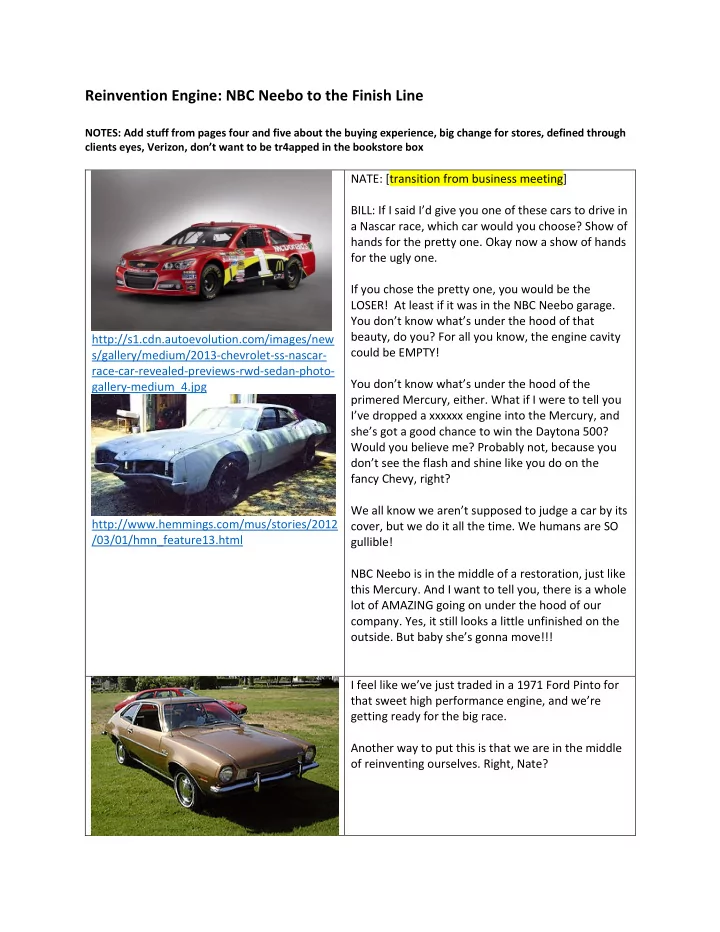
http://s1.cdn.autoevolution.com/images/new s/gallery/medium/2013-chevrolet-ss-nascar- race-car-revealed-previews-rwd-sedan-photo- gallery-medium_4.jpg http://www.hemmings.com/mus/stories/2012 /03/01/hmn_feature13.html NATE: [transition from business meeting] BILL: If I said I’d give you one of these cars to drive in a Nascar race, which car would you choose? Show of hands for the pretty one. Okay now a show of hands for the ugly one. If you chose the pretty one, you would be the LOSER! At least if it was in the NBC Neebo garage. You don’t know what’s under the hood of that beauty, do you? For all you know, the engine cavity could be EMPTY! You don’t know what’s under the hood of the primered Mercury, either. What if I were to tell you I’ve dropped a xxxxxx engine into the Mercury, and she’s got a good chance to win the Daytona 500? Would you believe me? Probably not, because you don’t see the flash and shine like you do on the fancy Chevy, right? We all know we aren’t supposed to judge a car by its cover, but we do it all the time. We humans are SO gullible! NBC Neebo is in the middle of a restoration, just like this Mercury. And I want to tell you, there is a whole lot of AMAZING going on under the hood of our

  • company. Yes, it still looks a little unfinished on the
  • utside. But baby she’s gonna move!!!

I feel like we’ve just traded in a 1971 Ford Pinto for that sweet high performance engine, and we’re getting ready for the big race. Another way to put this is that we are in the middle

  • f reinventing ourselves. Right, Nate?
slide-2
SLIDE 2

http://en.wikipedia.org/wiki/Ford_Pinto NATE: A Pinto? Really? That is sad, Bill. BILL: Well, when you compare our outdated transactional lines with the high-speed stuff available online these days, we HAVE been a little like a Pinto. NATE: That’s fair. Technology has driven our industry in a new direction for the past few years. We’ve even had some new contenders enter the race, because they see the potential, which is a good

  • thing. The potential, I mean. And competitors will
  • nly make us better at what we do, so I’d have to

say that’s good, too. I hate to admit it, but once the Web became the center of our industry, our acceleration off the starting line was pretty slow. Which is why some of

  • ur competitors are threatening to pull ahead of us.

We’ve got to roll up our sleeves and get that engine finished! What We Do Best In the business longer Better college relationships More campus stores More experience selling to college students (transactions) But still, no other company in the collegiate products and textbook market can do some of the things WE can do. Who has been in the business as long as we have? BILL: No one. And who has better college relationships than we have? No one. And who has more brick and mortar locations on campuses? NATE: No one. And who knows how to sell goods and services to students better than we do? No one! We are the best at collegiate store transactions. NBC Neebo stands alone in all those ways and that gives us a great foundation for winning this thing, but to do it—you’re right—we need to reinvent

  • urselves, and we HAVE been reinventing ourselves.

You’d have to’ve lived under a rock not to see that.

slide-3
SLIDE 3

http://www.vitahoboken.com/2011/06/old- garage-door/ [begin animation of garage doors opening very slowly] For a few years now all through the company, there have been rumblings of change behind the big garage doors. (SFX: clanking, hammering, engine revving and dying) Until now, maybe from the outside it has seemed like just a lot of noise. When it’s a big change, it sounds like we’re hammering on the engine block with a sledge hammer. (SFX: Big hammering sound) And when it’s a small change, it’s a little sound, like we’re torqueing a squeaky bolt under the body somewhere. (SFX: squeaking sounds) Both big and small changes are taking place in all corners of the company. It’s all being done in a very calculated way to get us going in the right direction. To help us defend our title as biggest, best—and winningest--higher education services company in the U.S. But we’ve been doing a lot of talking, and until now, you all haven’t seen much under the hood, right? Just little peeks now and then. While some of us have been working behind the doors and under the hood, many of you have been spending time polishing your driving skills—fine tuning your teams and refocusing your efforts. For those of us working behind the doors, we decided to focus on the engine BEFORE doing the paint job. So by some counts, even when you peek inside, it’s still not pretty yet. Until now, our new hotrod has looked somewhat like an unfinished project, because there has been little flash and shine. [animation of doors] BILL: Yeah, well all that’s about to change right here, right now, at the NBC Neebo 2014 leadership

  • meeting. We are going to let you see under the
slide-4
SLIDE 4

hood, and it won’t be long before we start making it pretty! (SFX: race car engine revving) Laying the Groundwork Our Vision: One Company, One Goal Our Mission: To grow by being the most

innovative, welcoming, and knowledgeable provider

  • f collegiate products and services

Our Why: To make college—one of life's best experiences—even better Our Values: [add values here]

BILL: First let’s lay the groundwork. Where are we at with all of this right now? We’ve been encouraging you to go back to our vision, mission, why and values as a compass to guide your actions every day. That’s what’s at the heart of our reinvention engine. So let’s review briefly. It’s a good idea for everybody to do this once a week or so. It just keeps your head in the game. [Read text quickly, but meaningfully] Our Vision: One Company, One Goal Our Mission: To grow by being the most innovative,

welcoming, and knowledgeable provider of collegiate products and services Our Why: To make college—one of life's best experiences—even better Our Values: [add values here]

[zoom out to mission and highlight words as Nate says them] NATE: Personally, I think our mission is at the heart

  • f it. To grow… To be the most innovative…

welcoming… and knowledgeable provider. Reinvention equals transformation After much study, discussion, investigation, and testing over the past few years, we now know fulfilling this mission means we must transform

  • urselves into something different.

Transactions [morph text Services After decades of experience, we have become the industry’s best transactors. Now we must become the industry’s best service providers. We need to break out of the transaction box, because there is so much more we can do and so much more we need to be doing. There truly are unlimited possibilities, and looking ahead to what we might someday become is very exciting. That doesn’t mean we stop doing the things we do

  • best. All of those old strengths are still there.

[Racing visual as background, so focus is on the speakers] But the little things that have been going on under the hood inside of our reinvention engine are the things that will make us better. These changes will take us where we want to go.

slide-5
SLIDE 5

BILL: And to stay with the racecar metaphor for a bit, I would like to point out, Nate, that the work you and your crew have been doing in technology is sort

  • f like building the track our race car is going to run
  • n.

NATE: I like that! So, you are saying technology is the infrastructure that supports all of this great change that’s going on, right? BILL: Right! At this point in time, infrastructure is the

  • key. It supports all the programs, new products and

new services we are working on. We absolutely must get the engine in great shape before we put the shiny new paint on the car. We absolutely have to get our infrastructure in place so we can move forward with confidence. [Ripples diagram] That doesn’t mean things aren’t happening in other areas, of course. As Sara and the others explained this morning, the changes all of us are making everywhere in the company are rippling outward and creating a network of progress. The ripples are extending not only through the company, but

  • utward to our customers, suppliers and the

media… and outward into the future. While all of this is been going on, Nate and I and the rest of the management team and our crews have been focusing on the infrastructure that will bring it all together. Today we’re going to reveal some of the exciting technology capabilities we’ve been building into our reinvention engine. Then we’re going to talk about a couple of ways you can be a part of it — ways we all can use this reinvention engine to confidently take us into the future. NATE: Bill, before we do that, I think we should talk a little bit about what happens if we don’t reinvent

  • urselves. I don’t want to pull any punches. We

need to be perfectly honest here. We are all adults. I think we can take the harsh truth, then we can move forward with our eyes wide open.

slide-6
SLIDE 6

We are a little like Ebenezer Scrooge. We need a scary ghost to force us to face the facts of our past, present and future. Our far past was stellar, but our recent past has had its challenges. We have a chance to turn things around in the present. And our future doesn’t look so great if we DON’T turn things around. BILL: I agree. So, what happens if we don’t build this infrastructure and create all of these ripples? What happens if we don’t get into the race and defend our position as the industry’s best higher education services provider? [Begin adding logos of failed companies] NATE: Well, it’s very simple. We end up like

  • Blockbuster. You heard their story this morning but

they aren’t the only ones. [Add 20 seconds of brief info about two or three failed companies] BILL: Wow, those are sobering stories! Or scary enough to drive a person to drink. J Isn’t it better to focus on the positive? NATE: Absolutely! But we have to be realistic too. The handwriting is on the wall: Our channel college textbook market has lost more than 30% to Amazon Chegg in the last five years. We can’t sit around and watch that get worse. As long as we know what’s at stake, then we can do what it takes to make sure we don’t fail. It’s the carrot and stick thing. Our mission and potential are the carrot. And the stick is the possibility of ending up like these companies. BILL: Makes sense. To avoid being on the list of great failures, we have to do things like change our infrastructure and hire great people who understand things like affiliate marketing, search marketing, content, and virtual inventory. As a merchandiser and marketer, I know we have to hire people who know how to merchandise online

  • vs. in the store—people who can help us create a

seamless web experience with great products and

slide-7
SLIDE 7

pricing that allows people to check out without any

  • hitches. The bookstore is still important, but it isn’t

good enough by itself anymore. So, are we ready to put those negative thoughts behind us and unveil the NBC Neebo reinvention engine for these folks? Reinvention Engine [animation] NATE: Absolutely! BILL: (in a big voice, like a circus barker) Ladies and gentlemen, start your NBC Neebo Reinvention Engine! (SFX: racing horns, fanfare, etc. as the words come

  • n the screen between the garage doors)

What We Do Best Textbook Collegiate Merchandise Supplies Gifts Other Products NATE: And we’re off and running. Let’s start with what we know—what we’ve done for decades. Because a lot of it still valid. At the heart of our reinvention are those things we already do best –

  • ur competencies. Without our primary

competencies, we would be down to dirt. We are very lucky the things we do best are an excellent foundation to build on. Essentially, everything we do best used to be centered around our campus locations and the products we sell there — primarily textbooks, but also collegiate products, supplies, gifts and other items our guests wanted to buy. [Photo of student in the store] [morph to photo of student at computer] [add word to photo:] Services The problem we realized late in the race, was that the needs of our guests were changing, mostly because of the great new capabilities of the

  • Internet. Naturally, students wanted to get books

and merchandise online. Other companies saw an opportunity there and the market got a little more crowded and competitive. Suddenly, the fact that we had bricks and mortar stores all over the U.S. was not as much of a differentiating factor as it used to be. What IS the most differentiating factor? There is no doubt — in this online world it’s service. The company that provides the best service, most

slide-8
SLIDE 8

[Add additional word:] Managed Services focused on actual needs of the guest — that company wins! When we realized service was the key to the future, we knew we could win this race because all we had to do was transmit the power of our old product- based competencies into new competencies focused

  • n service rather than product.

In fact, we took it one step further. We wanted to not only provide service to guests, but open up every capability we have and offer those capabilities to schools and guests to help them meet their own goals. For example, we use POS software in our stores that could work great on campus to handle student

  • transactions. And our school contacts would trust us

to implement that software and those processes for them, because they know us. That would make us very competitive. It’s like income that’s been sitting there all this time, just waiting for us to discover it. In many cases, we realized we could even provide consultative services to assure the products they buy from us are successful. The result was a very gnarly set of managed services you won’t find anywhere else in one place like you can find them at NBC Neebo. So, that’s what we’ve been creating. We’ve been building our powerful old competencies into a very exciting new network of services to provide our customers. [Photo of primered car as graphic header with logos] Reinvention Engine BILL: So, these competencies are what makes up the NBC Neebo reinvention engine. Can you tell us a little bit more about that? We want all of these guys to be aware of what’s going on under the hood. We want them to have a chance to feel as excited about all this as we are. NATE: I agree! And I’m glad you asked. Our competencies and the new services we are deriving from them are at the heart of the changes going on in our company. As you’ll see, we have reason to be pumped up!

slide-9
SLIDE 9

[Highlight boldfaced key terms one at a time as Nate talks about them] Create a comprehensive managed services platform by merging industry-leading products and services. Together, these turnkey solutions will allow educational institutions to focus on success in the classroom and be better positioned in the changing world of education. As we were working on all of this, we created a targeted vision statement to help us make the transformation from products to services. I want to share that, because it explains a lot. Our vision for reinvention is to “create a comprehensive managed services platform by merging industry-leading products and services.” We no longer want to focus solely on providing one- time solutions. Rather, we want to go deeper. We want to provide turnkey solutions that support the goals of the educational institutions we work with. When we do that, it will allow them to better focus

  • n success in the classroom and be better

positioned in the changing world of education. [Neebo managed services hexagon diagram, including all six categories — highlight each hexagon as Nate mentions i:] This is how we are working toward this vision. We have activity going on in all six of these competency

  • categories. Retail store operations. Supply chain
  • maximization. POS, ERP and e-commerce. Business

intelligence and analytics. Customer acquisition and

  • retention. Educational solutions and services.

In each category, we are building on what we already do best and adding managed services to support our customers. [Retail store operations slide — highlight areas

  • f slide as Nate talks about them]

In retail store operations, for example, we have competencies and opportunities in these six areas: retail best practices, workload planning, college store design, retail consulting, training and development, and virtual bookstores. Some of these things have been around for a long time, and some are brand new. On the right, you can see some of the products and services we’ve created or are creating using these

  • competencies. Of course, our offering includes the

Neebo managed stores network. It also includes programs all of us are very familiar with: Best Price Promise, Rent Every Book and Save, and Neebo Connect. These are parts of the high-performance reinvention engine we’ve been tinkering with.

slide-10
SLIDE 10

[Add 20 seconds: rationale behind work in this category; highlights; outlook for future—you will talk about details during the technology demonstration, so no need to cover that here] [Retail store operations competitive matrix slide] As you can see in this competitive comparison, Neebo is the only company that provides products and services in every one of the six categories. None

  • f our competitors has the chops we do in this area.

[Supply chain maximization slide — highlight areas of slide as Nate talks about them] In the area of supply chain maximization, we’ve identified these six opportunities: inventory

  • ptimization, forward and reverse logistics, global

inventory visibility, merchandise planning, supplier relationships, and physical content. [Add 20 seconds: rationale behind work in this category; highlights; outlook for future—you will talk about details during the technology demonstration, so no need to cover that here] [POS, ERP & e-commerce slide — highlight areas of slide as Nate talks about them] Let’s turn now to POS, ERP and e-commerce. In addition to POS and e-commerce, areas of

  • pportunity in this category include inventory

control and receiving, information security and compliance, payment solutions, and business process automation. Right now, we’re working on…. [Add 20 seconds: rationale behind work in this category; highlights;

  • utlook for future—you will talk about details during

the technology demonstration, so no need to cover that here] [Business intelligence and analytics slide — highlight areas of slide as Nate talks about them] When it comes to business intelligence and analytics, we have really stepped up our performance for customers. Opportunities include market insights, higher education product DB, voice

  • f customer DB, price management and
  • ptimization, and partnership management.

These are some of the products we’ve used

  • urselves for a long time. And we have identified

them as products that could also be of use to schools and educational institutions. We plan to monetize these products to strengthen the NBC Neebo business model.

slide-11
SLIDE 11

The most promising products and services include… [Add 20 seconds: rationale behind work in this category; highlights; outlook for future—you will talk about details during the technology demonstration, so no need to cover that here] [Customer acquisition and retention slide — highlight areas of slide as Nate talks about them] Customer acquisition and retention technologies are

  • ther examples of tools we can provide to support

customers and expand our profit potential. Opportunities and competencies in this area include customer relationship management, Sales Force software, advertising promotions and marketing services, customer service and support, and campus relations. The most important opportunities in this category include…[Add 20 seconds: rationale behind work in this category; highlights; outlook for future—you will talk about details during the technology demonstration, so no need to cover that here] [Educational solutions and services slide — highlight areas of slide as Nate talks about them] In this final reinvention category, we have

  • pportunities to provide managed services for our

customers in the areas of digital content, physical content, digital learning, learning management systems, and student information system integration. [Add 20 seconds: rationale behind work in this category; highlights; outlook for future—you will talk about details during the technology demonstration, so no need to cover that here] [Neebo managed services slide] So, there you have it — six areas of competency and six areas of opportunity. BILL: Wow. You and your pit crew have been busy! You’ve given my crew in the marketing and merchandising area a lot of go-power to work with. Thanks for that! NATE: You’re welcome! But you know it took collaboration between our team, your team, stores, service teams and a lot of people to create this vision.

slide-12
SLIDE 12

It all comes down to a set of technology tools that can give us a return on the investment we’ve already made in our supply chain. We need the right tools so we can be the best in the industry. We are using technology as a catalyst to build a really kick- ass system of managed services for our customers. BILL: One thing I notice is that some of these technology tools are available behind the scenes as services to the institutions, who then use them to help their own guests. And other technologies are more guest-facing in the form of point-of-purchase

  • services. But in both cases, whether it’s behind the

scenes or front-facing, the technology ultimately supports guests. I think that’s a very important point. Here are a couple of examples. On the one hand you have CRM software and services, which reside behind the scenes, but they definitely affect service because CRM systems make institutions more

  • rganized and more responsive to students, parents

and fans. On the other hand, we’re planning to offer cutting- edge learning tools accessible to faculty and students on Neebo.com. That’s a direct improvement in service to guests. Those of us in merchandising are trained to think of this from the point of view of the guest. In the stores, guests will still see premium merchandise and textbooks. However, through online technology they will now also see [10 second of general example — specifics will be discussed below]. I want to talk about this a little bit, because the website is probably the most visible example of the transition we’re making from transactions to managed services. [Screenshot of old website] Up to now, Neebo.com has been a hub where our traditional products are found. [10 seconds: explain briefly what was clunky about old site] This site is

  • ur 1971 Pinto. It’s using old technology, old

marketing channels and rusty merchandising methods – good enough in its day, but that day is long gone.

slide-13
SLIDE 13

[screenshots of newwebsite] As you know, we’ve been working on a NEW Neebo.com. It’s part of that high performance engine in the race car. THIS is the first time it has been seen in public! Let’s borrow a trick from the morning session on

  • values. May I have a drumroll please? [pause for

drum roll] Announcing the new Neebo.com [30 seconds: Bill and Nate take turns explaining examples of changes showing high-performance services online… Easier shopping experience quicker order processing in classroom experience supply chain aggregation managed rental and communication tools] It’s important to keep in mind technology itself isn’t the service. It is only the WAY we deliver our

  • services. Technology is a TOOL to help us do what

we do … better, faster and with a little more style. NATE: Right! The changes we are making aren’t just for the sake of having fun, flashy technology— although we’ve all bought software and gadgets we end up not using, right? Companies do that, too. We aren’t doing that anymore. We’re making changes in the way we choose technologies. It’s all based deeply on the needs of our customers. That’s where it starts. For example, technology allows us to communicate better with customers, and also to take our message to the places where they already are: and for most of our guests, that place is online a lot of the time. Technology also improves our speed to market. Every day we don’t have the technological tools to help us compete, our market share is being gradually eroded. The sooner we accelerate our plan and get to market with this technology, the more customers we can capture.

slide-14
SLIDE 14

In fact, this technology is not an option — it’s a necessity for survival in today’s world of commerce. But that doesn’t mean it can’t be fun! Right, Bill? BILL: Right! It’s really very exciting, because there’s so much potential in it! As a matter of fact, we’d love to take a minute to have some fun with this technology thing. NATE: Heck, yeah! Let’s have a little fun. [Add appropriate images] [10 seconds: Add language to implement giveaway to audience members] [PAUSE FOR TWO MINUTES OF CHAOS AS AUDIENCE MEMBERS RECEIVE GIVEAWAY — draw audience attention back to podium] And now…back to the race! NATE: Well, that was a great bonding moment, don’t you think?!!! You might be asking yourselves why we did we give you this technology gift. You think we’re buttering you up, don’t you. You might think we’re bribing you—to do what, I’m not sure, but let’s not go there. We are in fact NOT buttering you up or bribing you. We want you to remember this moment. We want you to remember the technology. Remember that technology is key to our reinvention. And we want you to be as excited about it as we are. The benefits

  • f technology are very real. They are as real as the

[giveaway] in your hand. Some of our new technologies are further along in development than others. But you will begin to see them trickle into your areas of responsibility and into the market. We have been very ambitious. As time goes one, we’ll keep you informed, so you know about the latest technologies we’re offering

  • ur customers and using to improve our work. We

are all in this together. We want everyone to have the opportunity to be excited and proud of what we’re doing with this great company—a lot like you felt when you were all discovering the technology gifts we left under your chairs. BILL: Okay, time for a little recap. So far this afternoon, this is what we’ve accomplished.

slide-15
SLIDE 15

Must change to stay alive as a company. Must change from transactions to managed services. Reinvention Engine = technology-based products and services Technology provides tools to move us forward It’s exciting! It’s real! Competitors are going to freak out! We’ve established the fact that we MUST change to stay alive. We absolutely do NOT want to end up like Blockbuster and all of those other failed companies. We’ve recognized that the BIG overall change we HAVE to make is to changing from purveyors of transactions to providers of managed services. We’ve also revealed the guts of our Reinvention Engine: that is the technology-based products and services we’re extracting from our traditional competencies. NATE: We’ve established that technology is like the racetrack or infrastructure our high performance machine is running on. And we’ve whipped up a little excitement about all this—because that’s what races are all about. Can’t you feel the thrill of competition in the air? Our competitors are going to be so defeated! [collage of people’s faces from the company] BILL: That’s the idea! But there are still ingredients missing, Nate. People. It’s people who will make this

  • happen. You don’t get anywhere just parking the

race car on the track—even if it’s a really great race car and a really great track. You have to have drivers. NATE: That makes total sense. The same is true of technology in general. You can have all the great software in the world, but if it just sits there, it’s like a hammer sitting on the workbench right by a nail. Nothing happens until a human hand picks them up and starting pounding away. I love technology as all of you know, but I’m a believer in the fact that technology is worthless if it’s not meeting a real need and if it’s not being used every day to solve problems and serve people. So, Bill, where does that leave us today? What are

  • ur next steps for using these tools to reach our

goals? And what advice can we give the leaders in

  • ur audience? I’ll bet they’d like to know how to

pass on some of this to their team members, too.

slide-16
SLIDE 16

Making it Real

  • 1. Collaboration
  • 2. Leadership

BILL: That’s exactly what we are going to talk about

  • next. How do we take this information and use it in
  • ur own areas with our own teams? The answer is

twofold. First and foremost, we need to partner with each

  • ther. That’s what you call collaboration. But the

kind of collaboration we’re talking about might be different from what you usually think of as

  • collaboration. More about that in a minute.

Second, to make the Reinvention Engine run right, we need to re-examine our roles as leaders. Each of the leaders in this room makes daily decisions and actions that affect the whole company. Each of you has a responsibility to understand the role you play so you can do your part to make the most of all these new opportunities. [“elf yourself’ style image with racing pit crew whose faces have been replaced by recognizable executives’ faces, including Steve, Sarah, Bill, Nate, others best known. As an aside, you might be wondering—if all of our team leaders are the drivers, who are Steve and the executive crew, including Nate and Me. I like to think of us as the pit crew and pit bosses. [pause for image to come up and hopefully people will laugh] You see, there we are. Steve is the pit boss checking the plan and crunching some numbers. I’m a wheel

  • jockey. Nate’s over there wiping up grease spots.

We are the ones who build and maintain the car, plan the strategy and fine tune the equipment to get the hotrod ready for you and your teams to drive. In the best companies, the executives work hard for the whole team, like this—well, maybe not exactly like this. It’s the executives’ job to make sure people throughout a company have the things they need to be successful. In the end, we are all members of the same big team, and we need the talents, skills and commitment every one of us if we are going to win this race. NBC Neebo Value #4: We Know We Produce the Best Results When We Work Together NATE: Yep, we’re all in it together. That’s what NBC Neebo value number 4 is all about – We Know We Produce the Best Results When We Work Together.

slide-17
SLIDE 17

Collaboration [still of penguin video] BILL: Exactly! And how do we work together? We

  • collaborate. This morning, [name] introduced you to

value number four and showed you how powerful working together is. Like those crazy penguins,

  • remember. They worked together to tip up the

iceberg and outsmart the shark. It wouldn’t have worked if only a few penguins moved to the edge of the iceberg. And the leader certainly couldn’t have done it himself. They ALL had to move together. We really can’t do any of the new things we want to accomplish for NBC Neebo without each other. We can’t avoid that scary Scrooge-like future without pulling together and getting really determined to succeed. For a minute, let’s go back to the idea of ripples that we talked about this morning. [build ripple diagram one set of ripples at a time to create a woven cloth of cross- threads—for this slide, show just one set of ripples representing the example Bill is talking about] The point of origin for any ripple is one of your teams or an idea you or one of your team members has had and is acting on. From a store team, we might see increased orders because they’ve figured out some new ways to step up customer service and get add-on, point-of- purchase sales. Those elevated product numbers ripple out to inventory and the warehouse. If product orders stay at elevated levels, it might mean we need to order packaging sooner, for example. Especially if word of this success ripple sout to other stores and inspires those stores to try the same thing. And I can imagine such a point-of-purchase idea rippling on over to our marketing and merchandising staff and making us think differently about the way we put together store displays. It would work somewhat in the same way with a home office team. [add new set of ripples, with lines crisscrossing lines of the first set] NATE: Here’s a home office example. What about the HR team. Let’s say they come up with the idea to use a specific type of pre-hiring evaluation to make

slide-18
SLIDE 18

sure we are hiring the right people. They would have to reach back to the team they are hiring for to determine what to evaluate. That creates one little ripple—and an opportunity for collaboration. Then, when they hire a great person, it affects the targeted team in a positive way—another ripple. Who knows what ripples that might cause down the line when that new team member begins making an impact on the company, suppliers, guests and customers? [add new set of ripples, with lines crisscrossing lines of the first two sets] BILL: What about support teams. Let’s take the warehouse as an example. I even have an example from real life. Last quarter, we launched an expedited supply chain strategy, which meant we had access to 72,000 more textbooks and products than usual during the big fall buying rush. As a result, we improved fulfillment of demand and improved our textbooks inventory position by 28 percent. The positive ripples of this action touched the warehouse, stores and even the marketing department and the CFO’s office. Because we all look good when we sell more product, right? J MOST importantly, this innovative action touched

  • ur customers. They were able to get what they

wanted, when they wanted it. And that makes loyal customers who come back AND who tell other people about us. In all of the examples we just shared, the ripples were not just the results of cause and effect, although that’s part of it. The ripples also represent

  • pportunities for collaboration.

NATE: So, in the case of the store, where they figured out a new way to step up customer service at point-of-purchase, there was collaboration between manager and cashier… possibly between two cashiers who might have come up with the idea together… between the manager and our merchandising department. And don’t forget about collaboration between stores.

slide-19
SLIDE 19

BILL: In the case of the HR pre-hiring evaluation, there likely was collaboration between the HR manager and team members. Who else? Probably between HR and the company that provided the evaluation software. And that might have involved collaboration with YOUR department in IT. Again, an important point to note here is that the ripples radiating out from our teams often have an impact outside of our company with suppliers and

  • thers who can then become influencers.

When they tell other people good things about us, you never know when one of those ripples will turn into a customer or a profitable partner. [photo of any newspaper article and/or web release using this story] NATE: In the case of the expedited supply chain strategy, you KNOW there was collaboration all over the place. Again, what happened on one team affected other teams, as well as customers, vendors, and in the end the entire company. Sometimes the ripples go out to the media. In this case, we included the supply chain success in our quarterly earnings press release distributed to the media… who then printed it…and it showed up in newspapers, on the web and probably in at least a few one-on-one conversations. See how powerful this is? I hope this helps everyone see that collaboration truly is critical for our success. Collaboration is NOT … Requesting resources Telling someone what you are doing Asking someone to do something BILL: I think we should talk about what collaboration is NOT as well as talking about what it IS. Some people think it’s collaboration when you request resources from another department or

  • person. But that’s not collaboration. That’s

requisition. Some people think it’s collaboration when you let another department know what you’re doing. And you say, “Oh, by the way, I’m doing this new thing.” But that’s not collaboration. That’s information.

slide-20
SLIDE 20

Some people think collaboration is when you ask someone – or tell them – to do something to get it

  • ff of your plate. That’s not collaboration. That’s

desperation. Collaboration: Working across boundaries, with another person, to merge ideas into one concept, to achieve a goal. This is what collaboration is: Working across boundaries… with another person… to merge your ideas into one concept… to achieve a goal. [three circles separated from one another, labeled “College Stores”, “Information Technology”, and “Home Office.”] [bring three circles together and overlap them, then bring them all together into one circle] In some ways, collaboration was difficult for us as a company for a long time, because we basically

  • perated in three silos: college stores, IT and home
  • ffice. If you’ve been with us for a while, you might

remember what that was like. This morning, [Name] mentioned the attorney

  • example. All three different divisions had separate

attorneys, which was a waste of money and time, but also probably crippled each attorney’s ability to advise us as a company. I’m assuming there were even legal policies contradicting one another. Not a good way to bring us together as a strong company. Through reinvention, you’ll see that our separate silos are slowly coming together. We are integrating them into one silo called “Our Company.” Collaboration IS … Working across boundaries (between silos) Dialogue between people Sharing of resources NATE: I’d like to break down the pieces of collaboration and look at them a little more closely, because it will help you create collaboration in your

  • wn world as an NBC Neebo leader.

First, collaboration involves a dialogue between human beings. I’d say face-to-face works best, because collaboration means a two-way

  • conversation. Email and texting could be a part of it,

but it’s not enough. You need to look each other in the eye and have a true conversation with the goal

  • f finding solutions together.

Collaboration also involves sharing resources. That means not keeping resources to yourself, but looking for ways they could be used even outside of your team.

slide-21
SLIDE 21

Sharing of ideas and concepts, not just facts Focused on a specific goal Alignment of strengths Behavior modeled by leaders We have a tendency to want to hold our resources close to the vest, but we need to be thinking in terms of all of us working for the greater good of the company, which we also believe will be good for our separate teams as well as the individuals on our teams. The next thing to note about collaboration is that it involves ideas and concepts. It’s not collaboration if you are simply sharing facts, for example. It’s not collaboration until you sit down together to interpret those facts and figure out how they could be used to solve a challenge and move us forward. Collaboration requires you to identify an expected goal or outcome. If you aren’t working toward some type of improvement or upgrade, it’s not

  • collaboration. Every collaboration at NBC Neebo

should be focused on helping us become NBC Neebo the supercool services provider. Sometimes, we’ll work on smaller goals that lead us to the larger goal. But it’s the larger goal we’re shooting for. Here’s another important point. Collaboration is about the alignment of the strengths of different teams, regardless of any walls that have been put up between teams. It’s less about remediating weaknesses and more about building on strengths. Finally, collaboration should begin with senior leaders, so all of our company leaders can see it and learn from it. Then, it’s up to all of the leaders— that’s you-- to model collaborative behavior for our

  • teams. And THAT is how we will strengthen our

culture of collaboration. BILL: Nate and I are a great example. Our two teams have been collaborating for months to identify our competencies and come up with technologies that could make viable products. It’s been a true sharing of ideas and alignment of strengths to get us to our goal of becoming a provider focused on managed services rather than just transactions. My area of responsibility, merchandising, is a good example of an area that had to change drastically to

slide-22
SLIDE 22

accommodate our Reinvention Engine. Because our guests and customers have changed the way they buy, we have been forced to merchandise in new

  • ways. We needed help from others in the company

to make that happen. We’ve been forced to share ideas and collaborate. But the funny thing is, even if some of us were a bit apprehensive at first about going across those boundaries, we’ve discovered that collaboration is energizing and promising. Some great products and projects have come out of all that collaboration. NATE: That’s right. I can point to a few other revolutionary changes at NBC Neebo that are a direct result of collaboration: the Neebo Student Network is one. BILL: How about the new order management system? It makes our products available to guests however and wherever they want to shop. NATE: Neebo.com and Rosetta are two other important examples of collaboration. BILL: Geez, where do you stop? There’s so much

  • more. The virtual classroom products. [add two

more examples] All of this collaboration is the work of collaborators at ALL levels across the ENTIRE company. Collaboration can come from anyone, but as we mentioned earlier, I think you’ll find that it often

  • riginates with leaders of teams.

That’s probably because collaboration is driven by the big picture and team leaders are in a position to see the big picture. That’s what we’re doing here today is revealing the big picture to you. So you are MUCH more likely than your team members to see how what you are doing could be combined with the efforts of other teams and other people! You are also in a position to set an example—to show team members how collaboration works, so they can use it at their level in their day to day work.

slide-23
SLIDE 23

NBC | Neebo Value #3: We Know all Team Members, Regardless of Position or Title, can Contribute Great Things. Which brings us to the second way we can make these changes real and impactful in our company. We can focus on our roles as leaders and step up to take our places with confidence. This equates with NBC Neebo value number 3: We Know all Team Members, Regardless of Position or Title, can Contribute Great Things. Much of that discussion, if you’ll remember back to this morning’s presentation, was about

  • empowerment. Just as you empower the team

members on your team to work at their peak potential, we want to empower you to take your rightful leadership role after reinvention. To do that, of course, you need to know where you fit into this new world order of managed services, right? Let’s talk about store leaders, first. If we are no longer all about product, all of you store leaders might be wondering where does product fit into our new service-based business model? We are saying YOU are the driver of our new managed services hotrod. Metaphors are great ways to help people understand things, but you must be asking yourself what exactly are you expected to drive and where? I happen to be very passionate about examining individual roles, because I KNOW what a profound impact individuals can make on an organization. I’ve seen it in my own career. At first I was just stubborn. I didn’t want anyone to say I wasn’t giving it my all, so I gave it my all. Then, when I saw the impact I was having, I was hooked! It is a GREAT feeling to know you REALLY are making a difference. NATE: I think all of us in executive leadership roles have similar stories, Bill. Once you’re hooked on making a difference, it’s like a drug. You can’t get enough, which is really great for the company and the people you lead. It also makes your job very enjoyable and satisfying.

slide-24
SLIDE 24

In my own case, I’ve been told when I get excited about new ideas, I kind of “go under” while I’m talking about it. I get lost in thinking about the possibilities. I guess that’s what we are hoping for all of you. We want to give you permission to immerse yourselves in the possibilities of your role as a leader. On the one hand, all of your colleagues are counting

  • n you to do this. On the other hand, we know from

experience how satisfying it can be to really make a difference, and you should get to feel that, too. [stick figure image of leader in blue] You, the NBC Neebo Team Leader [add balloon labels with the following words,

  • ne at a time]

Store manager [put in prominent place as subtitle to the “Team Leader” title shown above] [add bracket and these words to the title “Store Manager” above:] Not just a… BILL: I’m a marketing guy, so all this talk about what a leader is made of me think of something we use in marketing—personas. A persona is a compilation of qualities of the person we are trying to reach with

  • ur marketing materials. It helps us understand

what the message should be and target the right potential buyers. So to help you understand what your role as a leader in this company, I’ve created a couple of leader personas. We would like to introduce you to… YOU! … the NBC Neebo team leader. I’ve purposely created an androgynous persona, by the way, so you can identify with this person whether you are a man or a

  • woman. I know…weird…but bear with me. I promise

at the very least you are going to remember this, and that’s my goal. Our first team leader persona is a store manager. Let’s call this person Bobby Jo to help us visualize it. The first thing we want you to know about you and Bobby Jo that you are more than your title. We don’t want our company to fit into a box, and neither should our leaders. Until our reinvention, though, you thought of yourself as just a store manager—or just a department team leader. Your world was limited by the box you fit into. Now, after reinvention, you are much more than just a store manager.

slide-25
SLIDE 25

Problem solver Relationship builder Book finder Modern solutions finder Learning tool provider Success partner Needs evaluator Creative idea offerer Amazing technology provider Transactor [write with red slash through it] Managed services provider Better college experience seller Job simplifier Learning impacter Process streamliner Horizon expander Difference maker L iving provider After reinvention, you have a whole lot more to

  • ffer than merchandise and textbooks. You can now
  • ffer services that can help your schools solve
  • problems. So, you have become a problem solver.

It’s much more important for you now to build relationships with your campus contacts, so you can help them figure out solutions to the situations they are facing. So you have become a relationship

  • builder. You are the one they will come to depend
  • n for answers.

NATE: You also will be able to help faculty find the right books and other modern solutions to use in their classes. You will be able to offer professors and students tools to help them succeed at the learning

  • process. You are no longer just a person who orders
  • books. You are a partner in their success. You can

help your school clients evaluate their needs and come up with creative ideas to meet those needs using our amazing and wonderful technology. The technology products and services we told you about earlier ARE the tools you can now provide. We created them, as well as supporting infrastructure, to set the stage for YOU to transform personally from being a transactor to being a managed services provider on your campus. BILL: The help you provide to your guests and clients is so much more satisfying and exciting now! You truly can sell a better college experience. You are making teacher’s jobs easier, improving the impact

  • f learning for students and helping the school

streamline processes. You aren’t just standing in the store dusting off the shelves anymore and being weighed down by a million tactical low-impact tasks that don’t improve

  • services. You have permission to expand your
  • horizons. To choose daily tasks based on the impact

they’ll have in the lives of your guests and school

  • contacts. You have permission get out and talk with

people and make a real difference. Oh, and by the way, the people at the school you are building relationships with are the people who are providing a living for all of us. So, the better you

slide-26
SLIDE 26

Company grower Collaborator provide for them, the better they provide for all of us! You are helping our company grow. This takes us back to collaboration. You have an entire company full of colleagues you can collaborate with to help you provide these services to your school contacts. [add example of innovation and collaboration in a store] [Keep Team Leader title on the screen, but change the stick figure to red, and add this subtitle:] Home Office Manager [add in front of subtitle above] Not just a… Big picture seer Problem solver Relationship builder Collaborator Company grower [add all titles from store manager persona] Now, let me introduce you to our second team leader persona, the home office manager. This is going to be easy. Everything you do in the home

  • ffice supports what the store managers and sales

people will be doing when they’re in the field, on campuses and in other venues where we find a need for our services. Just as the store manager, you need to remember you are more than your title. Before reinvention, you had a narrow view of your job in the home office. Maybe you rarely looked up from your desk or outside of your team—either to get help or to help someone else. After reinvention, though, you can get rid of that box and expand your world view. The blinders are

  • ff. You can see the big picture, and you have

permission to become a big-picture problem solver. It’s much more important for you now, like the store manager, to build relationships and find ways to collaborate to help our company grow. Your view has expanded SO wide that you are now hyper aware of where our living is coming from— and that is from our guests and clients on campuses and online. So suddenly, your role aligns with the store manager’s role. You are all these things by association. [remove subtitle (Home Office Manager) and turn stick figure purple to represent combining the two personas into one—or otherwise graphically show the combination with the With the expanded view, I guess it makes sense that the two personas fill the same roles—just in different areas of the company. We really only have

  • ne persona. That’s how closely our leadership goals

should match up after reinvention.

slide-27
SLIDE 27

same main title (You, the NBC Neebo Team Leader)] Our Why: To make college—one of life’s best experiences—even better NATE: This fits right in with our NBC Neebo Why: to make college—one of life’s best experiences—even

  • better. We all do make that happen by fulfilling our

roles. Our Mission: To grow by being the most innovative, welcoming and knowledgeable provider of collegiate products and services The one-size-fits-all persona also fits with our NBC Neebo mission. The mission is the same for all of us. To grow by being the most innovative, welcoming and knowledgeable provider of collegiate products and services. [back to image of persona] I love this persona! It’s a perfect way to show the change in our mindset pre-reinvention and post- reinvention. Something I noticed about this is that leaders are no longer going to be defined by which team they are

  • n, but by the way they participate in service to

guests and clients. Just as your home address doesn’t define you, your team doesn’t define you. It’s things like your beliefs, your values, the things you care about, the ideas you share, and your strengths that really make you who you are. After reinvention, whether in the store or in the home office, you no longer get kudos just by taking

  • rders and filling them. It’s now what you do with all
  • f these resources and the way you collaborate with

your colleagues that helps you make your mark in the company. It’s your ability to focus on our goals and think creatively about ways to get there that matters most. Things like sales quotas and inventory positions are all still important. But it’s the mission behind those numbers that we want to keep our eye on. [garage door image from beginning of presentation] BILL: I think when we get to that point, with all cylinders firing the way they are supposed to, and all

  • f our leaders on the same page, and when we have

a bunch of clients who are using our great new managed services technologies…that’s going to be

slide-28
SLIDE 28

[throw open garage doors and show off a shiny race care with NBC and Neebo logo decals] like putting the shiny paint and the fancy decals on

  • ur racecar.

That’s when we can throw the garage doors wide

  • pen and show off the whole package—the high

performance engine in the shiny hotrod. [SFX: engine revving] [add stick figure with sunglasses on to the hotrod] With the industry’s best drivers. NATE: Baby she’s gonna move! BILL: Dang straight! Get ready to roll! [SFX: engine revving and tires screeching] [add dialogue to give instructions for returning to the meeting room after break for the technology demonstration]