Agenda Susan Gunderman Mimi Dyer Lenora Nyeste 1. Rigor, - - PDF document

agenda
SMART_READER_LITE
LIVE PREVIEW

Agenda Susan Gunderman Mimi Dyer Lenora Nyeste 1. Rigor, - - PDF document

Model Schools 06 High School Reinvention - Focus on Instruction High School Reinvention www.peterpappas.com ~ Focus on Instruction High School Social Studies Teacher K-12 Program Director Assistant Superintendent Senior Consultant


slide-1
SLIDE 1

1

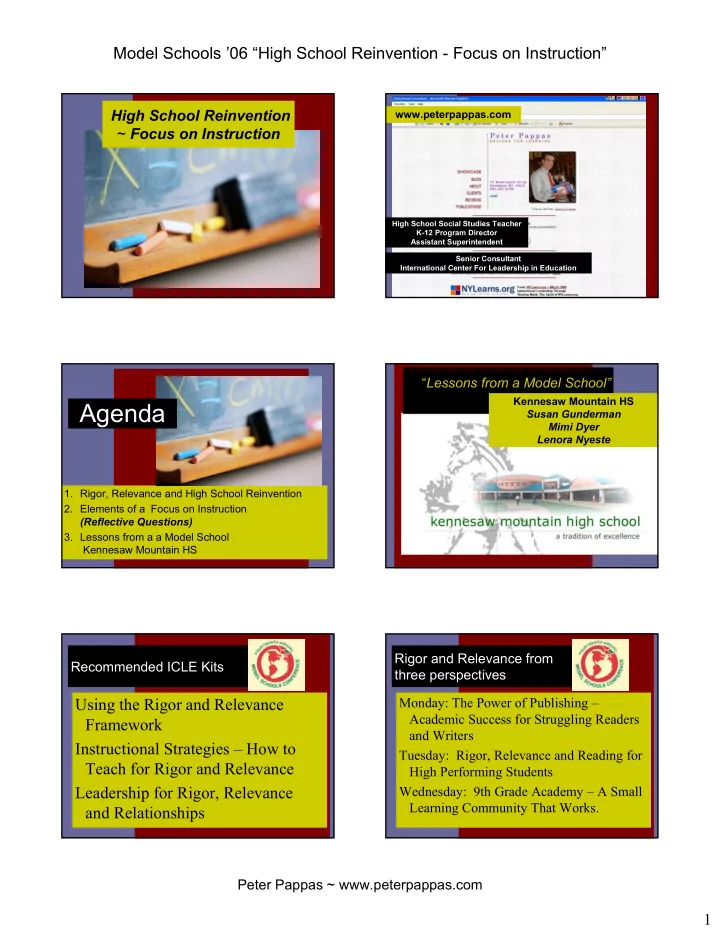
High School Reinvention ~ Focus on Instruction

High School Social Studies Teacher K-12 Program Director Assistant Superintendent

www.peterpappas.com

Senior Consultant International Center For Leadership in Education

  • 1. Rigor, Relevance and High School Reinvention
  • 2. Elements of a Focus on Instruction

(Reflective Questions)

  • 3. Lessons from a a Model School

Kennesaw Mountain HS

Agenda

“Lessons from a Model School”

Kennesaw Mountain HS Susan Gunderman Mimi Dyer Lenora Nyeste

Recommended ICLE Kits

Using the Rigor and Relevance Framework Instructional Strategies – How to Teach for Rigor and Relevance Leadership for Rigor, Relevance and Relationships

Rigor and Relevance from three perspectives Monday: The Power of Publishing – Academic Success for Struggling Readers and Writers Tuesday: Rigor, Relevance and Reading for High Performing Students Wednesday: 9th Grade Academy – A Small Learning Community That Works.

Model Schools ’06 “High School Reinvention - Focus on Instruction”

Peter Pappas ~ www.peterpappas.com
slide-2
SLIDE 2

2

Our essential questions:

“Has our school forged a common vision of teaching and learning?” “How have we organized to accomplish this vision?”

High School Reinvention The flow of information in the classroom has changed since I got started New technologies have put students in charge of the information they access, store, analyze and share. Flow of digital information is both personal and collaborative

Students can become their own researcher, editor, and entertainment director. And join new digital communities – linking them to the people who share their interests.

Access, catalogue and share Interact and collaborate

Model Schools ’06 “High School Reinvention - Focus on Instruction”

Peter Pappas ~ www.peterpappas.com

slide-3
SLIDE 3

3

Schools function as if they still controlled the flow of information

Literacy in the 21st century will mean the ability to find information, decode it, critically evaluate it,

  • rganize it into personal

digital libraries and find meaningful ways to share it with others.

Information is a raw material – students will need to learn to build with it

Will your vision

  • f instruction be

relevant to 21st century students? To change the flow of information in this session we’ll be using an audience response system You’ll need to share to enter either individual or group response Audience Response System courtesy of:

Mike Venrose Turning Technologies (330) 884-6044 mvenrose@turningtechnologies.com

Feather is to peacock as scale is to:

0% 4% 96% 0%

  • 1. shark
  • 2. bass
  • 3. dolphin
  • 4. whale

Model Schools ’06 “High School Reinvention - Focus on Instruction”

Peter Pappas ~ www.peterpappas.com

slide-4
SLIDE 4

4

Brain is to processor as eyes are to:

9% 91% 0% 0%

  • 1. hard drive
  • 2. mouse
  • 3. webcam
  • 4. monitor

The top two ideas that our school is considering as part of high school reinvention: One responder per school - Pick 2

10% 11% 3% 4% 10% 9% 21% 8% 25%

1. Small learning communities 2. Advisory program 3. Instructional strategies 4. Curriculum changes 5. Transition programs 6. Scheduling changes 7. Leadership and decision-making 8. Professional development 9. Assessment and data mining

Rigor and Relevance: A Foundation for Your Vision

  • f Instruction

Evaluation: appraise, defend, predict Synthesis: compose, design, develop Analysis: compare, contrast, categorize Application: demonstrate, illustrate, solve Comprehension: describe, explain Knowledge: memorize, name, recognize, recall

Bloom’s different levels of rigor

Basic Skills Basic Skills

Make it relevant with real-world application

Using skills and knowledge for myself in the real world

1 2 3 4 5

Using skills and knowledge in school Question: A cruise ship carries 200 passengers and crew. Each life boat carries 30 passengers. How many lifeboats will the ship need?

Almost one-third of the incoming 9th graders who took a NAEP math test answered

Model Schools ’06 “High School Reinvention - Focus on Instruction”

Peter Pappas ~ www.peterpappas.com

slide-5
SLIDE 5

5

Question: A cruise ship carries 200 passengers and crew. Each life boat carries 30 passengers. How many lifeboats will the ship need?

Almost one-third of the incoming 9th graders who took a NAEP math test answered

“6 remainder 20”

Recall of knowledge Complex use of knowledge

Higher-level thinking skills

In School: Test scores, class credits, academic progress In School: Test scores, class credits, academic progress In life: Performance, ability to adapt to change In life: Performance, ability to adapt to change Rigor Relevance

A

1 2 3 4 5

6 5 4 3 2 1

C D B

Rigor and Relevance Framework Rigor and Relevance Framework

Rigor Relevance

A

1 2 3 4 5

6 5 4 3 2 1

Quadrant A Gather and store bits of knowledge and information. Primarily expected to remember

  • r understand this knowledge.

Example Pick the right definition Example Pick the right definition

Rigor and Relevance Framework Rigor and Relevance Framework

Rigor Relevance 1 2 3 4 5

6 5 4 3 2 1

B

Quadrant B Apply knowledge in real-life situations. Example Compare car lease to loan Example Compare car lease to loan

Rigor Relevance 1 2 3 4 5

6 5 4 3 2 1

C

Quadrant C Use knowledge to analyze and solve school-based problems and create solutions. Example: Analyze symbolism in a poem Example: Analyze symbolism in a poem

Model Schools ’06 “High School Reinvention - Focus on Instruction”

Peter Pappas ~ www.peterpappas.com

slide-6
SLIDE 6

9

Teacher’s Toolbox Reader’s Toolbox

www.edteck.com/read Rigor, Relevance and Reading for High Performing Students

“Designed for honors / AP level teachers who think that an engaging learning environment is more than an inspired

  • lecture. Learn strategies to enable your students to read,

reflect, and write like historians, scientists, mathematicians, and literary critics. Teachers will find out how to support subject area mastery while building student literacy skills in defining, summarizing and analysis."

Tuesday - 2 Sessions Students who can function in an academic

  • r real-world setting that is unpredictable

and vital

Learn to research, think, problem-solve and write like a scientist, engineer, coach, artist, historian, mathematician, writer, musician, …. Model Schools ’06 “High School Reinvention - Focus on Instruction”

Peter Pappas ~ www.peterpappas.com

slide-7
SLIDE 7

10

Learning strategies are tools. Let’s look in the toolbox?

  • 1. Defining:

negotiating meaning

  • 2. Summarizing:

synthesis and judgment

  • 3. Comparing / Classifying: assessing

similarities and differences

Three “high yield" strategies

We’ll use the Rigor and Relevance Model as a framework

Focus on Instruction:

Reflective questions for your team to consider.

Strategy #1:

Defining

negotiating meaning

1 2 3 4 5

6 5 4 3 2 1

Defining Defining

Rigor Relevance

Define an experience to better analyze it Define an experience to better analyze it Negotiate meaning with a peer Negotiate meaning with a peer Modify meaning in real-world context Modify meaning in real-world context

  • Students with large vocabularies

have more background knowledge

  • Some students come to us from home

environments that are not academically rich

  • Vocabulary can be taught:

– Wide reading: more engaging, but may lack sufficient word exposure – Direct instruction: should be student-centered rather than rote-memorization

The relationship between vocabulary and academic achievement is well established ~ Marzano, What Works in Schools

Model Schools ’06 “High School Reinvention - Focus on Instruction”

Peter Pappas ~ www.peterpappas.com

slide-8
SLIDE 8

11

Does your school use a common vocabulary list? Teamwork! Organize a school or department

academic vocabulary list I think it would be a good idea if we

  • rganized a common vocabulary list

2% 2% 21% 75%

  • 1. Strongly Agree
  • 2. Agree
  • 3. Disagree
  • 4. Strongly Disagree

Strategies for teaching defining skills

  • 1. Connect new vocabulary with prior knowledge
  • What they think they know
  • Brainstorm their own explanations of terms
  • Introduce with story, current event, image
  • 2. Give students a chance to more deeply process vocabulary

to internalize meaning

  • Create their own non-linguistic models of terms
  • Activities that explore, restate, discuss terms with peers
  • Finalize with reflection and revisions to vocabulary notebooks

1 2 3 4 5

6 5 4 3 2 1

Copy definition from glossary Copy definition from glossary

Rigor

Use graphic

  • rganizer to

analyze meaning Use graphic

  • rganizer to

analyze meaning Student compares their own definitions to real world example Student compares their own definitions to real world example Improving the Rigor and Relevance of Defining Students learn and apply term in multi- disciplinary setting Students learn and apply term in multi- disciplinary setting

Model Schools ’06 “High School Reinvention - Focus on Instruction”

Peter Pappas ~ www.peterpappas.com

slide-9
SLIDE 9

12

Strategy #2:

Summarizing

synthesis and judgment

1 2 3 4 5

6 5 4 3 2 1

Summarizing Summarizing

Rigor Relevance

Summarize

  • pponent’s

arguments in debate Summarize

  • pponent’s

arguments in debate Summarize key elements of reading Summarize key elements of reading Summarize as foundation for analysis Summarize as foundation for analysis

Research shows student use of summarizing skills results in a 34- percentile gain in student performance.

Classroom Instruction that Works, ASCD, 2001

Case 1: Teacher lectures on the essential characteristics of mammals Case 2: Teacher lectures and then students do a summarizing exercise on the essential characteristics of mammals + 34% gain in content mastery

Does your school use common strategies to set the purpose for reading? If we expect our student to synthesize the essential information, do we help them set a purpose for their reading?

Think of purpose we set for our reading Students need to know what they should expect to learn

  • Main points or details?
  • Sequence of events?
  • Author’s viewpoint?
  • Connections to previous

learning?

Would your students benefit from standardized reading assignment form?

  • 1. Specific passage and due date
  • 2. Purpose – what should they know or be

able to do? And pay special attention to:

  • 3. New vocabulary that they will encounter
  • 4. Text features – headings, bold face,

images, data, graphs, footnotes

  • 5. Reading tips – skim, make predictions,

summarize, organize details, take notes

Model Schools ’06 “High School Reinvention - Focus on Instruction”

Peter Pappas ~ www.peterpappas.com

slide-10
SLIDE 10

13

I think it would be a good idea if we used common strategies to set the purpose for reading

0% 0% 13% 87%

  • 1. Strongly Agree
  • 2. Agree
  • 3. Disagree
  • 4. Strongly Disagree
  • Identify details – can you identify

key symbols, words, visual elements?

  • Recognizing context –where is

this taking place, time period, who’s involved?

  • Identify relationships –who are

these people, what is their relationship to one another?

Key comprehension skills

  • Identify opinions – is there a point of

view expressed in the source information?

  • Infer meaning – is there meaning that

can be extracted from what’s between the lines?

  • Make predictions – based on the

information, what will happen next? Key comprehension skills Active viewing, listening, and reading are

the foundation for comprehension / summarizing

Getting the visual message right “So what the artist is saying is…” Getting the spoken message right “So what you’re saying is…” Getting the written message right “So what the author is saying is ...” Does your school use common discussion group techniques?

The teacher models strategies then transfers responsibility to students working in small groups. Students learn to independently and flexibly

apply the strategies on their own.

  • Pair – share
  • 4-2-1- Free write
  • Jigsaw
  • Fishbowl
  • Clarifying
  • Predicting
  • Peer Reading Coach

Comprehension, summarizing

and the spoken message

Model Schools ’06 “High School Reinvention - Focus on Instruction”

Peter Pappas ~ www.peterpappas.com

slide-11
SLIDE 11

14

I think it would be a good idea if we used common discussion group techniques

4% 2% 20% 73%

  • 1. Strongly Agree
  • 2. Agree
  • 3. Disagree
  • 4. Strongly Disagree
  • What might you do in a similar situation?
  • What does this remind you of in your own life?
  • If you were telling this story, how might you end it?
  • What do you think would happen if... ?

Open-ended questions to deepen understanding … “What’s going on here? What do you see that makes you think so?”

Writing a summary matched to text structure

Recognizing how a piece of writing is organized helps to summarize it

Students may need to first map

  • ut the main points in a rough
  • utline so that they can see the

relationships

Does your school use common strategies to map text structure?

different; in contrast; alike; same as; on the

  • ther hand

Explains how two or more things are alike and/or how they are different.

Comparison

first, second, third; next; then; finally Lists items or events in numerical or chronological order.

Sequence

problem is; dilemma is; puzzle is solved; question... answer States a problem and lists one or more solutions for the problem.

Problem and Solution

reasons why; if...then; as a result; therefore; because Lists one or more causes and the resulting effect or effects.

Cause and Effect

for example, characteristics are Describes a topic by listing characteristics, features, and examples

Description

Cue Words Description Pattern

Description: listing

characteristics, features, and examples

Features Topic

Comparison: how

two or more things are alike or different

Model Schools ’06 “High School Reinvention - Focus on Instruction”

Peter Pappas ~ www.peterpappas.com

slide-12
SLIDE 12

15

Cause and Effect:

  • ne or more causes

and the resulting effect

  • r effects

Problem and Solution: States a

problem and lists one

  • r more solutions for

the problem

I think it would be a good idea if we used common text structure maps

5% 0% 29% 66%

  • 1. Strongly Agree
  • 2. Agree
  • 3. Disagree
  • 4. Strongly Disagree

1 2 3 4 5

6 5 4 3 2 1

Identify main points in text Identify main points in text

Rigor

Analyze the structure of a text Analyze the structure of a text Negotiate a collaborative summary with a peer Negotiate a collaborative summary with a peer Improving the Rigor and Relevance of Summarizing Summarize a real-life process Summarize a real-life process

Strategy #3:

Comparing

assessing similarities and differences Research shows student use of comparison skills results in a 45 - percentile gain in student performance.

Classroom Instruction that Works, ASCD, 2001

Case 1: Teacher lectures on the essential characteristics of mammals Case 2: Teacher lectures and then students design a comparison of the essential characteristics of mammals + 45% gain in content mastery

“Compare the animals and climate of the rain forest and desert.”

Ave rainfall 2-6” /yr Low humidity Frequent frosts Big variation in temp Low 8°F High 119°F Bats Iguana Ants Big Horn Sheep Tarantula Coyote Desert Tortoise Mohave Rattlesnake Ave rainfall 175”/yr High Humidity No frosts Little variation in temp-average 80°F Ave low 64°F Hot Spider Monkey Pit Viper Three-toed Sloth Jaguar Giant River Otter Bats Iguana Ants

Mohave Desert Amazon Rain Forest

Classroom Instruction that Works, ASCD

Model Schools ’06 “High School Reinvention - Focus on Instruction”

Peter Pappas ~ www.peterpappas.com

slide-13
SLIDE 13

16

Amazon Rain Forest Ave rainfall 175”/yr High Humidity No frosts Little variation in temp-average 80°F Ave low 64°F Mojave Desert Ave rainfall 2-6” /yr Low humidity Frequent frosts Big variation in temp Low 8°F High 119°F Both

Hot

Rain Forest and Desert - Climate

Amazon Rain Forest Spider Monkey Pit Viper Three-toed Sloth Jaguar Giant River Otter Mojave Desert Big Horn Sheep Tarantula Coyote Desert Tortoise Mohave Rattlesnake Both

Bats Iguana Ants

Rain Forest and Desert - Animals

A

1 2 3 4 5

6 5 4 3 2 1

C D B

Where would you put this activity? Where would you put this activity?

Rigor Relevance

“Compare the animals and climate of the rain forest and desert.” “Compare the animals and climate of the rain forest and desert.”

In which quadrant would you put this activity?

“Compare the animals and climate of the rain forest and desert.” “Compare the animals and climate of the rain forest and desert.” 8% 54% 26% 12%

  • A. Quadrant
  • B. Quadrant
  • C. Quadrant
  • D. Quadrant

But who is doing the thinking in this exercise? “Compare the animals and climate of the rain forest and desert.”

  • 1. Did students select the information and decide
  • n the categories?
  • 2. Did they design the graphic organizer?
  • 3. Is it really an exercise in memorizing and

repeating the appropriate (complex) information that others have told the student?

What’s the point of the comparison? What does it enable us to do or see?

How would students independently compare regions?

  • Select two geographic regions of

the world

  • Develop a model to compare the

regions

  • Select at least two factors to

compare

  • Develop a graphic organizer to

display your comparison.

Model Schools ’06 “High School Reinvention - Focus on Instruction”

Peter Pappas ~ www.peterpappas.com

slide-14
SLIDE 14

17

I think that a freshman of average ability level would be able to independently design a comparison

16% 35% 29% 20%

  • 1. Strongly Agree
  • 2. Agree
  • 3. Disagree
  • 4. Strongly Disagree

I think that 21st workplace requires critical thinkers who can independently problem solve.

2% 6% 8% 83%

  • 1. Strongly Agree
  • 2. Agree
  • 3. Disagree
  • 4. Strongly Disagree

Do you give students an opportunity to develop their own models for comparison?

  • 1. They could select items to compare from a

teacher-produced list.

  • 2. They could independently decide what to

compare.

  • 3. Can include some combination of selecting

both the items and / or characteristics.

  • Of what use is the comparison
  • What does it enable us to do or see?

Is Tuesday’s school lunch better than Wednesday’s?

Design comparison Select characteristics Rating system

Move from Comparing to Classifying

1. Comparing is the process of identifying similarities and differences between or among things or ideas (technically contrasting is looking for differences.) 2. Classifying is the process of grouping thing that are alike into categories on the basis of the characteristics

Comparison depends on classification. The student may not be aware of the connection, because the teacher did the classifying in advance, leaving only the comparing for the student.

It’s like comparing apples and oranges

Who determines the categories and “rules” for membership?

Model Schools ’06 “High School Reinvention - Focus on Instruction”

Peter Pappas ~ www.peterpappas.com

slide-15
SLIDE 15

18

Can your students move from comparing to designing classifications systems?

  • We typically ask students to take someone

else's classification system and apply it.

  • We rarely ask students to generate a

classification system of their own.

  • Creating categories gives them a chance to

assert their intellectual independence.

  • Of what use is the classification system?
  • What does it enable us to do or see?

Rigor and relevance in practice:

Student-designed classifying exercise

  • 1. What do I want to classify?
  • 2. What things are alike that I can put into

a group?

  • 3. Does everything fit into a group now?
  • 4. Would it be better to split up any of the

groups or put any groups together?

9th Grade Academy – A small learning community that works.

“Boost student achievement with rigor, relevance and literacy strategies for academic success. This workshop traces the success of the ninth grade academy at East Irondequoit CSD, an inner-ring suburb of Rochester NY. High standards, parent partnerships and assessment driven instruction are helping teachers of all disciplines support their subject area while building student literacy skills."

Wednesday - 1 Session

www.edteck.com/slc

All teachers trained in: Rigor and Relevance Learning and Content Reading Strategies (also trained our school board and parents)

Focus on Instruction

NGA teacher:

“Our students are successful because we use learning strategies that put them in charge of their own learning.”

A shared vision of teaching and learning

Model Schools ’06 “High School Reinvention - Focus on Instruction”

Peter Pappas ~ www.peterpappas.com

slide-16
SLIDE 16

19

NGA teacher:

“We’re no different than most teachers, but because of the support - we’re outstanding teachers.” I’m so grateful for the opportunity I’ve had to teach in the Academy for the last two years. I‘m seeing that it can happen. This is the best experience I could have hoped for.”

Teachers and students talk about a shared vision

  • f teaching

and learning.

Model Schools updates and data reports on my blog

Please leave the responders

  • n your table

~Thanks!

Break Time!

Kennesaw Mountain HS Susan Gunderman Mimi Dyer Lenora Nyeste

Model Schools ’06 “High School Reinvention - Focus on Instruction”

Peter Pappas ~ www.peterpappas.com