
SLIDE 1
REINFORCEMENT LEARNING
How does it work? We detect a state We choose an action We get a reward Our aim is to learn a policy – what action to choose in what state to get maximum reward Maximum reward over the long term, not necessarily imme- diate maximum reward – watch TV now, panic over home- work later vs. do homework now, watch TV while all your pals are panicking...
1
BANDIT PROBLEMS
N-armed bandits – as in slot machines – action selection – evaluation
What are bandit problems? Action-values – Q: how good (in the long term) it is to dothis action in this situation, Q(s,a)
Estimating Q How to select an action Evaluation vs. instruction– Evaluation tells you how well you did after choosing an action – Instruction tells you what the right thing to do was – make your action more like that next time!
2
EVALUATION VS. INSTRUCTION
RL – Training information evaluates the action. Doesn’t say whether it was best or correct. Relative to all other actions – must try them all and compare to see which is best Supervised – Training instructs – it gives the correct answer regardless of the action chosen. So no search in the action space in supervised learning (though may need to search parameters, e.g. neural network weights) So RL needs
trial-and-error search must try all actions feedback is a scalar – other actions could be better (orworse)
learning by selection – selectively choose those actionsthat prove to be better What about GAGP?
3
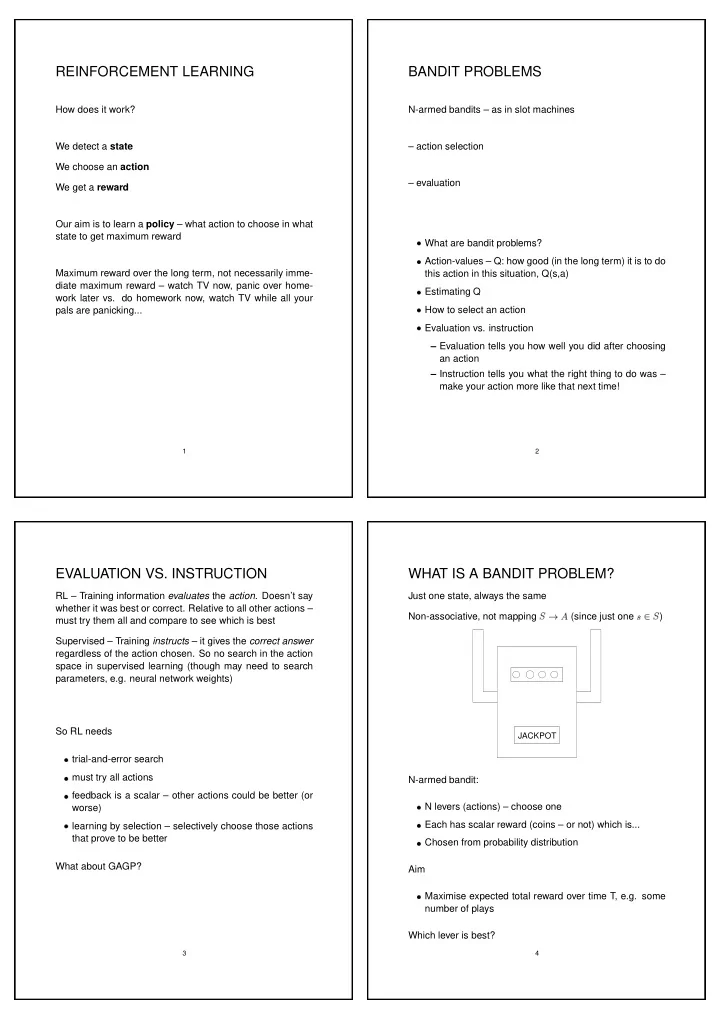
WHAT IS A BANDIT PROBLEM?
Just one state, always the same Non-associative, not mapping
✁✄✂✆☎(since just one
✝✟✞ ✁ )JACKPOT
N-armed bandit:
N levers (actions) – choose one Each has scalar reward (coins – or not) which is... Chosen from probability distributionAim
Maximise expected total reward over time T, e.g. somenumber of plays Which lever is best?
4