Regulating Murals: Legal Parameters to Consider Federal Law: United - - PDF document

regulating murals
SMART_READER_LITE
LIVE PREVIEW

Regulating Murals: Legal Parameters to Consider Federal Law: United - - PDF document

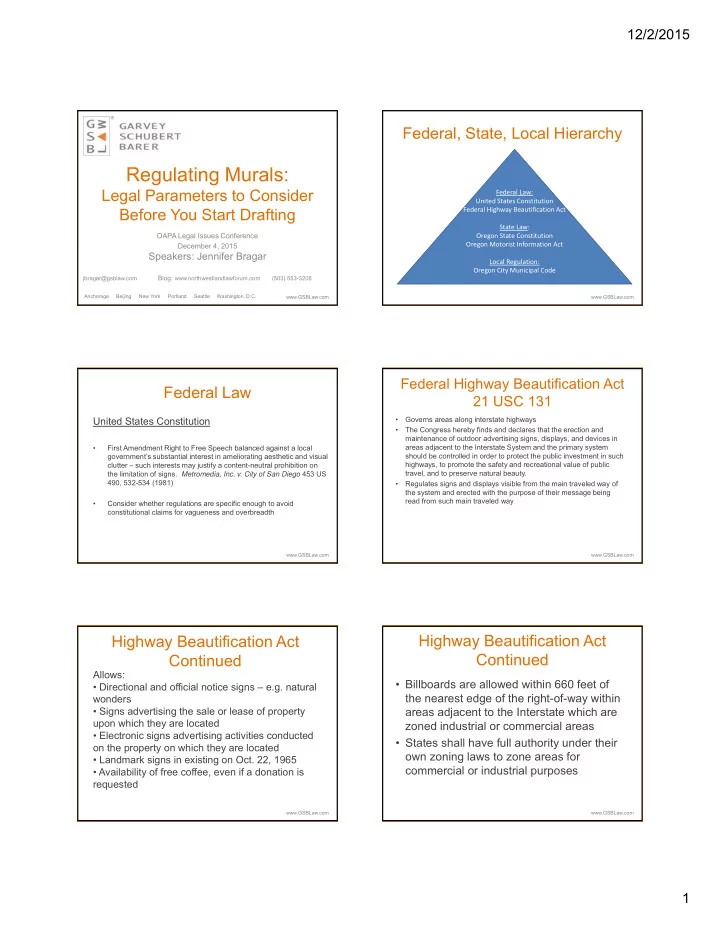
12/2/2015 Federal, State, Local Hierarchy Regulating Murals: Legal Parameters to Consider Federal Law: United States Constitution Before You Start Drafting Federal Highway Beautification Act State Law: OAPA Legal Issues Conference Oregon State


slide-1
SLIDE 1

12/2/2015 1

www.GSBLaw.com Anchorage Beijing New York Portland Seattle Washington, D.C.

Regulating Murals:

Legal Parameters to Consider Before You Start Drafting

OAPA Legal Issues Conference December 4, 2015

Speakers: Jennifer Bragar

jbragar@gsblaw.com

Blog: www.northwestlandlawforum.com

(503) 553-3208

www.GSBLaw.com

Federal, State, Local Hierarchy

Federal Law: United States Constitution Federal Highway Beautification Act State Law: Oregon State Constitution Oregon Motorist Information Act Local Regulation: Oregon City Municipal Code

www.GSBLaw.com

Federal Law

United States Constitution

  • First Amendment Right to Free Speech balanced against a local

government’s substantial interest in ameliorating aesthetic and visual clutter – such interests may justify a content-neutral prohibition on the limitation of signs. Metromedia, Inc. v. City of San Diego 453 US 490, 532-534 (1981)

  • Consider whether regulations are specific enough to avoid

constitutional claims for vagueness and overbreadth

www.GSBLaw.com

Federal Highway Beautification Act 21 USC 131

  • Governs areas along interstate highways
  • The Congress hereby finds and declares that the erection and

maintenance of outdoor advertising signs, displays, and devices in areas adjacent to the Interstate System and the primary system should be controlled in order to protect the public investment in such highways, to promote the safety and recreational value of public travel, and to preserve natural beauty.

  • Regulates signs and displays visible from the main traveled way of

the system and erected with the purpose of their message being read from such main traveled way

www.GSBLaw.com

Highway Beautification Act Continued

Allows:

  • Directional and official notice signs – e.g. natural

wonders

  • Signs advertising the sale or lease of property

upon which they are located

  • Electronic signs advertising activities conducted
  • n the property on which they are located
  • Landmark signs in existing on Oct. 22, 1965
  • Availability of free coffee, even if a donation is

requested

www.GSBLaw.com

Highway Beautification Act Continued

  • Billboards are allowed within 660 feet of

the nearest edge of the right-of-way within areas adjacent to the Interstate which are zoned industrial or commercial areas

  • States shall have full authority under their
  • wn zoning laws to zone areas for

commercial or industrial purposes

slide-2
SLIDE 2

12/2/2015 2

www.GSBLaw.com

State Law

Oregon Constitution – Broad protection of free speech.

Article I, section 8, provides, in part, that “[n]o law shall be passed restraining the free expression of

  • pinion, or restricting the right to

speak, write, or print freely on any subject whatever[.]”

www.GSBLaw.com

Oregon Motorist Information Act (OMIA)

A person may not erect or maintain a sign visible to the traveling public from a state highway, except where permitted outside the right of way of a state highway, unless the sign complies with the provisions of ORS 377.505 to 377.540 and 377.700 to 377.840, and the rules adopted pursuant thereto. A person may not erect or maintain a sign on the right of way of a state highway, other than a traffic control sign or device.

www.GSBLaw.com

OMIA continued

ORS 377.723 requires an applicant for a sign permit along a state highway to submit an affidavit from the city that certifies the proposed sign would comply with all applicable ordinances, plans, rules and other requirements of the city.

www.GSBLaw.com

OMIA continued

State law imposes limitations on the form and size of signs for

  • utdoor advertising along state highways under ORS 377.745:

An outdoor advertising sign may not exceed: (a) A length of 48 feet; (b) A height, excluding foundation and supports, of 14 feet; or (c) A sign area of 825 square feet.

www.GSBLaw.com

OMIA continued

Particular rules govern the determination of dimensions depending on the type

  • f sign:

(a) Cutouts that project beyond the borders of an outdoor advertising sign shall be included in measuring the area of a sign, but not the height or length of a sign. The sign area of cutouts shall be no more than 20 percent of the area of the sign to which attached. (b) The limitations apply separately to each side of a back-to-back sign. (c) The size limitations apply separately to each sign forming a V-type sign. (d) The size limitations apply separately to each of the display surfaces on a tri-vision sign. The exception to the rules: A nonconforming outdoor advertising sign in existence on May 30, 2007, may continue to exceed the size limitations established in this section until the sign is reconstructed or relocated, at which time the sign must comply with the size limitations shown on the previous slide.

www.GSBLaw.com

Take Away

What kinds of regulations may the City adopt without running afoul of federal or state law? Reasonable time, place, and manner restrictions that are CONTENT NEUTRAL

slide-3
SLIDE 3

12/2/2015 3

www.GSBLaw.com

Content Neutral Defined

In general, the term “content neutral” means that a particular restriction on expression applies to all expression, regardless of its subject or content. For example, a law that prohibits all signs that interfere with drivers’ lines of sight near an intersection is “content neutral,” while a law that permits noncommercial signs (for example, political) but prohibits commercial signs is not content neutral. See Outdoor Media Dimensions, Inc. v. Department of Transportation, 340 Or. 275, 287 (2006).

www.GSBLaw.com

Additional Parameters

  • Taking us full circle back to the First

Amendment Protection, content neutral time, place, or manner restrictions must advance a significant government interest to be constitutional.

  • A city’s interest in its appearance and the

safety of the public are significant and well established.

www.GSBLaw.com

In the Context of Murals

  • A jurisdictions’ ownership of a mural may

allow some input on artistic aspects of murals

  • But to guarantee constitutionality aim for

content neutrality

www.GSBLaw.com

Please Contact Me With Questions

Jennifer Bragar

jbragar@gsblaw.com 503.553.3208