regarding a prescription, the RPh (c) drug-disease - - PDF document

regarding a prescription the rph
SMART_READER_LITE
LIVE PREVIEW

regarding a prescription, the RPh (c) drug-disease - - PDF document

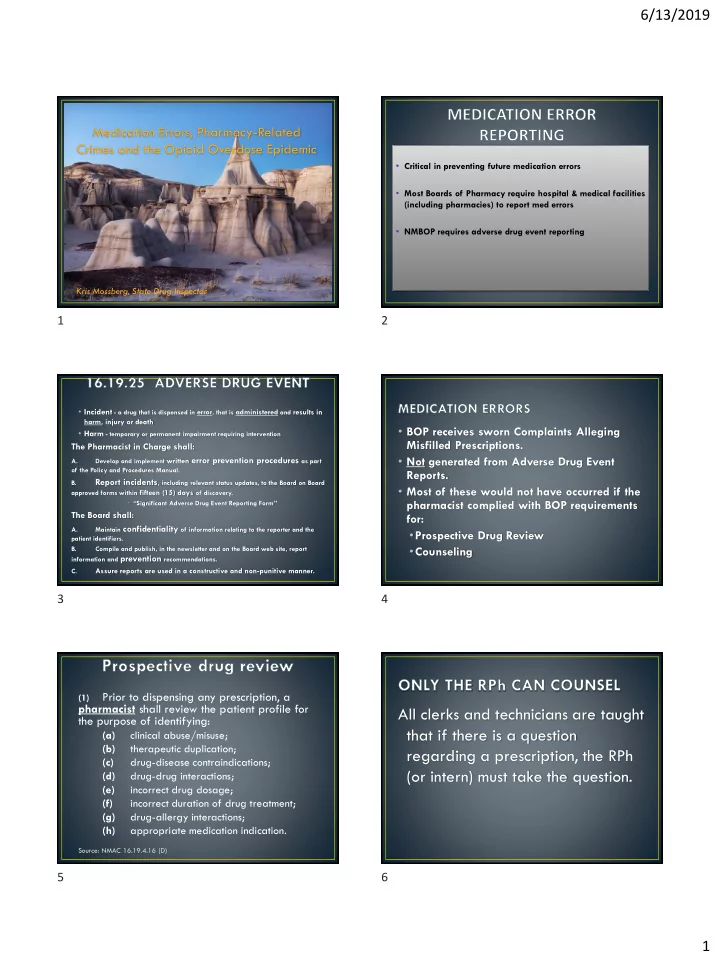
6/13/2019 Medication Errors, Pharmacy-Related Crimes and the Opioid Overdose Epidemic Critical in preventing future medication errors Most Boards of Pharmacy require hospital & medical facilities (including pharmacies) to report med


slide-1
SLIDE 1

6/13/2019 1

Medication Errors, Pharmacy-Related Crimes and the Opioid Overdose Epidemic

Kris Mossberg, State Drug Inspector

  • Critical in preventing future medication errors
  • Most Boards of Pharmacy require hospital & medical facilities

(including pharmacies) to report med errors

  • NMBOP requires adverse drug event reporting
  • Incident - a drug that is dispensed in error, that is administered and results in

harm, injury or death

  • Harm - temporary or permanent impairment requiring intervention

The Pharmacist in Charge shall:

A. Develop and implement written error prevention procedures as part

  • f the Policy and Procedures Manual.

B.

Report incidents, including relevant status updates, to the Board on Board

approved forms within fifteen (15) days of discovery.

  • “Significant Adverse Drug Event Reporting Form”

The Board shall:

A. Maintain confidentiality of information relating to the reporter and the patient identifiers. B. Compile and publish, in the newsletter and on the Board web site, report information and prevention recommendations. C.

Assure reports are used in a constructive and non-punitive manner.

  • BOP receives sworn Complaints Alleging

Misfilled Prescriptions.

  • Not generated from Adverse Drug Event

Reports.

  • Most of these would not have occurred if the

pharmacist complied with BOP requirements for:

  • Prospective Drug Review
  • Counseling

(1)

Prior to dispensing any prescription, a pharmacist shall review the patient profile for the purpose of identifying:

(a) clinical abuse/misuse; (b) therapeutic duplication; (c) drug-disease contraindications; (d) drug-drug interactions; (e) incorrect drug dosage; (f) incorrect duration of drug treatment; (g) drug-allergy interactions; (h) appropriate medication indication.

Source: NMAC 16.19.4.16 (D)

All clerks and technicians are taught that if there is a question regarding a prescription, the RPh (or intern) must take the question.

1 2 3 4 5 6

slide-2
SLIDE 2

6/13/2019 2

Patients need to know: ➢ The name of the medication ➢ How to take it ➢ What it’s for ➢ If the medication looks different, talk to the pharmacist

http://www.fda.gov/ForConsumers/ConsumerUpdates/ucm096403.htm accessed 6/3/16

➢Estimate: half of medication-related deaths could have been prevented by appropriate and timely counseling .* ➢Show the patient the drug while asking: 1) Tell me what you take this drug for? 2) Tell me how you take the medication?

  • how often, and
  • directions for taking the medication

http://www.uspharmacist.com/continuing_education/ceviewtest/lessonid/105916 *Abood RR. Errors in pharmacy practice. US Pharm. 1996;21(3):122-130.

  • Patients provide a major safety check

➢Counseling – not a “veiled offer”

➢ Wrong patient errors: Not opening the bag at the point of sale ➢ Risk of dispensing a correctly filled Rx to the wrong patient at POS – about 6 per month per (community) pharmacy

https://www.ismp.org/newsletters/acutecare/showarticle.aspx?id=91 10/9/2014, accessed 6/3/2016

  • the majority of medical errors are caused by

faulty systems, processes, and conditions that:

  • lead people to make mistakes
  • fail to prevent mistakes

When an error occurs, blaming an individual does little to make the system safer and prevent someone else from committing the same error.

  • Be compassionate

➢ISMP persistent safety gaffe #4 respond with empathy and concern

  • Evaluate and address medication use

system issues ➢Root cause analysis

https://www.ismp.org/newsletters/acutecare/showarticl e.aspx?id=91

  • Process for identifying the basic or causal factors

that underlie variation in performance, including the occurrence or risk of occurrence of a sentinel event.

  • Focus is on systems and processes, not individual

performance

  • Identifying root causes illuminates significant,

underlying, fundamental conditions that increase the risk of adverse consequences.

  • RCA facilitates system evaluation, analysis of

need for corrective action, tracking and trending

7 8 9 10 11 12

slide-3
SLIDE 3

6/13/2019 3

  • Source: NM Board of Pharmacy newsletter March 2013
  • 753 patients were diagnosed with fungal meningitis after receiving injections
  • f NECC’s preservative free MPA (methylprednisolone acetate). Out of 753

patients, 64 patients in nine states died

  • December 17, 2014 – United States attorney’s office charged owner and

head pharmacist Barry J. Cadden, and Glenn A. Chin, a supervisory pharmacist, with 25 acts of second-degree murder in seven states

  • Twelve other individuals, all associated with NECC, were charged with

additional crimes including racketeering, mail fraud, conspiracy, contempt, structuring, and violations of the Food, Drug and Cosmetic Act. (6 other pharmacists, 2 owners and 1 unlicensed technician)

https://www.justice.gov/usao-ma/pr/owner-new-england-compounding-center-sentenced-racketeering-leading- nationwide-fungal https://www.cdc.gov/hai/outbreaks/clinicians/index.html https://www.justice.gov/opa/pr/14-indicted-connection-new-england-compounding-center-and-nationwide- fungal-meningitis

Cadden directed and authorized the shipping of contaminated MPA to NECC customers nationwide - before test results confirming their sterility were returned, never notified customers of nonsterile results, and compounded drugs with expired ingredients. Cadden claimed to be dispensing drugs pursuant to valid, patient-specific prescriptions. In fact, NECC routinely dispensed drugs in bulk without valid prescriptions. NECC even used fictional and celebrity names on fake prescriptions to dispense drugs, such as “Michael Jackson,” “Freddie Mae” and “Diana Ross.” Chin improperly sterilized the MPA, failed to verify the sterilization process, and improperly tested it to ensure sterility. Despite knowing these deficiencies, Chin directed the MPA to be filled into thousands of vials and shipped to NECC customers nationwide. Chin directed the shipping of drugs prior to receiving test results confirming their sterility, and he directed NECC staff to mislabel drugs to conceal this practice. He also directed the compounding of drugs with expired ingredients, including chemotherapy drugs that had expired several years prior. Chin forged cleaning logs, and routinely ignored mold and bacteria found inside the clean rooms.

https://www.fda.gov/ICECI/CriminalInvestigations/ucm594800.htm https://www.fda.gov/ICECI/CriminalInvestigations/ucm564768.htm

  • Putting on gowning apparel in a way that may cause the

gowning apparel to become contaminated

  • Leaving the cleanroom and re-entering from a non-classified

area without first replacing gowning apparel

  • Performing aseptic manipulations outside of a certified ISO 5

area

  • Failing to disinfect containers of sterile drug components or

supplies immediately prior to opening

  • Lack of adequate routine environmental monitoring - nonviable

airborne particulate sampling; viable airborne sampling; and surface sampling, including but not limited to equipment, work surfaces, and room surfaces

  • Lack of adequate personnel sampling (including glove fingertip

sampling)

  • Lack of routine certification of the ISO 5 area, including smoke

studies performed under dynamic conditions

  • Lack of HEPA-filtered air, or inadequate HEPA filter coverage or

airflow, over the critical area

  • Buffer room or ISO 5 areas that contain overhangs or ledges

capable of collecting dust (pipes and window sills)

  • Failing to appropriately and regularly clean and disinfect (or

sterilize) equipment located in the ISO 5 area

  • Lack of disinfection of equipment and/or supplies at each transition

from areas of lower quality air to areas of higher quality

13 14 15 16 17 18

slide-4
SLIDE 4

6/13/2019 4

  • Vermin (e.g., insects, rodents) or other animals (e.g., dogs) in ISO 5 areas or

areas immediately accessible to production

  • Visible microbial growth (e.g., bacteria, mold) in the ISO 5 area or in

immediately adjacent areas

  • Sources of non-microbial contamination in the ISO 5 area (e.g., rust, glass

shavings, hairs, paint chips)

  • Performing aseptic manipulations outside of a certified ISO 5 area
  • Cleanroom areas with unsealed or loose ceiling tiles
  • Production of drugs while construction is underway in an adjacent area
  • Consistent and frequent pressure reversals from areas of less clean air to areas
  • f higher cleanliness
  • Consumer protection program operated by NABP
  • Only 5% of online pharmacies reviewed by NABP are in

compliance with US pharmacy laws and practice standards

  • Rogue online drug sellers put consumers at risk:
  • Fillers used: dry wall and rat poison
  • Consumer’s financial and personal information stolen
  • Spam mail infect home computers with viruses
  • Counterfeit medications did not treat their medical condition and patients

have died

  • Every day, illicit online pharmacy operators create

approximately 20 new websites worldwide.

  • Of 30,000 to 35,000 illicit online pharmacies, 96%

(globally and in the US) fail to adhere to applicable legal requirements.

  • 92% of those operating illegally are doing so in a blatantly

illicit manner – e.g. as the sale of prescription drugs without a valid prescription.

  • Among the 92% of “blatantly illicit” online pharmacies,

about 9% are selling controlled‐substance prescription drugs India was the most common point of

  • rigin for the drug shipments.

Other countries included Germany, Singapore, the US, Canada, and The UK, although they were not always the original source of the drugs.

  • EVApharmacy largest illegal online pharmacy network has

from 3,000 to 10,000 online pharmacies at one time that sell prescription drugs without a prescription. Tries to persuade customers that is it is a safe Canadian online pharmacy but is primarily run out of Russia and Eastern Europe

  • Evapharmacy hijacked reynoldsdrug.com and retained the

pharmacy’s address and branding, orders placed on the website are filled by EVApharmacy with drugs being shipped from Pakistan and China

19 20 21 22 23 24

slide-5
SLIDE 5

6/13/2019 5

  • Verified Internet Pharmacy Practice Sites (VIPPS) enables

consumers to confidently access legitimate internet pharmacies

  • https://nabp.pharmacy/programs/vipps/vipps-accredited-

pharmacies-list/

  • What is diversion?
  • Definition: Transfer of a prescription drug

from a lawful to an unlawful channel of distribution or use.

Check Patient PMP Reports Keep E-alerts

  • A RPh Shall request and review a PMP report if (at least 1

year time period):

  • PERSON EXHIBITS POTENTIAL ABUSE/MISUSE OF

OPIATES

  • OVER-UTILIZATION
  • EARLY REFILLS
  • MULTIPLE PRESCRIBERS
  • SEDATED/INTOXICATED
  • UNFAMILIAR PATIENT
  • PAYING CASH INSTEAD OF INSURANCE
  • A RPh Shall request and review a PMP report if

(at least 1 year time period):

  • OPIATE Rx FROM UNFAMILIAR PRACTITIONER
  • OUT OF STATE OR USUAL GEOGRAPHIC

AREA

  • OPIATE Rx FROM UNFAMILIAR PATIENT
  • OUTSIDE USUAL PHARMACY

GEOGRAPHIC PATIENT POPULATION AREA

25 26 27 28 29 30

slide-6
SLIDE 6

6/13/2019 6

  • A RPh Shall request and review a PMP report if (at

least 1 year time period):

  • INITIAL RX FOR ANY LONG-ACTING OPIOID

FORMULATION

  • INCLUDES ORAL AND TRANSDERMAL DOSAGE

FORMS

  • BECOME AWARE PATIENT IS RECEIVING AN OPIOID

CONCURRENTLY WITH A BENZODIAZEPINE OR CARISOPRODOL.

  • WHAT ARE THE FOLLOWING

PRESCRIPTIONS?

  • STOLEN Rx FORMS
  • PHOTOCOPIED/SCANNED PRESCRIPTIONS
  • COMPUTER GENERATED PRESCRIPTIONS
  • April 29, 2015 - Six Albuquerque Residents Indicted on

Federal Robbery, Firearms, and Prescription Drug Trafficking Crimes Arising Out of Pharmacy Robberies –FBI.gov

  • 3 fugitives at time of indictment
  • Last suspect (Blake Gallardo) was arrested June 11, 2015
  • Stole over 68,000 tablets of oxycodone

Pharmacy Safety

31 32 33 34 35 36

slide-7
SLIDE 7

6/13/2019 7

RXPATROL.COM RxPATROL.COM

RxPATROL.COM

Robbery Awareness Training Sergeant Lowe clowe@cabq.gov

37 38 39 40 41 42

slide-8
SLIDE 8

6/13/2019 8

43 44 45 46 47 48

slide-9
SLIDE 9

6/13/2019 9

  • For each year, rates were significantly higher for males than females. For

males, the rate increased from 8.2 in 1999 to 29.1 in 2017. For females, the rate increased from 3.9 in 1999 to 14.4 in 2017. SOURCE: NCHS, National Vital Statistics

System, Mortality.

  • Amount of prescription painkillers dispensed in the U.S. quadrupled between 1999 and 2013
  • Deaths from prescription painkillers have also quadrupled since 1999, killing more than 16,000 people in the

U.S. in 2013.1

  • Nearly two million Americans, aged 12 or older, either abused or were dependent on opioids in 2013

http://www.cdc.gov/drugoverdose/epidemic/riskfact

  • rs.html

49 50 51 52 53 54

slide-10
SLIDE 10

6/13/2019 10

New Mexico Prescription Drug Overdose Epidemic

The State of New Mexico compared to the United States average ➢ In 2014, New Mexico had the second highest drug overdose death rate (27.3 deaths per 100,000 age-adjusted population). ➢ In 2015, New Mexico had the eighth highest drug overdose death rate (25.3 deaths per 100,000 age-adjusted population). ➢ In 2016, New Mexico had the twelfth highest drug overdose death rate (25.2 deaths per 100,000 age-adjusted population). ➢ In 2017, New Mexico had the seventeenth highest drug overdose death rate (24.8 deaths per 100,000 age-adjusted population). Other States: WV, OH, PA, KY, NH, DE, MD, ME, MA, RI, CT, NJ, IN, MI, TN, FL 52.0 39.1 39.0 38.8 37.9 33.5 33.2 33.0 30.8 30.8 28.7 27.4 25.2 24.5 24.4 32.0 18.9 13.4 12.6 19.0 25.0 13.7 12.7 18.2 15.2 11.5 12.1 24.7 17.6 13.5 10 20 30 40 50 60 West Virginia Ohio New Hampshire District of Columbia Pennsylvania Kentucky Maryland Massachusetts Rhode Island Delaware Maine Connecticut New Mexico Tennessee Michigan Deaths per 100,000 population age adjusted

Drug Overdose Death Rate 2012 and 2016 by State

Source: National Center for Health Statistics, CDC, via CDC Wonder

Although New Mexico has been progressing, NM is still statistically higher compared to the United States drug overdose death rate average (21.7 deaths per 100,000)

Source: NCHS Data Brief, Number 294, December 2017

55 56 57 58 59 60

slide-11
SLIDE 11

6/13/2019 11

20 40 60 80 100 120

  • xycodone

alprazolam fentanyl hydrocodone methadone diazepam clonazepam morphine lorazepam tramadol zolpidem Overdose death involvements

Top Rx Drugs in Overdose Death, NM, 2016

Deaths may involve more than one drug Source: NM Office of the Medical Investigator

61 62 63 64 65 66

slide-12
SLIDE 12

6/13/2019 12

Source: NM Substance Abuse Epidemiology Profile November 2017 (NM DOH, page 34 chart 3)

<24.6 24.6-36.9 ≥36.9

Source: NM Substance Abuse Epidemiology Profile February 2017 (NM Department of Health, page 36 chart 5)

0.00 2.00 4.00 6.00 8.00 10.00 12.00 14.00 16.00 18.00 Risk relative to <=20 Average Daily Dose (total MME/total days in 6 months)

Relative Risk of Prescription OD Death by Opioid Dose level, NM 2007-2011

Slide Credit: James Davis, MA, Drug Epidemiologist, NM DOH

67 68 69 70 71 72

slide-13
SLIDE 13

6/13/2019 13

0.00 10.00 20.00 30.00 40.00 50.00 60.00 70.00 80.00 90.00 100.00 Relative Risk to <=20 MME, <30 days Average dose level (morphine equivalents, MME)

Relative Risk of Rx OD Death by Opioid Dose and Days Prescribed in 6 months

160+ days 90-159 days 30-89 days <30 days Slide Credit: James Davis, MA, Drug Epidemiologist, NM DOH 5 10 15 20 25 30 35 40 none 1-9 10-29 30-89 90+ Risk relative to None Days of Overlap in 6 mo (different prescribers)

Relative Risk of Rx opioid OD Death by days of overlap

Opioid

Slide Credit: James Davis, MA, Drug Epidemiologist, NM DOH

0.00 5.00 10.00 15.00 20.00 25.00 30.00 35.00 40.00 45.00 None <10 d 10-29d 30-89d 90+d Risk relative to None Opioid-Sedative/Hypnotic overlap days in 6 months

Relative risk of OD death with Opioid/sedative- hypnotic overlap, NM 2007-2011

Prescription Drug OD Illicit Drug OD Slide Credit: James Davis, MA, Drug Epidemiologist, NM DOH

  • Long term use of opioids (≥ 90 days)
  • High doses of opioids (≥ 90 MME/day)
  • Overlapping prescriptions of opioids from

different prescribers

  • Multiple Provider Episodes ( MPE: Doctor and

pharmacy shopping)

  • The combination of opioids and sedative-

hypnotics

  • The combination of opioids, benzodiazepines

and muscle relaxants

73 74 75 76 77 78

slide-14
SLIDE 14

6/13/2019 14

In NM, the rate of Neonatal Abstinence Syndrome increased 324% between 2008 (3.3 per 1,000 livebirths) and 2017 (14.0). In the US, the rate increased by 207% between 2008 (2.8) and 2016 (8.6) (Figure 1).

Saavedra, L.G. Epidemiology and Response Division New Mexico Department of Health. New Mexico Epidemiology. 2018. 10

  • Estimate of the number of people in NM in 2017Q2 who are

chronic prescription opioid users, and may need treatment (22% of chronic prescription opioid patients)* = 12,400

  • Cost per year per person misusing opioids estimate*** =

$46,970

  • Estimated annual cost of prescription opioid misuse to NM

= $582,000,000

Data Sources: NM Board of Pharmacy Prescription Monitoring Program; NMDOH Harm Reduction Syringe Services Program * Vowles, K. E., McEntee, M. L., Siyahhan Julnes, P., Frohe, T., Ney, J. P., & van der Goes, D. N. (2015). Rates of opioid misuse, abuse, and addiction in chronic pain: A systematic review and data

  • synthesis. Pain, 156, 569-576.

Note: The Winsorized mid point (min+max)/2 was used as a proxy for the number of people who have potentially problematic prescription opioid use. From: Florence et al, The Economic Burden of Prescription Opioid Overdose, Abuse, and Dependence in the United States, 2013, Medical Care, Volume 54, Number 10, October 2016

High Risk Prescribing and PMP Usage over Time, NM, 2015-2017

Source: New Mexico Board of Pharmacy Prescription Monitoring Program Data

2015 Q2 2016 Q2 2017 Q2 % Change 2015Q2- 2017Q2 High Dose Prescriptions (>=90 MME/day) 57,801 53,462 46,358

  • 20%

Chronic Opioid Patients 55,663 56,240 55,783 0% Concurrent Opioids and Benzodiazepines 29,059 27,182 24,240

  • 17%

Multiple Provider Patients (4 prescribers

  • r 4 pharmacies in 3 months)

5,156 4,133 3,647

  • 29%

%Chronic Opioid Patients with a PMP check 41% 47% 56% 37% %New Opioid Patients with a PMP check 7% 9% 14% 82%

OPIOID OVERDOSE EPIDEMIC RESPONSE

  • expands upon the Administration’s National

Drug Control Strategy and includes action in four major areas to reduce prescription drug abuse:

  • Education
  • Tracking and monitoring
  • Proper medication disposal
  • Enforcement

Source: Epidemic: Responding to America’ s Prescription Drug Abuse Crisis; Executive Office of the President

  • f the United States; 2011; http://www.whitehouse.gov/sites/default/files/ondcp/policy-and-

research/rx_abuse_plan.pdf

79 80 81 82 83 84

slide-15
SLIDE 15

6/13/2019 15 Prescription Drug Abuse: Strategies to Stop the Epidemic

October 2013

Key recommendations

  • Educate the public to understand the risks of Rx drug use to

avoid misuse in the first place;

  • Ensure responsible prescribing practices, including increasing

education of healthcare providers and prescribers to better

understand how medications can be misused and to identify patients in need of treatment;

  • Increase understanding about safe storage of medication and

proper disposal of unused medications, such as through "take

back" programs;

  • Make sure patients do receive the pain and other medications they

need, and that patients have access to safe and effective

drugs

http://healthyamericans.org/reports/drugabuse2013/

  • 23% Report having abused Rx medications at least once in their

lifetime.

  • More than half of teens (73%) indicate that it’s easy to get

prescription drugs from their parent’s medicine cabinet

  • Almost four in 10 teens (38%) who have misused or abused a

prescription drug obtained it from their parent’s medicine cabinet

  • Source U.S. Drug Enforcement Administration 2013 Partnership Attitude Tracking Study,

published 7/23/14

Source: SAMHSA, Center for Behavioral Health Statistics and Quality, NSDUH, 2013 and 2014. (http://pdas.samhsa.gov/saes/state#, 1/8/18)

Past 30-day Painkiller Use to Get High Grades 9-12, New Mexico, 2007-2015

Source: Prescription Painkiller Overdoses in the US; CDC; Nov 2011

85 86 87 88 89 90

slide-16
SLIDE 16

6/13/2019 16

  • Laws Requiring a Physical Examination before Prescribing*
  • Laws Requiring Tamper-Resistant Prescription Forms
  • Laws Regulating Pain Clinics
  • Laws Setting Prescription Drug Limits*
  • Laws Prohibiting “Doctor Shopping”/Fraud* - general language
  • Laws Requiring Patient Identification before Dispensing*
  • Laws Providing Immunity from Prosecution/Mitigation at

Sentencing for Individuals Seeking Assistance During an Overdose*

Source: http://www.cdc.gov/HomeandRecreationalSafety/Poisoning/laws/state/index.html *NM has law in this category

  • In 2001, New Mexico - first state to amend its

laws to make it easier for medical professionals to provide naloxone, and for lay administrators to use it without fear of legal repercussions.

  • In 2007, New Mexico - first state to amend its

laws to encourage Good Samaritans to summon aid in the event of an overdose. Provides criminal immunity for both the person in need and the person who sought help.

  • Source: Legal Interventions to Reduce Overdose Mortality: Naloxone Access and Overdose Good Samaritan Laws; The Network for Public Health Law May 2013

➢March 2016, SB 262 / HB 277 signed into law : significantly expanded naloxone access (possess, store, distribute, prescribe, administer). NMSA 24-23-1 ➢Naloxone standing orders (issued NM DOH March 2016) ➢Any person acting under a standing order issued by a licensed prescriber may store or distribute an opioid antagonist ➢A licensed prescriber may directly or by SO prescribe, dispense, or distribute an opioid antagonist to (several categories)

Sources: SB 262, HB 277; Legal Interventions to Reduce Overdose Mortality: Naloxone Access and Overdose Good Samaritan Laws; The Network for Public Health Law May 2013

Source: The Network for Public Health Law, last updated July 2015

  • From SAMHSA website 03/01/2019

91 92 93 94 95 96

slide-17
SLIDE 17

6/13/2019 17

97