April 2018 Teri Rolan RPh NW Cathleen Wingert Public Chris - - PDF document

april 2018
SMART_READER_LITE
LIVE PREVIEW

April 2018 Teri Rolan RPh NW Cathleen Wingert Public Chris - - PDF document

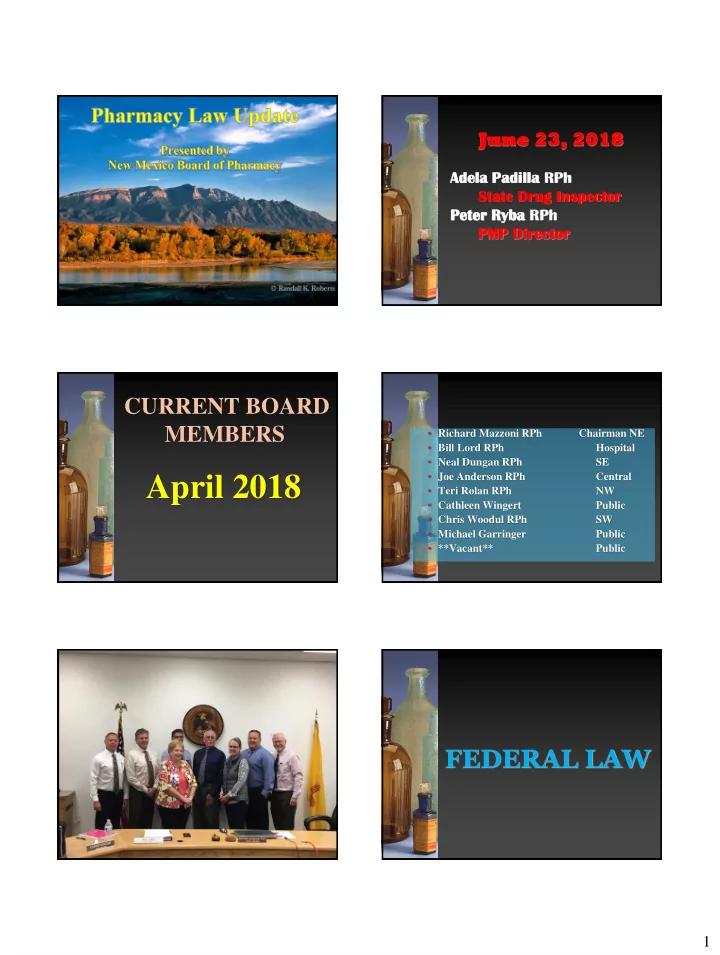
June e 23, 2018 23, 2018 Adela Padilla RPh State Drug Inspe pecto tor Peter Ryba RPh PMP Directo tor CURRENT BOARD MEMBERS Richard Mazzoni RPh Chairman NE Bill Lord RPh Hospital Neal Dungan RPh SE Joe Anderson RPh


slide-1
SLIDE 1

1

June e 23, 2018 23, 2018

Adela Padilla RPh State Drug Inspe pecto tor Peter Ryba RPh PMP Directo tor

CURRENT BOARD MEMBERS

April 2018

  • Richard Mazzoni RPh

Chairman NE

  • Bill Lord RPh

Hospital

  • Neal Dungan RPh

SE

  • Joe Anderson RPh

Central

  • Teri Rolan RPh

NW

  • Cathleen Wingert

Public

  • Chris Woodul RPh

SW

  • Michael Garringer

Public

  • **Vacant**

Public

FEDERAL LAW

slide-2
SLIDE 2

2

Drug Disposal

  • Secure and Responsible Drug Disposal Act
  • The goal of this Act is to allow for the collection

and disposal of Controlled Substances in a secure, convenient, and responsible manner

  • Also reduces diversion and the introduction of

some potentially harmful substances into the environment

  • Drug Take-Back events began in September

2010.

  • The DEA has sponsored 15 total take-back

events

  • Most recently on April 28, 2018
  • October 28, 2017
  • Record setting amount of 456 tons collected
  • Previous record 450 tons in April 2017
  • Total collection of 9,015,668 pounds

DEA Drug Take-Back Events

Current Drug Disposal Information DEA.gov

slide-3
SLIDE 3

3

Controlled Substance Disposal Locations

12-01-17 DEA.GOV

Next National Take-Back

  • Late September to October 2018
  • Check back on DEA website to locate

collection sites starting September 1, 2018

  • To find an authorized collector in your area

call DEA Office at 800-882-9539

slide-4
SLIDE 4

4

Syringe Disposal

safeneedledisposal.org

CONTACT INFO

  • DEA Office for Northern NM
  • 2660 Fritts Crossing SE

Albuquerque, NM 87106

  • Diversion Number: (505) 452-4500

Diversion Fax: (505) 873-9921

CONTACT INFO

  • DEA Office for Southern NM
  • 660 Mesa Hills Drive, Suite 2000

El Paso, TX 79912

  • Las Cruces (575)526-0700
  • El Paso

(915)832-6000

MORE FROM DEA

slide-5
SLIDE 5

5

STILL MORE FROM DEA

  • DEA Updates the electronic 106 Form for

Reporting Theft or Loss of Controlled Substances

  • Requires registrants to include the NDC

which will help to accurately track controlled substances reported as stolen or lost

  • Required to report a “Significant Loss”

What is Significant?

According to the DEA . . .

  • What constitutes a significant loss for one

registrant may be construed as insignificant for another

  • “. . . the repeated loss of small quantities of

controlled substances over a period of time may indicate a significant aggregate problem that must be reported to DEA, even though the individual quantity of each occurrence is not significant.”

NMBOP Definition

  • Significant Loss: includes suspected

diversions, in-transit losses or any other unexplained loss and must be reported to the Board of Pharmacy within five (5) days

  • f becoming aware of that loss

16.19.20.36B

E-PRESCRIBING UPDATE

  • All electronically transmitted

controlled substance prescriptions are valid

  • Includes Schedule II
  • Please do not reject a C-II Rx

because it is an E-prescription

DEA Issues Policy Statement on Role of Agents in Communicating CS Prescriptions

Drug Enforcement Administration (DEA) issued a statement of policy that clarifies the proper role of a duly authorized agent of a DEA-registered individual practitioner in communicating controlled substance (CS) prescription information to a pharmacy. The statement, published October 6, 2010, in the Federal Register, reminds health care providers that a prescription for a CS medication must be issued by a DEA-registered practitioner acting in the usual course

  • f professional practice.
slide-6
SLIDE 6

6

DEA Issues Policy Statement on Role of Agents in Communicating CS Prescriptions

  • An authorized agent may prepare the prescription. . .

for the signature of that DEA-registered practitioner.

  • For a Schedule III–V drug, an authorized agent may

transmit a practitioner-signed prescription to a pharmacy via facsimile, or orally to a pharmacy on behalf of the practitioner.

  • An authorized agent may transmit by facsimile a

practitioner-signed Schedule II prescription for a patient in a hospice or long-term care facility (LTCF)

  • n behalf of the practitioner.

EMPLOYMENT SCREENING

  • According to DEA regulations:

– A pharmacy registrant (i.e., the registrant or corporation which owns the pharmacy) must not employ in a position which allows access to controlled substances, anyone who has been convicted of a felony relating to controlled

  • substances. . .

C.F.R. Section 1301.76 Other security controls for practitioners.

NMCourts.gov CIII-V Partial Refilling

  • Partial filling is allowed provided that:

– Quantities are < prescribed – Total quantity on all partial refills does not exceed the total quantity prescribed – No dispensing occurs after 6 months from written date

CFR 1306.23

Controlled Substance Prescription Transfer

  • CFR 1306.25 Transfer between

pharmacies

– (a) The transfer of original prescription information for a controlled substance listed in Schedule III, IV, or V for the purpose of refill dispensing is permissible between pharmacies on a one-time basis only. However, pharmacies electronically sharing a real-time, online database may transfer up to the maximum refills permitted by law and the prescriber's authorization.

1306.25(a) 05-12-17

slide-7
SLIDE 7

7

  • An unfilled original EPCS prescription can

be forwarded from one DEA registered retail pharmacy to another DEA registered retail pharmacy, and this includes Schedule II controlled substances

Controlled Substance Prescription Transfer

Added 02-19-18

CARA ACT 2016

  • The Comprehensive Addiction and Recovery Act

(CARA)

  • Signed into law by President Obama on July 22,

2016

  • First major federal addiction legislation in 40

years and the most comprehensive effort to address the opioid epidemic.

CARA ACT 2016

  • Summary of Provisions of CARA
  • Expand prevention and educational efforts—particularly aimed at teens, parents and other caretakers, and aging

populations—to prevent the abuse of methamphetamines, opioids and heroin, and to promote treatment and recovery.

  • Expand the availability of naloxone to law enforcement agencies and other first responders to help in the reversal
  • f overdoses to save lives.
  • Expand resources to identify and treat incarcerated individuals suffering from addiction disorders promptly by

collaborating with criminal justice stakeholders and by providing evidence-based treatment.

  • Expand disposal sites for unwanted prescription medications to keep them out of the hands of our children and

adolescents.

  • Launch an evidence-based opioid and heroin treatment and intervention program to expand best practices

throughout the country.

  • Launch a medication-assisted treatment and intervention demonstration program.
  • Strengthen prescription drug monitoring programs to help states monitor and track prescription drug diversion

and to help at-risk individuals access services.

CARA ACT 2016

  • Title VII: Sec. 702 of the CARA ACT of 2016

– Partial Fills of Schedule II Controlled Substances: Amends the Controlled Substances Act by allowing schedule II substances to be partially filled if certain conditions and restrictions are met.

  • Title VIII: Sec. 303 of the CARA ACT of 2016

– Medication-assisted treatment for recovery from addition: NPs and PAs who have completed 24 hours of required training may seek a DATA 2000 waiver for up to 30 patients to prescribe BUPRENORPHINE.

  • Complete bill language available at

https://www.congress.gov/114/plaws/publ198/PLAW- 114publ198.pdf

PHARMACY COMPOUNDING

  • HR 3204
  • The Drug Quality and Security Act
  • Became public law on November

27, 2013

The Drug Quality and Security Act (H.R. 3204)

  • This legislation distinguishes

compounders engaged in traditional pharmacy practice from those making large volumes of compounded drugs without individual prescriptions.

slide-8
SLIDE 8

8

The Drug Quality and Security Act (H.R. 3204)

  • State pharmacy boards regulate traditional pharmacy

compounding

  • FDA registration as an Outsourcing Facility

– Compounding of sterile drugs – Elected to register as an outsourcing facility – Not required to be a licensed pharmacy, but compounding must be done by or under direct supervision of a pharmacist – May or may not obtain prescriptions for individual patients

  • Providers and patients would have the option of

purchasing products from outsourcing facilities that comply with FDA quality standards.

New Mexico Law & Board Activity

PHARMACY COMPOUNDING

  • A pharmacy may compound a patient-

specific sterile preparation pursuant to a prescription or order for an individual patient.

  • Preparation of non-patient specific

compounded sterile product for sale is considered manufacturing, and requires registration with the FDA and the NM Board

  • f Pharmacy as an outsourcing facility.

Compounded Sterile Preparations

  • Must be compounded properly in accordance

with all USP chapters

  • Currently USP <797>
  • USP <800> effective on December 1, 2019

– Hazardous compounding must be done in a negative pressure room – Can no longer have hazardous and non-hazardous compounding in the same room

16.19.36

Repackaging and Distribution by a Pharmacy

  • Pharmacy licensed by the board may repackage

under the following conditions:

– By a managing pharmacy for use in an automated drug distribution system of a licensed health care facility – To a clinic under the same ownership as the pharmacy – Must be repackaged into a sealed unit-dosed container with appropriate BUD, and properly labeled

16.19.6.30 11-28-17

slide-9
SLIDE 9

9

Ephedrine Reporting

  • OTC products containing Ephedrine shall

be reported as required of a pseudoephedrine containing product

– Shall submit electronically to the board or its agents every 7 days

16.19.17.7B 11-28-17

Examination Repeats

  • A candidate who fails either the NAPLEX or MPJE may

repeat that examination upon submittal of the proper application and fee. A candidate may not take either the NAPLEX or MPJE more than five consecutive times without passing. Failure to finish an examination is counted as an attempt. Candidates who fail or do not complete the NAPLEX shall wait a period of at least 45 days prior to retaking the examination. Candidates who fail or do not complete the MPJE shall wait a period of at least 30 days prior to retaking the examination.

16.19.2.9 06-23-17

Prescriptive Authority Expanded

  • Pharmacist prescriptive authority was expended to

add Hormonal Contraception Drug Therapy

  • Prescriptive authority is allowed following a

protocol approved by the NM Medical Board, NM Board of Nursing, and the Board of Pharmacy

16.19.26.14 06-09-17

CII Partial Refilling

  • A prescription for a controlled substance in

Schedule II may be partially filled if the total quantity dispensed in all partial fillings does not exceed the total quantity prescribed.

  • Remaining portions shall be filled not later than 30

days after the date on which the prescription is written.

16.19.20.46A 03-29-17

Controlled Substance Prescriptions

  • Expiration Dates

– All CS prescriptions now expire in 6 months – Non-Controlled

  • 12 months from the date written

16.19.20.45A,B Effective 10-16-16

Prescription Requirements

  • Shall verify the identity of the patient or

representative who is receiving any prescription for a CS before it is released

  • Current govt issued photo identification required,

and the documentation of: – Name – Number – Identification Type (DL, ID card, passport) – State (If applicable)

16.19.20.42G 10-16-16

slide-10
SLIDE 10

10

  • Inventory required for change of PIC

– All controlled substances – Must be taken within 72 hours by the new PIC – Shall document date, time, and open or close of business activity

  • Also required upon transfer of ownership of

a pharmacy

16.19.20.20E,F 10-16-16

Controlled Substance Inventory Records Automated Drug Distribution Systems

  • A managing pharmacy may use an automated drug

distribution system to supply medications for patients

  • f a health care facility
  • The system may be located in a health care facility that

is not at the same location as the managing pharmacy

  • Considered an extension of the managing pharmacy.
  • If the system contains controlled substances, the

managing pharmacy must submit and maintain a separate registration with the DEA

08-28-15 16.19.6.27

Prescription Transfers

  • A pharmacy may not refuse to transfer
  • riginal prescription information to another

pharmacy who is acting on behalf of a patient and who is making a request for this information

03-22-15 16.19.6.23D

Non-Sterile Compounding

  • The wording allowing for office use

compounding was removed from the regulation.

  • A pharmacy may no longer compound

for a prescriber’s office use.

06-14-13 16.19.30.9A(4) Removed

Board of Pharmacy Newsletter

  • Only utilizing an electronic version

published by the NABP

  • To subscribe, please go to

NABP.pharmacy

– Boards of Pharmacy

  • New Mexico

– Click on link to subscribe

  • Enter email, first and last name
  • PHI items must be shredded or otherwise

altered so that confidential patient information does not end up discarded unaltered

Protected Health Information

slide-11
SLIDE 11

11

CPE Requirements

  • REG PART 4 – PHARMACIST
  • Effective January 1, 2013, pharmacist

and pharmacist clinician renewal applications shall document:

ACPE UNIVERSAL ACTIVITY NUMBER

B: Both

CPE Requirements

  • REG PART 4 – PHARMACIST
  • 1. A MINIMUM of 10 hours

(EXCLUDING LAW CE) shall be

  • btained thru “Live Programs”
  • 2. ACPE, ACCME OR BOARD

APPROVED

CPE Requirements

  • REG PART 4 – PHARMACIST
  • 3. A minimum of 0.2 CEU (2 contact

hours) per renewal period shall be in the area of PATIENT SAFETY as applicable to the practice of pharmacy

CPE Requirements

  • REG PART 4 – PHARMACIST
  • 4. A minimum of 0.2 CEU ( 2

contact hours) per renewal period shall be in the subject area pharmacy law offered by the N.M. board of pharmacy

CPE Requirements

  • REG PART 4 – PHARMACIST
  • Effective January 1, 2015, a

minimum of 0.2 CEU (2 contact hours) per renewal period shall be in the area of safe and appropriate use of opioids.

slide-12
SLIDE 12

12

CPE Requirements

  • REG PART 4 – PHARMACIST
  • Live Programs

–CPE activities that provide for direct interaction between faculty and participants and may include lectures, symposia, live teleconferences, and workshops.

Immunization Renewal

  • Pharmacists who exercise their right to

prescribe vaccines must receive an additional 0.2 CEU of live ACPE approved vaccine related continuing education every 2 years

  • In addition to the required 30

CPE Requirements

  • 30 Total Hours Required

– 10 Hours of Live Programs – 2 Hours Patient Safety (Applicable to Pharmacy) – 2 Hours Pharmacy Law – 2 Hours Safe and Appropriate Use of Opioids

  • – CEs obtained for Immunization Certification,

Smoking Cessation, Naloxone etc. are in addition to the 30 hour requirement (16.19.26)

CPE Requirements

  • PHARMACIST CLINICIAN:
  • Effective January 1, 2015, a Pharmacist

Clinician with a controlled substance registration to prescribe controlled substances listed in Schedule II or Schedule III shall complete a minimum of 0.2 CEU (2 contact hours) per renewal period in the subject area of responsible opioid prescribing practices.

16.19.4.17C

CPE Requirements

  • PHARMACIST CLINICIANS
  • Educational programs approved by the

New Mexico Medical Board in the subject area of opioid prescribing shall meet the requirements of this section. These hours are included with the 20 required live CE hours.

CPE Requirements

  • PHARMACIST

– Allows CPE programs that are approved by other state boards of pharmacy to count toward your New Mexico pharmacist renewal

16.19.4.10A

slide-13
SLIDE 13

13

CPE Requirements

  • Pharmacists and pharmacist

clinicians without sufficient documentation of completion of CPE requirements shall:

CPE Requirements

  • Be subject to a fine of not less than

$1,000

  • Be required to complete the

deficient CPE in a satisfactory time period as determined by the board

16.19.4.10F

Pharmacist Clinician

  • Prohibit prescribing for themselves or

immediate family members, except under emergency situations.

  • Does not apply to meds under 16.19.26

(Vaccines, tobacco cessation, naloxone, TB testing)

  • Prohibited from referring a patient for the use
  • f medical cannabis

04-18-13 16.19.4.17D

Pharmacist Clinician: PMP

  • Shall register with the PMP
  • May authorize delegate(s) but is solely responsible

for reviewing PMP and documentation of medical record

  • 1st rx written for over a 4 day supply for a CII, III,

IV require PMP review OR if there is a gap in prescribing the CS for 30 days or more.

  • Other regs for utilizing PMP reports for

continuous use of CS

(With Prescriptive Authority for CS)

16.19.4.17F 10-14-16

Pharmacy Technicians

  • Non-Certified Technician

– Registration expires after 1 year – Cannot be renewed – Exception: Technician that is enrolled in a board recognized technician training program.

16.19.22.9E

Pharmacy Technicians

  • MUST be registered PRIOR to working

as a pharmacy technician

  • Pharmacy Techs that are being allowed to

work after their registration has expired may result in disciplinary action against the supervising pharmacist as well as the pharmacist-in-charge

16.19.22.11A

slide-14
SLIDE 14

14

Pharmacist

  • ACTIVE STATUS

Any pharmacist who maintains competency through the development and maintenance of knowledge, skill and aptitude, to ensure continuing competence as a pharmacy professional, and is able to demonstrate to the board said competence in the practice of pharmacy shall be issued an active license.

16.19.4.14

Pharmacy Technicians

  • The permissible ratio of pharmacy

technicians to pharmacists on duty is to be determined by the Pharmacist-In- Charge

16.19.22.10

Support Personnel

  • Allow support personnel (who are not

pharmacy technicians) to place prescription drugs on the pharmacy shelf, in bins, or in a dispensing technology system in sites that utilize a barcode verification…

  • Excludes the direct processing and filling of

prescriptions

16.19.22.7H

Controlled Substances

  • Pseudoephedrine Sales
  • The board is authorized to contract

with another agency for collection of data.

  • New Mexico Methamphetamine

Special Information System (NMMSIS) – Brian Sallee

16.19.20.53B 06-20-13

NMMSIS CONTACTS

  • Batch File Upload:

– https://secure.nmhidta.org

  • Direct Data Entry:

– www.nmmsis.org

  • Joe Herrera, NM HIDTA

– jherrera@nmhidta.org

  • Todd Thacker, NM HIDTA

– tthacker@nmhidta.org

  • Detective Brian Sallee, APD

– bsallee@cabq.gov

Limited Drug Clinics

  • Public Health Clinic Licensure

– (d) Class D clinic drug permit for school health

  • ffices (which does not include a Class A, B, or C

school based health clinic) where emergency dangerous drugs are maintained for administration to students of the school – For Class D clinic drug permits, the approved drugs are albuterol aerosol canisters with spacers and epinephrine auto-injectors

10-24-14 16.19.10.11A

slide-15
SLIDE 15

15

Optometrist Prescribing

An Optometrist:

  • May prescribe hydrocodone and

hydrocodone combination medications;

  • Shall not prescribe any other controlled

substance classified in Schedule I or II pursuant to the CS Act

2015 SB 367

Prescription Synchronization

  • Prescription drug or device benefit shall allow an insured

to fill or refill a prescription for less than a thirty-day supply of the prescription drug, AND apply a prorated daily copayment or coinsurance for the fill or refill, if – Prescribing practitioner or the pharmacist determines it to be in the best interest of the insured – The insured requests or agrees to receive less than a thirty-day supply of the prescription drug; and – The reduced fill or refill is made for the purpose of synchronizing the insured's prescription drug fills.

2015 HB 274 Legislature

Prescription Synchronization

  • The insurer shall allow a pharmacy to override

any denial indicating that a prescription is being refilled too soon for the purposes of medication synchronization; and prorate a dispensing fee to a pharmacy that fills a prescription with less than a thirty-day supply

2015 HB 274 Legislature

Controlled Substances

  • Registration Requirements: Persons

required to register

  • Practitioners, excluding veterinarians,

must register with the New Mexico prescription monitoring program. . .

16.19.20.8 10-24-14

Prescription Monitoring Program

  • Reporting

– Previously reported every 7 days – Now all CS prescriptions must be reported within one business day of a prescription being filled

03-22-15 16.19.29.8C

Pharmacist

  • Responsibilities of RPh and Interns

– Prospective Drug Review: Prior to dispensing any prescription, a pharmacist shall review the patient profile for the purpose of identifying:

  • (a) clinical abuse/misuse;
  • (b) therapeutic duplication;
  • (c) drug-disease contraindications;
  • (d) drug-drug interactions;
  • (e) incorrect drug dosage;
  • (f) incorrect duration of drug treatment;
  • (g) drug-allergy interactions;
  • (h) appropriate medication indication

16.19.4.16 05-11-12

slide-16
SLIDE 16

16

Controlled Substance Refills

  • 16.19.20.45 PRESCRIPTION REFILL

REQUIREMENTS:

  • (1) Controlled substance prescriptions

dispensed directly to a patient shall not be refilled before 75% of the prescription days supply has passed, unless the practitioner authorizes the early refill, which must be documented by the pharmacist.

Controlled Substance Refills

  • 16.19.20.45 PRESCRIPTION REFILL

REQUIREMENTS:

  • (2) Controlled substance prescriptions

delivered to a patient indirectly (as in mail

  • rder) to a patient shall not be refilled before

66% of a 90 day supply has passed or 50% of a 30 day supply has passed, unless the practitioner authorizes the early refill, which must be documented by the pharmacist.

DRUG STORAGE

  • ALL LICENSED FACILITIES

STORING PRESCRIPTION DRUGS MUST MAINTAIN DRUG STORAGE TEMPERATURE MONITORING EQUIPMENT AND/OR LOGS

– High/Low thermometers and daily logs – Automated recording devices

DRUG STORAGE

  • Controlled Room Temp

– 68 to 77 degrees F

  • Cold

– 36 to 46 degrees F

  • Freezer

– -13 to 14 degrees F

NALOXONE

Volume XXV Number 4 February 28, 2014 Adopted Rules This is an amendment to 16.19.26 NMAC, addition of new Section 13, effective 03-14-14.

January 16, 2014

  • 16.19.26.13 NALOXONE FOR

OPIOID OVERDOSE

  • EDUCATION AND TRAINING

– A minimum of 0.2 CEU of live ACPE approved naloxone drug therapy related continuing education every two years. – Continuing education shall be in addition to requirements in 16.19.4.10 NMAC.

slide-17
SLIDE 17

17

January 16, 2014

  • 16.19.26.13 NALOXONE FOR

OPIOID OVERDOSE

  • EDUCATION AND TRAINING

– Board approved ACPE course

  • mechanisms of action;
  • contraindications;
  • identifying indications for use
  • patient screening criteria;
  • counseling and training patient and care-giver
  • evaluating patient's medical profile for drug interactions;

January 16, 2014

  • 16.19.26.13 NALOXONE FOR

OPIOID OVERDOSE

  • EDUCATION AND TRAINING

– Board approved ACPE course

referring patient for follow-up care with PCP informed consent record management management of adverse events

January 16, 2014

  • 16.19.26.13 NALOXONE FOR OPIOID

OVERDOSE – PROTOCOL – EDUCATION AND TRAINING – AUTHORIZED DRUG(S) – RECORDS – NOTIFICATION

January 16, 2014

  • 16.19.26.13 NALOXONE FOR

OPIOID OVERDOSE

  • PROTOCOL

– Board approved – Copy available on site

January 16, 2014

  • 16.19.26.13 NALOXONE FOR

OPIOID OVERDOSE

  • RECORDS & NOTIFICATION

– Generate naloxone prescription – Document informed consent – Notify PCP within 15 days of dispensing

slide-18
SLIDE 18

18

  • Update on Industry

Progress in Implementing Electronic Prescribing for Controlled Substances

–May 17, 2013

Automated Filling Systems

  • Pharmacist shall inspect and verify accuracy of final

contents, and label prior to dispensing the prescription unless:

  • AFS is maintained and operated according to policies

and procedures, and verification criteria per regulation

  • Completed and sealed prescription ready to be dispensed

to patient

  • Proper loading, quality assurance, and security are

pharmacist’s responsibility

  • No CII prescriptions

16.19.6.28 05-29-15

TIRF REMS (?)

  • Transmucosal Immediate

Release Fentanyl

  • Risk Evaluation & Mitigation

Strategies

TIRF REMS

  • FDA-required program
  • You must enroll in the TIRF

REMS Access program to prescribe, dispense, or distribute TIRF medicines.

TIRF REMS

  • https://www.tirfremsaccess.

com/TirfUI/rems/home.action

slide-19
SLIDE 19

19 Disposal of Controlled Substances

  • Final Rule published
  • Federal Register / Vol. 79, No. 174 /

Tuesday, September 9, 2014

– Pages 53520 - 53570

  • Effective Date October 9, 2014

Drug, Device & Cosmetic Act

  • Pharmacists may combine refills up to

a 90 day supply.

  • No controlled substances.
  • Practitioner can specify no combining
  • f refills on prescription.

06-14-13 26-1-16J

Controlled Substances

  • Pseudoephedrine Sales

– Pharmacies are required to submit PSE sales information electronically to the Board or their designated agency in a Board-defied format

Controlled Substances

  • Pseudoephedrine Sales

– Begins September 15, 2013 – Report every seven (7) days – Pharmacies may petition the executive director of the board for an alternative method for the submission

Health Care Work Force Data Collection, Analysis and Policy Act

  • 24-14C-5. HEALTH CARE WORK FORCE

DATA COLLECTION BY BOARDS

  • B. A board shall not approve a subsequent

application for a license or renewal of a license until the applicant provides the information pursuant to Subsection C of this section.

  • C. A board shall adopt rules regarding the

manner, form and content of reporting data; the consistency of data entry fields used; and the information that an applicant, pursuant to Subsection A of this section, shall provide to a board.

Health Care Work Force Data Collection, Analysis and Policy Act

  • 16.19.4.15

ISSUANCE OR RENEWAL OF PHARMACIST LICENSE

– (Adopted October 18, 2013)

  • The Board shall not approve the

application for a pharmacist license

  • r renewal of a pharmacist license

until the applicant provides the data required by the Health Care Work Force Data Collection, Analysis and Policy Act.
slide-20
SLIDE 20

20

PTCB Renewal Changes

  • Any CE hours earned by a CPhT will

need to be pharmacy technician specific in

  • rder to qualify toward recertification
  • PTCB will be reducing the number of

allowable “in-service” CE hours from 10 to 5

Rescheduling of Hydrocodone

  • Effective October 6, 2014
  • Federal Register / Vol. 79, No. 163 / Aug 29,
  • 2014. Pages 49661 - 49682
  • Schedule III to a Schedule II
  • Required inventory of all hydrocodone

containing products

  • All Schedule II regulations will apply

NMMSIS REPORTING

  • USER REQUEST FORM ON BOARD

WEB SITE

– NMMSIS USER REQUEST FORM – IN “FORMS” SECTION

STILL MORE FROM DEA

  • New DEA Number Series
  • Effective December 6, 2013, DOD personal service

contractors will be issued a new DEA registration number that begins with the letter "G"

  • Registrant type (first letter of DEA Number):

– A/B/F/G – Hospital/Clinic/Practitioner/Teaching Institution/Pharmacy – M – Mid-Level Practitioner (NP/PA/OD/ET, etc.) – P/R – Manufacturer/Distributor/Researcher/Analytical Lab/Importer/Exporter/Reverse Distributor/Narcotic Treatment Program – X – Buprenorphine (Suboxone) physician

NABP Issues Rogue Online Pharmacy Public Health Alert – July, 2013

  • 10,533 internet drug outlets ranked as Not

Recommended by NABP

  • 97% out of 10,181 sites reviewed by the NABP

were found to be out of compliance with pharmacy laws and practice standards established in the United States to protect the public health.

NABP Issues Rogue Online Pharmacy Public Health Alert – July, 2013

  • Of these Not Recommended sites:
  • 2,372 have a physical address located outside of the US
  • 8,961 do not require a valid prescription
  • 6,129 issue prescriptions per online consultation or

questionnaire only

  • 4,935 offer foreign or non-FDA approved drugs
  • 1,614 do not have secure sites
  • 4,144 have server locations in foreign countries
  • 1,181 dispense controlled substances
slide-21
SLIDE 21

21 DEA DIVERSION CONTROL PROGRAM WEB SITE

  • www.deadiversion.usdoj.gov

newsletters registration fed.register notices scheduling issues publications diversion offices electronic commerce chemicals

F. . Y. I. . I.