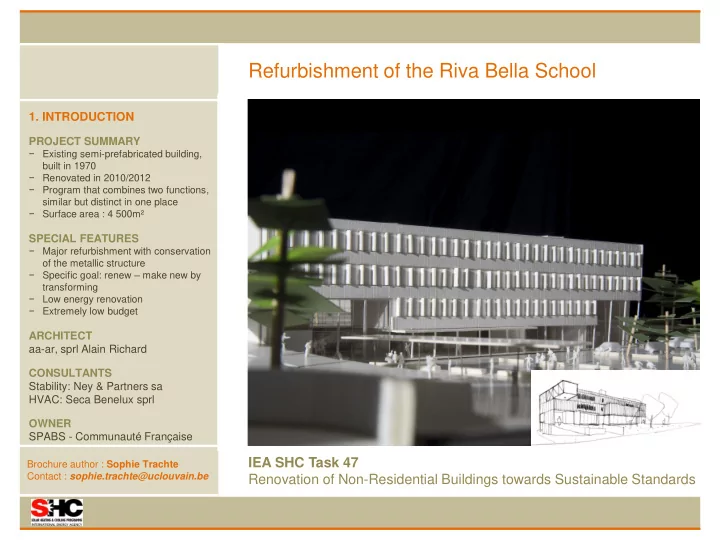
Refurbishment of the Riva Bella School 1. INTRODUCTION PROJECT - - PowerPoint PPT Presentation

refurbishment of the riva bella school
SMART_READER_LITE
LIVE PREVIEW

Refurbishment of the Riva Bella School 1. INTRODUCTION PROJECT - - PowerPoint PPT Presentation

Refurbishment of the Riva Bella School 1. INTRODUCTION PROJECT SUMMARY Existing semi-prefabricated building, built in 1970 Renovated in 2010/2012 Program that combines two functions, similar but distinct in one place Surface area


slide-1
SLIDE 1

Refurbishment of the Riva Bella School

  • 1. INTRODUCTION

PROJECT SUMMARY

− Existing semi-prefabricated building, built in 1970 − Renovated in 2010/2012 − Program that combines two functions, similar but distinct in one place − Surface area : 4 500m²

SPECIAL FEATURES

− Major refurbishment with conservation

  • f the metallic structure

− Specific goal: renew – make new by transforming − Low energy renovation − Extremely low budget

ARCHITECT aa-ar, sprl Alain Richard CONSULTANTS Stability: Ney & Partners sa HVAC: Seca Benelux sprl OWNER SPABS - Communauté Française

Brochure author : Sophie Trachte Contact : sophie.trachte@uclouvain.be

IEA SHC Task 47 Renovation of Non-Residential Buildings towards Sustainable Standards

slide-2
SLIDE 2
  • 2. CONTEXT AND BACKGROUND

BACKGROUND

The Royal Atheneum Riva Bella (Braine- l'Alleud) forms a campus of various buildings. The building “BSP” is a semi-prefabricated building, east-west oriented and disused for reasons relating to fire safety and presence of asbestos. The competition

  • rganized

by the French speaking Community aimed to save, renovate and reassign the building for two types of education: compulsory education during the day and social advancement courses in the evening.

OBJECTIVES OF THE RENOVATION

Specific goal: make new by transforming

  • Prefabrication and reuse
  • Restore links with the city and the built

environment

  • Energy performance and thermal comfort
  • Users participation and integrated design

approach as a teaching tool

SUMMARY OF THE RENOVATION

Reduction of energy requirement

  • Heating demand: 35 kWh/m².year

Costs (excluding fee) 3 800 000€ or 845€/m² (incl. subsidies)

slide-3
SLIDE 3
  • 3. DECISION MAKING PROCESSES

The building “BSP”, built in 1970, has been disused since 1995 for reasons relating to fire safety and presence of asbestos. The students

  • f

Riva Bella school were relocated into trailers waiting for the new construction. In 2008, the Ministry of the French Community and the Société publique d’administration des bâtiments scolaires (SPABS) decided to renovate the building while maintaining the existing structure. A competition was organized and awarded to aa-ar office (Alain Richard). The contractor and subcontractors were chosen through an open tendering process (public contract).

Timeline for the decision making process

Evaluation among occupants

No evaluation expected

Renovation completed September 2012* Start renovation February 2010 Signing of contract with main contractor December 2009 Tendering process started October 2009 Detailed project description completed March 2009 Competition awarded to aa-ar office May 2008 Competition organized Mars 2008

* Building site was stopped during 6 months due to non payement of works

slide-4
SLIDE 4

Before After Roof/attic 0,5 W/m²K 0,19 W/m²K Floor/slab 2,5 W/m²K 0,51 W/m²K Walls 0,8 W/m²K 0,17 W/m²K Frame 6 W/m²K 1,6 W/m²K Glazing 5,7 W/m²K 1,1 W/m²K

Summary of U-values [W/m²K]

  • 4. BUILDING ENVELOPE

Roof construction - U-value: 0,19 W/m²K

Materials (int. to ext.):

  • Fireproof plasterboard

15 mm

  • Plenum + steel structure

variable

  • Existing steel panel

3 mm

  • Existing PUR insulation

50 mm

  • Vapour barrier

2 mm

  • High density Mineral wool

200 mm

  • Roofing membrane

5 mm Total: min 275 mm

Wall construction - U-value: 0,17 W/m²K

Materials (int. to ext.):

  • Firepoof Plasterboard

15 mm

  • DURELIS panel

15 mm

  • Mineral wool between wood frame

240 mm

  • AGEPAN panel

16 mm

  • Air layer

40 mm

  • Polycabonate

2 mm Total: 328mm

Slab construction - U-value: 0,51 W/m²K

Materials (int. to ext.):

  • Flooring

2 mm

  • Existing tiles

8 mm

  • Cement screed

40 mm

  • Existing slab

120 mm

  • PUR foam (sprayed)

60 mm Total: 230mm

Thermal bridge avoidance:

Thermal bridges have been avoided by:

  • a clear dissociation between the façade and

the rest of the structure

  • a continuing inside insulation
slide-5
SLIDE 5
  • 5. BUILDING SERVICES SYSTEM

OVERALL DESIGN STRATEGY

  • Low

energy retrofitting with structural mesh conservation and reuse of different existing components and materials;

  • Redefining interior and exterior spaces by

combining two types of education and recreating links with the city

LIGHTING SYSTEM

  • Percentage
  • f

glazed façade was increased

  • Solar

shading

  • n

the east and west façade

  • Light sensors and sensors for illumination

level in classrooms

HEATING SYSTEM

  • Before: fuel heating
  • After: 2 condensing boilers with gas

COOLING SYSTEM

  • No mechanical cooling
  • Free and night cooling

VENTILATION

  • Hygienic ventilation: dual flow ventilation

system with heat recovery (h 85%)

  • Intensive ventilation: free-cooling

RENEWABLE ENERGY SYSTEMS

  • Solar thermal planned for hairdressing

and cooking classes was postponed for financial reasons.

slide-6
SLIDE 6
  • 6. ENERGY PERFORMANCES

The building was unoccupied for 15 years. It is therefore difficult to obtain accurate data about its energy performance before renovation. However, we can estimate it to be 180 kWh/m²/year. Renovation of the building was carried out before the implementation of the European Directive on Energy Performance of Buildings. This is why no EPB or PHPP calculation was made. However, depending on the U values ​of the walls, the heat requirement of the building can be approximated at 35kWh / m² / year. The energy savings are due to:

  • Installation of two condensing boilers;
  • Heating control: external probe, night break

and thermostatic valves;

  • Installation
  • f

mechanical ventilation system (dual flow) with high efficiency

  • Free-cooling by night;
  • Demand controlled artificial lighting which

means maximum use

  • f

daylight and minimum use of artificial lighting; and

  • Artificial lighting provided by low energy

equipment.

slide-7
SLIDE 7
  • 7. ENVIRONMENTAL ASPECTS

WATER MANAGEMENT

  • Efficient appliances
  • Rainwater tank of 20 000 liters
  • Use of external draining coatings and flow

to infiltration trench

WASTE MANAGEMENT and MATERIALS

  • Reuse of many existing components and

materials: metallic structure, concrete floor, partition walls, flooring materials, steel panels, etc.

  • Demolition waste management during the

retrofitting works: recycle building waste as much as possible

  • Prefabricated insulated wood elements for

façade, PEFC and FSC wood for facade and frames

INCREASING QUALITY OF LIFE

  • New and comfortable classrooms

and teaching spaces

  • Improvement
  • f

the thermal comfort (summer and winter)

  • Implementation
  • f

green spaces and green roofs

LIGHTING QUALITY

  • Improvement of daylighting in classrooms:

extension of glazed areas, sunshadings, etc.

slide-8
SLIDE 8
  • 8. MORE INFORMATION

RENOVATION COSTS

  • Expected

pay back time for all the environmental measures: approximately 15 years

  • Extra

investment for energy savings (insulation, ventilation system, new boiler, acoustic panels, sunshadings, water management, green roofs, etc) : 400 000€

FINANCING MODEL

The renovation project was funded by the SPABS – French Speaking Community

OTHER INTERESTING ASPECTS

Enhance and live in the existing structural mesh (metallic) The program has two types

  • f

rooms: classrooms and

  • ther

teaching facilities. These need to be in relation to the outside world, directly or through the media. All classes are east oriented. They receive generous natural light and are

  • pen

to the campus and the other buildings in the complex with which they interact. Other spaces and rooms are facing west, towards the city. Each function is housed in a specific space, according to its morphology, its size, its dimensions, openings, connections, its views and its relationship to the outdoor space and to the public space.