
SLIDE 1
JUS5530: 14 March 2014
Refugees & Africa
Svjatoslav Posylajev Elyse Leonard
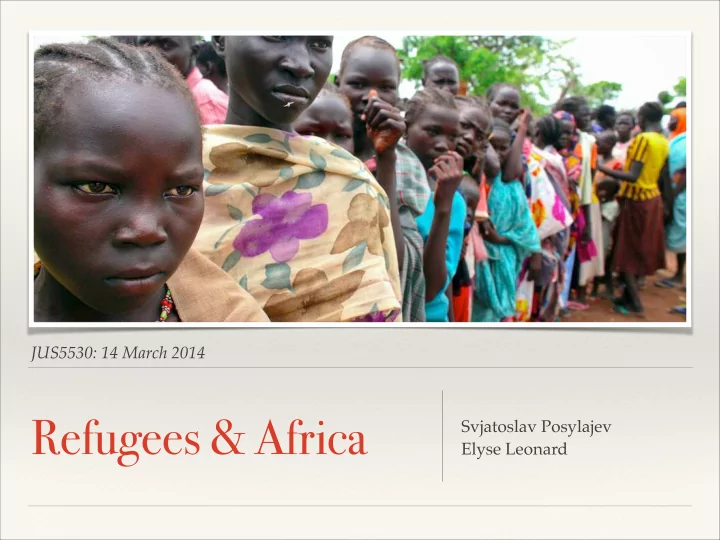
Refugees & Africa Svjatoslav Posylajev Elyse Leonard entered - - PowerPoint PPT Presentation
JUS5530: 14 March 2014 Refugees & Africa Svjatoslav Posylajev Elyse Leonard entered into force 1974 OAU Convention on Refugees POLITICAL CHOICE TO DE-POLICITIZE motives of OAU Convention were political and stress security concerns
JUS5530: 14 March 2014
Svjatoslav Posylajev Elyse Leonard
entered into force 1974
political and stress security concerns
Convention
grant of asylum, increase humanitarianism (predictability, coherence and transparency)
POLITICAL CHOICE TO DE-POLICITIZE
term "refugee" shall mean every person who, owing to well-founded fear of being persecuted for reasons of race, religion, nationality, membership of a particular social group or political opinion, is outside the country of his nationality and is unable
himself of the protection of that country, or who, not having a nationality and being
residence as a result of such events is unable or, owing to such fear, is unwilling to return to it.
to every person who, owing to external aggression, occupation, foreign domination or events seriously disturbing public order in either part or the whole of his country of origin or nationality, is compelled to leave his place of habitual residence in order to seek refuge in another place outside his country of origin or nationality.
❖ places more weight on objective circumstances (v. subjective
fear)
❖ less emphasis on State action as a necessary condition: ❖ includes accidental situations w/o deliberate State action ❖ source of danger need not be actions of State or State agents ❖ includes people displaced from internal conflict ❖ establishes prima facie protection for groups of displaced
peoples
Bangkok Principles (adopted 1966 by the Asian-African Legal Consultative Organization)
Article I: Definition of the term “refugee”
persecution or a well-founded fear of persecution for reasons of race, colour, religion, nationality, ethnic origin, gender, political opinion or membership of a particular social group.
person, who, owing to external aggression,
seriously disturbing public order in either part or the whole of his country origin or nationality, is compelled to leave his place of habitual residence in order to seek refuge in another place outside his country of origin or nationality.
be deemed to be refugees.
ACPHR, or “Banjul Charter” (entered into force 1986)
Article 12: Freedom of Movement
1.Every individual shall have the right, when persecuted, to seek and obtain asylum in
with laws of those countries and international conventions.
Cairo Declaration of Human Rights in Islam (adopted 1990)
Article 12
framework of the Shari'ah, to free movement and to select his place of residence whether within or outside his country and if persecuted, is entitled to seek asylum in another country. The country of refuge shall be obliged to provide protection to the asylum-seeker until his safety has been attained, unless asylum is motivated by committing an act regarded by the Shari'ah as a crime.
ACHPR Protocol on the Rights of Women,
(entered into force 2005)
Article 4: The Rights to Life, Integrity and Security of the Person
1.States Parties shall take appropriate and effective measures to: k) ensure that women and men enjoy equal rights in terms of access to refugee status determination procedures and that women refugees are accorded the full protection and benefits guaranteed under international refugee law, including their own identity and other documents.
Also see Maputo Protocol´s
❖
A r t . 1 : R i g h t t
e a c e
A r t . 1 1 : P r
e c t i
W
e n i n A r m e d C
fl i c t s
AU Convention on IDPs,
(entered into force 2012)
Article 1: Definitions
situations of generalized violence, violations of human rights or natural or human-made disasters, and who have not crossed an internationally recognized State border. Article 5: Obligations of States Parties relating to Protection and Assistance
and assist persons who have been internally displaced due to natural or human made disasters, including climate change.
❖ Nearly one-third of UNHCR’s population of
concern lives in Africa (11 million out of 35.8 million).
❖ 26% of the world’s refugee population
(2.8 million out of a total of 10.5 million refugees)
❖ Africa is home to almost 1/3 of the
world's IDPs
❖ 10.4 million people displaced by
conflict and violence.
❖ In 2012, a further 8.5 million people
displaced by sudden onset natural disasters such as floods and storms.
❖ The number of refugees in Africa increase
for the 3rd consecutive year.
Most affected countries (2014)
❖ Somalia: With more than 1 million refugees,
Somalia is the 2nd main country of origin, after Afghanistan.
❖ DRC: 1/2 million refugees & 2.6 million IDPs ❖ Sudan/South Sudan: ?? ❖ ca 600,000 refugees from Sudan ❖ ca 200,000 refugees from S. Sudan ❖ CAR: 220,000 refugees & 400,000 IDPs
2008-2010
Internship with PASSOP, a migrant rights NGO in Cape Town
❖ Started in township of
Johannesburg but spread
❖ 62 killed & 60,000 displaced ❖ Reasons: Abject conditions and
poor governance in townships?
Where do we go?
❖ Shelter: ❖ temporary shelters (gymnasiums,
police stations, churches, etc.)
❖ UNHCR-sponsored camps ❖ South African government-
sponsored camps
❖ Re-integration in South Africa ❖ “Voluntary” return to country of
❖ The 65,000 refugees & 230,000 asylum-
seekers (classified by the UNHCR) living in SA?
❖ From Somalia, DRC, etc. ❖ SA´s Zimbabwean neighbors? ❖ largest foreign national group ❖ 1-5 million ❖ economic migrants? ❖ Matabeleland residents? ❖ food refugees? economic
migrants? illegal immigrants?
❖ Ndebele tribe? ❖ forced evictees?
❖ My Projects: ❖ MediaWatch ❖ Legal Help Desk ❖ Camp condition surveillance ❖ Important because: ❖ Raised migrant awareness of
their rights
❖ Shifted public perception
Commitment & Action is Needed
❖ Limited effect of OAU Convention: ❖ Achievements in legal domain alone
not enough.
❖ Commitment is needed by political
leaders to the principles stipulated in the OAU Convention.
❖ Changing context in Africa (climate, IDPs,
chronic displacement, etc.) needs to be addressed…and QUICKLY!
http://blogs.wsj.com/photojournal/2013/09/03/worlds-largest-refugee-camps/ http://www.aljazeera.com/indepth/inpictures/2014/02/car-refugees-most- important-th-2014228203850937544.html http://www.afrikanspot.com/2013/11/xenophobic-violence-continues-to- grow-in-south-africa/ http://www.jamesoatway.com/#/xenophobic-violence-in-south-africa/03web http://alexengwete.blogspot.no/2009/11/african-news-roundup-xenophobic- attacks.html http://westcapenews.com/?p=994