References and Resources Textbook: Simmons and Young, 3 rd edition: - - PDF document

references and resources
SMART_READER_LITE
LIVE PREVIEW

References and Resources Textbook: Simmons and Young, 3 rd edition: - - PDF document

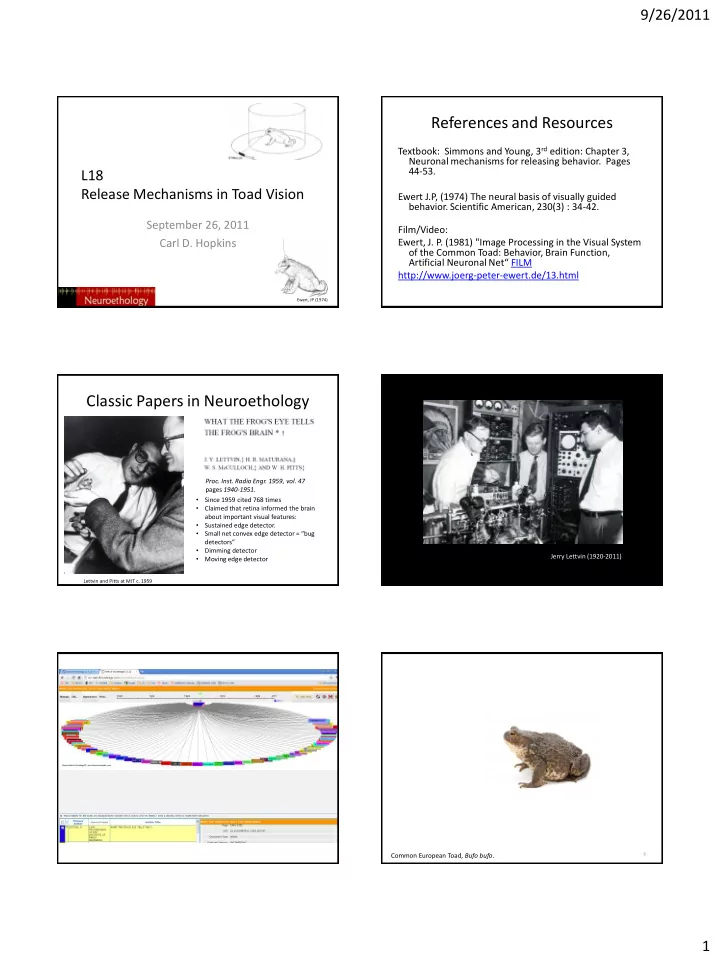
9/26/2011 References and Resources Textbook: Simmons and Young, 3 rd edition: Chapter 3, Neuronal mechanisms for releasing behavior. Pages 44-53. L18 Release Mechanisms in Toad Vision Ewert J.P, (1974) The neural basis of visually guided


slide-1
SLIDE 1

9/26/2011 1 L18 Release Mechanisms in Toad Vision

September 26, 2011 Carl D. Hopkins

Ewert, JP (1974)

References and Resources

Textbook: Simmons and Young, 3rd edition: Chapter 3, Neuronal mechanisms for releasing behavior. Pages 44-53. Ewert J.P, (1974) The neural basis of visually guided

  • behavior. Scientific American, 230(3) : 34-42.

Film/Video: Ewert, J. P. (1981) "Image Processing in the Visual System

  • f the Common Toad: Behavior, Brain Function,

Artificial Neuronal Net“ FILM http://www.joerg-peter-ewert.de/13.html

Classic Papers in Neuroethology

  • Proc. Inst. Radio Engr. 1959, vol. 47

pages 1940-1951.

Lettvin and Pitts at MIT c. 1959

  • Since 1959 cited 768 times
  • Claimed that retina informed the brain

about important visual features:

  • Sustained edge detector.
  • Small net convex edge detector = “bug

detectors”

  • Dimming detector
  • Moving edge detector

Jerry Lettvin (1920-2011)

6

Bufo bufo, the common toad Common European Toad, Bufo bufo.

slide-2
SLIDE 2

9/26/2011 2

7

Prey capture in toads is a stereotyped sequence of events

In response to: a worm moving in the lateral visual field turn to orient in frontal visual field, binocular fixation snap swallow wiping mouth

Turn to orient -- brings object into binocular field of

  • view. Binocular fixation

snapping Swallowing Wiping mouth crouching Ewert, JP (1974)

In response to a moving predator: avoidance

Planting down 1 Planting down 2 Crouching

8 Ewert, JP (1974)

9

Experimental Set Up

Toad held in a glass container at fixed distance from object.

Stimuli: square, moving bar (worm-like) Turning response

strong response weak response

turns

Video of Toad Behavior and Neuroethology

10

http://www.joerg-peter-ewert.de/13.html

Kassel Germany

11

NATO Symposium on Vertebrate Neuroethology, August 1981

12

Jörg-Peter Ewert

slide-3
SLIDE 3

9/26/2011 3

Small and Large Objects

Square turn toward if small turn away if large Small (1-16 ) Large (20+ ) (avoid)

13

Behavioral Responses

Vertical moving bar

Weak, decreases with increasing length

Horizontal moving bar:

strong response, increases with length

Bar + square:

  • decreases with distance of

square, d, but then increases again (as bar and square are separated)

14

Response Invariance

Identical response to differing stimuli given under varying conditions. e.g.

  • Size stimulus
  • Color
  • Background
  • Direction of movement

Responses: W = toad oriented and snapped (worm response) A = toad turns away (avoids) anti-worm response

15

From Carew (2000) Ch. 4

Toad Visual System

16 Ewert (1974) Sci. American.

The Retina: a neural network

17

John Dowling 1968

18

glutamate is released by receptors onto bipolar cells The vertical pathway from receptor to ganglion cell

John Dowling 1968

slide-4
SLIDE 4

9/26/2011 4 Receptive Fields of Retinal Ganglion Cells

19

On-center,

  • ff-surround cell

Off-center,

  • n-surround cell

From Carew (2000) Ch. 4

20

How do Ganglion cells respond? Consider 3 types, with differing size ERFs. Ewert, JP. Trends Neurosci. (1997) 20, 332–339

Responses of Retinal Ganglion Cells

22

  • -- +++ ++ ++

+++ ++ + +

23

metabotropic cAMP closes Na+ channels ionotropic AMPA glutamate released ON center OFF center

Lateral Inhibition

24

slide-5
SLIDE 5

9/26/2011 5

Two projections of retina

  • Main projection: to optic

tectum (midbrain)

  • To Thalamus-pre-tectum

25

Thalamic Neuron, Type TH3

26

Large receptive fields (receives inputs only from R3, R4. Excitatory throughout. Larger stimulus: stronger response.

Tectal Neuons, Type T5(1) and T5(2)

27

Circuitry Between Tectum and Thalamus Pre-Tectum

28

Stimulation in optic tectum causes cells in thalamus to fire. Cells are excited by visual stimuli. Stimulation in thalamus pretectum causes cells in tectum to be

  • inhibited. (Cells were responding to

visual stimulus).

29 30

From Carew (2000) Ch. 4

slide-6
SLIDE 6

9/26/2011 6

From Carew (2000) Ch. 4

32

Tectal Stimulation

Electrical stimulation results: In optic tectum:

  • frog orients to different

parts of visual space. (Compare with map). Stimulation in thalamus (pre- tectal area) evokes avoidance response

33

Lessons from Toad Vision

1. Toads discriminate complex visual stimuli based on size, direction of motion, shape in a large variety of visual contexts (background, color, contrasts, outline) 2. Robust adaptive behavior in laboratory: following and snapping in response to “worm”, no response or avoidance of “antiworm”. 3. No prey detectors or predator detectors in retina, instead circular center surround RFs. 4. RGC project to optic tectum (midbrain) and pretectum (thalamus). 5. OT: respond to small square, worm, but not large square, not antiworm. 6. PT: respond to large square, antiworm, not worm, not small square. 7. OT organizes strike behavior, PT organizes avoidance. 8. Does toad with PT lesion remain immobile when given a large stimulus? No, PT lesioned toads strike at any object. 9. Neurons in OT now respond to all types of stimuli, even large. 10. PT respond to large objects, initiate avoidance, and inhibit OT. 11. OT neurons respond to any object, increasing with increasing size, in addition, OT neurons stimulate approach (and snapping). 12. The net behavior is the combination of excitation and inhibition.

34

References

Ewert, J. P. (1974) The neural basis of visual guided behavior. Sci. American 230(3):34-42. Ewert, J. P. (1980) Neuroethology: An Introduction to Neurophysiological Basis of Behavior. Springer. Washington, D. C. Ewert, J.P. (1999) Neural correlates of key stimulus and releasing mechanisms: A case study and two concepts. Trends in

  • Neuroscience. 20(8):332-39.

Carew, T. (2000) Behavioral Neurobiology. Sinauer Associates. Sunderland, MA.

  • D. L. Wang and M. A. Arbib (1991) How does the toad's visual

system discriminate different worm-like stimuli? Biological Cybernetics, 1990, 64(3): 251-261.

35