Refactoring Noun: A change made to the internal structure of - - PDF document

refactoring noun a change made to the internal structure
SMART_READER_LITE
LIVE PREVIEW

Refactoring Noun: A change made to the internal structure of - - PDF document

Refactoring Noun: A change made to the internal structure of Refactoring software to make it easier to understand and cheaper to modify without changing its observable behaviour Verb: To restructure software by applying a series


slide-1
SLIDE 1

Refactoring Refactoring

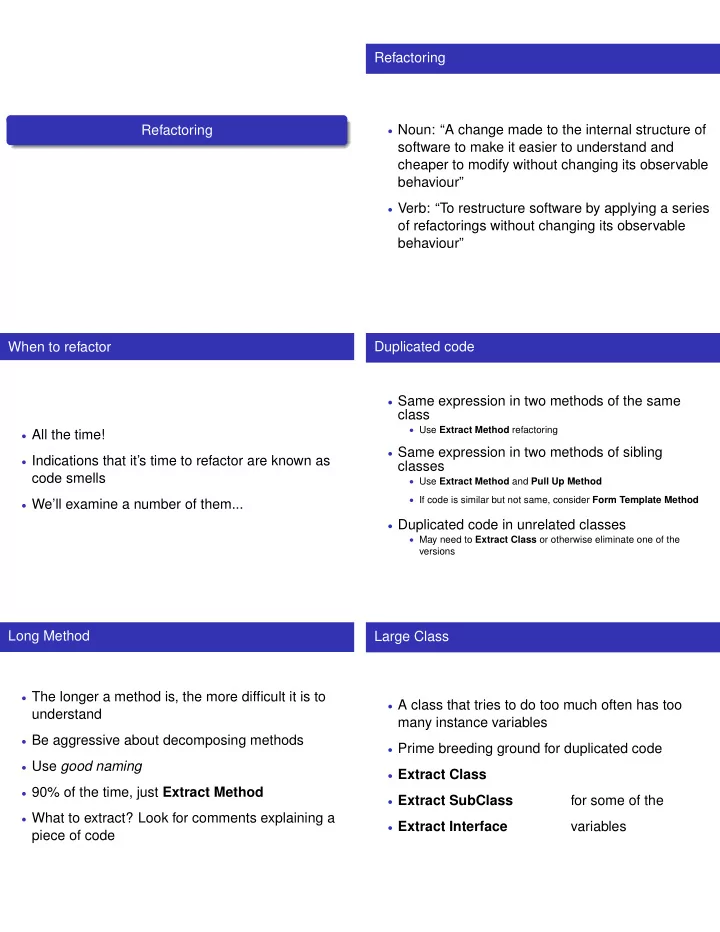
  • Noun: “A change made to the internal structure of

software to make it easier to understand and cheaper to modify without changing its observable behaviour”

  • Verb: “To restructure software by applying a series
  • f refactorings without changing its observable

behaviour” When to refactor

  • All the time!
  • Indications that it’s time to refactor are known as

code smells

  • We’ll examine a number of them...

Duplicated code

  • Same expression in two methods of the same

class

  • Use Extract Method refactoring
  • Same expression in two methods of sibling

classes

  • Use Extract Method and Pull Up Method
  • If code is similar but not same, consider Form Template Method
  • Duplicated code in unrelated classes
  • May need to Extract Class or otherwise eliminate one of the

versions

Long Method

  • The longer a method is, the more difficult it is to

understand

  • Be aggressive about decomposing methods
  • Use good naming
  • 90% of the time, just Extract Method
  • What to extract? Look for comments explaining a

piece of code Large Class

  • A class that tries to do too much often has too

many instance variables

  • Prime breeding ground for duplicated code
  • Extract Class
  • Extract SubClass

for some of the

  • Extract Interface

variables

slide-2
SLIDE 2

Long parameter list

  • Hard to understand, requires frequent changes
  • In OO systems, much fewer parameters are

required

  • Shorten parameter lists with

Replace Parameter with Method Preserve Whole Object Introduce Parameter Object Divergent Change

  • A class is commonly changed in different ways for

different reasons

  • “I will have to change these three methods every

time I get a new database; I have to change these four methods every time there is a new financial instrument”

  • Extract Class to alleviate this problem

Shotgun Surgery

  • Every time you make a kind of change, you have

to make a lot of little changes

  • Easy to miss an important change
  • Move Method and Move Field to put all changes

into a single class

  • You might even use Inline Class

Feature Envy

  • A method seems more interested in a class other

than the one it is in

  • Invokes many getter methods from another class
  • Move Method to where it wants to be
  • Strategy and Visitor design patterns result in code

that has feature envy

  • Acceptable since this way we fight divergent change
  • Often there are tradeoffs in fighting code smells

Data Clumps

  • Bunches of data that hang around together ought

to be made into their own object (Extract Class)

  • Delete one of the data values. Do the others make

sense?

  • You can then slim parameter lists down with

Introduce Parameter Object Preserve Whole Object Switch statements

  • Switch statements are often duplicated
  • If you add a new clause, you need to find all

related switch statements

  • Polymorphism can solve this problem
  • If switching on type code

Extract Method Move Method Replace Type Code with Subclasses Replace Conditional with Polymorphism

slide-3
SLIDE 3

Parallel Inheritance Hierarchies

  • Special case of shotgun surgery
  • Every time you make a subclass of one class, you

also have to make a subclass of another

  • Eliminate duplication by having instances of one

hierarchy refer to instances of the other Lazy class

  • If a class is not doing enough to justify maintaining

it, it should be removed

  • Refactoring often results in lazy classes that can

be removed with Collapse Hierarchy Inline Class Speculative Generality

  • Machinery added for future use that never gets

implemented

  • Makes system much harder to understand
  • Often identified because test cases are the only

users of a method of a class

  • Remove unnecessary machinery with

Inline Class / Collapse Hierarchy Remove Parameter / Rename Method Temporary Field

  • Fields that are not used (or used only in certain

circumstances)

  • Very difficult to determine their usefulness
  • Maybe they are only used as global variables to

avoid passing them around as parameters

  • Extract Class for temporary fields

Refused Bequest

  • Subclasses do not want or need methods or data
  • f their parents
  • Push Down Method and Push Down Field to

move unwanted methods to siblings

  • If the subclass does not want to support the

interface of the superclass Replace Inheritance with Delegation Comments

  • Comments are of course a sweet smell, but they

should not be used as deodorant

  • When you feel the need to write a comment, first

try to refactor the code so that any comment becomes superfluous

  • Can also use

Extract Method Rename Method Introduce Assertion

slide-4
SLIDE 4

More code smells

  • Primitive obsession
  • Message Chains
  • Middle man
  • Inappropriate intimacy
  • Alternative classes with different interfaces
  • Incomplete library class
  • Data class

Refactoring catalog

  • Many different refactorings possible
  • Martin Fowler lists about 80 of them in his book on

Refactoring

  • Other refactorings have been identified as well
  • They all come with well-defined mechanisms for

their application Mechanics of Extract Method

  • Create a new method, and name it after the

intention of the method (what it does, not how it does it)

  • Copy the extracted code from the source method

to the target method

  • Scan the extracted code for references to any

variables that are local in scope to the source method

  • See whether any temporary variables are used
  • nly within the extracted code. If so, declare them

in the new method Mechanics of Extract Method (cont.)

  • See if the extracted code modifies any local-scope
  • variables. If only one, it can be the return value of

the new method. If more, extraction cannot happen as is

  • Pass into the target method as parameters

local-scope variables that are read from the extracted code

  • Replace the extracted code in the source method

with a call to the target method

  • Compile and test

The first step: Testing

  • In order to refactor, you need a solid suite of tests
  • Tests must be automatic and self-checking
  • Run tests often, after every small change
  • Frameworks such as JUnit can help with the

automation part (www.junit.org)