Reducing the energy cost of human walking using an unpowered - - PowerPoint PPT Presentation

reducing the energy cost of human walking using an
SMART_READER_LITE
LIVE PREVIEW

Reducing the energy cost of human walking using an unpowered - - PowerPoint PPT Presentation

Reducing the energy cost of human walking using an unpowered exoskeleton [Collins, Wiggin & Sawicki (2015) Nature ] Steve Collins Associate Professor Mechanical Engineering & Robotics Institute Carnegie Mellon University Steve Collins


slide-1
SLIDE 1

Steve Collins  Carnegie Mellon University  biomechatronics.cit.cmu.edu  stevecollins@cmu.edu

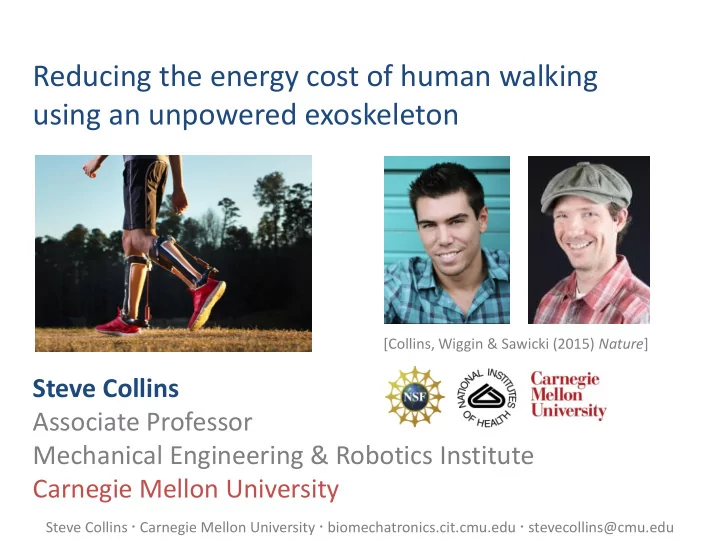
Reducing the energy cost of human walking using an unpowered exoskeleton

Steve Collins Associate Professor Mechanical Engineering & Robotics Institute Carnegie Mellon University

[Collins, Wiggin & Sawicki (2015) Nature]

slide-2
SLIDE 2

Steve Collins  Carnegie Mellon University  biomechatronics.cit.cmu.edu  stevecollins@cmu.edu

Humans are expert at walking efficiently. Walking is still most energy-intensive activity. Challenge: Reduce energy cost of normal walking.

slide-3
SLIDE 3

Steve Collins  Carnegie Mellon University  biomechatronics.cit.cmu.edu  stevecollins@cmu.edu

Initial attempts, 1800’s and 1900’s

[Yagn (1890) Patent; Seireg (1971); GE Hardiman (1965)]

slide-4
SLIDE 4

Steve Collins  Carnegie Mellon University  biomechatronics.cit.cmu.edu  stevecollins@cmu.edu

Recent serious attempts

[Zoss et al. (2006); van Dijk et al. (2011); Cherry et al. (2009); Charalambous et al. (2012)]

slide-5
SLIDE 5

Steve Collins  Carnegie Mellon University  biomechatronics.cit.cmu.edu  stevecollins@cmu.edu

Success with powered devices, 2013—2014

[Malcolm et al. (2013); Mooney et al. (2014)]

slide-6
SLIDE 6

Steve Collins  Carnegie Mellon University  biomechatronics.cit.cmu.edu  stevecollins@cmu.edu

Energy flow in steady-state, level walking

slide-7
SLIDE 7

Steve Collins  Carnegie Mellon University  biomechatronics.cit.cmu.edu  stevecollins@cmu.edu

Wasted energy: Muscle inefficiencies.

slide-8
SLIDE 8

Steve Collins  Carnegie Mellon University  biomechatronics.cit.cmu.edu  stevecollins@cmu.edu

Related unpowered successes, 2006—2012

[Rome et al. (2006); Franz et al. (2012); Donelan et al. (2008); Grabowski et al. (2009)]

slide-9
SLIDE 9

Steve Collins  Carnegie Mellon University  biomechatronics.cit.cmu.edu  stevecollins@cmu.edu [Collins, Wiggin & Sawicki (2015) Nature]

Our Device: Passive Exoskeleton Targets Calves

slide-10
SLIDE 10

Steve Collins  Carnegie Mellon University  biomechatronics.cit.cmu.edu  stevecollins@cmu.edu [Collins, Wiggin & Sawicki (2015) Nature]

Our Device: Passive Exoskeleton Targets Calves

slide-11
SLIDE 11

Steve Collins  Carnegie Mellon University  biomechatronics.cit.cmu.edu  stevecollins@cmu.edu

Beating evolution: More efficient walking

[Collins, Wiggin & Sawicki (2015) Nature]

slide-12
SLIDE 12

Steve Collins  Carnegie Mellon University  biomechatronics.cit.cmu.edu  stevecollins@cmu.edu

Does 7% matter?: Yes.

slide-13
SLIDE 13

Steve Collins  Carnegie Mellon University  biomechatronics.cit.cmu.edu  stevecollins@cmu.edu

How? Reduced muscle force

[Collins, Wiggin & Sawicki (2015) Nature]

slide-14
SLIDE 14

Steve Collins  Carnegie Mellon University  biomechatronics.cit.cmu.edu  stevecollins@cmu.edu

How? Reduced muscle activation

[Collins, Wiggin & Sawicki (2015) Nature]

slide-15
SLIDE 15

Steve Collins  Carnegie Mellon University  biomechatronics.cit.cmu.edu  stevecollins@cmu.edu

How? Probably not muscle work

[Collins, Wiggin & Sawicki (2015) Nature]

slide-16
SLIDE 16

Steve Collins  Carnegie Mellon University  biomechatronics.cit.cmu.edu  stevecollins@cmu.edu

How? Not center of mass work

[Collins, Wiggin & Sawicki (2015) Nature]

slide-17
SLIDE 17

Steve Collins  Carnegie Mellon University  biomechatronics.cit.cmu.edu  stevecollins@cmu.edu

Why back up? Calf muscle-tendon dynamics

[Collins, Wiggin & Sawicki (2015) Nature]

slide-18
SLIDE 18

Steve Collins  Carnegie Mellon University  biomechatronics.cit.cmu.edu  stevecollins@cmu.edu

Why back up? Knee moments

[Collins, Wiggin & Sawicki (2015) Nature]

slide-19
SLIDE 19

Steve Collins  Carnegie Mellon University  biomechatronics.cit.cmu.edu  stevecollins@cmu.edu

Conclusions:

  • 1. Efficiency of human gait can be improved
  • 2. Key: biomechanics knowledge (not tech)
  • 3. Formula: lightweight + medium force (+ work)
slide-20
SLIDE 20

Steve Collins  Carnegie Mellon University  biomechatronics.cit.cmu.edu  stevecollins@cmu.edu

Discussion.

slide-21
SLIDE 21

Steve Collins  Carnegie Mellon University  biomechatronics.cit.cmu.edu  stevecollins@cmu.edu

Discussion.