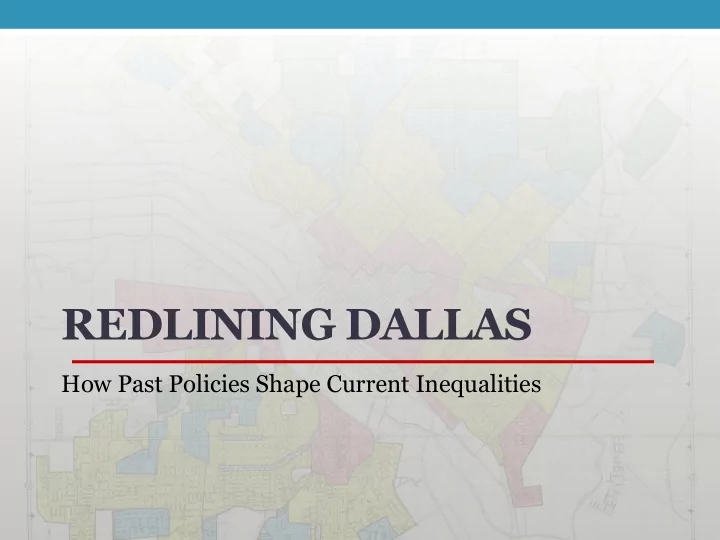
REDLINING DALLAS How Past Policies Shape Current Inequalities The - - PowerPoint PPT Presentation
REDLINING DALLAS How Past Policies Shape Current Inequalities The Kirwan Institute Our model is designed to create a just and inclusive society where all Structural Racialization: a barrier to opportunity people and communities have the
The Kirwan Institute
Our model is designed to create a just and inclusive society where all people and communities have the
- pportunity to succeed.
Criminal Justice Public Health Education Housing & Neighborhoods
four opportunity domains
Structural Racialization: a barrier to opportunity Race and Cognition: a barrier to opportunity
Framework for Engagement & Capacity Building
Policy Law & Civil Rights Policy Recommendations Advocacy Law Research & Commentary Mapping Analysis & Engagement Participatory Research & Surveys Opportunity Mapping Data Driven Decision- Making Communications, Field Building & Engagement Communications & Outreach Leadership Development & Civic Engagement Teaching & Training
the work barriers to opportunity and the domains we engage
Goals For This Convening
- Listen and learn from one another
- Relationship-building
- Identify new historical resources and questions
- Consider how the past can inform future regional equity
Every City Has a Story
“Great cities, like great men, have their distinctive, individual characters and
- qualities. While all have
something in common, each has something peculiar to itself, and each makes its own peculiar impression on the
- utside world. New York is not
Boston, nor is Boston Philadelphia; and neither one nor the other is Washington”
- Frederick Douglass, 1877
Case in point: Dallas, Texas
“Dallas’ unique geographical position, its place as a major American city, and its importance in national political and religious life should have spawned a lively tradition of serious scholarship. Academic neglect of Dallas, however, represents amnesia by design. In this obsessively image-conscious city, elites feared that a conflict-marred past filled with class and racial strife represented a dangerous model for the future. City leaders transformed the community into a laboratory of forgetfulness.”
- Michael Phillips, White Metropolis: Race, Ethnicity, and Religion in Dallas, 1841-2001
Layers of Structural Inequality
- Racial Zoning
- Race-Restrictive Covenants
- “Redlining”
- Racial Steering
- Block Busting
- Expulsive Zoning
- Exclusionary Zoning
- Highway Construction
- Slum Clearance & Public Housing Administration
- School Desegregation
- Neighborhood Fabric
- Land
- Housing Units
- People
- Markets
- Access
How policies reshape urban order:
How Dallas’ urban core has been reshaped between 1953 and 2013
- http://iqc.ou.edu/2014/12/09/60years/
“Redlining”
- The Fair Housing Center of Greater Boston
The FHA explicitly
practiced a policy of “redlining” when determining which neighborhoods to approve mortgages in. Redlining is the practice of denying or limiting financial services to certain neighborhoods based on racial or ethnic composition without regard to the residents’ qualifications or
- creditworthiness. The
term “redlining” refers to the practice of using a red line on a map to delineate the area where financial institutions would not invest.
Why did we redline?
How were neighborhoods assessed?
How did the HOLC policy work?
Exclusively White Eligible for 80% of mortgage value Mostly White Eligible for 60-80% of mortgage value Mixed, Poor Eligible for only 15% of mortgage value Mostly Black Ineligible for mortgage insurance
Dallas HOLC Map, 1937
Web-Based HOLC Map and Notes http://www.arcgis.com/home/webmap/viewer.html?webma p=29041b0623ef482981e1bcc50220eff6&extent=- 96.9465,32.7017,-96.6097,32.8614
0.2 0.4 0.6 0.8 1 1.2 1 7 13 19 25 31 37 43 49 55 61 67 73 79 85 91 97 103 109 115 121 127
% Nonwhite
The Significance of Redlining
Spatial Bias- Based structural
The Impact of Redlining
- Negro population
viewed as detrimental influence that posed risk to public health and property value
Bias
- Structural
disinvestment in people & place
- Denied access to
capital
Disinvestment
- Inability to maintain
property
- Abandonment & blight
- Future investment is
even more discouraged
Decline
Theory of How Redlining Impacts Cities & Neighborhoods
Redlining Foreclosure & Vacancy Asset Wealth Loss, Dwindling Tax Base Crime & Safety, Health Problems
Disinvestment Housing Decline Predatory Lending Property Value Loss Racial Wealth Gap City Services and Maintenance “Million Dollar Blocks” Infant Mortality, Low Birth Weight Asthma, Lead, Diabetes
White Alone Black Alone Asian Alone Other Races Hispanic or Latino
Historic Impact on Health: Years of Potential Life Lost
Source: Data computed by Parkland Health & Hospital System, Population Medicine Dept.
Dallas-Arlington-Ft Worth
Regional Population Growth: 1940- Present
500000 1000000 1500000 2000000 2500000 3000000
Dallas Tarrant Collin Denton Other 9 Counties
Dallas Metro Population Growth by County
1940 Since 1940
What does this mean for a historical understanding of Redlining in the region?
0.0000 2.0000 4.0000 6.0000 8.0000 10.0000 12.0000 14.0000 Infant Mortality Rate Neonatal Mortality Rate Post-Neonatal Mortality Rate
Infant fant Mortality ty Rate Diabet etes es Rates
1.08 1.47 1.88 2.08 2.84 1.69 0.00 0.50 1.00 1.50 2.00 2.50 3.00 [green-blue] [blue] [blue-yellow] [yellow] [yellow-red] [red]
Diabetes Cases/1000 Persons Infant Deaths/1000 Births
Wh Which ch nei eighb ghbor
- rhoo
hoods ds recei eceived d th the e most t hi high-co cost st mortga tgage ge loan ans s before
- re th
the finan ancial cial crisis? is?
High- h-Cost Lo Loan an R Rat ate 60.1% - 81.4% 40.1% - 60% 20.1% - 40% 0% - 20% 1940 H HOLC C Map ap Se Securi rity R Rating ngs A B C D Industrial
Engagement & Dialogue
Engagement Discussion
What events, policies, or investments led to these historic injustices? What about this historical redlining work are you most interested in running with? What are you most interested in doing with this information?
Engagement Discussion
- What are the biggest opportunities to expand equity and
access to opportunity in the region?
- What are the most under-utilized community resources
and assets in the region? How might they be further leveraged?
- What strategic partnerships could improve social equity
and mobility in the region?
Appendix: polling responses from beginning of session
When you think of discrimination and inequality in the Dallas region, what domain stands out the most?
2 4 6 8 10 12 14 Transportation Education Criminal Justice Employment Access to Credit Housing Environment
* Highest number of responses for any question was 25 *
- Dallas Cowboys (6)
- JFK assassination (5)
- DFW Airport (2)
- Denim and Diamonds
- Big Business
- Who shot JR
- People move here for
jobs
- President Bush
- Wealth
- Big Hair
- It’s very segregated
- #blacklivesmatter
- Pecan Lodge
What are the things that everyone knows about the Dallas region?
* Highest number of responses for any question was 25 *
What are the biggest unknowns about the region?
- The inequality of pay
between race
- Dallas County has one of
the highest uninsured rates in the country
- How divided the city is
- The poverty rate
- How bad people drive
- That John Wiley Price
- wns the rights to the
Accommodation
- The rate of childhood
poverty is one of the highest in the nation
- There were no ‘race riots’
during the 60s
- The issues of
Gentrification in the Southern sector of Dallas
- The Trinity Forest (2)
- How big and diverse it is
- Its racist history
* Highest number of responses for any question was 25 *
What are the biggest challenges facing the region? What keeps you up at night?
- Too many hungry kids in our city
- The political bias that divides all
people
- There are over 3000 chronically
homeless people in Dallas County
- The rise of homelessness
- Denial and apathy
- Divide on issues of immigration and
Dreamers
- The Mayor said that the job market
loves Plano, but he never mentions the Southern part of Dallas
- #dfacesrace
- White abandonment of DISD
- Suburban sprawl
- Texas spends $44K per year on
Dallas inmates but DISD only spends $10K per year on students
- The working poor and the number
- f people living one crisis away
- The quality of our public schools
- Gentrification of southern Dallas
- White people’s divestment from
communities of color
- Obesity rates
- Food insecurity
- How to organize a coalition to
support #blacklivesmatter
- Face secrets that the city is
economically divided
- People are scared to talk about race
issues face-to-face
- Organizations working in silos
- Textbooks
- We don’t talk
- The number of restaurants per
capita * Highest number of responses for any question was 25 *
What [or who] are the most significant obstacles to addressing challenges in the region?
- Our decision makers’ failure to work and
think regionally
- Lack/fear of willingness to admit one’s own
culpability for maintaining the status quo
- Getting the people in the room who really
need to hear the message
- Lack of communication and compromise
- Silo municipalities
- Trying to get the rest of Dallas to approve a
bond package that is for South Dallas
- Whites who don’t address racism, and
Black preachers who were paid off during the Accommodation
- Geography/size of landscape/scale of
institutions
- Learning how to respond rather than
reacting in planning
- Improving schools so that companies will
move into DALLAS (not Collin County) and in particular South Dallas
- The food industry
- Aligning state and local politics with the
growing Hispanic population
- The unconsciousness of white people
- Refusal to admit Dallas has challenges
- We are our own barriers b/c we won’t
challenge status quo
- Us. We are not unified
- Politicization of everything
- Apathy
- Incentivize business southward
- Denial
- Politicians and finance
- There is inequality in economics; look at
the HR demographics
- Working together to solve problems
- Burgeoning interest in discussing
race/racism without having skills and grounding in a shared analysis to do so
- Profits over people
* Highest number of responses for any question was 25 *