Rediscovering the Art of Dying In a Post-Christian World Nuala - - PDF document

rediscovering the art of dying in a post christian world
SMART_READER_LITE
LIVE PREVIEW

Rediscovering the Art of Dying In a Post-Christian World Nuala - - PDF document

Rediscovering the Art of Dying In a Post-Christian World Nuala Kenny SC, OC, MD, FRCP Professor Emeritus Dalhousie University, Halifax, NS Former Ethics & Health Policy Advisor Catholic Health Association of Canada Ottawa, Ontario My


slide-1
SLIDE 1

1 Rediscovering the Art of Dying In a Post-Christian World

Nuala Kenny SC, OC, MD, FRCP Professor Emeritus Dalhousie University, Halifax, NS Former Ethics & Health Policy Advisor Catholic Health Association of Canada Ottawa, Ontario

My Objectives

 To identify challenges to a good death from

Canadian experience

 To recognize the medicalization of suffering  To clarify Church teaching on health

decisions and ethical issues at end of life

 To review dying today and responses to

requests for assisted death

 To propose challenges for all the baptized in

the ministry of care and accompaniment

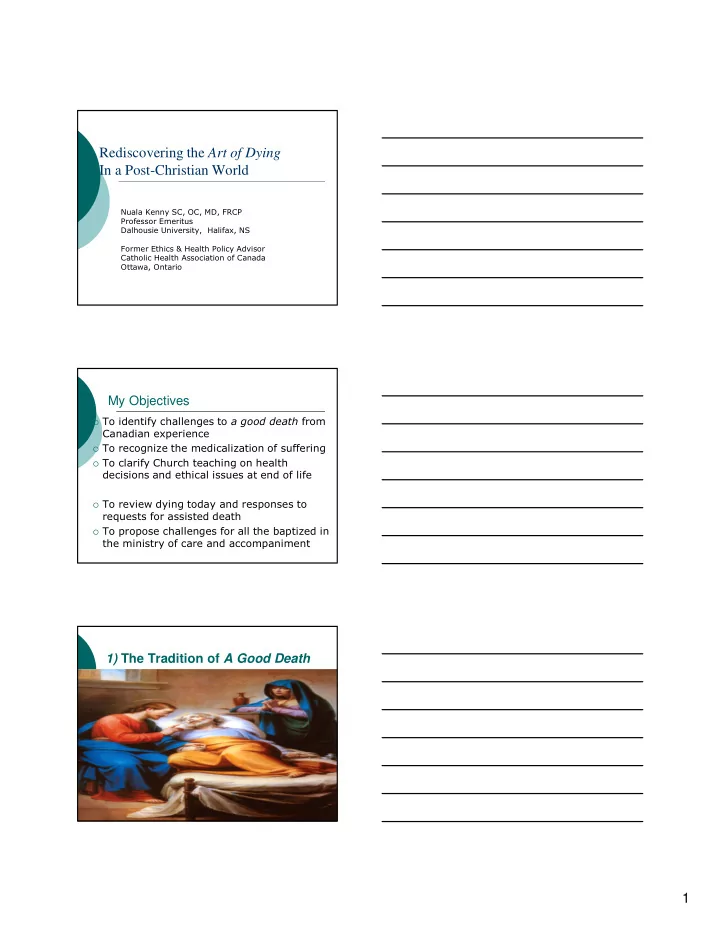
1) The Tradition of A Good Death

slide-2
SLIDE 2

2

The Medieval Ars Moriendi

 Depended upon two fundamental

features of the culture:

 shared faith in the birth, death,

and resurrection of Jesus

 the importance of families and

community in social organization

Care for the seriously ill and the

dying were normal family and community activities.

Modern Research on Characteristics of a Good Death

 Paradigm-shifting medical advances  The beginnings of hospice/palliative care  Research on a modern “good death”

 Non-abandonment and continuity of care  Avoidance of unwanted technological

intervention

 Respectful communication  Completion of life’s “last things”

Fundamental Features of Our Culture

 Death-denying and death-defying  Rejection of a religious world-view  Corrupt language in public discourse  Individual rights, choice and control  Belief in technology  The legalization of medically assisted

death in industrialized nations

slide-3
SLIDE 3

3

Medically Assisted Death Some U.S.A. -Canada Differences

 U.S.  Legislative process; State by state  Political environment  The ‘religious right’  Canada  Failure of 30yrs re legislation  Supreme Court of Canada

decriminalization on a Charter of Rights & Freedoms Challenge

 Rapid normalization

The Supreme Court of Canada Decriminalized MAD

 for competent adults with a  “grievous medical condition including

an illness, disease or disability)

 that is irremediable (cannot be

relieved by means acceptable to the individual)

 causes enduring suffering that is

intolerable to the individual in the circumstances of his or her condition.”

2) Medically Assisted Death is The Medicalization of Suffering

Reasons for Requesting MAD:

 Feelings of loss of dignity  Dependence and loss of control  Guilt at being a burden to others  Isolation and loneliness  Uncertainty regarding future care

needs

 Hopelessness and loss of meaning

slide-4
SLIDE 4

4

Differentiating Pain and Suffering Chest Pain vs Heartache Jesus’ Experience

 For it is not as if we had a high

priest who was incapable of feeling

  • ur weakness with us; but we have
  • ne who has been tempted in every

way that we are, though he is without sin. (Hebrews 4:15)

Gethsemane Avoidance, Denial & Isolation

slide-5
SLIDE 5

5

Denial and Avoidance of Suffering

 “Father” he said “if you are willing, take

this cup away from me.” …In his anguish he prayed even more earnestly, and his sweat fell to the ground like great drops of blood.” (Luke 22:42-44)

 Frank’s Story- 48yr old husband and

father with terminal lung cancer

 denial & aggressive pursuit of a

cure

Isolation in illness and Dying

 “Simon, are you asleep? Had you not the

strength to keep awake one hour? You should be praying not to be put to the

  • test. The spirit is willing but the flesh is

weak.” (Luke: 14:36-37)

 Shirley 76yr widow with COPD long

deterioration; d/c RX

 son knows; estranged daughter

refuses; no ACP.

Sources of Suffering

 Loss of dignity and identity

 Ellie 37yrs cervical cancer & fistula  Jocelyn 38yrs multiple sclerosis  Gloria 87yrs dementia and Richard 88yrs, her

husband

 Physical-Crushed down by pain

 Joe -67 yrs multiple myeloma

 Psychological-Falling into despair

 Gladys 75yrs hip fracture

 Spiritual-Falling out of love with God

 Debbie 32ys and death of 5yr old Sean

slide-6
SLIDE 6

6

3) Jesus is Captured Freedom & Health Care Decisions

 “…And the man called Judas, one of the

twelve, who went up to kiss him. Jesus said, “Judas, are you betraying the Son of Man with a kiss?” His followers, seeing what was happening, said, “Lord, shall we use our swords?” And one of them struck

  • ut at the high priest’s servant and cut off

his right ear. But at this Jesus spoke. “Leave off!” he said, “That will do!” And touching the man’s ear he healed him.”(Luke 22:47-51)

Clarifying Catholic Teaching on Health Care Decisions

Life and physical health are precious

gifts entrusted to us by God. We must take reasonable care of them, taking into account the needs of

  • thers and the common good.

 Catechism of the Catholic Church #2288

Refusal of Non-beneficial & Unduly Burdensome Care

 “ To forego extraordinary of

disproportionate means is not the equivalent of suicide or euthanasia; it rather expresses acceptance of the human condition in the face of death”

 John Paul II Evangelium Vitae,no.66 1995

slide-7
SLIDE 7

7

The Morality of “We Must Do Everything Possible”

 We regularly hear of demands for

doing ‘everything possible” to prolong biologic life as a duty of those who stand for life.

If morality requires respect for the

life of the body, it does not make it an absolute value.

Catechism of the Catholic Church #2289

Accepting limits and Advance Care Planning

 “Human life, however, has intrinsic

limitations, and sooner or later it ends in death. This is an experience to which each human being is called, and one for which he or she must be prepared”

 Pope Benedict XVI Message for the World

Day of the Sick February 11, 2008

Advance Care Planning: A Spiritual Activity

 Clarification of values

 Opportunity for evangelization

 Communication, communication  An advance directive for when you

are not competent to decide

 The decision must be made as the

patient would want

 ‘Best interest’ for those who have never had

capacity

 Substituted judgment for all others

slide-8
SLIDE 8

8

Simon Helps Jesus

 “On their way out, they came across

a man from Arimathea, Simon by name, and enlisted him to carry his cross.” Matthew 27:82

 Mark a 56yr old father and successful radio

announcer with ALS and progressive neurological deterioration

 Thinking of ending it all to save his family

from suffering

Palliative Care

 Much confusion re palliative care

 “Palliative care is an expression of the

properly human attitude of taking care of

  • ne another, especially of those who

suffer.” (Pope Francis)

 Palliative care’s philosophy  Neither hastens nor prolongs death  Balances pain and symptom control

with the ‘last things’

 Focuses on the dying person and

their intimate others

Misunderstanding Pain Control

 “The use of painkillers to alleviate the

sufferings of the dying, even at the risk of shortening their days, can be morally in conformity with human dignity if death is not willed as either an end or a means, but only foreseen and tolerated as inevitable.”

 (Catechism of the Catholic Church, no. 2279)

slide-9
SLIDE 9

9

Jesus is Crucified and Dies on the Cross

 It was the third hour when they

crucified him. (Mark 15: 24-25)

 The last words of Jesus show him

responding to the Father’s will and demonstrating his care and concern for others until his last breath

Trajectories of dying today

 Isobel 80yr Italian matriarch with CHF and

then a serious stroke

 She accepts dying but her family can’t.

They demand MANH so she does not “starve to death”

 Rosa 59 yr devout wife and mother with

terminal breast cancer

 Ready to die but circumstances become

difficult and distressing for all

 Palliative sedation is now and issue

slide-10
SLIDE 10

10 Food and Drink vs MANH

 Confusion about medically assisted

nutrition and hydration, especially at end of life

 Special concerns:  Social significance of feeding  Anorexia at the end of life is normal  The importance of non-

abandonment and ordinary care

 The 2004 Papal Allocution

Palliative sedation

 Palliative sedation (PS) is the

lowering of patient consciousness using medications for the express purpose of limiting patient awareness

  • f suffering that is intractable and

intolerable.”

 (Kirk & Mahon, 2010)

4) Responding to Interest in MAID: Challenges for Medicine & Ministry

 “Sit down; lean in”; review care and

assess spiritual issues

 Recognize a continuum of issues  Balance the duty of care and non-

abandonment with non-complicity with evil

 Judge when they are in conflict

slide-11
SLIDE 11

11 Rejecting Euthanasia and Assisted Suicide

 “ Euthanasia is a false solution to the

drama of suffering, a solution unworthy of man. Indeed, the true response cannot be to put someone to death, however ‘kindly’ but rather to witness to the love that helps people to face their pain and agony in a human way”

(Pope Benedict XVI, February,

2009)

The Continuum of Issues

 Approach will differ across pastoral-

  • rthodoxy perspectives and the

principle of cooperation

 Recognize a continuum of issues

 expression of interest  request for eligibility assessment  firm commitment  completion of the act

Catholic Conceptions of Conscience

 Conscience:  is essential to the moral life  formed by Scripture, tradition,

especially Magisterial teaching, and experience

 Conscience has two components:  a commitment to morality  the activity of judging past or future

acts as violating that commitment

slide-12
SLIDE 12

12

Contemporary Views of Conscience

 Conscience as a private/ religious claim

with no place in medicine.

 Conscience as conflict -the physician’s

right to conscience protection versus the patient’s right to legally sanctioned medical interventions.

 Refusal based on conscience is seen as

selfish of abuse of power.

5) Challenges for a Resurrection People

 Prophetic resistance to the

medicalization of suffering

 Prophetic witness to mercy and

compassion

 Protection of the vulnerable  Protection of conscience

An Evangelizing Community

 “Gets involved by word and deed

in people’s lives; it bridges distances, it is wiling to abase itself if necessary, and it embraces human life, touching the suffering flesh of Christ in

  • thers.”

 Evangelium Gaudii #24

slide-13
SLIDE 13

13

Lessons from Halifax Yarmouth

 Medically assisted death(MAD) is a

rejection of moral teaching and the Paschal Mystery itself

 MAD has become the ‘new normal’  Persons request MAD for suffering  We need to re-claim our Baptismal call to

care for the sick and suffering in our midst

 We must encourage and support new

ministries of care and accompaniment

slide-14
SLIDE 14

14