Redevelopment of Closed Landfills in Florida: A Case Study Brian n - - PowerPoint PPT Presentation

redevelopment of closed landfills in florida
SMART_READER_LITE
LIVE PREVIEW

Redevelopment of Closed Landfills in Florida: A Case Study Brian n - - PowerPoint PPT Presentation

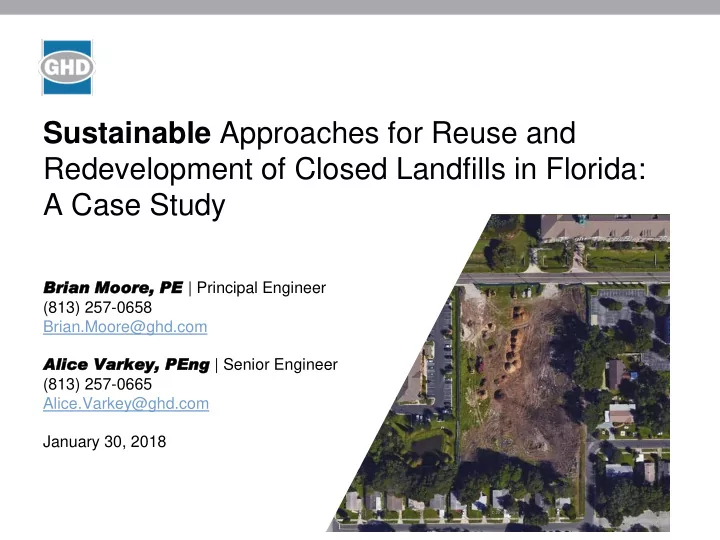
Sustainable Approaches for Reuse and Redevelopment of Closed Landfills in Florida: A Case Study Brian n Moore, re, PE | Principal Engineer (813) 257-0658 Brian.Moore@ghd.com Alice Varkey, ey, PEng | Senior Engineer (813) 257-0665


slide-1
SLIDE 1

Sustainable Approaches for Reuse and Redevelopment of Closed Landfills in Florida: A Case Study

Brian n Moore, re, PE | Principal Engineer (813) 257-0658 Brian.Moore@ghd.com Alice Varkey, ey, PEng | Senior Engineer (813) 257-0665 Alice.Varkey@ghd.com January 30, 2018

slide-2
SLIDE 2

What do these photos have in common?

slide-3
SLIDE 3

Overview of presentation

  • Closed landfills in Florida
  • Why recycle closed landfills
  • Case Studies
  • Lessons Learned
slide-4
SLIDE 4

Local Old Landfills/ Abandoned Dumps 171

  • ld landfills/abandoned

dumps identified

Source: Environmental Protection Commission – Hillsborough County Old Landfills/Abandoned Dumps http://www.epchc.org/divisions/waste-management/solid-hazardous-waste/old-landfills-abandoned-dumps

slide-5
SLIDE 5

Why Recycle Closed Landfills

 Value of land

  • Suburban areas are expanding; Sites exist in former

rural areas

  • New land uses/applications (buildings, infrastructure,

solar and wind power applications, etc…)  Value of buried disposed recyclables

  • Mining, processing, and marketing/selling

recyclables has become more feasible  Landfill Management/Compliance  Cost savings from reduced post closure care monitoring  Environmental benefits (reuse of land, reuse of recyclable materials, etc…)  Health and Safety (improved controls)

slide-6
SLIDE 6

FirstWord second third

Why recycle closed landfills

slide-7
SLIDE 7

Why Recycle Closed Landfills

Value of Land

  • Redevelopment for Residential/Commercial

use has increased over past several years throughout Florida

  • Sites exist in areas that were once rural, but

are now part of the suburbs

  • “Problem” sites are becoming more desirable
  • Stigma associated with blighted properties

has diminished for many

slide-8
SLIDE 8

Why Recycle Closed Landfills

Value of buried disposed recyclables

  • FDEP Rule 62-701.730 Construction and

Demolition Debris Disposal and Recycling

  • Mandated material recovery
  • Certified evaluation of economic feasibility
  • Buried materials provide value for redevelopment
slide-9
SLIDE 9

Why Recycle Closed Landfills

Landfill Management/Compliance

Regulatory Approvals

  • Post Closure Care regulations
  • Permitting
  • Financial Assurance obligations
  • Liabilities
  • Incentive programs
  • Remediation options
slide-10
SLIDE 10

Why Recycle Closed Landfills

Environmental Regulations Related to Waste Disposal Areas in Florida

  • Leachate

– Lined vs. Unlined – Leachate during construction

  • Gas

– Active/Passive Recovery Systems – Will Development Facilitate Gas Accumulation

  • Groundwater

– Is Groundwater Impacted? – Is groundwater quality adequately Characterized

  • Landfill Cover

– Exposure – Settlement Cost savings from reduced post closure care monitoring costs

slide-11
SLIDE 11

Why Recycle Closed Landfills

  • Offer compliance for facilities that may be out of compliance
  • Improved Aesthetics
  • Habitat Restoration

Environmental Benefits

slide-12
SLIDE 12

Why Recycle Closed Landfills

Health and Safety

  • Improved Controls
  • Trespassing
  • Health Risks
  • Gas migration
slide-13
SLIDE 13

Regulatory Oversight in Florida

Florida Department of Environmental Protection

“Guidance for Disturbance and Use of Old Closed Landfills or Waste Disposal Areas in Florida” August 19, 2015

  • Waste relocation
  • Waste left In-Place
  • Waste Removal and Offsite Disposal
  • Recycling Wastes and Vegetative Matter
  • Use of Screened Solid Waste
  • Water Quality Evaluations
  • Construction Near Waste-filled Areas
  • Construction Over Waste-filled Areas
slide-14
SLIDE 14

FirstWord second third

Case Studies

slide-15
SLIDE 15

Case Study 1 - Former Tampa Jai Alai

Former City of Tampa Landfill

  • 13.09 Acres
  • Primarily C&D Materials
  • Proposed Multifamily
  • Hillsborough County EPC Director’s Authorization
  • Initial Application Submitted July 2014
  • Several Redesigns of Site and Wetlands Permitting
  • Permit (DA) Issued March 2016
slide-16
SLIDE 16

Case Study 1 - Former Tampa Jai Alai

  • Leachate

‒ Unlined Facility, but leachate control required during RSM processing. Stormwater Controls (Lined Ponds)

  • Gas

‒ Venting Under Buildings and Monitoring

  • Groundwater

‒ Arsenic and TDS

  • Cover

‒ RSM will be Processed and reused under Asphalt

slide-17
SLIDE 17

Case Study 1 - Former Tampa Jai Alai

Challenges

  • Geotechnical Issues

‒ Slab design over waste

  • RSM Quality

‒ Well over 5% Organics make reuse difficult

  • Dewatering

‒ Unknown quantities of water (large voids)

  • Venting

‒ Passive with ability to go active quickly

  • Adjacent properties with Waste
slide-18
SLIDE 18

Case Study 1 - Former Tampa Jai Alai

Outcomes

  • Reuse of former blighted property
  • Increase in tax base for City of Tampa
  • Recovery and Recycling of Landfill Materials

‒ On-site Reuse

  • RSM in perimeter greenspaces
  • Crushed concrete for structural fill
  • Former landfill cover for structural fill

‒ Off-site recycling

  • Scrap Metal
  • Mulch
  • Compliance with current regulations (County/State)
  • Improve groundwater quality by removing waste
  • Trespassers/Hazards removed
  • Brownfields designation
slide-19
SLIDE 19

Case Study 2 – Shredder Residue Landfill (Texas)

Mining of former Shredder Residue Landfill

  • Active landfill which is short on capacity in remote area
  • Evaluation of landfill mining to increase capacity versus alternative

disposal site

‒ New technologies capable of material recovery (bench-scale) ‒ Mining allows increased capacity at existing landfill ‒ Revenue source offset costs of mining and processing buried materials ‒ Same equipment used for mining and processing of new material

slide-20
SLIDE 20

Case Study 3 – Millersville Landfill (Maryland)

Mining of former municipal solid waste landfill

  • Cell 1 East
  • Considered partial and full mining of 15-acre cell
  • Increase capacity for adjacent yard waste facility
  • Schematic Design Report

‒ Material recovery technologies ‒ Regulatory approvals ‒ Extent/volume of materials ‒ Disposal options

  • 25% Recyclables (100,000 CY)
  • Tires/metal/stumps/concrete
  • Clean Cover
slide-21
SLIDE 21

Lessons Learned Considerations for Developers/Owners

  • Is landfill permitted or unpermitted
  • Communicate with Regulators early in the process
  • Include community in decision making process early
  • Investigate opportunities to maximize site use and

materials recovery

  • If an unknown facility, important to characterize the

material

  • Utilization of site should be conceptualized early, well in

advance of site closure when possible

slide-22
SLIDE 22

Questions/Contacts

Brian Moore Brian.Moore@ghd.com (813) 257-0658

www.ghd.com

Alice Varkey Alice.Varkey@ghd.com (813) 257-0665

Tampa Orlando West Palm Beach Fort Myers Jacksonville Miami

slide-23
SLIDE 23

www.ghd.com