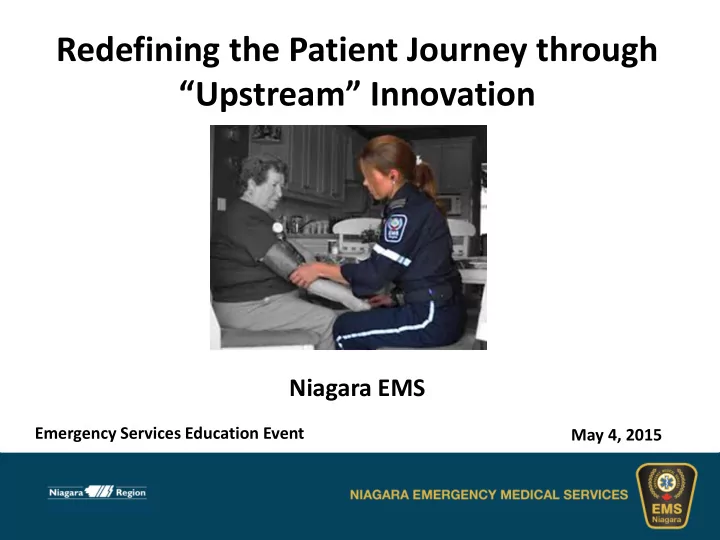
SLIDE 1 Redefining the Patient Journey through “Upstream” Innovation
Niagara EMS
Emergency Services Education Event May 4, 2015
SLIDE 2 Niagara in Comparison to the Rest of Ontario
Niagara compared to rest of province:
- Higher number of seniors
- High incidence of chronic disease
- Pockets of low socioeconomic status
- Some communities challenged with accessing
health care
2
SLIDE 3 Impact of System Pressures
- EMS – off load delays, increased emergency
response time, increased call volumes
- Hospitals – staffing pressures and resource
restraints including closures of smaller EDs
- Physicians – time pressures
- Community – insufficient funding for
community programs
SLIDE 4 How do these System Pressures affect Care for our Patients?
- Gaps in the trajectory of the patient journey
as they try to navigate the health care system
– Absent or inefficient care networks – Inability to navigate the resources that are available – Patients who use EMS as primary care – High risk patients discharged from hospital who are complex both medically and socially
SLIDE 5
SLIDE 6 University of Sheffield’s Medical Research Unit1
“Central to each (country’s) vision is the concept of providing pre-hospital care as a system, rather than just a single service type, that can provide a flexible response to a wide range of condition types in collaboration with
- ther related healthcare
- providers. “ (Sheffield, pg. 44)
University of Sheffield, Medical Research Unit (2011). Building the Evidence Base in Pre-Hospital Urgent and Emergency Care. Sheffield: University of Sheffield, Medical Research Unit.
SLIDE 7
Opportunity Exists to Build an Evidence Based “Holistic” System of Pre-Hospital Care
SLIDE 8 Omega Study
- Matches the patient's health care needs with the
appropriate level of service
- Safely manages the growing demands on health care
providers
- Reduces the demand on ambulance transportation
services
- Reduces emergency room visits and wait times
http://www.prioritysolutionsinc.com/psiam_software/introduction_to_psiam.html
SLIDE 9
What we know to date
Phase 1 – Modeling – Retrospective Analysis Phase 2 – Exploratory Trial – Prospective Analysis
SLIDE 10 OMEGA Phase 2 Run in Data
Hypothetically not diverted (42%) Hypothetically diverted (53.5%)
Ambulance arrived before CA finished questioning Incomplete (4.5%)
N=298
Although the CA’s may not have recommended hypothetical diversion from the ED, 10.5 % of those calls did hypothetically recommended alternate transport (non-ambulance).
SLIDE 11
Community Paramedic Program
1. Collaboration with key health care stakeholders through value stream mapping of community defined needs and building referral pathways 2. Expansion of the Community Paramedic Program in Wainfleet – enhancements Oct. 1 2015 3. 1 Community Paramedic to service patients in Welland, Port Colborne and Pelhem - Jan. 16 2015 4. 1 Community Paramedic to work with 1 Community Services Worker and 1 Rapid Response Nurse service area of St. Catharines, Thorold, Niagara on the Lake, Niagara Falls, Fort Erie – Just started
SLIDE 12
Enhancement of Wainfleet Community Paramedic Program
SLIDE 13 Community Paramedics in Wainfleet
- 26 patients currently rostered
- Seniors (65 and older)
- Complex needs and at risk with primary focus of:
– Falls prevention – Heart disease – COPD
- Identified via 9-1-1 calls, Niagara EMS database
- r primary care provider
SLIDE 14
Niagara South West Health Link - One fulltime Community Paramedic
SLIDE 15 Community Paramedic Activities in Niagara South West Health Link
- Servicing Welland, Port Colborne and Pelham
- 21 patients rostered
- Mostly 65 and older
- Complex needs and at risk with a primary focus of:
– CHF – COPD – Mental Health – Addictions
Patients are high EMS/hospital users
SLIDE 16 Role of Community Paramedic
- Timely alerts of admissions or discharges to/from ED
and hospital to Primary Care Provider
- Home visits with report to primary care, liaise with
CCAC if patient has care coordination
- Respiratory/cardiac/diabetic/nutrition education
- Falls Risk Assessments with ensuing referrals as
required
- Provide and follow recommendations as given by
primary care in conjunction with care coordinator
- Ensure follow up appointments are made and kept
with primary care
SLIDE 17 Community Paramedic Program Activities cont’d
- Assist with Medication reconciliation
– Use patient’s or Health Link’s pharmacist
- Referral to Existing Community Support Programs
– Help supplement a client’s needs in the home (e.g., Caring for My COPD, Safety at Home, CCAC, South Niagara Health and Wellness, Mental Health, Alzheimer’s Society)
- Case discussions with Medical Oversight
– Dr. Jeff Remington
SLIDE 18 Enhanced Training Tailored to Community Needs
New skill set for paramedics in response to community needs:
- Falls Prevention Training
- Cardiac/Diabetic Education Training
- Enhanced COPD Training
- Food Advisor Training
- Enhanced ACS/Cardiac Education
- Home Exercise Support
SLIDE 19 Community Paramedic Program Activities
- Teach-back’s and check-in’s:
– Note, by telephone via clinical advisor, RN, embedded within Niagara Ambulance Communications Centre
SLIDE 20 4 2 6 6 3 3 1 1 1 1 1 1 1 1 2 1 1 1 1 1 3
Referral Agencies and Linkages
CCAC Primary Care Provider Pharmacy Caring for my COPD Safety at Home Alzheimer's Society Red Cross VON Niagara South Health and Wellness March of Dimes United Way Hope House Gatekeeper Niagara CAMH Niagara Region Mental Health
SLIDE 21
Documentation of all visits
SLIDE 22
SLIDE 23