Reconstruction 1865- 1877 Reconstruction My friend I think you - - PDF document

reconstruction
SMART_READER_LITE
LIVE PREVIEW

Reconstruction 1865- 1877 Reconstruction My friend I think you - - PDF document

Reconstruction 1865- 1877 Reconstruction My friend I think you had better use all means to get ashore, even it if is Give me your hand a black man that saves master, now that i have you got a good hold of this tree I can help


slide-1
SLIDE 1

Reconstruction

1865- 1877

Reconstruction

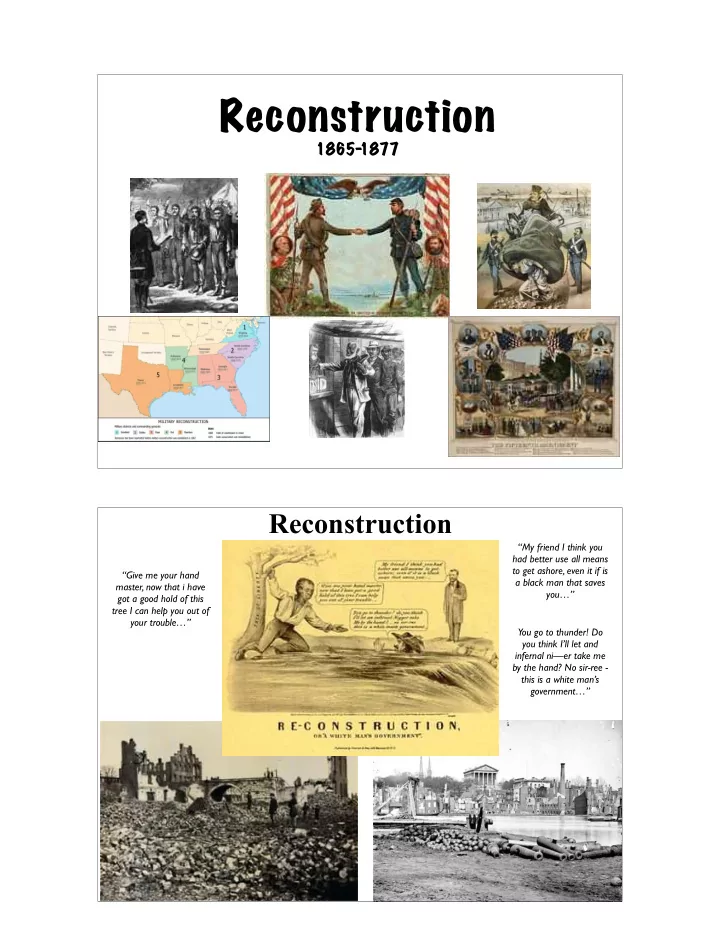
“Give me your hand master, now that i have got a good hold of this tree I can help you out of your trouble…” “My friend I think you had better use all means to get ashore, even it if is a black man that saves you…” You go to thunder! Do you think I’ll let and infernal ni—er take me by the hand? No sir-ree - this is a white man’s government…”

slide-2
SLIDE 2

__________________________

! the name of the ! __________________________ plan: ! Radical Republicans were Northern politicians who wanted to punish former Confederates (especially slave owners) and give Southern blacks full citizenship ! their plan said that Confederate states could rejoin the Union once a ________________

  • f those on the 1860 voting lists took an oath

to uphold the Constitution would also have to swear that they never supported the Confederacy in any way ! 1865-1877; the rebuilding of America right after the Civil War

Wade-Davis Bill Congress’s majority Proclamation of ________________________________

the name of ___________________ plan: he wanted to reunite the country quickly and painlessly ! granted pardons to Confederates who would swear allegiance to the Union

Confederate officials and those accused of war crimes were not pardoned as part of this plan

! each former Confederate state would be allowed to form a government and petition to rejoin the Union once ___________ of the voters registered in 1860 swore to follow the Constitution

Amnesty and Reconstruction Lincoln’s 10%

Reconstruction

With the Freedmen’s Bureau’s help, the recently freed slaves began voting !

(700,000 blacks voted for Grant in the 1868 election, helping him to become the next President)

! ! the Bureau was unable to protect the slaves from the ____________ , who terrorized freedmen for trying to vote, hold a political office, or own land !

fun fact: the Freedmen’s Bureau was headed by Headed by Union Army General ________________________________, born in Leeds, Maine; he attended Monmouth Academy, North Yarmouth Academy, and Kents Hill School and graduated from Bowdoin College; graduated fourth in his class from the United States Military Academy and fought valiantly for the Union in the Civil War, losing his arm and earning the Medal of Honor

_________________________________

federal organization created to provide !

_______________, _______________, _______________,

fuel, and advice on negotiating labor contracts to newly freed blacks

(but unfortunately no medical help)

! also attempted to oversee relations between freedmen and their former masters ! the Bureau was authorized to sell confiscated Confederate land in portions of up to

________ acres per buyer

!

(a myth was that slaves had been promised 40 acres and a mule, but this was not so)

Freedmen’s Bureau

food clothing shelter 40 KKK Oliver O. Howard

slide-3
SLIDE 3

“rules that created a twilight zone between slavery and freedom” ! ! blacks could ______________________, own property, ! sue in court, and ____________________________ ! blacks could not ______________________,

______________________, testify against or

!

______________ whites, or start their own businesses

! they also had to obey ________________ and needed permits to travel ! many were unjustly arrested and placed in work camps, used for their labor

legally marry

Jim Crow Laws

serve on juries carry weapons marry curfews

Black Codes

go to school ______________________________

! ! established a pattern of ___________________________ in all public facilities ! blacks and whites were separated in railway cars, schools, hospitals, restaurants, parks, playgrounds, water fountains, etc. ! began in 1870 and by 1890 existed throughout the entire South

segregation __________________________

Sharecropping and Tenant Farming

_______________________________________________________

! “______________________” were blacks and poor whites lived on and worked land they did not own they gave the owner a portion of the harvest in return for allowing them to farm the land ! in theory, they could save money and eventually rent the land from the owner or buy it outright they could keep all of their harvest each year (this rarely happened) ! after crops were shared and they paid their debts there was usually no money left ! “________________” farmers owned their own mules and equipment !

(sharecroppers were poorer and of lower status)

sharecroppers tenant

slide-4
SLIDE 4

The ____________ Amendment

(ratified by December, 1865)

! although slaves had been declared free by the _____________________________________ in 1863, it was only in “areas in rebellion” against the Union ! the 13th Amendment abolished _________________ and “involuntary servitude” throughout the nation

(again, an amendment is more permanent)

Constitutional Assistance

The ____________ Amendment

(passed by Congress June 13, 1866; ratified in 1868)

! in 1866, Johnson vetoed one bill that would have provided civil rights to blacks and another that would have continued to fund the Freedmen’s Bureau ! angry Radical Republicans overrode Johnson’s vetoes ! they drafted the 14th Amendment to take the place of the Civil Rights Bill

(again, an amendment is more permanent)

! the 14th Amendment stated that all US citizens were entitled to _____________________ under the law !

it also said that any state that stopped black people from voting would lose their representatives in Congress!

Thirteenth Emancipation Proclamation slavery Fourteenth equal protection

___________________________ occurs when someone’s right to vote is taken away from them !

at first, racist Southern whites controlled black voters in poorer “white counties” so they let them vote

!

  • nce blacks started voting for themselves (and for black candidates) the racist whites started passing local voting

laws that made it more difficult for blacks to vote:

Voting Rights

the “_________________________________________ of 1882” (SC): there were separate ballots and ballot boxes for each candidate or issue illiterate voters couldn’t tell which box to use - boxes were even moved around!

The ____________ Amendment of 1870

granted African American men the right to vote

!

“the right of citizens of the United States to vote shall not be denied or abridged by the United States or by any state on account of race, color, or previous condition of servitude”

!

(only fully realized when the Voting Rights Act was passed in 1965)

instituted a ____________________: a yearly tax paid to vote and had to bring receipt with you

disenfranchisement Eight-Box Ballot Act Poll Tax Fifteenth

added a two year ___________________________________: newly-freed blacks were moving around, trying to find a good living situation; they weren’t usually in one place for two years at a time

!

men convicted of certain crimes couldn’t vote

!

instituted the “____________________________________:” a voter had to read and interpret a portion of the Constitution the level of “understanding” was decided by a voting clerk

(usually white - sometimes illiterate themselves!)

!

instituted a “_________________________________________:” if your grandfather voted, then you could

residency requirement understanding clause grandfather clause
slide-5
SLIDE 5

Reconstruction Ends

__________________: white Southerners who worked with Northern businessmen and politicians considered traitors in the South __________________: Northerners who moved to the South after the war some teachers and ministers felt a moral duty to help some business people wanted to start new industries some were dishonest, stealing from the locals

supposedly carried all their belongings in a bag made of carpet

Scalawags Carpetbaggers

the focus of Reconstruction began to shift from ___________ (equality) needs to _____________ (income) needs ! Southerners really resented the presence of federal troops and other northerners in the South

social economic Election of 1876

! Republican Rutherford B. _______________ v. Democrat Samuel J. _______________ ! ! elections in some southern states were disputed: both Democrats and Republicans claimed victory ! the House of Representatives set up an electoral commission to figure it out comprised of _____ Republicans and _____ Democrats ! the commission (by majority [Republican]vote) gave all the disputed votes to Hayes (of course) ! Southerners weren’t happy, so the House created the ___________________________: ! Southern states would accept Hayes as the winner if: > Southern states received funds for railroads, roads, bridges, etc. > _________________________ were withdrawn from the South ! Reconstruction is essentially over (especially for the blacks)

Hayes Tilden federal troops Compromise of 1877 8 7

(supported by the north) (supported by the south)

in 1896, the Supreme Court upheld the Louisiana segregation as constitutional ! Justice Henry Brown wrote:

“The object of the Fourteenth Amendment was undoubtedly to enforce the absolute equality of the two races before the law, but in the nature of things it could not have been intended to abolish distinctions based upon color,

  • r to enforce social, as distinguished from political equality, or a commingling of the two races

upon terms unsatisfactory to either.”

! the Plessy decision set the precedent that “________________” facilities for blacks and whites were constitutional as long as they were “_______________” (they never were) ! the “___________________________________” doctrine was quickly extended to cover many areas of public life, such as restaurants, theaters, restrooms, and public schools ! facilities for blacks, however, were always inferior to those for whites ! not until the 1954 ________________________________________ case would “separate but equal” be struck down Louisiana passed the Separate Car Act in 1892, legally segregating railroad cars ! 30-year-old Homer Plessy, an “__________________” (1/8th black), sat in white section of a railroad car was arrested for violating the segregation law ! his case was appealed all the way to the Supreme Court

  • ctoroon

separate equal separate but equal Brown v. Board of Education

_______________________

(1896)

Plessy v. Ferguson