Recommendations in Context Francesco Ricci Free University of - - PDF document

recommendations in context
SMART_READER_LITE
LIVE PREVIEW

Recommendations in Context Francesco Ricci Free University of - - PDF document

Recommendations in Context Francesco Ricci Free University of Bolzano/ Bozen fricci@unibz.it What movie should I see? 2 1 What book should I buy? 3 What news should I read? 4 2 What paper should I read ? 5 What travel should I do ? I


slide-1
SLIDE 1

1

Recommendations in Context

Francesco Ricci

Free University of Bolzano/ Bozen fricci@unibz.it

2
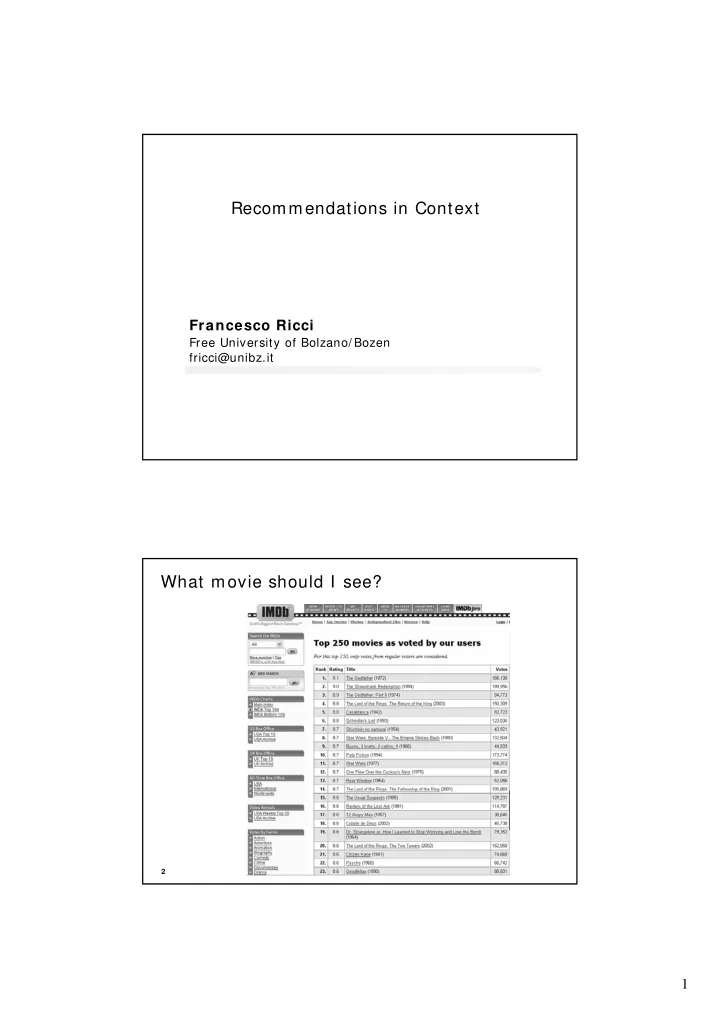
What movie should I see?

slide-2
SLIDE 2

2

3

What book should I buy?

4

What news should I read?

slide-3
SLIDE 3

3

5

What paper should I read ?

6

What travel should I do ?

  • I would like to escape from this ugly an tedious work life and

relax for two weeks in a sunny place. I am fed up with these crowded and noisy places … just the sand and the sea … and some “adventure”.

  • I would like to bring my wife and my children on a holiday … it

should not be to expensive. I prefer mountainous places… not to far from home. Children parks, easy paths and good cuisine are a must.

  • I want to experience the contact with a completely different
  • culture. I would like to be fascinated by the people and learn

to look at my life in a totally different way.

slide-4
SLIDE 4

4

7

Content

What problems we’d like to be solved by recommender

systems

What has been proposed – rating prediction What does not work in this approach – just a bit! Contextualization and personalization Examples of contextualization Learning to contextualize: process adaptation

8

Original Definition of RS

In everyday life we rely on recommendations from

  • ther people either by word of mouth, recommendation

letters, movie and book reviews printed in newspapers …

In a typical recommender system people provide

recommendations as inputs, which the system then aggregates and directs to appropriate recipients

– Aggregation of recommendations – Match the recommendations with those searching for

recommendations

[Resnick and Varian, 1997]

slide-5
SLIDE 5

5

9

Recommender Systems

  • A recom m ender system helps to make choices without

sufficient personal experience of the alternatives

To suggest products to their customers

To provide consumers with inform ation to help them decide which products to purchase

  • They are based on a number of technologies: information

filtering, machine learning, adaptive and personalized system, user modeling, …

  • Not clear separation from IR – [ Burke, 2002] claims that is

the “individualized” and “interesting and useful” features that make the difference.

10

“Core” Recommendation Techniques

[Burke, 2002]

U is a set of users I is a set of items/ products

slide-6
SLIDE 6

6

11

Collaborative-Based Filtering

12

slide-7
SLIDE 7

7

13

Collaborative-Based Filtering

  • The collaborative based filtering recommendation techniques

proceeds in these steps:

1.

For a target/ active user (the user to whom a recommendation has to be produced) the set of his ratings is identified

2.

The users more similar to the target/ active user (according to a similarity function) are identified (neighbor formation)

3.

The products bought by these similar users are identified

4.

For each one of these products a prediction - of the rating that would be given by the target user to the product - is generated

5.

Based on this predicted rating a set of top N products are recommended.

14

Content-Based Filtering: Syskill & Webert

The user indicated interest in The user indicated no interest in System Prediction

slide-8
SLIDE 8

8

15

Content-Based Recommender

  • It is mainly used for recommending text-based products

(web pages, usenet news messages, )

  • The items to recommend are “described” by their associated

features (e.g. keywords)

  • The User Model can be structured in a “similar” way as the

content: for instance the features/ keywords more likely to

  • ccur in the preferred documents (lazy approach)

– Then, text documents can be recommended based on a

comparison between their content (words appearing in the text) and a user model (a set of preferred words)

  • The user model can also be a classifier based on whatever

technique (Neural Networks, Naïve Bayes, C4.5, )

16

Demographic-based personalization

slide-9
SLIDE 9

9

17

Utility related information

Utility-Based

18

Utility methods

A utility function is a map from a state onto a real

number, which describes the associated degree of happiness

Can build a long term utility function but more often the

systems using such an approach try to acquire a short term utility function

They m ust acquire the user utility function, or the

parameters defining such a function

slide-10
SLIDE 10

10

19

Knowledge-Based Recommender System

  • Entree is a case-

based restaurant recommender system – it finds restaurants:

1.

in a new city similar to restaurants the user knows and likes

2.

  • r those

matching some user goals (case features).

20

Partial Match

  • In general,
  • nly a subset
  • f the

preferences will be matched in the recommended restaurant.

slide-11
SLIDE 11

11

21

A Simplified Model of Recommendation

1.

Two types of entities: Users and Items

2.

A background knowledge:

  • A set of ratings: a map R: Users x Items [ 0,1] U { ?}
  • A set of “features” of the Users and/ or Items

3.

A m ethod for eliminating all or part of the ‘?’ values for some (user, item) pairs – substituting ‘?’ with the true values

4.

A method for selecting the items to recommend

  • Recommend to u the item i* such that:
  • i* = arg maxi∈Items { R(u,i)}

[Adomavicius et al., 2005]

22

A Bidimensional Model

user item

ratings User features Product features 5

slide-12
SLIDE 12

12

23

Collaborative Filtering

user item

ratings

Ex: 4 out of 5

24

Content Based Filtering (Classical)

user item

ratings Product features

Uses only the ratings of the target (active) user

slide-13
SLIDE 13

13

25

ratings

Knowledge-Based

user item

User features Product features

Rich user and product profiles and complex relationships between the two models

relations relations relations

26

What these techniques forget

What the user is doing when asking for a

recommendation

What the user really wants (e.g., improve his

knowledge or really buy a product)

Is the user alone or with other fellows? Are there many products to choose or only few? Is the word economy growing or falling? …

slide-14
SLIDE 14

14

27

Contextual Computing

  • Contextual com puting refers to the enhancement of a

user’s interactions by understanding the user, the context, and the applications and information being used, typically across a wide set of user goals

  • Actively adapting the computational environment - for each

and every user - at each point of com putation

  • Contextual computing approach focuses on understanding the

inform ation consum ption patterns of each user

  • Contextual computing focuses on the process not only on the
  • utput of the search process.

[Pitkow et al., 2002]

28

Contextualization and Individualization

  • Contextualization: the interrelated conditions that occur

within an activity

– It includes factors like the nature of information available,

the information currently being examined, the applications in use, when, and so on

  • I ndividualization: the totality of characteristics that

distinguishes an individual

– It encompasses elements like the user’s goals, prior and

tacit knowledge, past information-seeking behaviors, among others

  • Personalization m ust focus on the com bination of the

user and the context within the application of search.

[Pitkow et al., 2002]

slide-15
SLIDE 15

15

29

Factors influencing Holiday Decision

Decision

Personal Motivators Personality Disposable Income Health Family commitments Past experience Works commitments Hobbies and interests Knowledge of potential holidays Lifestyle Attitudes,

  • pinions and

perceptions

Internal to the tourist External to the tourist

Availability of products Advice of travel agents Information obtained from tourism

  • rganization and

media Word-of-mouth recommendations Political restrictions: visa, terrorism, Health problems Special promotion and offers Climate

30

Context Preferences

slide-16
SLIDE 16

16

31

Preferences

Ranking is computed by considering more recommendable those products/ services that where selected in other travel plans with similar contextual features

32

When an Attribute-Based Search May Fail

  • The user is seeking suggestions, hints, and inspiration rather

than options that must optimize a collection of decision criteria

  • The user does not have knowledge of the tourism jargon that

is typically used in the description of travel products and services

  • The user can be intimidated and even not able to use

advanced search tools based on queries – conjunction of constraints

  • The preferences are not defined before the search process but

are “constructed” while learning about available products [ Bettman et al., 1998] .

All of these issues point to different contextual conditions

slide-17
SLIDE 17

17

33

Seeking for Inspiration – Preference-based Feeedback http://dietorecs.itc.it

[Ricci et al., 2005b]

34

Seeking for Inspiration

I-Like(ci)

Explanation

Case Base

Retrieval

Browsed Cases

user Selection Presentation

seed case

(c1, c2, c3 , c4 , c5 , c6)

Seeking for Inspiration

slide-18
SLIDE 18

18

35

www.visiteurope.com

Major European Tourism Destination Portal of the

European Travel Commission (ETC)

34 National Tourism Organizations Project started

2004

Consortium:

EC3, TIScover, ITC-irst, Siemens, Lixto

On line since

April 06

500.000 page

views/ month

100.000

visitors/ month

36

Context-dependent travel planning

There is no single best strategy for bundling – a

strategy must be influenced by:

1 . The travel plan – the goal of the process: it could

be many “different” objects: package, flight&drive, itinerary, just an event

2 . Travelers – the user: they have different motivations,

goals, preferences, style of traveling, …

3 . I nform ation search and package bundling

preferences: user may need to consults parents, read reviews, compare offers, think about, …

slide-19
SLIDE 19

19

37

Multiple bundling strategies

Single iterative product selection from

catalogues: manual search of products/ services with interactive query support (dealing with query failures)

Recom m endation by proposal: after products

suggestion the user can critique these products and the critiques are incorporated in a new products’ list

Selection of a com plete package: user search from

a catalogue of fixed or simple customizable packages

Com pletion of a partial package: a partial solution,

e.g., product selected by the traveller (e.g. an event or an accommodation) is completed by the system either by fulfilling a still open goal or by simply proposing products types that can be found in similar travel plans.

38

Scenarios

  • One strategy may better fit the current context than another
  • Offer the user the possibility to choose one function and

follow her preferred strategy

  • Provide good metaphors to let her understand what she will

get User

Incremental single item selection Recommendation by proposal Package selection Package completion Package customization Dynamic bundling

slide-20
SLIDE 20

20

39

For instance

This tries to dispatch users to strategies according to a user self evaluation and identification to a behavioral profile

40

Observations

  • It is difficult for a user to understand what is the best

“entrance”

  • It is even more difficult to understand what is the system

functions that might better suit her and how to better use them

  • The user needs to explore the system and learn:

– The precise behavior of system functions – The advantages of one function over the others – The possibility to combine and integrate functions to

achieve a goal (e.g. bundle a set of services)

  • Taks support is required – but how to learn to correctly

support the user in the task?

slide-21
SLIDE 21

21

41

Sequences of recommendation functions

  • The possible sequences of recommendation functions can be

too large to be explored by a user (if she has to learn a best system usage)

  • Some “paths” could perform rather poorly in general
  • Some “paths” may suit better a single user
  • Can we rank paths?

Incremental single item selection Recommendation by proposal Package selection Package completion Package customization Dynamic bundling Incremental single item selection Incremental single item selection Package customization

Time 1 2 3

42

… the word is one click away

We should consider that the options are not limited to

that included in the web site

Some visit to external sites may be beneficial and keep

the customer

Some exits may be fatal Incremental single item selection Seach Google Package selection Package customization Dynamic bundling Visit Competitor Site BUY Package customization

Time 1 2 3

NOT BUY ABORT SESSION

slide-22
SLIDE 22

22

43

Structured recommendation functions (UML Model)

Incremental single item selection Edit Query Execute Query Suggest Tightening Suggest Relaxation Show ranked list Add to bundle

System decision: execute the query or ask additional information to the user?

User decision User decision User decision

44

Learning Best Recommendation Strategy

  • If we want to adapt the recommendation process to the context then

the system must be able to decide on a number of open questions:

What packaging method/ strategy should be suggested?

What type of information should be asked?

In which order the system m ust present all the information required?

When it is better to actively support the user with directions?

When the system should push a recommendation?

When the system would be better listening to the user needs?

we need to LEARN the system behavior from

the interaction logs rather than the products to recommend!

slide-23
SLIDE 23

23

45

Augmenting a IS with a Recommender

  • The information system

provides information seeking and recommendation functions

  • The recommender agent
  • bserves: the user, the

interaction and IS

  • The recommender agent

interact with the user when believes there is a need for help

  • The recommender agents

suggests to the user actions to be performed on the IS Recommender System Information System Recommender Agent User

46

Multiple Output for a User Action

P0 P1 P2 P3 P4 f1 f1 f2 f5 f4 f3 f4 f1 f1 f0 Goal

  • The user is in P0 and ask for

a list of products (f1)

  • The system has now tw o
  • ptions:

– Show the full list ( as

before)

– Recom m end a

product, i.e., bring the user in P3

  • f1 asks for a lists of products
  • f2 asks to sort the list by an attribute
  • f3 asks a recommendation
  • f4 asks to buy a product
  • f5 asks to compare two products

User Actions How to learn to take this decision?

slide-24
SLIDE 24

24

47

Agent/ Environment

Agent = recom m ender agent – Performs actions and perceives reward and new

state

Environm ent = the inform ation system and the

user

– Determine the state transition and returns to the

user the next state information and the reward

48

A Markov Decision Process Model

  • State: S = I × R × U

I is a model of the interaction (e.g. the current and last visited page, the number of page seen, etc.)

R is a model of the recommendation agent (e.g. the number of times it has pushed a suggestion, the type of the last action suggestion, etc.)

U is a model of the user (preferences, emotions, group composition, etc.)

  • A set AR of actions available to the recommender (suggestion for actions

that the user may or should do, e.g., “look at last minute offers!”

  • A transition m odel T(s, a, s') that gives the probability to make a transition

from state s to state s' when the recommendation agent makes the action a.

  • A rew ard function R(s, a) that assign a reward value, i.e., a real number, to

the recommendation agent, for each state s and action a taken in state s of the interaction. The goal state (check out) has a positive reward, whereas each, intermediary state has a negative reward. Reward should be greater if the user “followed” the recommender suggestion.

  • GOAL: compute a policy, i.e., a map from states to actions that when applied

will maximize the total expected discounted reward t t t T

R R

∞ =

=

Rt is the reward at time t and 0< γt < 1

slide-25
SLIDE 25

25

49

Example: Query Tightening

50

Example: Query Tightening

  • Currently when a query returns too many options (greater

than 50) the system suggest tightening

  • Is it a good strategy? Can we improve the strategy?

– Goal: reduce the interaction length (reward is negative in

each state unless the goal state is reached)

– How: have a dynamic strategy – the system decides (state

by state) if it is better to suggest tightening or is better to show all the results

  • W hat are the relevant variables that should describe

the state?

[Ricci and Mahmood, 2006]

slide-26
SLIDE 26

26

51

Pages and user actions

  • Pages

Start = s

Query form = QF

Tightening = T

Result set = R

End = G

  • User actions

Start interaction = go

Modify query = modq

Execute query = execq

Accept tightening = acct

Reject Tightening show all = rejt

Add to cart = add

S QF T R G modq

execq execq

add modq acct, rejt go

52

Query Form

In this page the user can only fill the form and execute the query (search)

slide-27
SLIDE 27

27

53

Tigthening

  • In this page the user can either

1.

Accept tightening and modify the query with respect to one of the features suggested (“Category”, “Car park”, or “TV”) - acct

2.

Reject tightening and execute the original query (“Get all results”) -rejt

3.

Modify the query on other features - m odq

3: modq 1: acct 2: rejt

54

Result set

  • Here the user can

1.

either add an item to the travel bag (cart) – add

2.

Or modify the query an execute it - m odq

1: add 2: modq

slide-28
SLIDE 28

28

55

Policy

  • The transition probabilities - T(s, a, s’) - model the user

stochastic reply to the system actions

  • A policy is a function that assign to each state an action
  • If the system adopts that policy the value of a state is

given by

A S → : π

56

Policy Learning

  • If T(s, a, s’) are known then the optimal behavior of the

recommendation agent would be a policy

  • such that, for each initial state s, if the agent behaves

accordingly to the policy then the expected total reward is maximum

A S → : π

slide-29
SLIDE 29

29

57

Results

When the cost of each interaction is sm all it is better to

execute the query, do not propose tightening, and let the user to modify the query autonomously

If the cost of interaction become larger than it is better

to suggest the tightening.

Initial policy

(m,s) means current size m and expected new size (after tightening) small

58

User1: 3 stars hotel in Cracow? User2: 3 stars hotel in Cracow? User1: 3 stars hotel in Cracow? User2: 3 stars hotel in Cracow? It seems that they can be served with the same strategy and products Different serving strategies and products for “lazy” and “eager” users

slide-30
SLIDE 30

30

59

Conclusion

Recommender systems have offered “complex”

techniques to predict user ratings under “simple” contextual conditions

We need to devote more thoughts about what makes

the recommendation process more useful for the user – considering that both the user and the system live in a larger context

We should explore learning technologies that adapts

the recommendation process and not only the product to be recommended.

60

fricci@unibz.it