2003 Retention Task Force Recommendations Recommendation - - PowerPoint PPT Presentation

2003 retention task force recommendations
SMART_READER_LITE
LIVE PREVIEW

2003 Retention Task Force Recommendations Recommendation - - PowerPoint PPT Presentation

2003 Retention Task Force Recommendations Recommendation Recommendations Current Status of Programs/Services That Address the Recommendations of the Task Theme Force Establish First Year Academic Affairs/Enrollment Services created Office of


slide-1
SLIDE 1

2003 Retention Task Force Recommendations

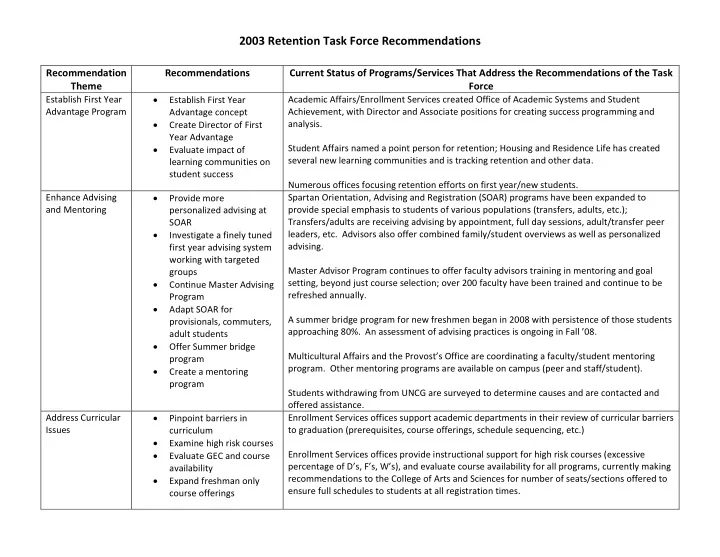
Recommendation Theme Recommendations Current Status of Programs/Services That Address the Recommendations of the Task Force

Establish First Year Advantage Program

  • Establish First Year

Advantage concept

  • Create Director of First

Year Advantage

  • Evaluate impact of

learning communities on student success Academic Affairs/Enrollment Services created Office of Academic Systems and Student Achievement, with Director and Associate positions for creating success programming and analysis. Student Affairs named a point person for retention; Housing and Residence Life has created several new learning communities and is tracking retention and other data. Numerous offices focusing retention efforts on first year/new students. Enhance Advising and Mentoring

  • Provide more

personalized advising at SOAR

  • Investigate a finely tuned

first year advising system working with targeted groups

  • Continue Master Advising

Program

  • Adapt SOAR for

provisionals, commuters, adult students

  • Offer Summer bridge

program

  • Create a mentoring

program Spartan Orientation, Advising and Registration (SOAR) programs have been expanded to provide special emphasis to students of various populations (transfers, adults, etc.); Transfers/adults are receiving advising by appointment, full day sessions, adult/transfer peer leaders, etc. Advisors also offer combined family/student overviews as well as personalized advising. Master Advisor Program continues to offer faculty advisors training in mentoring and goal setting, beyond just course selection; over 200 faculty have been trained and continue to be refreshed annually. A summer bridge program for new freshmen began in 2008 with persistence of those students approaching 80%. An assessment of advising practices is ongoing in Fall ’08. Multicultural Affairs and the Provost’s Office are coordinating a faculty/student mentoring

  • program. Other mentoring programs are available on campus (peer and staff/student).

Students withdrawing from UNCG are surveyed to determine causes and are contacted and

  • ffered assistance.

Address Curricular Issues

  • Pinpoint barriers in

curriculum

  • Examine high risk courses
  • Evaluate GEC and course

availability

  • Expand freshman only

course offerings Enrollment Services offices support academic departments in their review of curricular barriers to graduation (prerequisites, course offerings, schedule sequencing, etc.) Enrollment Services offices provide instructional support for high risk courses (excessive percentage of D’s, F’s, W’s), and evaluate course availability for all programs, currently making recommendations to the College of Arts and Sciences for number of seats/sections offered to ensure full schedules to students at all registration times.

slide-2
SLIDE 2

2003 Retention Task Force Recommendations

  • Update versions of UNS

101

  • Create learning

community clusters

  • Improve course

information on web

  • Ensure course schedules

for late attendees at SOAR UNS (transition to college) courses have been expanded into every academic unit and enrollment has increased. Persistence for students taking UNS courses exceeds 78% compared with 74% for those not taking the courses. Supplemental Instruction offered more widely. New learning communities and the Lloyd International Honors program has been added. Some courses are held for late SOAR registrants. Encourage Faculty Involvement

  • Encourage faculty

strategies to foster success

  • Take attendance
  • Provide early indication of

performance

  • Develop early warning

system

  • Disseminate tutorial and

support system information in class Early Spartan Success Initiative (ESSI) and UNCG Cares (550 faculty/staff trained) are new programs designed to allow faculty and staff to report early when academic and social issues

  • ccur. The ESSI online report form is also available to students who are concerned about their

peers and students are being asked through UNCG Cares: Students Helping Students to get their peers or the information to one of four hub offices. Faculty are increasingly requiring Supplemental Instruction for students in courses with high rates of D, F, W grades. Student Success Advisory Group, comprised of representatives from school advising center and Enrollment Services offices, share information about retention efforts within the departments and schools for greater understanding of their contributions to the overall retention efforts. Many support offices speak in each of the UNS sections, at SOAR, and in other programming to insure information is widely distributed. Improve Financial Aid Funding

  • Increase financial aid

funding

  • Identify scholarship

recipients and track success

  • Increase merit awards
  • Increase need based aid

ASSA and the Financial Aid Office are currently studying the level of student unmet financial need, creating programming for students who fail to make Satisfactory Academic Progress. Student Affairs assists students who face financial hardships and/or have extenuating

  • circumstances. Career Services continues to assess on‐campus job availability and success of

students based on hours worked. Improve Business Practices and Campus Environment to

  • Reduce run‐around for

students both physically and procedurally

  • Study stumbling blocks in

The campus has added two parking/public transportation options and added common space for students, such as food courts, lounge space for working together and socializing. Enrollment Services offices continue to study policies that are barriers to success and have

slide-3
SLIDE 3

2003 Retention Task Force Recommendations

Foster Success areas of parking, lack of accessible day care, lack of clarity in academic policies, easily accessible and timely psychological counseling

  • Integrate campus physical

environment to foster success.

  • Develop seamless

enrollment process.

  • Stress student success as

desired outcome in admissions material, presentations; continue to hone PGPA criteria. modified some. Counseling Center now has 11 full time counselors as well as 4 days of psychiatric services; triage system allows for immediate access for students in crisis. UNCG Cares has trained 550 faculty and staff in creating a culture of care at UNCG and reaching out to students in distress. Dean of Students Office is now a support center for students in distress or those who are disruptive and the faculty/staff/families working with those students. Admissions, Orientation, Registrar, Advising Council and others work to insure enrollment process is seamless and affirming for students. Many offices provide services and programming that address needs of various student populations (freshmen, transfers, under‐represented groups, for example). Significant amount

  • f change since 2003 regarding community service and service learning, both of which

contribute to student success. Student success is stressed in all presentations, publications, and activities. Examine Data for Tracking Student Success

  • Initiate longitudinal

database

  • Gather and store relevant

data in Banner

  • Track cohorts
  • Examine demographics

Much demographic and survey data is being stored and analyzed, based on cohorts of students of different types. Students who participate in various programs are being tracked to determine programs’ contributions to success. Analysis of the predictive value of the Predicted GPA for new freshmen is underway. A pilot program is currently underway evaluating the importance of students’ Emotional Intelligence (EI) and preparedness for college.