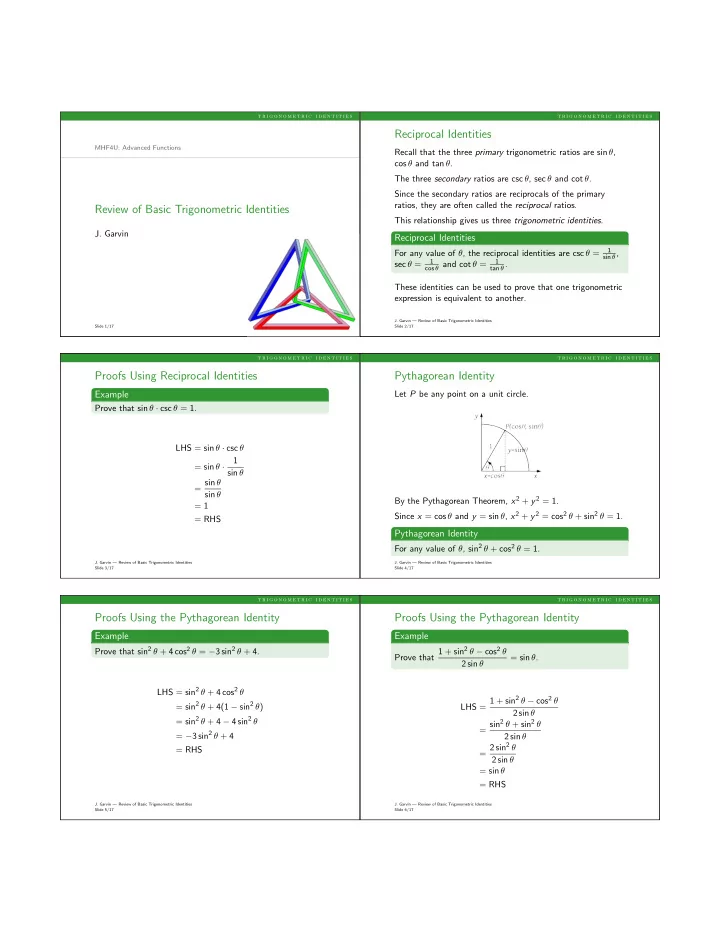

SLIDE 1
t r i g o n o m e t r i c i d e n t i t i e s
MHF4U: Advanced Functions
Review of Basic Trigonometric Identities
- J. Garvin
Slide 1/17
t r i g o n o m e t r i c i d e n t i t i e s
Reciprocal Identities
Recall that the three primary trigonometric ratios are sin θ, cos θ and tan θ. The three secondary ratios are csc θ, sec θ and cot θ. Since the secondary ratios are reciprocals of the primary ratios, they are often called the reciprocal ratios. This relationship gives us three trigonometric identities.
Reciprocal Identities
For any value of θ, the reciprocal identities are csc θ =
1 sin θ,
sec θ =
1 cos θ and cot θ = 1 tan θ.
These identities can be used to prove that one trigonometric expression is equivalent to another.
- J. Garvin — Review of Basic Trigonometric Identities
Slide 2/17
t r i g o n o m e t r i c i d e n t i t i e s
Proofs Using Reciprocal Identities
Example
Prove that sin θ · csc θ = 1. LHS = sin θ · csc θ = sin θ · 1 sin θ = sin θ sin θ = 1 = RHS
- J. Garvin — Review of Basic Trigonometric Identities
Slide 3/17
t r i g o n o m e t r i c i d e n t i t i e s
Pythagorean Identity
Let P be any point on a unit circle. By the Pythagorean Theorem, x2 + y2 = 1. Since x = cos θ and y = sin θ, x2 + y2 = cos2 θ + sin2 θ = 1.
Pythagorean Identity
For any value of θ, sin2 θ + cos2 θ = 1.
- J. Garvin — Review of Basic Trigonometric Identities
Slide 4/17
t r i g o n o m e t r i c i d e n t i t i e s
Proofs Using the Pythagorean Identity
Example
Prove that sin2 θ + 4 cos2 θ = −3 sin2 θ + 4. LHS = sin2 θ + 4 cos2 θ = sin2 θ + 4(1 − sin2 θ) = sin2 θ + 4 − 4 sin2 θ = −3 sin2 θ + 4 = RHS
- J. Garvin — Review of Basic Trigonometric Identities
Slide 5/17
t r i g o n o m e t r i c i d e n t i t i e s
Proofs Using the Pythagorean Identity
Example
Prove that 1 + sin2 θ − cos2 θ 2 sin θ = sin θ. LHS = 1 + sin2 θ − cos2 θ 2 sin θ = sin2 θ + sin2 θ 2 sin θ = 2 sin2 θ 2 sin θ = sin θ = RHS
- J. Garvin — Review of Basic Trigonometric Identities
Slide 6/17