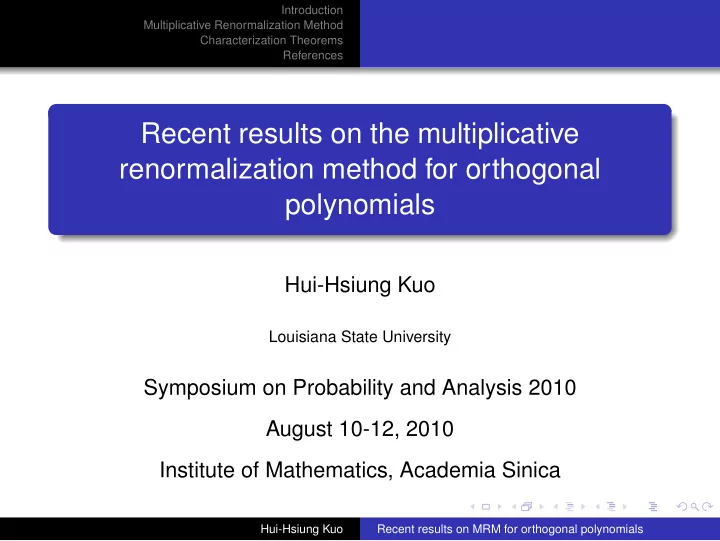
Recent results on the multiplicative renormalization method for - - PowerPoint PPT Presentation

recent results on the multiplicative renormalization
SMART_READER_LITE
LIVE PREVIEW

Recent results on the multiplicative renormalization method for - - PowerPoint PPT Presentation

Introduction Multiplicative Renormalization Method Characterization Theorems References Recent results on the multiplicative renormalization method for orthogonal polynomials Hui-Hsiung Kuo Louisiana State University Symposium on


slide-1
SLIDE 1

Introduction Multiplicative Renormalization Method Characterization Theorems References

Recent results on the multiplicative renormalization method for orthogonal polynomials

Hui-Hsiung Kuo

Louisiana State University

Symposium on Probability and Analysis 2010 August 10-12, 2010 Institute of Mathematics, Academia Sinica

Hui-Hsiung Kuo Recent results on MRM for orthogonal polynomials

slide-2
SLIDE 2

Introduction Multiplicative Renormalization Method Characterization Theorems References

Outline

1

Introduction Orthogonal polynomials An example (key idea) Another example (key idea)

2

Multiplicative Renormalization Method OP-generating function MRM procedure Classical distributions

3

Characterization Theorems Characterization problems MRM-applicable measures MRM-factors

4

References

Hui-Hsiung Kuo Recent results on MRM for orthogonal polynomials

slide-3
SLIDE 3

Introduction Multiplicative Renormalization Method Characterization Theorems References Orthogonal polynomials An example (key idea) Another example (key idea)

Outline

1

Introduction Orthogonal polynomials An example (key idea) Another example (key idea)

2

Multiplicative Renormalization Method OP-generating function MRM procedure Classical distributions

3

Characterization Theorems Characterization problems MRM-applicable measures MRM-factors

4

References

Hui-Hsiung Kuo Recent results on MRM for orthogonal polynomials

slide-4
SLIDE 4

Introduction Multiplicative Renormalization Method Characterization Theorems References Orthogonal polynomials An example (key idea) Another example (key idea)

µ: a probab measure on R such that

  • R |x|n dµ(x) < ∞, ∀n ≥ 1

Apply the Gram-Schmidt orthogonalization process to get

  • 1, x, . . . , xn, . . .

  • P0(x), P1(x), . . . , Pn(x), . . .
  • where Pn(x) is a poly of degree n with leading coefficient 1.

Theorem (Recursion formula) ∃ sequences {αn}, {ωn} such that xPn(x) = Pn+1(x) + αnPn(x) + ωnPn−1, n ≥ 0, where ω0 = 1 and P−1 = 0. Question: Given µ, how can we derive

  • Pn(x), αn, ωn
  • ?

Hui-Hsiung Kuo Recent results on MRM for orthogonal polynomials

slide-5
SLIDE 5

Introduction Multiplicative Renormalization Method Characterization Theorems References Orthogonal polynomials An example (key idea) Another example (key idea)

µ: a probab measure on R such that

  • R |x|n dµ(x) < ∞, ∀n ≥ 1

Apply the Gram-Schmidt orthogonalization process to get

  • 1, x, . . . , xn, . . .

  • P0(x), P1(x), . . . , Pn(x), . . .
  • where Pn(x) is a poly of degree n with leading coefficient 1.

Theorem (Recursion formula) ∃ sequences {αn}, {ωn} such that xPn(x) = Pn+1(x) + αnPn(x) + ωnPn−1, n ≥ 0, where ω0 = 1 and P−1 = 0. Question: Given µ, how can we derive

  • Pn(x), αn, ωn
  • ?

Hui-Hsiung Kuo Recent results on MRM for orthogonal polynomials

slide-6
SLIDE 6

Introduction Multiplicative Renormalization Method Characterization Theorems References Orthogonal polynomials An example (key idea) Another example (key idea)

µ: a probab measure on R such that

  • R |x|n dµ(x) < ∞, ∀n ≥ 1

Apply the Gram-Schmidt orthogonalization process to get

  • 1, x, . . . , xn, . . .

  • P0(x), P1(x), . . . , Pn(x), . . .
  • where Pn(x) is a poly of degree n with leading coefficient 1.

Theorem (Recursion formula) ∃ sequences {αn}, {ωn} such that xPn(x) = Pn+1(x) + αnPn(x) + ωnPn−1, n ≥ 0, where ω0 = 1 and P−1 = 0. Question: Given µ, how can we derive

  • Pn(x), αn, ωn
  • ?

Hui-Hsiung Kuo Recent results on MRM for orthogonal polynomials

slide-7
SLIDE 7

Introduction Multiplicative Renormalization Method Characterization Theorems References Orthogonal polynomials An example (key idea) Another example (key idea)

µ: a probab measure on R such that

  • R |x|n dµ(x) < ∞, ∀n ≥ 1

Apply the Gram-Schmidt orthogonalization process to get

  • 1, x, . . . , xn, . . .

  • P0(x), P1(x), . . . , Pn(x), . . .
  • where Pn(x) is a poly of degree n with leading coefficient 1.

Theorem (Recursion formula) ∃ sequences {αn}, {ωn} such that xPn(x) = Pn+1(x) + αnPn(x) + ωnPn−1, n ≥ 0, where ω0 = 1 and P−1 = 0. Question: Given µ, how can we derive

  • Pn(x), αn, ωn
  • ?

Hui-Hsiung Kuo Recent results on MRM for orthogonal polynomials

slide-8
SLIDE 8

Introduction Multiplicative Renormalization Method Characterization Theorems References Orthogonal polynomials An example (key idea) Another example (key idea)

Outline

1

Introduction Orthogonal polynomials An example (key idea) Another example (key idea)

2

Multiplicative Renormalization Method OP-generating function MRM procedure Classical distributions

3

Characterization Theorems Characterization problems MRM-applicable measures MRM-factors

4

References

Hui-Hsiung Kuo Recent results on MRM for orthogonal polynomials

slide-9
SLIDE 9

Introduction Multiplicative Renormalization Method Characterization Theorems References Orthogonal polynomials An example (key idea) Another example (key idea)

Let µ be Gaussian N(0, σ2). Then Eetx = e

1 2 σ2t2,

ψ(t, x) := etx Eetx = etx− 1

2 σ2t2

Observation 1 E

  • ψ(t, x)ψ(s, x)
  • = eσ2ts is a function of ts.

Observation 2 We can expand ψ(t, x) as a power series in t ψ(t, x) =

  • n=0

1 n!Pn(x)tn where Pn(x) is a polynomial given by Pn(x) =

[ [n/2] ]

  • k=0

n 2k

  • (2k − 1)!!(−σ2)kxn−2k

Key Idea Observation 1 = ⇒ Pn’s are orthogonal (Hermite)

Hui-Hsiung Kuo Recent results on MRM for orthogonal polynomials

slide-10
SLIDE 10

Introduction Multiplicative Renormalization Method Characterization Theorems References Orthogonal polynomials An example (key idea) Another example (key idea)

Let µ be Gaussian N(0, σ2). Then Eetx = e

1 2 σ2t2,

ψ(t, x) := etx Eetx = etx− 1

2 σ2t2

Observation 1 E

  • ψ(t, x)ψ(s, x)
  • = eσ2ts is a function of ts.

Observation 2 We can expand ψ(t, x) as a power series in t ψ(t, x) =

  • n=0

1 n!Pn(x)tn where Pn(x) is a polynomial given by Pn(x) =

[ [n/2] ]

  • k=0

n 2k

  • (2k − 1)!!(−σ2)kxn−2k

Key Idea Observation 1 = ⇒ Pn’s are orthogonal (Hermite)

Hui-Hsiung Kuo Recent results on MRM for orthogonal polynomials

slide-11
SLIDE 11

Introduction Multiplicative Renormalization Method Characterization Theorems References Orthogonal polynomials An example (key idea) Another example (key idea)

Let µ be Gaussian N(0, σ2). Then Eetx = e

1 2 σ2t2,

ψ(t, x) := etx Eetx = etx− 1

2 σ2t2

Observation 1 E

  • ψ(t, x)ψ(s, x)
  • = eσ2ts is a function of ts.

Observation 2 We can expand ψ(t, x) as a power series in t ψ(t, x) =

  • n=0

1 n!Pn(x)tn where Pn(x) is a polynomial given by Pn(x) =

[ [n/2] ]

  • k=0

n 2k

  • (2k − 1)!!(−σ2)kxn−2k

Key Idea Observation 1 = ⇒ Pn’s are orthogonal (Hermite)

Hui-Hsiung Kuo Recent results on MRM for orthogonal polynomials

slide-12
SLIDE 12

Introduction Multiplicative Renormalization Method Characterization Theorems References Orthogonal polynomials An example (key idea) Another example (key idea)

Let µ be Gaussian N(0, σ2). Then Eetx = e

1 2 σ2t2,

ψ(t, x) := etx Eetx = etx− 1

2 σ2t2

Observation 1 E

  • ψ(t, x)ψ(s, x)
  • = eσ2ts is a function of ts.

Observation 2 We can expand ψ(t, x) as a power series in t ψ(t, x) =

  • n=0

1 n!Pn(x)tn where Pn(x) is a polynomial given by Pn(x) =

[ [n/2] ]

  • k=0

n 2k

  • (2k − 1)!!(−σ2)kxn−2k

Key Idea Observation 1 = ⇒ Pn’s are orthogonal (Hermite)

Hui-Hsiung Kuo Recent results on MRM for orthogonal polynomials

slide-13
SLIDE 13

Introduction Multiplicative Renormalization Method Characterization Theorems References Orthogonal polynomials An example (key idea) Another example (key idea)

Let µ be Gaussian N(0, σ2). Then Eetx = e

1 2 σ2t2,

ψ(t, x) := etx Eetx = etx− 1

2 σ2t2

Observation 1 E

  • ψ(t, x)ψ(s, x)
  • = eσ2ts is a function of ts.

Observation 2 We can expand ψ(t, x) as a power series in t ψ(t, x) =

  • n=0

1 n!Pn(x)tn where Pn(x) is a polynomial given by Pn(x) =

[ [n/2] ]

  • k=0

n 2k

  • (2k − 1)!!(−σ2)kxn−2k

Key Idea Observation 1 = ⇒ Pn’s are orthogonal (Hermite)

Hui-Hsiung Kuo Recent results on MRM for orthogonal polynomials

slide-14
SLIDE 14

Introduction Multiplicative Renormalization Method Characterization Theorems References Orthogonal polynomials An example (key idea) Another example (key idea)

Let µ be Gaussian N(0, σ2). Then Eetx = e

1 2 σ2t2,

ψ(t, x) := etx Eetx = etx− 1

2 σ2t2

Observation 1 E

  • ψ(t, x)ψ(s, x)
  • = eσ2ts is a function of ts.

Observation 2 We can expand ψ(t, x) as a power series in t ψ(t, x) =

  • n=0

1 n!Pn(x)tn where Pn(x) is a polynomial given by Pn(x) =

[ [n/2] ]

  • k=0

n 2k

  • (2k − 1)!!(−σ2)kxn−2k

Key Idea Observation 1 = ⇒ Pn’s are orthogonal (Hermite)

Hui-Hsiung Kuo Recent results on MRM for orthogonal polynomials

slide-15
SLIDE 15

Introduction Multiplicative Renormalization Method Characterization Theorems References Orthogonal polynomials An example (key idea) Another example (key idea)

Outline

1

Introduction Orthogonal polynomials An example (key idea) Another example (key idea)

2

Multiplicative Renormalization Method OP-generating function MRM procedure Classical distributions

3

Characterization Theorems Characterization problems MRM-applicable measures MRM-factors

4

References

Hui-Hsiung Kuo Recent results on MRM for orthogonal polynomials

slide-16
SLIDE 16

Introduction Multiplicative Renormalization Method Characterization Theorems References Orthogonal polynomials An example (key idea) Another example (key idea)

Let µ be Poisson with parameter λ. Then Eeρ(t)x = e−λ(1−eρ(t)) ψ(t, x) := eρ(t)x Eeρ(t)x = eρ(t)x+λ(1−eρ(t)) Then we have E

  • ψ(t, x)ψ(s, x)
  • = eλ(eρ(t)−1)(eρ(s)−1)

Observation E

  • ψ(t, x)ψ(s, x)
  • is a function of ts if we take

eρ(t) − 1 = t, i.e., ρ(t) = ln(1 + t) Thus we have the function ψ(t, x) = e−λt(1 + t)x

Hui-Hsiung Kuo Recent results on MRM for orthogonal polynomials

slide-17
SLIDE 17

Introduction Multiplicative Renormalization Method Characterization Theorems References Orthogonal polynomials An example (key idea) Another example (key idea)

Let µ be Poisson with parameter λ. Then Eeρ(t)x = e−λ(1−eρ(t)) ψ(t, x) := eρ(t)x Eeρ(t)x = eρ(t)x+λ(1−eρ(t)) Then we have E

  • ψ(t, x)ψ(s, x)
  • = eλ(eρ(t)−1)(eρ(s)−1)

Observation E

  • ψ(t, x)ψ(s, x)
  • is a function of ts if we take

eρ(t) − 1 = t, i.e., ρ(t) = ln(1 + t) Thus we have the function ψ(t, x) = e−λt(1 + t)x

Hui-Hsiung Kuo Recent results on MRM for orthogonal polynomials

slide-18
SLIDE 18

Introduction Multiplicative Renormalization Method Characterization Theorems References Orthogonal polynomials An example (key idea) Another example (key idea)

Let µ be Poisson with parameter λ. Then Eeρ(t)x = e−λ(1−eρ(t)) ψ(t, x) := eρ(t)x Eeρ(t)x = eρ(t)x+λ(1−eρ(t)) Then we have E

  • ψ(t, x)ψ(s, x)
  • = eλ(eρ(t)−1)(eρ(s)−1)

Observation E

  • ψ(t, x)ψ(s, x)
  • is a function of ts if we take

eρ(t) − 1 = t, i.e., ρ(t) = ln(1 + t) Thus we have the function ψ(t, x) = e−λt(1 + t)x

Hui-Hsiung Kuo Recent results on MRM for orthogonal polynomials

slide-19
SLIDE 19

Introduction Multiplicative Renormalization Method Characterization Theorems References Orthogonal polynomials An example (key idea) Another example (key idea)

Let µ be Poisson with parameter λ. Then Eeρ(t)x = e−λ(1−eρ(t)) ψ(t, x) := eρ(t)x Eeρ(t)x = eρ(t)x+λ(1−eρ(t)) Then we have E

  • ψ(t, x)ψ(s, x)
  • = eλ(eρ(t)−1)(eρ(s)−1)

Observation E

  • ψ(t, x)ψ(s, x)
  • is a function of ts if we take

eρ(t) − 1 = t, i.e., ρ(t) = ln(1 + t) Thus we have the function ψ(t, x) = e−λt(1 + t)x

Hui-Hsiung Kuo Recent results on MRM for orthogonal polynomials

slide-20
SLIDE 20

Introduction Multiplicative Renormalization Method Characterization Theorems References Orthogonal polynomials An example (key idea) Another example (key idea)

Let µ be Poisson with parameter λ. Then Eeρ(t)x = e−λ(1−eρ(t)) ψ(t, x) := eρ(t)x Eeρ(t)x = eρ(t)x+λ(1−eρ(t)) Then we have E

  • ψ(t, x)ψ(s, x)
  • = eλ(eρ(t)−1)(eρ(s)−1)

Observation E

  • ψ(t, x)ψ(s, x)
  • is a function of ts if we take

eρ(t) − 1 = t, i.e., ρ(t) = ln(1 + t) Thus we have the function ψ(t, x) = e−λt(1 + t)x

Hui-Hsiung Kuo Recent results on MRM for orthogonal polynomials

slide-21
SLIDE 21

Introduction Multiplicative Renormalization Method Characterization Theorems References Orthogonal polynomials An example (key idea) Another example (key idea)

Let µ be Poisson with parameter λ. Then Eeρ(t)x = e−λ(1−eρ(t)) ψ(t, x) := eρ(t)x Eeρ(t)x = eρ(t)x+λ(1−eρ(t)) Then we have E

  • ψ(t, x)ψ(s, x)
  • = eλ(eρ(t)−1)(eρ(s)−1)

Observation E

  • ψ(t, x)ψ(s, x)
  • is a function of ts if we take

eρ(t) − 1 = t, i.e., ρ(t) = ln(1 + t) Thus we have the function ψ(t, x) = e−λt(1 + t)x

Hui-Hsiung Kuo Recent results on MRM for orthogonal polynomials

slide-22
SLIDE 22

Introduction Multiplicative Renormalization Method Characterization Theorems References Orthogonal polynomials An example (key idea) Another example (key idea)

Expand ψ(t, x) as a power series in t: ψ(t, x) =

  • n=0

1 n!Cn(x)tn where Cn(x) is a polynomial given by Cn(x) =

n

  • k=0

n k

  • (−λ)kpx,n−k

with px,0 = 1, px,m = x(x − 1)(x − 2) · · · (x − m + 1), m ≥ 1. Key Idea The above Observation = ⇒ Cn’s are orthogonal (Charlier polynomials)

Hui-Hsiung Kuo Recent results on MRM for orthogonal polynomials

slide-23
SLIDE 23

Introduction Multiplicative Renormalization Method Characterization Theorems References Orthogonal polynomials An example (key idea) Another example (key idea)

Expand ψ(t, x) as a power series in t: ψ(t, x) =

  • n=0

1 n!Cn(x)tn where Cn(x) is a polynomial given by Cn(x) =

n

  • k=0

n k

  • (−λ)kpx,n−k

with px,0 = 1, px,m = x(x − 1)(x − 2) · · · (x − m + 1), m ≥ 1. Key Idea The above Observation = ⇒ Cn’s are orthogonal (Charlier polynomials)

Hui-Hsiung Kuo Recent results on MRM for orthogonal polynomials

slide-24
SLIDE 24

Introduction Multiplicative Renormalization Method Characterization Theorems References Orthogonal polynomials An example (key idea) Another example (key idea)

Expand ψ(t, x) as a power series in t: ψ(t, x) =

  • n=0

1 n!Cn(x)tn where Cn(x) is a polynomial given by Cn(x) =

n

  • k=0

n k

  • (−λ)kpx,n−k

with px,0 = 1, px,m = x(x − 1)(x − 2) · · · (x − m + 1), m ≥ 1. Key Idea The above Observation = ⇒ Cn’s are orthogonal (Charlier polynomials)

Hui-Hsiung Kuo Recent results on MRM for orthogonal polynomials

slide-25
SLIDE 25

Introduction Multiplicative Renormalization Method Characterization Theorems References OP-generating function MRM procedure Classical distributions

Outline

1

Introduction Orthogonal polynomials An example (key idea) Another example (key idea)

2

Multiplicative Renormalization Method OP-generating function MRM procedure Classical distributions

3

Characterization Theorems Characterization problems MRM-applicable measures MRM-factors

4

References

Hui-Hsiung Kuo Recent results on MRM for orthogonal polynomials

slide-26
SLIDE 26

Introduction Multiplicative Renormalization Method Characterization Theorems References OP-generating function MRM procedure Classical distributions

Let µ be a probab measure with infinite support and {Pn(x)} the orthog polys from the Gram-Schmidt orthog process. Definition A function ψ(t, x) is called an OP-generating function for µ if it has the series expansion in t ψ(t, x) =

  • n=0

cnPn(x)tn where cn = 0 for all n. Remark ψ(t, x) is called a generating function in the literature. It is a close-form function, e.g., ψ(t, x) = etx− 1

2σ2t2 (Gaussian),

ψ(t, x) = e−λt(1 + t)x (Poisson)

Hui-Hsiung Kuo Recent results on MRM for orthogonal polynomials

slide-27
SLIDE 27

Introduction Multiplicative Renormalization Method Characterization Theorems References OP-generating function MRM procedure Classical distributions

Let µ be a probab measure with infinite support and {Pn(x)} the orthog polys from the Gram-Schmidt orthog process. Definition A function ψ(t, x) is called an OP-generating function for µ if it has the series expansion in t ψ(t, x) =

  • n=0

cnPn(x)tn where cn = 0 for all n. Remark ψ(t, x) is called a generating function in the literature. It is a close-form function, e.g., ψ(t, x) = etx− 1

2σ2t2 (Gaussian),

ψ(t, x) = e−λt(1 + t)x (Poisson)

Hui-Hsiung Kuo Recent results on MRM for orthogonal polynomials

slide-28
SLIDE 28

Introduction Multiplicative Renormalization Method Characterization Theorems References OP-generating function MRM procedure Classical distributions

Let µ be a probab measure with infinite support and {Pn(x)} the orthog polys from the Gram-Schmidt orthog process. Definition A function ψ(t, x) is called an OP-generating function for µ if it has the series expansion in t ψ(t, x) =

  • n=0

cnPn(x)tn where cn = 0 for all n. Remark ψ(t, x) is called a generating function in the literature. It is a close-form function, e.g., ψ(t, x) = etx− 1

2 σ2t2 (Gaussian),

ψ(t, x) = e−λt(1 + t)x (Poisson)

Hui-Hsiung Kuo Recent results on MRM for orthogonal polynomials

slide-29
SLIDE 29

Introduction Multiplicative Renormalization Method Characterization Theorems References OP-generating function MRM procedure Classical distributions

Let µ be a probab measure with infinite support and {Pn(x)} the orthog polys from the Gram-Schmidt orthog process. Definition A function ψ(t, x) is called an OP-generating function for µ if it has the series expansion in t ψ(t, x) =

  • n=0

cnPn(x)tn where cn = 0 for all n. Remark ψ(t, x) is called a generating function in the literature. It is a close-form function, e.g., ψ(t, x) = etx− 1

2 σ2t2 (Gaussian),

ψ(t, x) = e−λt(1 + t)x (Poisson)

Hui-Hsiung Kuo Recent results on MRM for orthogonal polynomials

slide-30
SLIDE 30

Introduction Multiplicative Renormalization Method Characterization Theorems References OP-generating function MRM procedure Classical distributions

Fact Pn2 := λn = ω0ω1 · · · ωn, n ≥ 0, or ωn = λn/λn−1 Theorem If ψ(t, x) is an OP-generating function for µ, then

  • R

ψ(t, x)2 dµ(x) =

  • n=0

c2

nλnt2n

  • R

xψ(t, x)2 dµ(x) =

  • n=0
  • c2

nαnλnt2n + 2cncn−1λnt2n+1

where c−1 = 0. Conclusion If we have an OP-generating function ψ(t, x), then we can find {Pn(x), αn, ωn}. Question How can we find an OP-generating function ψ(t, x)?

Hui-Hsiung Kuo Recent results on MRM for orthogonal polynomials

slide-31
SLIDE 31

Introduction Multiplicative Renormalization Method Characterization Theorems References OP-generating function MRM procedure Classical distributions

Fact Pn2 := λn = ω0ω1 · · · ωn, n ≥ 0, or ωn = λn/λn−1 Theorem If ψ(t, x) is an OP-generating function for µ, then

  • R

ψ(t, x)2 dµ(x) =

  • n=0

c2

nλnt2n

  • R

xψ(t, x)2 dµ(x) =

  • n=0
  • c2

nαnλnt2n + 2cncn−1λnt2n+1

where c−1 = 0. Conclusion If we have an OP-generating function ψ(t, x), then we can find {Pn(x), αn, ωn}. Question How can we find an OP-generating function ψ(t, x)?

Hui-Hsiung Kuo Recent results on MRM for orthogonal polynomials

slide-32
SLIDE 32

Introduction Multiplicative Renormalization Method Characterization Theorems References OP-generating function MRM procedure Classical distributions

Fact Pn2 := λn = ω0ω1 · · · ωn, n ≥ 0, or ωn = λn/λn−1 Theorem If ψ(t, x) is an OP-generating function for µ, then

  • R

ψ(t, x)2 dµ(x) =

  • n=0

c2

nλnt2n

  • R

xψ(t, x)2 dµ(x) =

  • n=0
  • c2

nαnλnt2n + 2cncn−1λnt2n+1

where c−1 = 0. Conclusion If we have an OP-generating function ψ(t, x), then we can find {Pn(x), αn, ωn}. Question How can we find an OP-generating function ψ(t, x)?

Hui-Hsiung Kuo Recent results on MRM for orthogonal polynomials

slide-33
SLIDE 33

Introduction Multiplicative Renormalization Method Characterization Theorems References OP-generating function MRM procedure Classical distributions

Fact Pn2 := λn = ω0ω1 · · · ωn, n ≥ 0, or ωn = λn/λn−1 Theorem If ψ(t, x) is an OP-generating function for µ, then

  • R

ψ(t, x)2 dµ(x) =

  • n=0

c2

nλnt2n

  • R

xψ(t, x)2 dµ(x) =

  • n=0
  • c2

nαnλnt2n + 2cncn−1λnt2n+1

where c−1 = 0. Conclusion If we have an OP-generating function ψ(t, x), then we can find {Pn(x), αn, ωn}. Question How can we find an OP-generating function ψ(t, x)?

Hui-Hsiung Kuo Recent results on MRM for orthogonal polynomials

slide-34
SLIDE 34

Introduction Multiplicative Renormalization Method Characterization Theorems References OP-generating function MRM procedure Classical distributions

Outline

1

Introduction Orthogonal polynomials An example (key idea) Another example (key idea)

2

Multiplicative Renormalization Method OP-generating function MRM procedure Classical distributions

3

Characterization Theorems Characterization problems MRM-applicable measures MRM-factors

4

References

Hui-Hsiung Kuo Recent results on MRM for orthogonal polynomials

slide-35
SLIDE 35

Introduction Multiplicative Renormalization Method Characterization Theorems References OP-generating function MRM procedure Classical distributions

Let h(x) be a “good" function. Define two functions θ(t) =

  • R

h(tx) dµ(x),

  • θ(t, s) =
  • R

h(tx)h(sx) dµ(x) Theorem (Asai-Kubo-K, TJM 2003) Let ρ(t) be an analytic function at 0 with ρ(0) = 0 and ρ′(0) = 0. Then the multiplicative renormalization ψ(t, x) := h(ρ(t)x) θ(ρ(t)) is an OP-generating function for µ if and only if the function Θρ(t, s) :=

  • θ(ρ(t), ρ(s))

θ(ρ(t))θ(ρ(s)) defined in some neighborhood of (0, 0) is a function of ts.

Hui-Hsiung Kuo Recent results on MRM for orthogonal polynomials

slide-36
SLIDE 36

Introduction Multiplicative Renormalization Method Characterization Theorems References OP-generating function MRM procedure Classical distributions

Let h(x) be a “good" function. Define two functions θ(t) =

  • R

h(tx) dµ(x),

  • θ(t, s) =
  • R

h(tx)h(sx) dµ(x) Theorem (Asai-Kubo-K, TJM 2003) Let ρ(t) be an analytic function at 0 with ρ(0) = 0 and ρ′(0) = 0. Then the multiplicative renormalization ψ(t, x) := h(ρ(t)x) θ(ρ(t)) is an OP-generating function for µ if and only if the function Θρ(t, s) :=

  • θ(ρ(t), ρ(s))

θ(ρ(t))θ(ρ(s)) defined in some neighborhood of (0, 0) is a function of ts.

Hui-Hsiung Kuo Recent results on MRM for orthogonal polynomials

slide-37
SLIDE 37

Introduction Multiplicative Renormalization Method Characterization Theorems References OP-generating function MRM procedure Classical distributions

Let h(x) be a “good" function. Define two functions θ(t) =

  • R

h(tx) dµ(x),

  • θ(t, s) =
  • R

h(tx)h(sx) dµ(x) Theorem (Asai-Kubo-K, TJM 2003) Let ρ(t) be an analytic function at 0 with ρ(0) = 0 and ρ′(0) = 0. Then the multiplicative renormalization ψ(t, x) := h(ρ(t)x) θ(ρ(t)) is an OP-generating function for µ if and only if the function Θρ(t, s) :=

  • θ(ρ(t), ρ(s))

θ(ρ(t))θ(ρ(s)) defined in some neighborhood of (0, 0) is a function of ts.

Hui-Hsiung Kuo Recent results on MRM for orthogonal polynomials

slide-38
SLIDE 38

Introduction Multiplicative Renormalization Method Characterization Theorems References OP-generating function MRM procedure Classical distributions

Let h(x) be a “good" function. Define two functions θ(t) =

  • R

h(tx) dµ(x),

  • θ(t, s) =
  • R

h(tx)h(sx) dµ(x) Theorem (Asai-Kubo-K, TJM 2003) Let ρ(t) be an analytic function at 0 with ρ(0) = 0 and ρ′(0) = 0. Then the multiplicative renormalization ψ(t, x) := h(ρ(t)x) θ(ρ(t)) is an OP-generating function for µ if and only if the function Θρ(t, s) :=

  • θ(ρ(t), ρ(s))

θ(ρ(t))θ(ρ(s)) defined in some neighborhood of (0, 0) is a function of ts.

Hui-Hsiung Kuo Recent results on MRM for orthogonal polynomials

slide-39
SLIDE 39

Introduction Multiplicative Renormalization Method Characterization Theorems References OP-generating function MRM procedure Classical distributions

Let h(x) be a “good" function. Define two functions θ(t) =

  • R

h(tx) dµ(x),

  • θ(t, s) =
  • R

h(tx)h(sx) dµ(x) Theorem (Asai-Kubo-K, TJM 2003) Let ρ(t) be an analytic function at 0 with ρ(0) = 0 and ρ′(0) = 0. Then the multiplicative renormalization ψ(t, x) := h(ρ(t)x) θ(ρ(t)) is an OP-generating function for µ if and only if the function Θρ(t, s) :=

  • θ(ρ(t), ρ(s))

θ(ρ(t))θ(ρ(s)) defined in some neighborhood of (0, 0) is a function of ts.

Hui-Hsiung Kuo Recent results on MRM for orthogonal polynomials

slide-40
SLIDE 40

Introduction Multiplicative Renormalization Method Characterization Theorems References OP-generating function MRM procedure Classical distributions

Let h(x) be a “good" function. Define two functions θ(t) =

  • R

h(tx) dµ(x),

  • θ(t, s) =
  • R

h(tx)h(sx) dµ(x) Theorem (Asai-Kubo-K, TJM 2003) Let ρ(t) be an analytic function at 0 with ρ(0) = 0 and ρ′(0) = 0. Then the multiplicative renormalization ψ(t, x) := h(ρ(t)x) θ(ρ(t)) is an OP-generating function for µ if and only if the function Θρ(t, s) :=

  • θ(ρ(t), ρ(s))

θ(ρ(t))θ(ρ(s)) defined in some neighborhood of (0, 0) is a function of ts.

Hui-Hsiung Kuo Recent results on MRM for orthogonal polynomials

slide-41
SLIDE 41

Introduction Multiplicative Renormalization Method Characterization Theorems References OP-generating function MRM procedure Classical distributions

Definition A probab measure µ is called MRM-applicable for h(x) if there exists an analytic function ρ(t) at 0 with ρ(0) = 0, ρ′(0) = 0 such that ψ(t, x) := h(ρ(t)x)

θ(ρ(t)) is an OP-generating function for µ.

Remark A probab measure can be MRM-applicable for two different functions (not so obvious). Definition A function h(x) is called an MRM-factor for µ if µ is MRM-applicable for h(x). Remark A function can be an MRM-factor for several different probab measures (obvious, e.g., ex is an MRM-factor for Gaussian and Poisson measures).

Hui-Hsiung Kuo Recent results on MRM for orthogonal polynomials

slide-42
SLIDE 42

Introduction Multiplicative Renormalization Method Characterization Theorems References OP-generating function MRM procedure Classical distributions

Definition A probab measure µ is called MRM-applicable for h(x) if there exists an analytic function ρ(t) at 0 with ρ(0) = 0, ρ′(0) = 0 such that ψ(t, x) := h(ρ(t)x)

θ(ρ(t)) is an OP-generating function for µ.

Remark A probab measure can be MRM-applicable for two different functions (not so obvious). Definition A function h(x) is called an MRM-factor for µ if µ is MRM-applicable for h(x). Remark A function can be an MRM-factor for several different probab measures (obvious, e.g., ex is an MRM-factor for Gaussian and Poisson measures).

Hui-Hsiung Kuo Recent results on MRM for orthogonal polynomials

slide-43
SLIDE 43

Introduction Multiplicative Renormalization Method Characterization Theorems References OP-generating function MRM procedure Classical distributions

Definition A probab measure µ is called MRM-applicable for h(x) if there exists an analytic function ρ(t) at 0 with ρ(0) = 0, ρ′(0) = 0 such that ψ(t, x) := h(ρ(t)x)

θ(ρ(t)) is an OP-generating function for µ.

Remark A probab measure can be MRM-applicable for two different functions (not so obvious). Definition A function h(x) is called an MRM-factor for µ if µ is MRM-applicable for h(x). Remark A function can be an MRM-factor for several different probab measures (obvious, e.g., ex is an MRM-factor for Gaussian and Poisson measures).

Hui-Hsiung Kuo Recent results on MRM for orthogonal polynomials

slide-44
SLIDE 44

Introduction Multiplicative Renormalization Method Characterization Theorems References OP-generating function MRM procedure Classical distributions

Definition A probab measure µ is called MRM-applicable for h(x) if there exists an analytic function ρ(t) at 0 with ρ(0) = 0, ρ′(0) = 0 such that ψ(t, x) := h(ρ(t)x)

θ(ρ(t)) is an OP-generating function for µ.

Remark A probab measure can be MRM-applicable for two different functions (not so obvious). Definition A function h(x) is called an MRM-factor for µ if µ is MRM-applicable for h(x). Remark A function can be an MRM-factor for several different probab measures (obvious, e.g., ex is an MRM-factor for Gaussian and Poisson measures).

Hui-Hsiung Kuo Recent results on MRM for orthogonal polynomials

slide-45
SLIDE 45

Introduction Multiplicative Renormalization Method Characterization Theorems References OP-generating function MRM procedure Classical distributions

Definition A probab measure µ is called MRM-applicable for h(x) if there exists an analytic function ρ(t) at 0 with ρ(0) = 0, ρ′(0) = 0 such that ψ(t, x) := h(ρ(t)x)

θ(ρ(t)) is an OP-generating function for µ.

Remark A probab measure can be MRM-applicable for two different functions (not so obvious). Definition A function h(x) is called an MRM-factor for µ if µ is MRM-applicable for h(x). Remark A function can be an MRM-factor for several different probab measures (obvious, e.g., ex is an MRM-factor for Gaussian and Poisson measures).

Hui-Hsiung Kuo Recent results on MRM for orthogonal polynomials

slide-46
SLIDE 46

Introduction Multiplicative Renormalization Method Characterization Theorems References OP-generating function MRM procedure Classical distributions

Definition A probab measure µ is called MRM-applicable for h(x) if there exists an analytic function ρ(t) at 0 with ρ(0) = 0, ρ′(0) = 0 such that ψ(t, x) := h(ρ(t)x)

θ(ρ(t)) is an OP-generating function for µ.

Remark A probab measure can be MRM-applicable for two different functions (not so obvious). Definition A function h(x) is called an MRM-factor for µ if µ is MRM-applicable for h(x). Remark A function can be an MRM-factor for several different probab measures (obvious, e.g., ex is an MRM-factor for Gaussian and Poisson measures).

Hui-Hsiung Kuo Recent results on MRM for orthogonal polynomials

slide-47
SLIDE 47

Introduction Multiplicative Renormalization Method Characterization Theorems References OP-generating function MRM procedure Classical distributions

Definition A probab measure µ is called MRM-applicable for h(x) if there exists an analytic function ρ(t) at 0 with ρ(0) = 0, ρ′(0) = 0 such that ψ(t, x) := h(ρ(t)x)

θ(ρ(t)) is an OP-generating function for µ.

Remark A probab measure can be MRM-applicable for two different functions (not so obvious). Definition A function h(x) is called an MRM-factor for µ if µ is MRM-applicable for h(x). Remark A function can be an MRM-factor for several different probab measures (obvious, e.g., ex is an MRM-factor for Gaussian and Poisson measures).

Hui-Hsiung Kuo Recent results on MRM for orthogonal polynomials

slide-48
SLIDE 48

Introduction Multiplicative Renormalization Method Characterization Theorems References OP-generating function MRM procedure Classical distributions

Definition A probab measure µ is called MRM-applicable for h(x) if there exists an analytic function ρ(t) at 0 with ρ(0) = 0, ρ′(0) = 0 such that ψ(t, x) := h(ρ(t)x)

θ(ρ(t)) is an OP-generating function for µ.

Remark A probab measure can be MRM-applicable for two different functions (not so obvious). Definition A function h(x) is called an MRM-factor for µ if µ is MRM-applicable for h(x). Remark A function can be an MRM-factor for several different probab measures (obvious, e.g., ex is an MRM-factor for Gaussian and Poisson measures).

Hui-Hsiung Kuo Recent results on MRM for orthogonal polynomials

slide-49
SLIDE 49

Introduction Multiplicative Renormalization Method Characterization Theorems References OP-generating function MRM procedure Classical distributions

Summary MRM procedure: µ − → h(x) − →

  • θ(t),

θ(t, s)

  • ρ(t), Θρ(t, s)

→ ψ(t, x) Remarks

  • 1. h(x) : ex, (1 − x)−κ, hypergeometric functions
  • 2. θ(t) =? (µ given or unknown)
  • 3. ρ(t) =? (µ given or unknown)

Hui-Hsiung Kuo Recent results on MRM for orthogonal polynomials

slide-50
SLIDE 50

Introduction Multiplicative Renormalization Method Characterization Theorems References OP-generating function MRM procedure Classical distributions

Summary MRM procedure: µ − → h(x) − →

  • θ(t),

θ(t, s)

  • ρ(t), Θρ(t, s)

→ ψ(t, x) Remarks

  • 1. h(x) : ex, (1 − x)−κ, hypergeometric functions
  • 2. θ(t) =? (µ given or unknown)
  • 3. ρ(t) =? (µ given or unknown)

Hui-Hsiung Kuo Recent results on MRM for orthogonal polynomials

slide-51
SLIDE 51

Introduction Multiplicative Renormalization Method Characterization Theorems References OP-generating function MRM procedure Classical distributions

Summary MRM procedure: µ − → h(x) − →

  • θ(t),

θ(t, s)

  • ρ(t), Θρ(t, s)

→ ψ(t, x) Remarks

  • 1. h(x) : ex, (1 − x)−κ, hypergeometric functions
  • 2. θ(t) =? (µ given or unknown)
  • 3. ρ(t) =? (µ given or unknown)

Hui-Hsiung Kuo Recent results on MRM for orthogonal polynomials

slide-52
SLIDE 52

Introduction Multiplicative Renormalization Method Characterization Theorems References OP-generating function MRM procedure Classical distributions

Summary MRM procedure: µ − → h(x) − →

  • θ(t),

θ(t, s)

  • ρ(t), Θρ(t, s)

→ ψ(t, x) Remarks

  • 1. h(x) : ex, (1 − x)−κ, hypergeometric functions
  • 2. θ(t) =? (µ given or unknown)
  • 3. ρ(t) =? (µ given or unknown)

Hui-Hsiung Kuo Recent results on MRM for orthogonal polynomials

slide-53
SLIDE 53

Introduction Multiplicative Renormalization Method Characterization Theorems References OP-generating function MRM procedure Classical distributions

Summary MRM procedure: µ − → h(x) − →

  • θ(t),

θ(t, s)

  • ρ(t), Θρ(t, s)

→ ψ(t, x) Remarks

  • 1. h(x) : ex, (1 − x)−κ, hypergeometric functions
  • 2. θ(t) =? (µ given or unknown)
  • 3. ρ(t) =? (µ given or unknown)

Hui-Hsiung Kuo Recent results on MRM for orthogonal polynomials

slide-54
SLIDE 54

Introduction Multiplicative Renormalization Method Characterization Theorems References OP-generating function MRM procedure Classical distributions

Outline

1

Introduction Orthogonal polynomials An example (key idea) Another example (key idea)

2

Multiplicative Renormalization Method OP-generating function MRM procedure Classical distributions

3

Characterization Theorems Characterization problems MRM-applicable measures MRM-factors

4

References

Hui-Hsiung Kuo Recent results on MRM for orthogonal polynomials

slide-55
SLIDE 55

Introduction Multiplicative Renormalization Method Characterization Theorems References OP-generating function MRM procedure Classical distributions

Classical distributions with their OP-generating functions: µ h(x) θ(t) ρ(t) ψ(t, x) Gaussian ex e

1 2σ2t2

t etx− 1

2 σ2t2

Poisson ex eλ(et−1) ln(1 + t) e−λt(1 + t)x gamma ex

1 (1−t)α t 1+t

(1 + t)−αe

tx 1+t

uniform

1 √ 1−x 2 √ 1+t+ √ 1−t 2t 1+t2 1

1−2tx+t2

arcsine

1 1−x 1

1−t2 2t 1+t2 1−t2 1−2tx+t2

semi-circle

1 1−x 2 1+√ 1−t2 2t 1+t2 1 1−2tx+t2

beta

1 (1−x)β 2β (1+√ 1−t2)β 2t 1+t2 1 (1−2tx+t2)β

Pascal ex

(1−q)r (1−qet)r

ln 1+t

1+qt

(1+t)x(1+qt)−x−r Stoch area ex sec t tan−1 t

ex tan−1 t

1+t2

Hui-Hsiung Kuo Recent results on MRM for orthogonal polynomials

slide-56
SLIDE 56

Introduction Multiplicative Renormalization Method Characterization Theorems References Characterization problems MRM-applicable measures MRM-factors

Outline

1

Introduction Orthogonal polynomials An example (key idea) Another example (key idea)

2

Multiplicative Renormalization Method OP-generating function MRM procedure Classical distributions

3

Characterization Theorems Characterization problems MRM-applicable measures MRM-factors

4

References

Hui-Hsiung Kuo Recent results on MRM for orthogonal polynomials

slide-57
SLIDE 57

Introduction Multiplicative Renormalization Method Characterization Theorems References Characterization problems MRM-applicable measures MRM-factors

Note that in the previous chart, there are several distributions µ which have the same MRM-factor h(x). Example 1 Gaussian, Poisson, gamma, Pascal, and stochastic area all have the same MRM-factor h(x) = ex. Example 2 The arcsine, semi-circle and the beta with β = 1 all have the same MRM-factor h(x) = (1 − x)−1. This leads to the following characterization problem. First Characterization Problem. Given an MRM-factor h(x), find all probab measures µ which are MRM-applicable for h(x).

Hui-Hsiung Kuo Recent results on MRM for orthogonal polynomials

slide-58
SLIDE 58

Introduction Multiplicative Renormalization Method Characterization Theorems References Characterization problems MRM-applicable measures MRM-factors

Note that in the previous chart, there are several distributions µ which have the same MRM-factor h(x). Example 1 Gaussian, Poisson, gamma, Pascal, and stochastic area all have the same MRM-factor h(x) = ex. Example 2 The arcsine, semi-circle and the beta with β = 1 all have the same MRM-factor h(x) = (1 − x)−1. This leads to the following characterization problem. First Characterization Problem. Given an MRM-factor h(x), find all probab measures µ which are MRM-applicable for h(x).

Hui-Hsiung Kuo Recent results on MRM for orthogonal polynomials

slide-59
SLIDE 59

Introduction Multiplicative Renormalization Method Characterization Theorems References Characterization problems MRM-applicable measures MRM-factors

Note that in the previous chart, there are several distributions µ which have the same MRM-factor h(x). Example 1 Gaussian, Poisson, gamma, Pascal, and stochastic area all have the same MRM-factor h(x) = ex. Example 2 The arcsine, semi-circle and the beta with β = 1 all have the same MRM-factor h(x) = (1 − x)−1. This leads to the following characterization problem. First Characterization Problem. Given an MRM-factor h(x), find all probab measures µ which are MRM-applicable for h(x).

Hui-Hsiung Kuo Recent results on MRM for orthogonal polynomials

slide-60
SLIDE 60

Introduction Multiplicative Renormalization Method Characterization Theorems References Characterization problems MRM-applicable measures MRM-factors

Note that in the previous chart, there are several distributions µ which have the same MRM-factor h(x). Example 1 Gaussian, Poisson, gamma, Pascal, and stochastic area all have the same MRM-factor h(x) = ex. Example 2 The arcsine, semi-circle and the beta with β = 1 all have the same MRM-factor h(x) = (1 − x)−1. This leads to the following characterization problem. First Characterization Problem. Given an MRM-factor h(x), find all probab measures µ which are MRM-applicable for h(x).

Hui-Hsiung Kuo Recent results on MRM for orthogonal polynomials

slide-61
SLIDE 61

Introduction Multiplicative Renormalization Method Characterization Theorems References Characterization problems MRM-applicable measures MRM-factors

Note that in the previous chart, there are several distributions µ which have the same MRM-factor h(x). Example 1 Gaussian, Poisson, gamma, Pascal, and stochastic area all have the same MRM-factor h(x) = ex. Example 2 The arcsine, semi-circle and the beta with β = 1 all have the same MRM-factor h(x) = (1 − x)−1. This leads to the following characterization problem. First Characterization Problem. Given an MRM-factor h(x), find all probab measures µ which are MRM-applicable for h(x).

Hui-Hsiung Kuo Recent results on MRM for orthogonal polynomials

slide-62
SLIDE 62

Introduction Multiplicative Renormalization Method Characterization Theorems References Characterization problems MRM-applicable measures MRM-factors

Note that in the previous chart, there are several distributions µ which have the same MRM-factor h(x). Example 1 Gaussian, Poisson, gamma, Pascal, and stochastic area all have the same MRM-factor h(x) = ex. Example 2 The arcsine, semi-circle and the beta with β = 1 all have the same MRM-factor h(x) = (1 − x)−1. This leads to the following characterization problem. First Characterization Problem. Given an MRM-factor h(x), find all probab measures µ which are MRM-applicable for h(x).

Hui-Hsiung Kuo Recent results on MRM for orthogonal polynomials

slide-63
SLIDE 63

Introduction Multiplicative Renormalization Method Characterization Theorems References Characterization problems MRM-applicable measures MRM-factors

On the other hand, a probab measure µ may have two different MRM-factors. Example For the semi-circle measure µ, we have two different MRM-factors, which lead to different OP-generating functions:

  • 1. h(x) =

1 1 − x is an MRM-factor for µ. In this case, θ(t) = 2 1 + √ 1 − t2 , ρ(t) = 2t 1 + t2 , ψ(t, x) = 1 1 − 2tx + t2

  • 2. h(x) =

1 (1 − x)2 is an MRM-factor for µ. In this case, θ(t) = 2 1 − t2 + √ 1 − t2 , ρ(t) = 2t 1 + t2 , ψ(t, x) = 1 − t2 (1 − 2tx + t2)2

Hui-Hsiung Kuo Recent results on MRM for orthogonal polynomials

slide-64
SLIDE 64

Introduction Multiplicative Renormalization Method Characterization Theorems References Characterization problems MRM-applicable measures MRM-factors

On the other hand, a probab measure µ may have two different MRM-factors. Example For the semi-circle measure µ, we have two different MRM-factors, which lead to different OP-generating functions:

  • 1. h(x) =

1 1 − x is an MRM-factor for µ. In this case, θ(t) = 2 1 + √ 1 − t2 , ρ(t) = 2t 1 + t2 , ψ(t, x) = 1 1 − 2tx + t2

  • 2. h(x) =

1 (1 − x)2 is an MRM-factor for µ. In this case, θ(t) = 2 1 − t2 + √ 1 − t2 , ρ(t) = 2t 1 + t2 , ψ(t, x) = 1 − t2 (1 − 2tx + t2)2

Hui-Hsiung Kuo Recent results on MRM for orthogonal polynomials

slide-65
SLIDE 65

Introduction Multiplicative Renormalization Method Characterization Theorems References Characterization problems MRM-applicable measures MRM-factors

On the other hand, a probab measure µ may have two different MRM-factors. Example For the semi-circle measure µ, we have two different MRM-factors, which lead to different OP-generating functions:

  • 1. h(x) =

1 1 − x is an MRM-factor for µ. In this case, θ(t) = 2 1 + √ 1 − t2 , ρ(t) = 2t 1 + t2 , ψ(t, x) = 1 1 − 2tx + t2

  • 2. h(x) =

1 (1 − x)2 is an MRM-factor for µ. In this case, θ(t) = 2 1 − t2 + √ 1 − t2 , ρ(t) = 2t 1 + t2 , ψ(t, x) = 1 − t2 (1 − 2tx + t2)2

Hui-Hsiung Kuo Recent results on MRM for orthogonal polynomials

slide-66
SLIDE 66

Introduction Multiplicative Renormalization Method Characterization Theorems References Characterization problems MRM-applicable measures MRM-factors

On the other hand, a probab measure µ may have two different MRM-factors. Example For the semi-circle measure µ, we have two different MRM-factors, which lead to different OP-generating functions:

  • 1. h(x) =

1 1 − x is an MRM-factor for µ. In this case, θ(t) = 2 1 + √ 1 − t2 , ρ(t) = 2t 1 + t2 , ψ(t, x) = 1 1 − 2tx + t2

  • 2. h(x) =

1 (1 − x)2 is an MRM-factor for µ. In this case, θ(t) = 2 1 − t2 + √ 1 − t2 , ρ(t) = 2t 1 + t2 , ψ(t, x) = 1 − t2 (1 − 2tx + t2)2

Hui-Hsiung Kuo Recent results on MRM for orthogonal polynomials

slide-67
SLIDE 67

Introduction Multiplicative Renormalization Method Characterization Theorems References Characterization problems MRM-applicable measures MRM-factors

On the other hand, a probab measure µ may have two different MRM-factors. Example For the semi-circle measure µ, we have two different MRM-factors, which lead to different OP-generating functions:

  • 1. h(x) =

1 1 − x is an MRM-factor for µ. In this case, θ(t) = 2 1 + √ 1 − t2 , ρ(t) = 2t 1 + t2 , ψ(t, x) = 1 1 − 2tx + t2

  • 2. h(x) =

1 (1 − x)2 is an MRM-factor for µ. In this case, θ(t) = 2 1 − t2 + √ 1 − t2 , ρ(t) = 2t 1 + t2 , ψ(t, x) = 1 − t2 (1 − 2tx + t2)2

Hui-Hsiung Kuo Recent results on MRM for orthogonal polynomials

slide-68
SLIDE 68

Introduction Multiplicative Renormalization Method Characterization Theorems References Characterization problems MRM-applicable measures MRM-factors

On the other hand, a probab measure µ may have two different MRM-factors. Example For the semi-circle measure µ, we have two different MRM-factors, which lead to different OP-generating functions:

  • 1. h(x) =

1 1 − x is an MRM-factor for µ. In this case, θ(t) = 2 1 + √ 1 − t2 , ρ(t) = 2t 1 + t2 , ψ(t, x) = 1 1 − 2tx + t2

  • 2. h(x) =

1 (1 − x)2 is an MRM-factor for µ. In this case, θ(t) = 2 1 − t2 + √ 1 − t2 , ρ(t) = 2t 1 + t2 , ψ(t, x) = 1 − t2 (1 − 2tx + t2)2

Hui-Hsiung Kuo Recent results on MRM for orthogonal polynomials

slide-69
SLIDE 69

Introduction Multiplicative Renormalization Method Characterization Theorems References Characterization problems MRM-applicable measures MRM-factors

On the other hand, a probab measure µ may have two different MRM-factors. Example For the semi-circle measure µ, we have two different MRM-factors, which lead to different OP-generating functions:

  • 1. h(x) =

1 1 − x is an MRM-factor for µ. In this case, θ(t) = 2 1 + √ 1 − t2 , ρ(t) = 2t 1 + t2 , ψ(t, x) = 1 1 − 2tx + t2

  • 2. h(x) =

1 (1 − x)2 is an MRM-factor for µ. In this case, θ(t) = 2 1 − t2 + √ 1 − t2 , ρ(t) = 2t 1 + t2 , ψ(t, x) = 1 − t2 (1 − 2tx + t2)2

Hui-Hsiung Kuo Recent results on MRM for orthogonal polynomials

slide-70
SLIDE 70

Introduction Multiplicative Renormalization Method Characterization Theorems References Characterization problems MRM-applicable measures MRM-factors

This leads to another characterization problem. Second Characterization Problem. Given an MRM-applicable probab measure µ, find all MRM-factors h(x) for µ. Finally, observe that the function ρ(t) =

2t 1+t2 is the ρ-function for

several probab meassures. Thus we also have the following characterization problem: Third Characterization Problem. Given a ρ-function ρ(t), find all MRM-applicable probab measures µ and MRM-factors h(x), which have the given ρ(t) as a ρ-function.

Hui-Hsiung Kuo Recent results on MRM for orthogonal polynomials

slide-71
SLIDE 71

Introduction Multiplicative Renormalization Method Characterization Theorems References Characterization problems MRM-applicable measures MRM-factors

This leads to another characterization problem. Second Characterization Problem. Given an MRM-applicable probab measure µ, find all MRM-factors h(x) for µ. Finally, observe that the function ρ(t) =

2t 1+t2 is the ρ-function for

several probab meassures. Thus we also have the following characterization problem: Third Characterization Problem. Given a ρ-function ρ(t), find all MRM-applicable probab measures µ and MRM-factors h(x), which have the given ρ(t) as a ρ-function.

Hui-Hsiung Kuo Recent results on MRM for orthogonal polynomials

slide-72
SLIDE 72

Introduction Multiplicative Renormalization Method Characterization Theorems References Characterization problems MRM-applicable measures MRM-factors

This leads to another characterization problem. Second Characterization Problem. Given an MRM-applicable probab measure µ, find all MRM-factors h(x) for µ. Finally, observe that the function ρ(t) =

2t 1+t2 is the ρ-function for

several probab meassures. Thus we also have the following characterization problem: Third Characterization Problem. Given a ρ-function ρ(t), find all MRM-applicable probab measures µ and MRM-factors h(x), which have the given ρ(t) as a ρ-function.

Hui-Hsiung Kuo Recent results on MRM for orthogonal polynomials

slide-73
SLIDE 73

Introduction Multiplicative Renormalization Method Characterization Theorems References Characterization problems MRM-applicable measures MRM-factors

This leads to another characterization problem. Second Characterization Problem. Given an MRM-applicable probab measure µ, find all MRM-factors h(x) for µ. Finally, observe that the function ρ(t) =

2t 1+t2 is the ρ-function for

several probab meassures. Thus we also have the following characterization problem: Third Characterization Problem. Given a ρ-function ρ(t), find all MRM-applicable probab measures µ and MRM-factors h(x), which have the given ρ(t) as a ρ-function.

Hui-Hsiung Kuo Recent results on MRM for orthogonal polynomials

slide-74
SLIDE 74

Introduction Multiplicative Renormalization Method Characterization Theorems References Characterization problems MRM-applicable measures MRM-factors

This leads to another characterization problem. Second Characterization Problem. Given an MRM-applicable probab measure µ, find all MRM-factors h(x) for µ. Finally, observe that the function ρ(t) =

2t 1+t2 is the ρ-function for

several probab meassures. Thus we also have the following characterization problem: Third Characterization Problem. Given a ρ-function ρ(t), find all MRM-applicable probab measures µ and MRM-factors h(x), which have the given ρ(t) as a ρ-function.

Hui-Hsiung Kuo Recent results on MRM for orthogonal polynomials

slide-75
SLIDE 75

Introduction Multiplicative Renormalization Method Characterization Theorems References Characterization problems MRM-applicable measures MRM-factors

This leads to another characterization problem. Second Characterization Problem. Given an MRM-applicable probab measure µ, find all MRM-factors h(x) for µ. Finally, observe that the function ρ(t) =

2t 1+t2 is the ρ-function for

several probab meassures. Thus we also have the following characterization problem: Third Characterization Problem. Given a ρ-function ρ(t), find all MRM-applicable probab measures µ and MRM-factors h(x), which have the given ρ(t) as a ρ-function.

Hui-Hsiung Kuo Recent results on MRM for orthogonal polynomials

slide-76
SLIDE 76

Introduction Multiplicative Renormalization Method Characterization Theorems References Characterization problems MRM-applicable measures MRM-factors

Outline

1

Introduction Orthogonal polynomials An example (key idea) Another example (key idea)

2

Multiplicative Renormalization Method OP-generating function MRM procedure Classical distributions

3

Characterization Theorems Characterization problems MRM-applicable measures MRM-factors

4

References

Hui-Hsiung Kuo Recent results on MRM for orthogonal polynomials

slide-77
SLIDE 77

Introduction Multiplicative Renormalization Method Characterization Theorems References Characterization problems MRM-applicable measures MRM-factors

  • First Characterization problem for h(x) = ex

Theorem (Kubo, IDAQP 2004) The class of all MRM-applicale probability measures for the function h(x) = ex consists of translations and dilations of Gaussian, Poisson, gamma, Pascal, and Mexiner measures Mκ,η with parameter κ > 0 and η ∈ R. Remark The proof of this theorem is relatively easy comparing with other functions h(x).

Hui-Hsiung Kuo Recent results on MRM for orthogonal polynomials

slide-78
SLIDE 78

Introduction Multiplicative Renormalization Method Characterization Theorems References Characterization problems MRM-applicable measures MRM-factors

  • First Characterization problem for h(x) = ex

Theorem (Kubo, IDAQP 2004) The class of all MRM-applicale probability measures for the function h(x) = ex consists of translations and dilations of Gaussian, Poisson, gamma, Pascal, and Mexiner measures Mκ,η with parameter κ > 0 and η ∈ R. Remark The proof of this theorem is relatively easy comparing with other functions h(x).

Hui-Hsiung Kuo Recent results on MRM for orthogonal polynomials

slide-79
SLIDE 79

Introduction Multiplicative Renormalization Method Characterization Theorems References Characterization problems MRM-applicable measures MRM-factors

  • First Characterization problem for h(x) = ex

Theorem (Kubo, IDAQP 2004) The class of all MRM-applicale probability measures for the function h(x) = ex consists of translations and dilations of Gaussian, Poisson, gamma, Pascal, and Mexiner measures Mκ,η with parameter κ > 0 and η ∈ R. Remark The proof of this theorem is relatively easy comparing with other functions h(x).

Hui-Hsiung Kuo Recent results on MRM for orthogonal polynomials

slide-80
SLIDE 80

Introduction Multiplicative Renormalization Method Characterization Theorems References Characterization problems MRM-applicable measures MRM-factors

  • First Characterization problem for h(x) = (1 − x)−1

Note that in the chart of classical distributions, there are two probab measures that are MRM-applicable for h(x) = (1 − x)−1, namely, (1) Arcsine dµ(x) = 1 π 1 √ 1 − x2 dx, |x| < 1, ψ(t, x) = 1 − t2 1 − 2tx + t2 . (2) Semi-circle dµ(x) = 2 π

  • 1 − x2 dx,

|x| < 1, ψ(t, x) = 1 1 − 2tx + t2 .

Hui-Hsiung Kuo Recent results on MRM for orthogonal polynomials

slide-81
SLIDE 81

Introduction Multiplicative Renormalization Method Characterization Theorems References Characterization problems MRM-applicable measures MRM-factors

  • First Characterization problem for h(x) = (1 − x)−1

Note that in the chart of classical distributions, there are two probab measures that are MRM-applicable for h(x) = (1 − x)−1, namely, (1) Arcsine dµ(x) = 1 π 1 √ 1 − x2 dx, |x| < 1, ψ(t, x) = 1 − t2 1 − 2tx + t2 . (2) Semi-circle dµ(x) = 2 π

  • 1 − x2 dx,

|x| < 1, ψ(t, x) = 1 1 − 2tx + t2 .

Hui-Hsiung Kuo Recent results on MRM for orthogonal polynomials

slide-82
SLIDE 82

Introduction Multiplicative Renormalization Method Characterization Theorems References Characterization problems MRM-applicable measures MRM-factors

  • First Characterization problem for h(x) = (1 − x)−1

Note that in the chart of classical distributions, there are two probab measures that are MRM-applicable for h(x) = (1 − x)−1, namely, (1) Arcsine dµ(x) = 1 π 1 √ 1 − x2 dx, |x| < 1, ψ(t, x) = 1 − t2 1 − 2tx + t2 . (2) Semi-circle dµ(x) = 2 π

  • 1 − x2 dx,

|x| < 1, ψ(t, x) = 1 1 − 2tx + t2 .

Hui-Hsiung Kuo Recent results on MRM for orthogonal polynomials

slide-83
SLIDE 83

Introduction Multiplicative Renormalization Method Characterization Theorems References Characterization problems MRM-applicable measures MRM-factors

  • First Characterization problem for h(x) = (1 − x)−1

Note that in the chart of classical distributions, there are two probab measures that are MRM-applicable for h(x) = (1 − x)−1, namely, (1) Arcsine dµ(x) = 1 π 1 √ 1 − x2 dx, |x| < 1, ψ(t, x) = 1 − t2 1 − 2tx + t2 . (2) Semi-circle dµ(x) = 2 π

  • 1 − x2 dx,

|x| < 1, ψ(t, x) = 1 1 − 2tx + t2 .

Hui-Hsiung Kuo Recent results on MRM for orthogonal polynomials

slide-84
SLIDE 84

Introduction Multiplicative Renormalization Method Characterization Theorems References Characterization problems MRM-applicable measures MRM-factors

Question Are there other probab measures that are MRM-applicable for h(x) = (1 − x)−1? Theorem (Kubo-Namli-K, IDAQP 2006) For 0< a ≤1, the probab measure dµa(x) = a √ 1 − x2 π

  • a2 + (1 − 2a)x2 dx,

|x| < 1, is MRM-applicable for h(x) = (1 − x)−1 with OP-generating function given by ψa(t, x) = 1 + (1 − 2a)t2 1 − 2tx + t2 . Remark (1) semi-circle: a = 1

  • 2. (2) arcsine: a = 1.

Hui-Hsiung Kuo Recent results on MRM for orthogonal polynomials

slide-85
SLIDE 85

Introduction Multiplicative Renormalization Method Characterization Theorems References Characterization problems MRM-applicable measures MRM-factors

Question Are there other probab measures that are MRM-applicable for h(x) = (1 − x)−1? Theorem (Kubo-Namli-K, IDAQP 2006) For 0< a ≤1, the probab measure dµa(x) = a √ 1 − x2 π

  • a2 + (1 − 2a)x2 dx,

|x| < 1, is MRM-applicable for h(x) = (1 − x)−1 with OP-generating function given by ψa(t, x) = 1 + (1 − 2a)t2 1 − 2tx + t2 . Remark (1) semi-circle: a = 1

  • 2. (2) arcsine: a = 1.

Hui-Hsiung Kuo Recent results on MRM for orthogonal polynomials

slide-86
SLIDE 86

Introduction Multiplicative Renormalization Method Characterization Theorems References Characterization problems MRM-applicable measures MRM-factors

Question Are there other probab measures that are MRM-applicable for h(x) = (1 − x)−1? Theorem (Kubo-Namli-K, IDAQP 2006) For 0< a ≤1, the probab measure dµa(x) = a √ 1 − x2 π

  • a2 + (1 − 2a)x2 dx,

|x| < 1, is MRM-applicable for h(x) = (1 − x)−1 with OP-generating function given by ψa(t, x) = 1 + (1 − 2a)t2 1 − 2tx + t2 . Remark (1) semi-circle: a = 1

  • 2. (2) arcsine: a = 1.

Hui-Hsiung Kuo Recent results on MRM for orthogonal polynomials

slide-87
SLIDE 87

Introduction Multiplicative Renormalization Method Characterization Theorems References Characterization problems MRM-applicable measures MRM-factors

The above theorem shows that there is a family {µa; 0 < a ≤ 1}

  • f MRM-applicable probab measures for h(x) = (1 − x)−1. But

are they all? It turns out that there are many more. But the computation is much much harder and more involved. Lemma Let µ be MRM-applicable for h(x) = (1 − x)−1. Then ρ(t), θ(ρ(t)), and ψ(t, x) must be given by ρ(t) = 2t α + 2βt + γ2 , θ(ρ(t)) = 1 1 − (b + at)ρ(t), ψ(t, x) = α + 2(β − b)t + (γ − 2a)t2 a − 2t(x − β) + γt2 , where α, β, γ, a, b are constants under some constraints.

Hui-Hsiung Kuo Recent results on MRM for orthogonal polynomials

slide-88
SLIDE 88

Introduction Multiplicative Renormalization Method Characterization Theorems References Characterization problems MRM-applicable measures MRM-factors

The above theorem shows that there is a family {µa; 0 < a ≤ 1}

  • f MRM-applicable probab measures for h(x) = (1 − x)−1. But

are they all? It turns out that there are many more. But the computation is much much harder and more involved. Lemma Let µ be MRM-applicable for h(x) = (1 − x)−1. Then ρ(t), θ(ρ(t)), and ψ(t, x) must be given by ρ(t) = 2t α + 2βt + γ2 , θ(ρ(t)) = 1 1 − (b + at)ρ(t), ψ(t, x) = α + 2(β − b)t + (γ − 2a)t2 a − 2t(x − β) + γt2 , where α, β, γ, a, b are constants under some constraints.

Hui-Hsiung Kuo Recent results on MRM for orthogonal polynomials

slide-89
SLIDE 89

Introduction Multiplicative Renormalization Method Characterization Theorems References Characterization problems MRM-applicable measures MRM-factors

Theorem (Kubo-Namli-K, COSA 2007) For any a > 0 and |b| ≤ 1 − a, the probab meassure dµa,b(x) = a √ 1 − x2 π

  • a2 + b2 − 2b(1 − a)x + (1 − 2a)x2 dx, |x| < 1,

is MRM-applicable for h(x) = (1 − x)−1 with OP-generating function given by ψa,b(t, x) = 1 − 2bt + (1 − 2a)t2 1 − 2tx + t2 .

Hui-Hsiung Kuo Recent results on MRM for orthogonal polynomials

slide-90
SLIDE 90

Introduction Multiplicative Renormalization Method Characterization Theorems References Characterization problems MRM-applicable measures MRM-factors

Theorem (Kubo-Namli-K, COSA 2007) The class of all MRM-applicale probability measures for the function h(x) = (1 − x)−1 consists

  • f translations and dilations of the probab measures of the form

dµ(x) = W0 √ 1 − x2 π(1 − px)(1 − qx) 1(−1,1)(x) dx + W1 dδ 1

p (x) + W2 dδ 1 q (x),

where δc is the Dirac delta meassure at c and p, q, W0, W1, W2 are constants depending on two parameters A > 0 and B ≥ 0.

Hui-Hsiung Kuo Recent results on MRM for orthogonal polynomials

slide-91
SLIDE 91

Introduction Multiplicative Renormalization Method Characterization Theorems References Characterization problems MRM-applicable measures MRM-factors

  • First Characterization problem for h(x) = (1 − x)−1/2

In the chart of classical distributions, the uniform distribution is MRM-applicable for the function h(x) = (1 − x)−1/2. Are there other MRM-applicable probab measures for this function? The computation for trying to find out the answer is rather complicated. Ideas ϕ(t) := θ(ρ(t)) satisfies the Fundamental Equations: ϕ′(t) ϕ(t) = F1(ρ(t), ρ′(t), t) = F2(ρ(t), ρ′(t), t) = F3(ρ(t), ρ′(t), t) which can be solved (extremely complicated!) to find possible forms of ρ(t). Then derive ϕ(t) and θ(t), and finally µ.

Hui-Hsiung Kuo Recent results on MRM for orthogonal polynomials

slide-92
SLIDE 92

Introduction Multiplicative Renormalization Method Characterization Theorems References Characterization problems MRM-applicable measures MRM-factors

  • First Characterization problem for h(x) = (1 − x)−1/2

In the chart of classical distributions, the uniform distribution is MRM-applicable for the function h(x) = (1 − x)−1/2. Are there other MRM-applicable probab measures for this function? The computation for trying to find out the answer is rather complicated. Ideas ϕ(t) := θ(ρ(t)) satisfies the Fundamental Equations: ϕ′(t) ϕ(t) = F1(ρ(t), ρ′(t), t) = F2(ρ(t), ρ′(t), t) = F3(ρ(t), ρ′(t), t) which can be solved (extremely complicated!) to find possible forms of ρ(t). Then derive ϕ(t) and θ(t), and finally µ.

Hui-Hsiung Kuo Recent results on MRM for orthogonal polynomials

slide-93
SLIDE 93

Introduction Multiplicative Renormalization Method Characterization Theorems References Characterization problems MRM-applicable measures MRM-factors

  • First Characterization problem for h(x) = (1 − x)−1/2

In the chart of classical distributions, the uniform distribution is MRM-applicable for the function h(x) = (1 − x)−1/2. Are there other MRM-applicable probab measures for this function? The computation for trying to find out the answer is rather complicated. Ideas ϕ(t) := θ(ρ(t)) satisfies the Fundamental Equations: ϕ′(t) ϕ(t) = F1(ρ(t), ρ′(t), t) = F2(ρ(t), ρ′(t), t) = F3(ρ(t), ρ′(t), t) which can be solved (extremely complicated!) to find possible forms of ρ(t). Then derive ϕ(t) and θ(t), and finally µ.

Hui-Hsiung Kuo Recent results on MRM for orthogonal polynomials

slide-94
SLIDE 94

Introduction Multiplicative Renormalization Method Characterization Theorems References Characterization problems MRM-applicable measures MRM-factors

  • First Characterization problem for h(x) = (1 − x)−1/2

In the chart of classical distributions, the uniform distribution is MRM-applicable for the function h(x) = (1 − x)−1/2. Are there other MRM-applicable probab measures for this function? The computation for trying to find out the answer is rather complicated. Ideas ϕ(t) := θ(ρ(t)) satisfies the Fundamental Equations: ϕ′(t) ϕ(t) = F1(ρ(t), ρ′(t), t) = F2(ρ(t), ρ′(t), t) = F3(ρ(t), ρ′(t), t) which can be solved (extremely complicated!) to find possible forms of ρ(t). Then derive ϕ(t) and θ(t), and finally µ.

Hui-Hsiung Kuo Recent results on MRM for orthogonal polynomials

slide-95
SLIDE 95

Introduction Multiplicative Renormalization Method Characterization Theorems References Characterization problems MRM-applicable measures MRM-factors

  • First Characterization problem for h(x) = (1 − x)−1/2

In the chart of classical distributions, the uniform distribution is MRM-applicable for the function h(x) = (1 − x)−1/2. Are there other MRM-applicable probab measures for this function? The computation for trying to find out the answer is rather complicated. Ideas ϕ(t) := θ(ρ(t)) satisfies the Fundamental Equations: ϕ′(t) ϕ(t) = F1(ρ(t), ρ′(t), t) = F2(ρ(t), ρ′(t), t) = F3(ρ(t), ρ′(t), t) which can be solved (extremely complicated!) to find possible forms of ρ(t). Then derive ϕ(t) and θ(t), and finally µ.

Hui-Hsiung Kuo Recent results on MRM for orthogonal polynomials

slide-96
SLIDE 96

Introduction Multiplicative Renormalization Method Characterization Theorems References Characterization problems MRM-applicable measures MRM-factors

  • First Characterization problem for h(x) = (1 − x)−1/2

In the chart of classical distributions, the uniform distribution is MRM-applicable for the function h(x) = (1 − x)−1/2. Are there other MRM-applicable probab measures for this function? The computation for trying to find out the answer is rather complicated. Ideas ϕ(t) := θ(ρ(t)) satisfies the Fundamental Equations: ϕ′(t) ϕ(t) = F1(ρ(t), ρ′(t), t) = F2(ρ(t), ρ′(t), t) = F3(ρ(t), ρ′(t), t) which can be solved (extremely complicated!) to find possible forms of ρ(t). Then derive ϕ(t) and θ(t), and finally µ.

Hui-Hsiung Kuo Recent results on MRM for orthogonal polynomials

slide-97
SLIDE 97

Introduction Multiplicative Renormalization Method Characterization Theorems References Characterization problems MRM-applicable measures MRM-factors

  • First Characterization problem for h(x) = (1 − x)−1/2

In the chart of classical distributions, the uniform distribution is MRM-applicable for the function h(x) = (1 − x)−1/2. Are there other MRM-applicable probab measures for this function? The computation for trying to find out the answer is rather complicated. Ideas ϕ(t) := θ(ρ(t)) satisfies the Fundamental Equations: ϕ′(t) ϕ(t) = F1(ρ(t), ρ′(t), t) = F2(ρ(t), ρ′(t), t) = F3(ρ(t), ρ′(t), t) which can be solved (extremely complicated!) to find possible forms of ρ(t). Then derive ϕ(t) and θ(t), and finally µ.

Hui-Hsiung Kuo Recent results on MRM for orthogonal polynomials

slide-98
SLIDE 98

Introduction Multiplicative Renormalization Method Characterization Theorems References Characterization problems MRM-applicable measures MRM-factors

  • First Characterization problem for h(x) = (1 − x)−1/2

In the chart of classical distributions, the uniform distribution is MRM-applicable for the function h(x) = (1 − x)−1/2. Are there other MRM-applicable probab measures for this function? The computation for trying to find out the answer is rather complicated. Ideas ϕ(t) := θ(ρ(t)) satisfies the Fundamental Equations: ϕ′(t) ϕ(t) = F1(ρ(t), ρ′(t), t) = F2(ρ(t), ρ′(t), t) = F3(ρ(t), ρ′(t), t) which can be solved (extremely complicated!) to find possible forms of ρ(t). Then derive ϕ(t) and θ(t), and finally µ.

Hui-Hsiung Kuo Recent results on MRM for orthogonal polynomials

slide-99
SLIDE 99

Introduction Multiplicative Renormalization Method Characterization Theorems References Characterization problems MRM-applicable measures MRM-factors

Theorem (Kubo-Namli-K, COSA 2008) A probab measure µ (with infinite support ) is MRM-applicale for h(x) = (1 − x)−1/2 if and only if it is a uniform probab measure on an interval. Remark For the function h(x) = (1 − x)−1, the corresponding class has a lot of probab measures. But for the function h(x) = (1 − x)−1/2, uniform distribution on [−1, 1] is the only one (up to translation and dilation).

Hui-Hsiung Kuo Recent results on MRM for orthogonal polynomials

slide-100
SLIDE 100

Introduction Multiplicative Renormalization Method Characterization Theorems References Characterization problems MRM-applicable measures MRM-factors

Theorem (Kubo-Namli-K, COSA 2008) A probab measure µ (with infinite support ) is MRM-applicale for h(x) = (1 − x)−1/2 if and only if it is a uniform probab measure on an interval. Remark For the function h(x) = (1 − x)−1, the corresponding class has a lot of probab measures. But for the function h(x) = (1 − x)−1/2, uniform distribution on [−1, 1] is the only one (up to translation and dilation).

Hui-Hsiung Kuo Recent results on MRM for orthogonal polynomials

slide-101
SLIDE 101

Introduction Multiplicative Renormalization Method Characterization Theorems References Characterization problems MRM-applicable measures MRM-factors

Theorem (Kubo-Namli-K, COSA 2008) A probab measure µ (with infinite support ) is MRM-applicale for h(x) = (1 − x)−1/2 if and only if it is a uniform probab measure on an interval. Remark For the function h(x) = (1 − x)−1, the corresponding class has a lot of probab measures. But for the function h(x) = (1 − x)−1/2, uniform distribution on [−1, 1] is the only one (up to translation and dilation).

Hui-Hsiung Kuo Recent results on MRM for orthogonal polynomials

slide-102
SLIDE 102

Introduction Multiplicative Renormalization Method Characterization Theorems References Characterization problems MRM-applicable measures MRM-factors

  • First Characterization problem for h(x) = (1 − x)−2

Definition The beta distribution on [−1, 1] is defined by dµ(x) = 1 βa,b (1 + x)a−1(1 − x)b−1 dx, |x| < 1, where βa,b = 1

−1(1 + x)a−1(1 − x)b−1 dx.

Follow the same ideas as those for the case h(x) = (1 − x)−1/2, except the computation is now much much more complicated. Theorem (Kubo-Namli-K, 2009) The class of continuous MRM-applicale probab measures for h(x) = (1 − x)−2 consists of translations and dilations of the β(5

2, 5 2), β(5 2, 3 2), and β(3 2, 3 2) distributions.

Hui-Hsiung Kuo Recent results on MRM for orthogonal polynomials

slide-103
SLIDE 103

Introduction Multiplicative Renormalization Method Characterization Theorems References Characterization problems MRM-applicable measures MRM-factors

  • First Characterization problem for h(x) = (1 − x)−2

Definition The beta distribution on [−1, 1] is defined by dµ(x) = 1 βa,b (1 + x)a−1(1 − x)b−1 dx, |x| < 1, where βa,b = 1

−1(1 + x)a−1(1 − x)b−1 dx.

Follow the same ideas as those for the case h(x) = (1 − x)−1/2, except the computation is now much much more complicated. Theorem (Kubo-Namli-K, 2009) The class of continuous MRM-applicale probab measures for h(x) = (1 − x)−2 consists of translations and dilations of the β(5

2, 5 2), β(5 2, 3 2), and β(3 2, 3 2) distributions.

Hui-Hsiung Kuo Recent results on MRM for orthogonal polynomials

slide-104
SLIDE 104

Introduction Multiplicative Renormalization Method Characterization Theorems References Characterization problems MRM-applicable measures MRM-factors

  • First Characterization problem for h(x) = (1 − x)−2

Definition The beta distribution on [−1, 1] is defined by dµ(x) = 1 βa,b (1 + x)a−1(1 − x)b−1 dx, |x| < 1, where βa,b = 1

−1(1 + x)a−1(1 − x)b−1 dx.

Follow the same ideas as those for the case h(x) = (1 − x)−1/2, except the computation is now much much more complicated. Theorem (Kubo-Namli-K, 2009) The class of continuous MRM-applicale probab measures for h(x) = (1 − x)−2 consists of translations and dilations of the β(5

2, 5 2), β(5 2, 3 2), and β(3 2, 3 2) distributions.

Hui-Hsiung Kuo Recent results on MRM for orthogonal polynomials

slide-105
SLIDE 105

Introduction Multiplicative Renormalization Method Characterization Theorems References Characterization problems MRM-applicable measures MRM-factors

  • First Characterization problem for h(x) = (1 − x)−2

Definition The beta distribution on [−1, 1] is defined by dµ(x) = 1 βa,b (1 + x)a−1(1 − x)b−1 dx, |x| < 1, where βa,b = 1

−1(1 + x)a−1(1 − x)b−1 dx.

Follow the same ideas as those for the case h(x) = (1 − x)−1/2, except the computation is now much much more complicated. Theorem (Kubo-Namli-K, 2009) The class of continuous MRM-applicale probab measures for h(x) = (1 − x)−2 consists of translations and dilations of the β(5

2, 5 2), β(5 2, 3 2), and β(3 2, 3 2) distributions.

Hui-Hsiung Kuo Recent results on MRM for orthogonal polynomials

slide-106
SLIDE 106

Introduction Multiplicative Renormalization Method Characterization Theorems References Characterization problems MRM-applicable measures MRM-factors

  • First Characterization problem for h(x) = (1 − x)−κ

(κ = 0, 1, 1

2)

Follow the same ideas as those for the case h(x) = (1 − x)−2, except that the computation is now extremely complicated. Theorem (Kubo-Namli-K, 2009) Let |κ| < 1

2, κ = 0. Then the class of

continuous MRM-applicale probab measures for h(x) = (1 − x)−κ consists of translations and dilations of the β(κ + 1

2, κ + 1 2) distribution.

Theorem (Kubo-Namli-K, 2009) Let κ > 1

2, κ = 1. Then the class of

continuous MRM-applicale probab measures for h(x) = (1 − x)−κ consists of translations and dilations of the β(κ + 1

2, κ + 1 2), β(κ + 1 2, κ − 1 2), and β(κ − 1 2, κ − 1 2) distributions

Hui-Hsiung Kuo Recent results on MRM for orthogonal polynomials

slide-107
SLIDE 107

Introduction Multiplicative Renormalization Method Characterization Theorems References Characterization problems MRM-applicable measures MRM-factors

  • First Characterization problem for h(x) = (1 − x)−κ

(κ = 0, 1, 1

2)

Follow the same ideas as those for the case h(x) = (1 − x)−2, except that the computation is now extremely complicated. Theorem (Kubo-Namli-K, 2009) Let |κ| < 1

2, κ = 0. Then the class of

continuous MRM-applicale probab measures for h(x) = (1 − x)−κ consists of translations and dilations of the β(κ + 1

2, κ + 1 2) distribution.

Theorem (Kubo-Namli-K, 2009) Let κ > 1

2, κ = 1. Then the class of

continuous MRM-applicale probab measures for h(x) = (1 − x)−κ consists of translations and dilations of the β(κ + 1

2, κ + 1 2), β(κ + 1 2, κ − 1 2), and β(κ − 1 2, κ − 1 2) distributions

Hui-Hsiung Kuo Recent results on MRM for orthogonal polynomials

slide-108
SLIDE 108

Introduction Multiplicative Renormalization Method Characterization Theorems References Characterization problems MRM-applicable measures MRM-factors

  • First Characterization problem for h(x) = (1 − x)−κ

(κ = 0, 1, 1

2)

Follow the same ideas as those for the case h(x) = (1 − x)−2, except that the computation is now extremely complicated. Theorem (Kubo-Namli-K, 2009) Let |κ| < 1

2, κ = 0. Then the class of

continuous MRM-applicale probab measures for h(x) = (1 − x)−κ consists of translations and dilations of the β(κ + 1

2, κ + 1 2) distribution.

Theorem (Kubo-Namli-K, 2009) Let κ > 1

2, κ = 1. Then the class of

continuous MRM-applicale probab measures for h(x) = (1 − x)−κ consists of translations and dilations of the β(κ + 1

2, κ + 1 2), β(κ + 1 2, κ − 1 2), and β(κ − 1 2, κ − 1 2) distributions

Hui-Hsiung Kuo Recent results on MRM for orthogonal polynomials

slide-109
SLIDE 109

Introduction Multiplicative Renormalization Method Characterization Theorems References Characterization problems MRM-applicable measures MRM-factors

  • First Characterization problem for h(x) = (1 − x)−κ

(κ = 0, 1, 1

2)

Follow the same ideas as those for the case h(x) = (1 − x)−2, except that the computation is now extremely complicated. Theorem (Kubo-Namli-K, 2009) Let |κ| < 1

2, κ = 0. Then the class of

continuous MRM-applicale probab measures for h(x) = (1 − x)−κ consists of translations and dilations of the β(κ + 1

2, κ + 1 2) distribution.

Theorem (Kubo-Namli-K, 2009) Let κ > 1

2, κ = 1. Then the class of

continuous MRM-applicale probab measures for h(x) = (1 − x)−κ consists of translations and dilations of the β(κ + 1

2, κ + 1 2), β(κ + 1 2, κ − 1 2), and β(κ − 1 2, κ − 1 2) distributions

Hui-Hsiung Kuo Recent results on MRM for orthogonal polynomials

slide-110
SLIDE 110

Introduction Multiplicative Renormalization Method Characterization Theorems References Characterization problems MRM-applicable measures MRM-factors

Outline

1

Introduction Orthogonal polynomials An example (key idea) Another example (key idea)

2

Multiplicative Renormalization Method OP-generating function MRM procedure Classical distributions

3

Characterization Theorems Characterization problems MRM-applicable measures MRM-factors

4

References

Hui-Hsiung Kuo Recent results on MRM for orthogonal polynomials

slide-111
SLIDE 111

Introduction Multiplicative Renormalization Method Characterization Theorems References Characterization problems MRM-applicable measures MRM-factors

Now, we address the second characterization problem, i.e., given an MRM-applicable probab measure µ, find all MRM-factors for µ. Notation (a)n = a(a+1) · · · (a+n −1), (a)0 = 1, rising factorial Definition A hypergeometric function is a function of the form

pFq(a1, . . . , ap; b1, . . . , bq; x) = ∞

  • n=0

(a1)n · · · (ap)n (b1)n · · · (bq)n 1 n!xn Notation 0Fq(−; b1, . . . , bq; x), pF0(a1, . . . , ap; −; x) Examples

0F0(−; −; x) = ex 1F0(κ; −; x) = (1 − x)−κ 1F1(1; 2; x) = ex − 1

x

Hui-Hsiung Kuo Recent results on MRM for orthogonal polynomials

slide-112
SLIDE 112

Introduction Multiplicative Renormalization Method Characterization Theorems References Characterization problems MRM-applicable measures MRM-factors

Now, we address the second characterization problem, i.e., given an MRM-applicable probab measure µ, find all MRM-factors for µ. Notation (a)n = a(a+1) · · · (a+n −1), (a)0 = 1, rising factorial Definition A hypergeometric function is a function of the form

pFq(a1, . . . , ap; b1, . . . , bq; x) = ∞

  • n=0

(a1)n · · · (ap)n (b1)n · · · (bq)n 1 n!xn Notation 0Fq(−; b1, . . . , bq; x), pF0(a1, . . . , ap; −; x) Examples

0F0(−; −; x) = ex 1F0(κ; −; x) = (1 − x)−κ 1F1(1; 2; x) = ex − 1

x

Hui-Hsiung Kuo Recent results on MRM for orthogonal polynomials

slide-113
SLIDE 113

Introduction Multiplicative Renormalization Method Characterization Theorems References Characterization problems MRM-applicable measures MRM-factors

Now, we address the second characterization problem, i.e., given an MRM-applicable probab measure µ, find all MRM-factors for µ. Notation (a)n = a(a+1) · · · (a+n −1), (a)0 = 1, rising factorial Definition A hypergeometric function is a function of the form

pFq(a1, . . . , ap; b1, . . . , bq; x) = ∞

  • n=0

(a1)n · · · (ap)n (b1)n · · · (bq)n 1 n!xn Notation 0Fq(−; b1, . . . , bq; x), pF0(a1, . . . , ap; −; x) Examples

0F0(−; −; x) = ex 1F0(κ; −; x) = (1 − x)−κ 1F1(1; 2; x) = ex − 1

x

Hui-Hsiung Kuo Recent results on MRM for orthogonal polynomials

slide-114
SLIDE 114

Introduction Multiplicative Renormalization Method Characterization Theorems References Characterization problems MRM-applicable measures MRM-factors

Now, we address the second characterization problem, i.e., given an MRM-applicable probab measure µ, find all MRM-factors for µ. Notation (a)n = a(a+1) · · · (a+n −1), (a)0 = 1, rising factorial Definition A hypergeometric function is a function of the form

pFq(a1, . . . , ap; b1, . . . , bq; x) = ∞

  • n=0

(a1)n · · · (ap)n (b1)n · · · (bq)n 1 n!xn Notation 0Fq(−; b1, . . . , bq; x), pF0(a1, . . . , ap; −; x) Examples

0F0(−; −; x) = ex 1F0(κ; −; x) = (1 − x)−κ 1F1(1; 2; x) = ex − 1

x

Hui-Hsiung Kuo Recent results on MRM for orthogonal polynomials

slide-115
SLIDE 115

Introduction Multiplicative Renormalization Method Characterization Theorems References Characterization problems MRM-applicable measures MRM-factors

Now, we address the second characterization problem, i.e., given an MRM-applicable probab measure µ, find all MRM-factors for µ. Notation (a)n = a(a+1) · · · (a+n −1), (a)0 = 1, rising factorial Definition A hypergeometric function is a function of the form

pFq(a1, . . . , ap; b1, . . . , bq; x) = ∞

  • n=0

(a1)n · · · (ap)n (b1)n · · · (bq)n 1 n!xn Notation 0Fq(−; b1, . . . , bq; x), pF0(a1, . . . , ap; −; x) Examples

0F0(−; −; x) = ex 1F0(κ; −; x) = (1 − x)−κ 1F1(1; 2; x) = ex − 1

x

Hui-Hsiung Kuo Recent results on MRM for orthogonal polynomials

slide-116
SLIDE 116

Introduction Multiplicative Renormalization Method Characterization Theorems References Characterization problems MRM-applicable measures MRM-factors

Theorem (Kubo-K, 2010) All MRM-factors for the standard Gaussian distribution are given, up to scaling, by the functions: h(x) = ex and

  • h(x) = 1F1(c

2; 1 2; −x2) + 1F1(c + 1 2 ; 3 2; −x2)x where c = 0, −1, −2, −3, . . . Theorem (Kubo-K, 2010) All MRM-factors for the gamma distribution Γ(α) are given, up to scaling, by the functions: h(x) = 0F1(−; α; x) and

  • h(x) = 1F1(c; α; x)

where c = 0, −1, −2, −3, . . .

Hui-Hsiung Kuo Recent results on MRM for orthogonal polynomials

slide-117
SLIDE 117

Introduction Multiplicative Renormalization Method Characterization Theorems References Characterization problems MRM-applicable measures MRM-factors

Theorem (Kubo-K, 2010) All MRM-factors for the standard Gaussian distribution are given, up to scaling, by the functions: h(x) = ex and

  • h(x) = 1F1(c

2; 1 2; −x2) + 1F1(c + 1 2 ; 3 2; −x2)x where c = 0, −1, −2, −3, . . . Theorem (Kubo-K, 2010) All MRM-factors for the gamma distribution Γ(α) are given, up to scaling, by the functions: h(x) = 0F1(−; α; x) and

  • h(x) = 1F1(c; α; x)

where c = 0, −1, −2, −3, . . .

Hui-Hsiung Kuo Recent results on MRM for orthogonal polynomials

slide-118
SLIDE 118

Introduction Multiplicative Renormalization Method Characterization Theorems References Characterization problems MRM-applicable measures MRM-factors

Theorem (Kubo-K, 2010) All MRM-factors for the standard Gaussian distribution are given, up to scaling, by the functions: h(x) = ex and

  • h(x) = 1F1(c

2; 1 2; −x2) + 1F1(c + 1 2 ; 3 2; −x2)x where c = 0, −1, −2, −3, . . . Theorem (Kubo-K, 2010) All MRM-factors for the gamma distribution Γ(α) are given, up to scaling, by the functions: h(x) = 0F1(−; α; x) and

  • h(x) = 1F1(c; α; x)

where c = 0, −1, −2, −3, . . .

Hui-Hsiung Kuo Recent results on MRM for orthogonal polynomials

slide-119
SLIDE 119

Introduction Multiplicative Renormalization Method Characterization Theorems References Characterization problems MRM-applicable measures MRM-factors

Theorem (Kubo-K, 2010) All MRM-factors for the standard Gaussian distribution are given, up to scaling, by the functions: h(x) = ex and

  • h(x) = 1F1(c

2; 1 2; −x2) + 1F1(c + 1 2 ; 3 2; −x2)x where c = 0, −1, −2, −3, . . . Theorem (Kubo-K, 2010) All MRM-factors for the gamma distribution Γ(α) are given, up to scaling, by the functions: h(x) = 0F1(−; α; x) and

  • h(x) = 1F1(c; α; x)

where c = 0, −1, −2, −3, . . .

Hui-Hsiung Kuo Recent results on MRM for orthogonal polynomials

slide-120
SLIDE 120

Introduction Multiplicative Renormalization Method Characterization Theorems References Characterization problems MRM-applicable measures MRM-factors

Theorem (Kubo-K, 2010) MRM-factor for shifted Poisson distribution Poi(λ) is uniquely, up to scaling, given by h(x) = ex. Theorem (Kubo-K, 2010) MRM-factor for Pascal distribution is uniquely, up to scaling, given by h(x) = ex. Theorem (Kubo-K, 2010) All MRM-factors for Meixner distribution Mκ,η are given by

  • κ > 0, κ = 2: h(x) = ex
  • κ = 2: h(x) = ex and

h(x) = ex−1

x

Hui-Hsiung Kuo Recent results on MRM for orthogonal polynomials

slide-121
SLIDE 121

Introduction Multiplicative Renormalization Method Characterization Theorems References Characterization problems MRM-applicable measures MRM-factors

Theorem (Kubo-K, 2010) MRM-factor for shifted Poisson distribution Poi(λ) is uniquely, up to scaling, given by h(x) = ex. Theorem (Kubo-K, 2010) MRM-factor for Pascal distribution is uniquely, up to scaling, given by h(x) = ex. Theorem (Kubo-K, 2010) All MRM-factors for Meixner distribution Mκ,η are given by

  • κ > 0, κ = 2: h(x) = ex
  • κ = 2: h(x) = ex and

h(x) = ex−1

x

Hui-Hsiung Kuo Recent results on MRM for orthogonal polynomials

slide-122
SLIDE 122

Introduction Multiplicative Renormalization Method Characterization Theorems References Characterization problems MRM-applicable measures MRM-factors

Theorem (Kubo-K, 2010) MRM-factor for shifted Poisson distribution Poi(λ) is uniquely, up to scaling, given by h(x) = ex. Theorem (Kubo-K, 2010) MRM-factor for Pascal distribution is uniquely, up to scaling, given by h(x) = ex. Theorem (Kubo-K, 2010) All MRM-factors for Meixner distribution Mκ,η are given by

  • κ > 0, κ = 2: h(x) = ex
  • κ = 2: h(x) = ex and

h(x) = ex−1

x

Hui-Hsiung Kuo Recent results on MRM for orthogonal polynomials

slide-123
SLIDE 123

Introduction Multiplicative Renormalization Method Characterization Theorems References Characterization problems MRM-applicable measures MRM-factors

Theorem (Kubo-K, 2010) MRM-factor for shifted Poisson distribution Poi(λ) is uniquely, up to scaling, given by h(x) = ex. Theorem (Kubo-K, 2010) MRM-factor for Pascal distribution is uniquely, up to scaling, given by h(x) = ex. Theorem (Kubo-K, 2010) All MRM-factors for Meixner distribution Mκ,η are given by

  • κ > 0, κ = 2: h(x) = ex
  • κ = 2: h(x) = ex and

h(x) = ex−1

x

Hui-Hsiung Kuo Recent results on MRM for orthogonal polynomials

slide-124
SLIDE 124

Introduction Multiplicative Renormalization Method Characterization Theorems References

Asai-Kubo-Kuo: (part I), Taiwanese J. Math. (2003) Asai-Kubo-Kuo: Probability and Math. Stat. (2003) Asai-Kubo-Kuo: (part II), Taiwanese J. Math. (2004) Kubo: (Exponential function) IDAQP (2004) Asai-Kubo-Kuo: QP–PQ (2005) Asai-Kubo-Kuo: Quantum Information V (2006) Kubo-Kuo-Namli: (general Chebychev polys) IDAQP (2006) Kubo-Kuo-Namli: (power of order 1) COSA (2007) Kubo-Kuo-Namli: (MRM-factors) COSA (2008)

Hui-Hsiung Kuo Recent results on MRM for orthogonal polynomials

slide-125
SLIDE 125

Introduction Multiplicative Renormalization Method Characterization Theorems References

Kuo: QP–PQ (2008) Kubo-Kuo: (MRM-appl and MRM-factors) COSA (2009) Kubo: (Jacobi polynomials) COSA (2009) Kubo-Kuo-Namli: QP–PQ (2010) Kubo-Kuo: (MRM-factors for Meixner) IDAQP (to appear) Kubo-Kuo-Namli: (power of order 2) Preprint (2009) Kubo-Kuo-Namli: (power of general order) Preprint (2009) Kubo-Kuo: (MRM-appl for hypogeo func) Preprint (2010)

Hui-Hsiung Kuo Recent results on MRM for orthogonal polynomials