Recent Results from MAST Mikhail Gryaznevich for the MAST Team - - PowerPoint PPT Presentation

recent results from mast
SMART_READER_LITE
LIVE PREVIEW

Recent Results from MAST Mikhail Gryaznevich for the MAST Team - - PowerPoint PPT Presentation

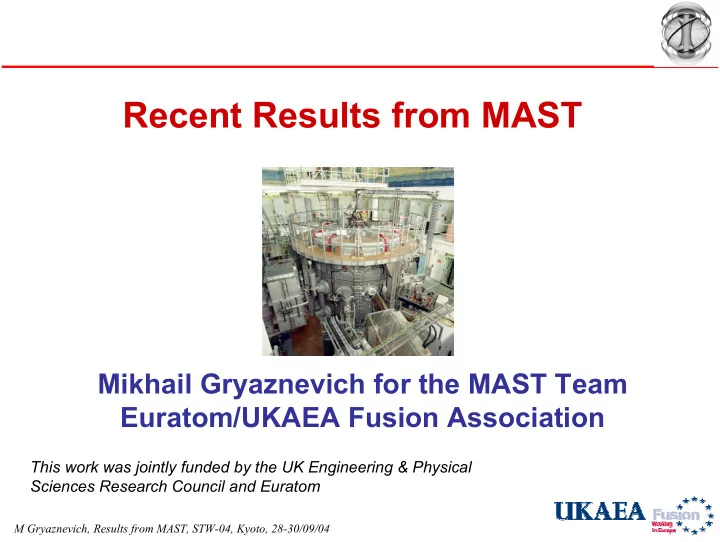
Recent Results from MAST Mikhail Gryaznevich for the MAST Team Euratom/UKAEA Fusion Association This work was jointly funded by the UK Engineering & Physical Sciences Research Council and Euratom M Gryaznevich, Results from MAST, STW-04,


slide-1
SLIDE 1

M Gryaznevich, Results from MAST, STW-04, Kyoto, 28-30/09/04

Recent Results from MAST

Mikhail Gryaznevich for the MAST Team Euratom/UKAEA Fusion Association

This work was jointly funded by the UK Engineering & Physical Sciences Research Council and Euratom

slide-2
SLIDE 2

M Gryaznevich, Results from MAST, STW-04, Kyoto, 28-30/09/04

M.P. Gryaznevich 1), J-W. Ahn 2), R.J. Akers 1), F.Alladio 11), L.C. Appel 1), D. Applegate 1), K.B. Axon 1), Y. Baranov 1), C. Brickley 1), C. Bunting 1), R.J. Buttery 1), P.G. Carolan 1), C. Challis 1), D. Ciric 1), N.J. Conway 1), M. Cox 1), G.F. Counsell 1), G. Cunningham 1), A. Darke 1), A. Dnestrovskij 3), J. Dowling 1), B. Dudson 4), M.R. Dunstan 1), A.R. Field 1), S. Gee 1), P. Helander 1), T.C. Hender 1), M. Hole 1), N. Joiner 2), D. Keeling 1), A. Kirk 1), I.P. Lehane 5), B. Lloyd 1),

  • F. Lott 2), G.P. Maddison 1), S.J. Manhood 1), R. Martin 1), G.J. McArdle 1), K.G. McClements 1), H. Meyer 1), A.W.

Morris 1), M. Nelson 6), M. R. O'Brien 1), A. Patel 1), T. Pinfold 1), J Preinhaelter 7), M.N. Price 1), C.M. Roach 1), V. Rozhansky 8), S. Saarelma 1), A. Saveliev 9), R. Scannell 5), S. Sharapov 1), V. Shevchenko 1), S. Shibaev 1), K. Stammers 1), J. Storrs 1), A. Sykes 1), A. Tabasso 1), D. Taylor 1), M.R. Tournianski 1), A. Turner 1), G. Turri 2), M. Valovic 1), F. Volpe 1), G. Voss 1), M.J. Walsh 10), J.R. Watkins 1), H.R. Wilson 1), M. Wisse 5) and the MAST, NBI and ECRH Teams. 1)EURATOM/UKAEA Fusion Association, Culham Science Centre, Abingdon, Oxfordshire OX14 3DB, UK 2)Imperial College, Prince Consort Road, London SW7 2BZ, UK 3)Kurchatov Institute, Moscow, Russia 4)Oxford University, UK 5)University College, Cork, Ireland 6)Queens University, Belfast, UK 7)EURATOM/IPP.CR Fusion Association, Institute of Plasma Physics, Prague, Czech Republic 8)St. Petersburg State Politechnical University, Polytechnicheskaya 29, 195251 St. Petersburg, Russia 9)A.F. Ioffe Physico-Technical Institute, St. Petersburg, Russia 10)Walsh Scientific Ltd, Culham Science Centre, Abingdon, OX14 3EB, UK 11)ENEA, Frascati, Italy
slide-3
SLIDE 3

M Gryaznevich, Results from MAST, STW-04, Kyoto, 28-30/09/04

Outline

Recent modifications to MAST Future plans Main aims of M4 campaign

  • non-solenoid start-up
  • EBW heating and current drive experiments
  • Error field studies and control
  • ELMs, SOL and exhaust studies

First Results: Analysis of 2003 results

slide-4
SLIDE 4

M Gryaznevich, Results from MAST, STW-04, Kyoto, 28-30/09/04

MAST Parameters

Open divertor, up-down symmetric - upgraded 2004 Graphite protection on all plasma contacting surfaces Flexible configuration Adaptable fuelling systems - inboard & outboard gas puffing plus multi-pellet injector Digital plasma control (PCS supplied by GA) Plasma cross-section and current comparable to ASDEX-U and DIII-D.

slide-5
SLIDE 5

M Gryaznevich, Results from MAST, STW-04, Kyoto, 28-30/09/04

Overall Focus

Three key elements:

  • Address key ITER physics issues, driven by International

Expert Groups (ITPA) and co-ordinated research activities

  • Test aspects of magnetised plasma physics at extreme

conditions, such as instabilities at high β

  • Explore long-term potential of the Spherical Tokamak,

guided by design studies for the ST power plant and component test facility

slide-6
SLIDE 6

M Gryaznevich, Results from MAST, STW-04, Kyoto, 28-30/09/04

Analysis of 2003 Results

slide-7
SLIDE 7

M Gryaznevich, Results from MAST, STW-04, Kyoto, 28-30/09/04

Confinement & Transport

b e t a ( % )

2 4 6 8 1 0

a / R

0 . 2 0 . 4 0 . 6 0 . 8 1 . 0 MAST Conventional tokamaks PBXM Asdex

MAST data significantly extend confinement databases e.g. should give greater confidence in ε and β dependencies Dataset improved e.g. spread in ε mainly determined by plasmas with conventional D-shaped cross-section ⇒ τE

MAST ~ τE IPB98y2 but MAST data support

somewhat stronger ε dependence (τE ∝ ε0.8) than IPB98y2 scaling [Valovic IAEA 2004] MAST data also exert strong leverage on two-term models of confinement: Wped ∝ ε –2.13±0.28 [Cordey et al NF 2003]

slide-8
SLIDE 8

M Gryaznevich, Results from MAST, STW-04, Kyoto, 28-30/09/04

  • Extrapolation to future STs is dominantly in υ*

There are indications that τE/ τE

IPB98y2 increases with decreasing collisionality

  • n MAST [Valovic IAEA 2004] as in some other tokamaks

(DIII-D, JET)

i t ok M AST N EXT b e t a n 0 . 1 1 . 0 1 0 . 0 r h o s t a r 0 . 0 0 1 0 . 0 1 0 0 . 1 0 0

JET, D3D, AUG MAST CTF STPP ITER

βN ρ*

Dimensionless extrapolation to future devices

slide-9
SLIDE 9

M Gryaznevich, Results from MAST, STW-04, Kyoto, 28-30/09/04

Pscal(MW) Pth(MW)

H-mode Power Threshold

Pscal ∝ |Bout|0.7ne

0.7S0.9F(A)γ

Low A data:

  • clearly favour Pth ~ S rather than

Pth ~ R2

  • favour dependence on |Bout|

rather than Bt(0) |Bout|2 = Bt

2 + Bp 2

[Takizuka et al PPCF 2004] The (non-linear) aspect ratio dependence is not yet well-determined - postulated by Takizuka et al that it may take a form related to fraction of untrapped particles

slide-10
SLIDE 10

M Gryaznevich, Results from MAST, STW-04, Kyoto, 28-30/09/04

Example simulation of a high purity

  • hmic MAST plasma #8961

Significant neoclassical enhancement of plasma resistivity in ST:

Ultra-high resolution TS and visible bremsstrahlung measurements of Te and Zeff in MAST allow neoclassical resistivity to be assessed with unique accuracy. neoclassical Spitzer

q=1 surface appears (from SXR data)

slide-11
SLIDE 11

M Gryaznevich, Results from MAST, STW-04, Kyoto, 28-30/09/04

χe ~ χi around mid-radius & close to χi

Z-CH [Chang & Hinton]

[ exact values very sensitive to relative values of Te, Ti ]

H-mode transport coefficients are close to neoclassical

TRANSP simulations Ti Te

x1019m-3

ne

slide-12
SLIDE 12

M Gryaznevich, Results from MAST, STW-04, Kyoto, 28-30/09/04

χe ~ χi >> χi

Z-CH

HH

IPB98y2 ~ 0.85

High performance in sawtooth-free L-mode

[m2/s] [keV] TRANSP simulations

slide-13
SLIDE 13

M Gryaznevich, Results from MAST, STW-04, Kyoto, 28-30/09/04

High performance in Counter-NBI

⇒ HH

IPB98y2 ~ 2

Measured neutron rates consistent with LOCUST modelling - only ~ 1/3 fast ion energy absorbed But stored energy comparable to co-NBI ne(r) more peaked, Te(r) broader than co-NBI High rotation (Vφ0 ~ 340km/s) due to rapid loss of co-moving ions ⇒ in-out Zeff asymmetry x2 (dominated by C6+)

slide-14
SLIDE 14

M Gryaznevich, Results from MAST, STW-04, Kyoto, 28-30/09/04

Neoclassical Ware pinch stronger at low A (Γ ∝ ε1/2) and augmented by beam-driven pinch for cntr-NBI (Ware pinch dominant)

  • further increased due to higher Zeff of cntr-NBI discharges

Density profile peaking strongly correlated with Ware pinch:

[Akers et al EPS 2004]

cntr-NBI co-NBI

slide-15
SLIDE 15

M Gryaznevich, Results from MAST, STW-04, Kyoto, 28-30/09/04

cntr-NBI co-NBI Sawtooth-free discharges HH → 1.5 with co-NBI; HH → 2 with cntr-NBI (ms) (ms)

slide-16
SLIDE 16

M Gryaznevich, Results from MAST, STW-04, Kyoto, 28-30/09/04

Ion & Electron ITBs

Co-NBI Strong ion ITB χi ~ χi

Z-CH

Weaker eITB χe ~ 2-3 x χi

Z-CH

Cntr-NBI Strong eITB at large radius ITB existence criteria Criteria based on critical values

  • f R/LT or ρs/LT fail - readily

satisfied even when no ITB In these discharges the driven toroidal flow is the dominant contribution to the ExB flow shear - for cntr-NBI the pressure gradient contribution is additive In this case ITB formation may be linked to a critical Mach number [Field et al EPS 2004]

x1019m-3 [keV]

TRANSP simulations

slide-17
SLIDE 17

M Gryaznevich, Results from MAST, STW-04, Kyoto, 28-30/09/04

Structure sometimes seen on TS profiles outboard

  • f separatrix.

Also observed on the mid-plane linear Dα array but not on divertor target power footprint

ELMs

Edge profile broadening or

  • ther structure only observed

in 20 - 25% of cases in which TS fires during ELM Dα rise.

slide-18
SLIDE 18

M Gryaznevich, Results from MAST, STW-04, Kyoto, 28-30/09/04

ELM spatial structure (theory+experiment)

Image simulation of an extended structure @q=4, n=10, #8814 High-speed video image, #8814

slide-19
SLIDE 19

M Gryaznevich, Results from MAST, STW-04, Kyoto, 28-30/09/04

The spatial and temporal evolution of an ELM:

Filament remains attached to core plasma & acts as conduit for enhanced transport into SOL Wfil << ∆WELM

Filament eventually detaches at outboard mid-plane Wfil < 0.03∆WELM

slide-20
SLIDE 20

M Gryaznevich, Results from MAST, STW-04, Kyoto, 28-30/09/04

TAE studies: β - dependence

64 66 68 70 72 1 2 δBZ, 10

  • 5 T

Time, ms

amp up, theory amp down, theory amp up, exp. amp down, exp burst amp, exp

64 66 68 70 72 ms f, 140 kHz 120 100 80

  • Chirping modes studies: decrease in amplitude with β increase on MAST and START

2 4 6 4 8 START δBθ/Bθ, a.u.

βT, %

0.0 0.1

MAST, #8498 βfast, βt, % t, sec

chirping mode ampl., a.u. 0.1 0.2 0.3 5 10

δBθ/Bθ, a.u. βt βfast

  • Hole-clump modes observed, features agree with theory (more in Sharapov et al.)
slide-21
SLIDE 21

M Gryaznevich, Results from MAST, STW-04, Kyoto, 28-30/09/04

2004-05 Experimental Campaign

slide-22
SLIDE 22

M Gryaznevich, Results from MAST, STW-04, Kyoto, 28-30/09/04

2003/04 2004/05

(provisional)

Operations Engineering Break

Operating schedule: 2004-2005

Jul Jun

Improved divertor, new centre column, install new PINI#1 Restart

Jul Jun Nov bake PINI#1

  • n-line

HV outage

PINI#2 & 28GHz EBW installation M4 M5

slide-23
SLIDE 23

M Gryaznevich, Results from MAST, STW-04, Kyoto, 28-30/09/04

Recent modifications to MAST

slide-24
SLIDE 24

M Gryaznevich, Results from MAST, STW-04, Kyoto, 28-30/09/04

Recent modifications to MAST

Experimental campaigns of 2004-05 will exploit improvements made during the 2003-04 shutdown (and on-going improvements due for completion in early 2005):

slide-25
SLIDE 25

M Gryaznevich, Results from MAST, STW-04, Kyoto, 28-30/09/04

Experimental campaigns of 2004-05 will exploit improvements made during the 2003-04 shutdown (and on-going improvements due for completion in early 2005): Neutral beam systems

  • higher power, longer pulse, improved reliability
  • 2 x 2.5MW for 5s capability

Recent modifications to MAST

Actively cooled calorimeter (gate in closed position) Residual Ion Dumps New JET-style PINI

slide-26
SLIDE 26

M Gryaznevich, Results from MAST, STW-04, Kyoto, 28-30/09/04

Experimental campaigns of 2004-05 will exploit improvements made during the 2003-04 shutdown (and on-going improvements due for completion in early 2005): Neutral beam systems Centre column, solenoid and P2 coils

  • longer and stronger solenoid
  • more Vs and higher κ

Recent modifications to MAST

present for M4

  • ld

P2 solenoid

slide-27
SLIDE 27

M Gryaznevich, Results from MAST, STW-04, Kyoto, 28-30/09/04

Recent modifications to MAST

Experimental campaigns of 2004-05 will exploit improvements made during the 2003-04 shutdown (and on-going improvements due for completion in early 2005): Neutral beam systems Centre column and solenoid Divertor

  • better power handling, improved diagnostic

access, tailored poloidal profile

present for M4

  • ld
slide-28
SLIDE 28

M Gryaznevich, Results from MAST, STW-04, Kyoto, 28-30/09/04

Recent modifications to MAST

Experimental campaigns of 2004-05 will exploit improvements made during the 2003-04 shutdown (and on-going improvements due for completion in early 2005): Neutral beam systems Centre column and solenoid Divertor Error field correction coils

  • Reduced perturbation in poloidal field
  • longer pulses at lower density
slide-29
SLIDE 29

M Gryaznevich, Results from MAST, STW-04, Kyoto, 28-30/09/04

Experimental campaigns of 2004-05 will exploit improvements made during the 2003-04 shutdown (and on-going improvements due for completion in early 2005): Neutral beam systems

  • higher power, longer pulse, improved reliability

Centre column and solenoid

  • longer and stronger solenoid

Divertor

  • better power handling, improved diagnostic

access, tailored poloidal profile Error field correction coils

  • Reduced perturbation in poloidal field

Range of diagnostic enhancements

  • including drilling two new ports in vessel

Recent modifications to MAST

slide-30
SLIDE 30

M Gryaznevich, Results from MAST, STW-04, Kyoto, 28-30/09/04

Charge-exchange recombination spectroscopy:

Ion temperature & flow velocity measurements Resolution of original CXRS system (19 chords) marginal for steep ITBs Upgraded CXRS facilitated by adaptable low A configuration ⇒ 200+ chord spectrometer spatial resolution ~ ρi poloidal and toroidal chords separate views of two NBI beams

co-NBI cntr-NBI

slide-31
SLIDE 31

M Gryaznevich, Results from MAST, STW-04, Kyoto, 28-30/09/04

ZEBRA 2D image

2D Zeff CCD detector (ZEBRA) 128x128 @200Hz, 256x256 @100Hz

Reconstruction of Zeff from visible bremsstrahlung:

Abel inverted emission Z=1 prediction from TS

slide-32
SLIDE 32

M Gryaznevich, Results from MAST, STW-04, Kyoto, 28-30/09/04

New Results:

  • July - September 2004
slide-33
SLIDE 33

M Gryaznevich, Results from MAST, STW-04, Kyoto, 28-30/09/04

2003/04 2004/05

(provisional)

Operations Engineering Break

Operating schedule: 2004-2005

Jul Jun

Improved divertor, new centre column, install new PINI#1 Restart

Jul Jun Nov bake PINI#1

  • n-line

HV outage

PINI#2 & 28GHz EBW installation M4 M5

slide-34
SLIDE 34

M Gryaznevich, Results from MAST, STW-04, Kyoto, 28-30/09/04

2004 MAST Experimental Campaign Targets

Integrated Scenario Development

  • 1. Quantify error field effects and extend MAST operational space by effective suppression.
  • 2. Develop baseline operating scenarios to meet the needs of the physics programme.

Transport & Turbulence

  • 3. Assess the relative roles of electron and ion transport in MAST and the impact of micro-instabilities (e.g. ETG

and ITG modes) by detailed transport analysis of discharges with and without ITBs and modelling.

  • 4. Identify the requirements for sustainable and wide ITBs in MAST.

Confinement

  • 5. Expand the confinement database parameter range and identify scaling of confinement with the main

engineering parameters (P, I, n ..)

  • 6. Identify scaling of confinement with dimensionless parameters, particularly beta and aspect ratio, including

joint experiments with other devices where appropriate.

  • 7. Evaluate particle confinement in MAST; assess the relative roles of pinch and diffusive terms.

ELMs & Pedestal Physics

  • 8. Measure ELM structure, evaluate the impact on plasma facing components and compare with ELM models.
  • 9. Assess impact of aspect ratio, first wall proximity and magnetic field on pedestal characteristics and ELM

behaviour [ASDEX-U/DIII-D joint experiments] EBW

  • 10. Demonstrate & optimise EBW heating at 60GHz.

Start-Up

  • 11. Demonstrate & optimise start-up using the P2-P5 coils only without plasma formation around P3.

Disruptions & Divertor Biasing

  • 12. Measure the distribution of energy to the first wall and divertor during disruptions.
  • 13. Demonstrate effective divertor biasing in neutral beam heated discharges where the power input due to

biasing is small compared to the total power input.

  • 14. Test 'passive' biasing for ELM amelioration.
slide-35
SLIDE 35

M Gryaznevich, Results from MAST, STW-04, Kyoto, 28-30/09/04

  • Objective: develop effective non-solenoidal start-up

compatible with burning device

  • CHI (HIT, NSTX) and merging-compression (START, MAST) difficult

to implement in future STs

Non-solenoid start-up

A different scheme is proposed by the TS-3/4 team Similar scheme was tested on START:

slide-36
SLIDE 36

M Gryaznevich, Results from MAST, STW-04, Kyoto, 28-30/09/04

Double-Null Merging Modelling by Frascati team:

t=15ms Ip = 150 kA t=21ms Ip = 250 kA t=45ms Ip = 450 kA t=60ms Ip = 600 kA t=75ms Ip = 600 kA

slide-37
SLIDE 37

M Gryaznevich, Results from MAST, STW-04, Kyoto, 28-30/09/04

Non-solenoid start-up

Z (m) 0.002 0.006 0.010 0.014 time (s)

  • 2.0

0.0 2.0

  • First results of DNM on MAST are very encouraging:
  • merging of two plasma rings formed in low-order null

between poloidal field coils

  • current ramp (up to 300kA)

using flux from vertical field coils

  • central solenoid was

disconnected in these experiments

TS profiles after merging

Te,

keV

ne,

1019m-3

slide-38
SLIDE 38

M Gryaznevich, Results from MAST, STW-04, Kyoto, 28-30/09/04

Bt Bv Bt+Bv

Ip~ neTeR-1Bv

  • 1

ECRH/EBW plasma current formation

Pure toroidal field: some flash, but no current measured Schematic of current generation Schematic of current generation

EC Resonance Btor B Plasma Drift RF Plasma

MAST experiment: MAST experiment: CCD and CCD and magnetics magnetics With 5 mT vertical magnetic field: current up to 10 kA.

ECRH pulse of 60 GHz, 0-20 ms (0.3 MW), O-mode polarisation.

slide-39
SLIDE 39

M Gryaznevich, Results from MAST, STW-04, Kyoto, 28-30/09/04

First results of EBWH

  • First experiments show increase in stored energy and

central electron heating

MW)

slide-40
SLIDE 40

M Gryaznevich, Results from MAST, STW-04, Kyoto, 28-30/09/04

EBW Spectra in L EBW Spectra in L-

  • mode and in H

mode and in H-

  • mode

mode

Measured and simulated EBW spectra in high density L-mode in MAST, shot #7798 at 0.24 s.

  • Model: 1D full wave mode coupling, EBW ray-tracing

including collisional and non-collisional damping, radiative transfer for non-local wave damping.

  • Good agreement in L-mode plasma
  • Disagreement is strong in high beta plasmas and in a

long sustained high density H-mode.

15 20 25 30 35 40 1 2

12

  • - 12
  • model

15

  • - 15
  • model

17

  • - 17
  • model

Experimental data

Intensity, a.u. Frequency, GHz

15 20 25 30 35 40 1 2 3

Intensity, a.u. Frequency, GHz

12

  • - 12
  • model

15

  • - 15
  • model

17

  • - 17
  • model

Experimental data

Measured and simulated EBW spectra in high density H-mode in MAST, shot #7786 at 0.24 s.

Harmonic overlap & large field line pitch angle in STs pose difficulties for heating but open up new diagnostic possibilities by EBW emission studies

q-profile diagnosis (Shevchenko 2000, Plasma

  • Phys. Rep. 26 1000)
slide-41
SLIDE 41

M Gryaznevich, Results from MAST, STW-04, Kyoto, 28-30/09/04

Error field correction

Four error field correction coils have been installed outside the vacuum vessel

Modelling of field structure from EFCC

slide-42
SLIDE 42

M Gryaznevich, Results from MAST, STW-04, Kyoto, 28-30/09/04

Error field correction

A Coil current B Coil current

  • 8
  • 7
  • 6
  • 5
  • 4
  • 3
  • 2
  • 1

1 2 3 4 5 6 7 8

  • 8 -7
  • 6 -5
  • 4
  • 3
  • 2 -1

1 2 3 4 5 6 7

t=200ms t=255ms

ne=2x10¹⁹m-3

  • Application of external helical field allows reduction of plasma density

in discharges previously limited by locked modes

Determination of the necessary EFCC current (also shows variation of

intrinsic error field with time)

ne 30% lower Locked mode 0.0 0.1 0.2 0.3 0.4 time (s)

Compensation of error field with EFCC

slide-43
SLIDE 43

M Gryaznevich, Results from MAST, STW-04, Kyoto, 28-30/09/04

Longer term: 2005-2006

  • Design and approval for comprehensive upgrade to MAST

(subject to spending review, large facilities roadmap)

  • No interruption to MAST operation during this phase
  • Upgrade will significantly enhance load assembly, heating

systems, divertor and diagnostics

  • Increased heating power (~50% increase)
  • Long pulse capability (e.g 4s flat-top at 1MA)
  • Adaptable heating and current drive for plasma control and

state-state scenarios

  • Actively pumped divertor for density control in long pulses
  • Test bed for first wall materials and novel divertor concepts