Recent progress towards the Kobayashi and Green-Griffiths-Lang - - PDF document

recent progress towards the kobayashi and green griffiths
SMART_READER_LITE
LIVE PREVIEW

Recent progress towards the Kobayashi and Green-Griffiths-Lang - - PDF document

Recent progress towards the Kobayashi and Green-Griffiths-Lang conjectures Jean-Pierre Demailly Institut Fourier, Universit e de Grenoble Alpes & Acad emie des Sciences de Paris November 28-29, 2015 16th Takagi Lectures, University


slide-1
SLIDE 1

Recent progress towards the Kobayashi and Green-Griffiths-Lang conjectures

Jean-Pierre Demailly

Institut Fourier, Universit´ e de Grenoble Alpes & Acad´ emie des Sciences de Paris

November 28-29, 2015 16th Takagi Lectures, University of Tokyo

J.-P. Demailly (Grenoble), 16th Takagi Lectures, Tokyo On the Kobayashi and Green-Griffiths-Lang conjectures 1/34

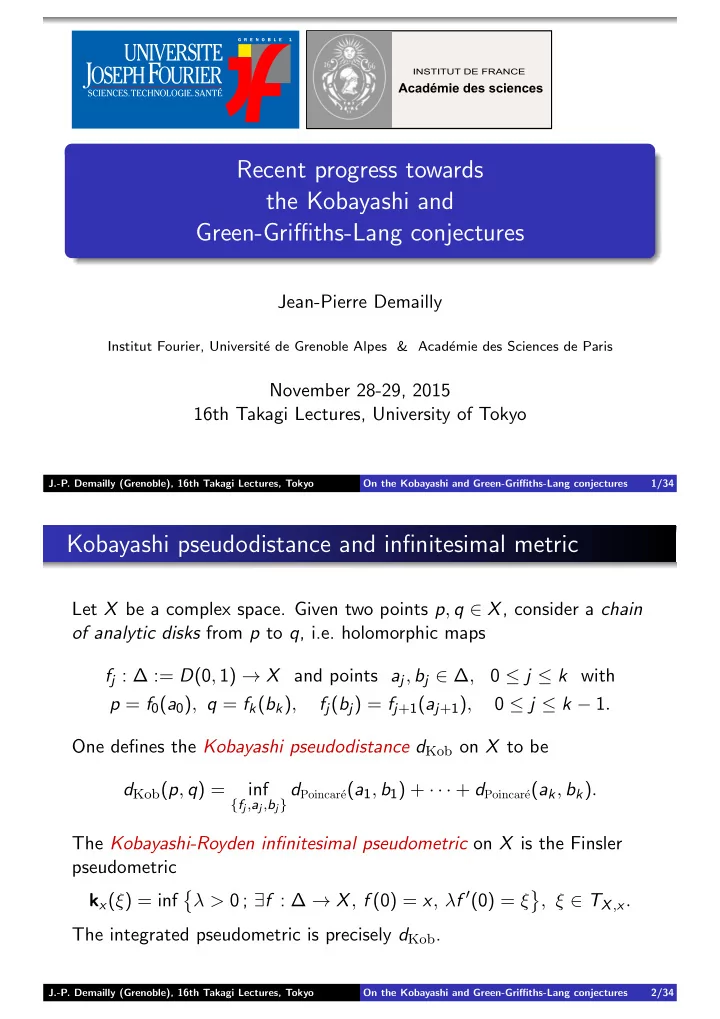
Kobayashi pseudodistance and infinitesimal metric

Let X be a complex space. Given two points p, q ∈ X, consider a chain

  • f analytic disks from p to q, i.e. holomorphic maps

fj : ∆ := D(0, 1) → X and points aj, bj ∈ ∆, 0 ≤ j ≤ k with p = f0(a0), q = fk(bk), fj(bj) = fj+1(aj+1), 0 ≤ j ≤ k − 1. One defines the Kobayashi pseudodistance dKob on X to be dKob(p, q) = inf

{fj,aj,bj} dPoincar´

e(a1, b1) + · · · + dPoincar´ e(ak, bk).

The Kobayashi-Royden infinitesimal pseudometric on X is the Finsler pseudometric kx(ξ) = inf

  • λ > 0 ; ∃f : ∆ → X, f (0) = x, λf ′(0) = ξ
  • , ξ ∈ TX,x.

The integrated pseudometric is precisely dKob.

J.-P. Demailly (Grenoble), 16th Takagi Lectures, Tokyo On the Kobayashi and Green-Griffiths-Lang conjectures 2/34

slide-2
SLIDE 2

Kobayashi hyperbolicity and entire curves

Definition A complex space X is said to be Kobayashi hyperbolic if the Kobayashi pseudodistance dKob : X × X → R+ is a distance (i.e. everywhere non degenerate). By an entire curve we mean a non constant holomorphic map f : C → X into a complex n-dimensional manifold. Theorem (Brody, 1978) For a compact complex manifold X, dimCX = n, TFAE: (i) X is Kobayashi hyperbolic (ii) X is Brody hyperbolic, i.e. ∃ entire curves f : C → X (iii) The Kobayashi infinitesimal pseudometric kx is everywhere non degenerate Our interest is the study of hyperbolicity for projective varieties. In dim 1, X is hyperbolic iff genus g ≥ 2.

J.-P. Demailly (Grenoble), 16th Takagi Lectures, Tokyo On the Kobayashi and Green-Griffiths-Lang conjectures 3/34

Kobayashi-Eisenman measures

In a similar way, one can introduce the p-dimensional Kobayashi-Eisenman infinitesimal metric on decomposable tensors ξ = ξ1 ∧ . . . ∧ ξp of ΛpTX,x (i.e. on the tautological line bundle over the Grassmann bundle Gr(TX, p)) by ep

x(ξ) = inf

  • λ > 0 ; ∃f : Bp → X, f (0) = x, λf ′(0) · τ = ξ
  • ,

where Bp ⊂ Cp is the unit ball and τ =

∂ ∂t1 ∧ . . . ∧ ∂ ∂tp .

Definition A complex space X is said to be p-measure hyperbolic in the sense of Kobayashi-Eisenman if ep is non degenerate on a dense Zariski open set. Volume hyperbolicity refers to the case p = n = dim X.

J.-P. Demailly (Grenoble), 16th Takagi Lectures, Tokyo On the Kobayashi and Green-Griffiths-Lang conjectures 4/34

slide-3
SLIDE 3

Main conjectures

Conjecture of General Type (CGT)

  • A compact complex variety X is volume hyperbolic ⇐

⇒ X is of general type, i.e. KX is big [implication ⇐ = is well known].

  • X Kobayashi (or Brody) hyperbolic should imply KX ample.

Green-Griffiths-Lang Conjecture (GGL) Let X be a projective variety/C of general type. Then ∃Y X algebraic such that all entire curves f : C → X satisfy f (C) ⊂ Y . Arithmetic counterpart (Lang 1987) – very optimistic ! If X is projective and defined over a number field K0, the smallest locus Y = GGL(X) in GGL’s conjecture is also the smallest Y such that X(K) Y is finite ∀K number field ⊃ K0. Consequence of CGT + GGL A compact complex manifold X should be Kobayashi hyperbolic iff it is projective and every subvariety Y of X is of general type.

J.-P. Demailly (Grenoble), 16th Takagi Lectures, Tokyo On the Kobayashi and Green-Griffiths-Lang conjectures 5/34

Solution of the Bloch conjecture

The following has been proved by Ochiai 77, Noguchi 77, 81, 84, Kawamata 80 in the algebraic situation. Theorem (Ochiai 77, Noguchi 77,81,84, Kawamata 80) Let Z = Cn/Λ be an abelian variety (resp. a complex torus). Then the (analytic) Zariski closure f (C)

Zar of the image of every entire curve

f : C → Z is the translate of a subtorus. Corollary 1 Let X be a complex analytic subvariety of a complex torus Z . Assume that X is of general type. Then every entire curve drawn in X is analytically degenerate. Corollary 2 Let X be a complex analytic subvariety of a complex torus Z . Assume that X does not contain any translate of a positive dimensional

  • subtorus. Then X is Kobayashi hyperbolic.

J.-P. Demailly (Grenoble), 16th Takagi Lectures, Tokyo On the Kobayashi and Green-Griffiths-Lang conjectures 6/34

slide-4
SLIDE 4

Results on the Kobayashi conjecture

Kobayashi conjecture (1970)

  • Let X ⊂ Pn+1 be a (very) generic hypersurface of degree d ≥ dn

large enough. Then X is Kobayashi hyperbolic.

  • By a result of M. Zaidenberg (1987), the optimal bound must

satisfy dn ≥ 2n + 1, and one expects dn = 2n + 1. Using “jet technology” and deep results of McQuillan for curve foliations on surfaces, the following has been proved: Theorem (D., El Goul, 1998) A very generic surface X⊂P3 of degree d ≥ 21 is hyperbolic. Independently McQuillan got d ≥ 35. This was more recently improved to d ≥ 18 (P˘ aun, 2008). In 2012, Yum-Tong Siu announced a proof of the case of arbitrary dimension n, with a very large dn (and a rather involved proof).

J.-P. Demailly (Grenoble), 16th Takagi Lectures, Tokyo On the Kobayashi and Green-Griffiths-Lang conjectures 7/34

Results on the generic Green-Griffiths conjecture

By a combination of an algebraic existence theorem for jet differentials and of Siu’s technique of “slanted vector fields” (itself derived from ideas of H. Clemens, L. Ein and C. Voisin), the following was proved: Theorem (S. Diverio, J. Merker, E. Rousseau, 2009) A generic hypersurface X ⊂ Pn+1 of degree d ≥ dn := 2n5 satisfies the GGL conjecture. The bound was improved by (D-, 2012) to dn =

  • n4

3

  • n log(n log(24n))

n = O(exp(n1+ε)), ∀ε > 0. Theorem (S. Diverio, S. Trapani, 2009) Additionally, a generic hypersurface X ⊂ P4 of degree d ≥ 593 is hyperbolic.

J.-P. Demailly (Grenoble), 16th Takagi Lectures, Tokyo On the Kobayashi and Green-Griffiths-Lang conjectures 8/34

slide-5
SLIDE 5

Category of directed varieties

  • Goal. We are interested in curves f : C → X such that f ′(C) ⊂ V

where V is a subbundle of TX or, more generally, a (possibly singular) linear subspace, i.e. a closed irreducible analytic subspace of the total space TX such that ∀x ∈ X, Vx := V ∩ TX,x is linear.

  • Definition. Category of directed varieties :

– Objects : pairs (X, V ), X variety/C and V ⊂ TX – Arrows ψ : (X, V ) → (Y , W ) holomorphic s.t. ψ∗V ⊂ W – “Absolute case” (X, TX), i.e. V = TX – “Relative case” (X, TX/S) where X → S – “Integrable case” when [V , V ] ⊂ V (foliations) Fonctor “1-jet” : (X, V ) → ( ˜ X, ˜ V ) where : ˜ X = P(V ) = bundle of projective spaces of lines in V π : ˜ X = P(V ) → X, (x, [v]) → x, v ∈ Vx ˜ V(x,[v]) =

  • ξ ∈ T ˜

X,(x,[v]) ; π∗ξ ∈ Cv ⊂ TX,x

  • J.-P. Demailly (Grenoble), 16th Takagi Lectures, Tokyo

On the Kobayashi and Green-Griffiths-Lang conjectures 9/34

Semple jet bundles (non singular case)

For every entire curve f : (C, TC) → (X, V ) tangent to V f[1](t) := (f (t), [f ′(t)]) ∈ P(Vf (t)) ⊂ ˜ X f[1] : (C, TC) → ( ˜ X, ˜ V ) (projectivized 1st-jet)

  • Definition. Semple jet bundles :

– (Xk, Vk) = k-th iteration of fonctor (X, V ) → ( ˜ X, ˜ V ) – f[k] : (C, TC) → (Xk, Vk) is the projectivized k-jet of f . Basic exact sequences 0 → T ˜

X/X → ˜

V

π⋆

→ O ˜

X(−1) → 0

⇒ rk ˜ V = r = rk V 0 → O ˜

X → π⋆V ⊗ O ˜ X(1) → T ˜ X/X → 0 (Euler)

0 → TXk/Xk−1 → Vk

(πk)⋆

→ OXk(−1) → 0 ⇒ rk Vk = r 0 → OXk → π⋆

kVk−1 ⊗ OXk(1) → TXk/Xk−1 → 0 (Euler)

J.-P. Demailly (Grenoble), 16th Takagi Lectures, Tokyo On the Kobayashi and Green-Griffiths-Lang conjectures 10/34

slide-6
SLIDE 6

k-jets of curves

For n = dim X and r = rk V , one gets a tower of Pr−1-bundles πk,0 : Xk

πk

→ Xk−1 → · · · → X1

π1

→ X0 = X with dim Xk = n + k(r − 1), rk Vk = r, and tautological line bundles OXk(1) on Xk = P(Vk−1). We define the bundle JkV of k-jets of curves tangent to V by taking JkVx to be the set of equivalence classes of germs f : (C, 0) → (X, V ) such that in some coordinates f (t) = (f1(t), . . . , fn(t)) has a Taylor expansion f (t) = x + tξ1 + . . . + tkξk + O(tk+1). Here we take ξs = 1

s!∇sf (0) with respect to some local holomorphic

connection on V (obtained e.g. from a trivialization). Thus ξs ∈ Vx and JkVx ≃ V ⊕k

x

≃ Ckr (non intrinsically).

J.-P. Demailly (Grenoble), 16th Takagi Lectures, Tokyo On the Kobayashi and Green-Griffiths-Lang conjectures 11/34

Semple bundles and reparametrization of curves

Consider the group Gk of k-jets of germs of biholomorphisms ϕ : (C, 0) → (C, 0), i.e. ϕ(t) = α1t + α2t2 + . . . + αktk + O(tk+1) and the natural Gk action on the right: JkV × Gk → JkV , (f , ϕ) → f ◦ ϕ. The action is free on germs JkV reg of regular curves with ξ1 = f ′(0) = 0. Theorem Xk is a smooth compactification of JkV reg/Gk. Now we want to deal with possibly singular directed varieties (X, V ), i.e. X and V both possibly singular.

J.-P. Demailly (Grenoble), 16th Takagi Lectures, Tokyo On the Kobayashi and Green-Griffiths-Lang conjectures 12/34

slide-7
SLIDE 7

Singular directed varieties

Definition A singular directed variety is a pair (X, V ) where X is a reduced complex space, and V ⊂ TX is a closed linear subspace of TX. This means that we have an irreducible component Vj lying over each irreducible component Xj of X. Assume X to be irreducible, dim X = n. Every point x ∈ X has a neighborhood U with an embedding U ֒ → Ω as a closed analytic subset in a smooth open set Ω ⊂ CN. Then TX|U is taken to be the closure of TUreg in TΩ, and V is always assumed to be the closure of Vreg|U (part

  • f V that is a subbundle of TXreg|U).

If X is non singular and V ⊂ TX is singular, V is a subbundle of TX

  • ver a Zariski open set X ′ = X Y , and we have at least an absolute

Semple tower (X a

k , V a k ) associated with (X, TX).

We then define (Xk, Vk) to be the closure of (X ′

k, V ′ k) [associated with

(X ′, V ′), V ′ = V|X ′] in (X a

k , V a k ).

J.-P. Demailly (Grenoble), 16th Takagi Lectures, Tokyo On the Kobayashi and Green-Griffiths-Lang conjectures 13/34

Base resolution of singularities

Let (X, V ) be singular pair. By Hironaka, there exists a modification µ : X → X (in the form of a composition of blow-ups with smooth centers), such that X is non singular. Let µ∗ : T

X → µ∗TX be the differential dµ. We define

  • V = µ−1V ⊂ T

X to be the closure of (µ∗)−1(V|X ′), where X ′ ⊂ Xreg is

a Zariski open set over which V|X ′ is a subbundle of TXreg and µ : µ−1(X ′) → X ′ is a biregular. We can then construct a Semple tower ( Xk, Vk) by taking the closure

  • ver regular points of (X ′

k, V ′ k) in the (regular) absolute tower (

X a

k ,

V a

k ),

where V a

0 = T X.

Big caution ! In general, for dim X ≥ 2, one can never make V non singular, even by blowing up further !

J.-P. Demailly (Grenoble), 16th Takagi Lectures, Tokyo On the Kobayashi and Green-Griffiths-Lang conjectures 14/34

slide-8
SLIDE 8

Algebraic differential operators

Let t → z = f (t) be a germ of curve, f[k] = (f ′, f ′′, . . . , f (k)) its k-jet at any point t = 0. We first look at the C∗-action induced by dilations ϕ(t) = ηλ(t) = λt. Putting ξs = ∆sf (0), the C∗ action is obtained by computing the derivatives of f (λt), hence it is given on JkVx ≃ V ⊕k

x

by (∗) λ · (ξ1, ξ2, . . . , ξk) = (λξ1, λ2ξ2, . . . , λkξk). We consider the Green-Griffiths bundle E GG

k,mV ∗ of polynomials of

weighted degree m on JkVx written locally in coordinate charts as P(x ; ξ1, . . . , ξk) = aα1α2...αk(x) ξα1

1 . . . ξαk k ,

ξs ∈ Vx. Take P to be a holomorphic section in x. It can then be viewed as an algebraic differential operator P(f[k]) = P(f ; f ′, f ′′, . . . , f (k)), P(f[k])(t) = aα1α2...αk(f (t)) f ′(t)α1f ′′(t)α2 . . . f (k)(t)αk.

J.-P. Demailly (Grenoble), 16th Takagi Lectures, Tokyo On the Kobayashi and Green-Griffiths-Lang conjectures 15/34

Direct image formula for Green-Griffiths bundles

The homogeneity expressed by the C∗ action (∗) means that P((f ◦ ηλ)[k]) = λmP(f[k]) ◦ ηλ for ηλ(t) = λt, and our polynomials are taken over multi-indices (α1, . . . , αk) such that |α1| + 2|α2| + . . . + k|αk| = m. Green Griffiths bundles Consider X GG

k

:= JkV =const/C∗. This defines a bundle πk : X GG

k

→ X

  • f weighted projective spaces and by definition

O(E GG

k,mV ∗) = (πk)∗OX GG

k

(m) is the direct image of the m-th power of the tautological bundle (or sheaf) OX GG

k

(1) on X GG

k

. In case V is singular, we take by definition OX GG

k

(m) to be the sheaf of germs of polynomials P(x; ξ1, . . . , ξk) that are locally bounded with respect to a smooth ambient hermitian metric h on TX (and the induced metric on Vk).

J.-P. Demailly (Grenoble), 16th Takagi Lectures, Tokyo On the Kobayashi and Green-Griffiths-Lang conjectures 16/34

slide-9
SLIDE 9

Direct image formula for Semple bundles

Now, look instead at the direct image of OXk(m) on the Semple bundle Xk = JkV reg/Gk, by the projection πk,0 : Xk → X0 from the Semple tower Xk → Xk−1 → . . . X1 → X0 = X (X non singular). Semple direct image formula The direct image sheaf (πk,0)∗OXk(m) = O(Ek,mV ∗) is the sheaf of sections of the bundle Ek,mV ∗ ⊂ E GG

k,mV ∗ of Gk-invariant

algebraic differential operators f → P(f[k]) such that P((f ◦ ϕ)[k]) = ϕ′mP(f[k]) ◦ ϕ, ∀ϕ ∈ Gk. (by definition, the sections are taken to be locally bounded with respect to an ambient smooth hermitian metric h on TX).

J.-P. Demailly (Grenoble), 16th Takagi Lectures, Tokyo On the Kobayashi and Green-Griffiths-Lang conjectures 17/34

Canonical sheaf of a singular pair (X,V)

When (X, V ) is nonsingular, we simply set KV = det(V ∗). When X is non singular and V singular, we first introduce the rank 1 sheaf bK V of sections of det V ∗ that are locally bounded with respect to a smooth ambient metric on TX. One can show that bK V is equal to the integral closure of the image of the natural morphism ΛrT ∗

X → ΛrV ∗ → LV := invert. sheaf (ΛrV ∗)∗∗

that is, if the image is LV ⊗ JV , JV ⊂ OX,

bK V = LV ⊗ J V ,

J V = integral closure of JV . Consequence If µ : X → X is a modification and X is equipped with the pull-back directed structure V = ˜ µ−1(V ), then

bK V ⊂ µ∗(bK V ) ⊂ LV

and µ∗(bK

V ) increases with µ.

J.-P. Demailly (Grenoble), 16th Takagi Lectures, Tokyo On the Kobayashi and Green-Griffiths-Lang conjectures 18/34

slide-10
SLIDE 10

Canonical sheaf of a singular pair (X,V) [cont.]

By Noetherianity, one can define a sequence of rank 1 sheaves K [m]

V

= lim

µ ↑ µ∗(bK V )⊗m,

(bK V )⊗m ⊂ K [m]

V

⊂ L⊗m

V

which we call the pluricanonical sheaf sequence of (X, V ). Remark The blow-up µ for which the limit is attained may depend on m. We do not know if there is a µ that works for all m. This generalizes the concept of reduced singularities of foliations, which is known to work only for surfaces. Definition We say that (X, V ) is of general type if the pluricanonical sheaf sequence is big, i.e. H0(X, K [m]

V ) provides a generic embedding of X for

a suitable m ≫ 1.

J.-P. Demailly (Grenoble), 16th Takagi Lectures, Tokyo On the Kobayashi and Green-Griffiths-Lang conjectures 19/34

Generalized GGL conjecture

Generalized GGL conjecture If (X, V ) is directed manifold of general type, i.e. K •

V is big, then

∃Y X such that ∀f : (C, TC) → (X, V ), one has f (C) ⊂ Y .

  • Remark. Elementary if r = rk V = 1, and more generally if V ∗ itself is

big, i.e. ∃A ample such that SmV ∗ ⊗ O(−A) generated by sections on a Zariski open set X Y . Ahlfors-Schwarz lemma Let γ = i γjkdtj ∧ dtk ≥ 0 be an a.e. positive hermitian form on the ball B(0, R) ⊂ Cp, such that −Ricci(γ) := i ∂∂ log det γ ≥ Cγ in the sense of currents, for some constant C > 0. Then the γ-volume form is controlled by the Poincar´ e volume form : det(γ) ≤ p + 1 CR2 p 1 (1 − |t|2/R2)p+1 . In particular one has a bound R ≤ p+1

C

1/2(det(γ(0))−1/2p.

J.-P. Demailly (Grenoble), 16th Takagi Lectures, Tokyo On the Kobayashi and Green-Griffiths-Lang conjectures 20/34

slide-11
SLIDE 11

Fundamental vanishing theorem

  • Proof. Construct a (singular) Finsler metric on V by

ξ2

V ,h := j |σj(x) · ξm|2 h∗

A

1/m with ξ ∈ Vx, σj ∈ H0(X, SmV ∗ ⊗ O(−A). Set γ(t) = if ′(t)2

V ,hdt ∧ dt on the disk

D(0, R). Then if γ ≡ 0, we have −Ricci(γ) = i∂∂f ′(t)2

V ,h ≥ f ∗ΘV ∗,h∗ ≥ 1

mf ∗ΘA,hA ≥ Cγ, thus R is bounded and one cannot have R = +∞. Fundamental vanishing theorem for jet differentials [Green-Griffiths 1979], [Demailly 1995], [Siu-Yeung 1996] ∀P ∈ H0(X, E GG

k,mV ∗ ⊗ O(−A)) : global diff. operator on X (A ample

divisor), ∀f : (C, TC) → (X, V ), one has P(f[k]) ≡ 0.

J.-P. Demailly (Grenoble), 16th Takagi Lectures, Tokyo On the Kobayashi and Green-Griffiths-Lang conjectures 21/34

Proof of fundamental vanishing theorem

Simple case. First assume that f is a Brody curve, i.e. f ′ω bounded for some hermitian metric ω on X. By raising P to a power, we can assume A very ample, and view P as a C valued differential operator whose coefficients vanish on a very ample divisor A. The Cauchy inequalities imply that all derivatives f (s) are bounded in any relatively compact coordinate chart. Hence uA(t) = P(f[k])(t) is bounded, and must thus be constant by Liouville’s theorem. Since A is very ample, we can move A ∈ |A| such that A hits f (C) ⊂ X. Bu then uA vanishes somewhere and so uA ≡ 0. Case of an invariant jet differential. Assume P ∈ H0(X, Ek,mV ∗ ⊗ O(−A)) is Gk-invariant. This is the same as a section σ ∈ H0(Xk, OXk(m) ⊗ π∗

k,0O(−A)).

J.-P. Demailly (Grenoble), 16th Takagi Lectures, Tokyo On the Kobayashi and Green-Griffiths-Lang conjectures 22/34

slide-12
SLIDE 12

Proof of fundamental vanishing theorem (cont.)

From the existence of σ and the fact that OXk(1) is relatively ample

  • ver Xk−1, we infer the existence of a singular hermitian metric hσ on

OXk(−1) (essentially given by |ξm · σ|2/m corrected with relatively ample terms), such that i∂∂ log hσ is bounded below by a positive definite K¨ ahler form ω on Xk, and the zeroes of hσ coincide with the zero divisor Zσ. Now f[k−1] : C → Xk−1 has a derivative f ′

[k−1] that can be viewed as a

section of the pull-back line bundle f ∗

[k]OXk(−1).

If we put γ(t) = i f ′

[k−1]2 hσdt ∧ dt, then assuming f (C) ⊂ Zσ, we get

γ ≡ 0 on C and −Ricci(γ) = i∂∂ log γ ≥ f ∗

[k]ΘOXk (1),h⋆

σ ≥ Cf ∗

[k]ω ≥ C ′γ.

This is a contradiction, hence f (C) ⊂ Zσ, as desired.

J.-P. Demailly (Grenoble), 16th Takagi Lectures, Tokyo On the Kobayashi and Green-Griffiths-Lang conjectures 23/34

Existence theorem for jet differentials

Relation between invariant and non invariant jet differentials. On a non invariant polynomial P one can define in a natural way a Gk-action by putting (ϕ∗P)(f[k]) := P((f ◦ ϕ)[k])(0). By expanding the derivatives, one finds (ϕ∗P)(f[k]) =

  • α∈Nk, |α|w=m

ϕ(α)(0) Pα(f[k]) where α = (α1, . . . , αk) ∈ Nk, ϕ(α) = (ϕ′)α1(ϕ′′)α2 . . . (ϕ(k))αk, |α|w = α1 + 2α2 + . . . + kαk is the weighted degree of α, and if one puts deg P = m, Pα is a homogeneous polynomial of degree deg Pα = m − (α2 + 2α3 + . . . + (k − 1)αk) = α1 + α2 + . . . + αk. Fundamental existence theorem (D-, 2010) Let (X, V ) be of general type, such that bK V is a big rank 1 sheaf. Then ∃ many P ∈ H0(X, Ek,mV ∗ ⊗ O(−A)), m≫k≫1 ⇒ ∃ algebr. hypersurface Z Xk such that f[k](C) ⊂ Z, ∀f : (C, TC) → (X, V )

J.-P. Demailly (Grenoble), 16th Takagi Lectures, Tokyo On the Kobayashi and Green-Griffiths-Lang conjectures 24/34

slide-13
SLIDE 13

Holomorphic Morse inequalities

Theorem (D, 1985, L. Bonavero 1996) Let L → X be a holomorphic line bundle on a compact complex

  • manifold. Assume L equipped with a singular hermitian metric h = e−ϕ

with analytic singularities in S ⊂ X, and θ =

i 2πΘL,h. Let

X(θ, q) :=

  • x ∈ X S ; θ(x) has signature (n − q, q)
  • be the q-index set of the (1, 1)-form θ, and

X(θ, E) =

j∈E X(θ, j),

E ⊂ {0, . . . , n}. Then (i) hq(X, L⊗m ⊗ I(mϕ)) ≤ mn

n!

  • X(θ,q) (−1)qθn + o(mn),

(ii) hq(X, L⊗m ⊗ I(mϕ)) ≥ mn

n!

  • X(θ,{q−1,q,q+1}) (−1)qθn − o(mn),

where I(mϕ) ⊂ OX denotes the multiplier ideal sheaf I(mϕ)x =

  • f ∈ OX,x ; ∃U ∋ x s.t.
  • U |f |2e−mϕdV < +∞
  • .

J.-P. Demailly (Grenoble), 16th Takagi Lectures, Tokyo On the Kobayashi and Green-Griffiths-Lang conjectures 25/34

Finsler metric on the k-jet bundles

Let JkV be the bundle of k-jets of curves f : (C, TC) → (X, V ) Assuming that V is equipped with a hermitian metric h, one defines a ”weighted Finsler metric” on JkV by taking p = k! and Ψhk(f ) :=

1≤s≤k

εs∇sf (0)2p/s

h(x)

1/p , 1 = ε1 ≫ ε2 ≫ · · · ≫ εk. Letting ξs = ∇sf (0), this can actually be viewed as a metric hk on Lk := OX GG

k

(1), with curvature form (x, ξ1, . . . , ξk) → ΘLk,hk = ωFS,k(ξ) + i 2π

  • 1≤s≤k

1 s |ξs|2p/s

  • t |ξt|2p/t
  • i,j,α,β

cijαβ ξsαξsβ |ξs|2 dzi ∧ dzj where (cijαβ) are the coefficients of the curvature tensor ΘV ∗,h∗ and ωFS,k is the vertical Fubini-Study metric on the fibers of X GG

k

→ X. The expression gets simpler by using polar coordinates xs = |ξs|2p/s

h

, us = ξs/|ξs|h = ∇sf (0)/|∇sf (0)|.

J.-P. Demailly (Grenoble), 16th Takagi Lectures, Tokyo On the Kobayashi and Green-Griffiths-Lang conjectures 26/34

slide-14
SLIDE 14

Probabilistic interpretation of the curvature

In such polar coordinates, one gets the formula ΘLk,hk = ωFS,p,k(ξ) + i 2π

  • 1≤s≤k

1 s xs

  • i,j,α,β

cijαβ(z) usαusβ dzi ∧ dzj where ωFS,k(ξ) is positive definite in ξ. The other terms are a weighted average of the values of the curvature tensor ΘV ,h on vectors us in the unit sphere bundle SV ⊂ V . The weighted projective space can be viewed as a circle quotient of the pseudosphere |ξs|2p/s = 1, so we can take here xs ≥ 0, xs = 1. This is essentially a sum of the form 1

s γ(us) where us are random

points of the sphere, and so as k → +∞ this can be estimated by a “Monte-Carlo” integral

  • 1 + 1

2 + . . . + 1 k

u∈SV

γ(u) du. As γ is quadratic here,

  • u∈SV γ(u) du = 1

r Tr(γ).

J.-P. Demailly (Grenoble), 16th Takagi Lectures, Tokyo On the Kobayashi and Green-Griffiths-Lang conjectures 27/34

Main cohomological estimate

⇒ the leading term only involves the trace of ΘV ∗,h∗, i.e. the curvature

  • f (det V ∗, det h∗), that can be taken > 0 if det V ∗ is big.

Corollary (D-, 2010) Let (X, V ) be a directed manifold, F → X a Q-line bundle, (V , h) and (F, hF) hermitian. Define Lk = OX GG

k

(1) ⊗ π∗

kO

1 kr

  • 1 + 1

2 + . . . + 1 k

  • F
  • ,

η = Θdet V ∗,det h∗ + ΘF,hF . Then ∀q ≥ 0 [q = 0 most useful!], ∀m ≫ k ≫ 1 with m suffici- ently divisible, the sheaf Sk,m = O(L⊗m

k

) ⊗ I(hm

k ) satisfies bounds

hq(X GG

k

, Sk,m) ≤ mn+kr−1 (n+kr−1)! (log k)n n! (k!)r

X(η,q)

(−1)qηn + C log k

  • hq(X GG

k

, Sk,m) ≥ mn+kr−1 (n+kr−1)! (log k)n n! (k!)r

X(η,q, q±1)

(−1)qηn − C ′ log k

  • .

J.-P. Demailly (Grenoble), 16th Takagi Lectures, Tokyo On the Kobayashi and Green-Griffiths-Lang conjectures 28/34

slide-15
SLIDE 15

Induced directed structure on a subvariety

Let Z be an irreducible algebraic subset of some Semple k-jet bundle Xk

  • ver X (k arbitrary).

We define an induced directed structure (Z, W ) ֒ → (Xk, Vk) by taking the linear subspace W ⊂ TZ ⊂ TXk|Z to be the closure of TZ ′ ∩ Vk taken on a suitable Zariski open set Z ′ ⊂ Zreg where the intersection has constant rank and is a subbundle of TZ ′. Alternatively, one could also take W to be the closure of TZ ′ ∩ Vk in the k-th stage (Xk, Ak) of the “absolute Semple tower” associated with (X0, A0) = (X, TX) (so as to deal only with nonsingular ambient Semple bundles). This produces an induced directed subvariety (Z, W ) ⊂ (Xk, Vk). It is easy to show that πk,k−1(Z) = Xk−1 ⇒ rk W < rk Vk = rk V .

J.-P. Demailly (Grenoble), 16th Takagi Lectures, Tokyo On the Kobayashi and Green-Griffiths-Lang conjectures 29/34

Partial solution of GGL conjecture

Definition Let (X, V ) be a directed pair where X is projective algebraic. We say that (X, V ) is “strongly of general type” if it is of general type and for every irreducible alg. subvariety Z Xk that projects onto X, Xk ⊂ Dk := P(TXk−1/Xk−2), the induced directed structure (Z, W ) ⊂ (Xk, Vk) is of general type modulo Xk → X, i.e.

bK W ⊗ OXk(m)|Z is big for some m ∈ Q+, after a suitable blow-up.

Theorem (D-, 2014) If (X, V ) is strongly of general type, the Green-Griffiths-Lang conjecture holds true for (X, V ), namely there ∃Y X such that every non constant holomorphic curve f : (C, TC) → (X, V ) satisfies f (C) ⊂ Y . Proof: Induction on rank V , using existence of jet differentials.

J.-P. Demailly (Grenoble), 16th Takagi Lectures, Tokyo On the Kobayashi and Green-Griffiths-Lang conjectures 30/34

slide-16
SLIDE 16

Related stability property

Definition Fix an ample divisor A on X. For every irreducible subvariety Z ⊂ Xk that projects onto Xk−1 for k ≥ 1, Z ⊂ Dk, and Z = X = X0 for k = 0, we define the slope of the corresponding directed variety (Z, W ) to be µA(Z, W ) = inf

  • λ ∈ Q ; ∃m ∈ Q+, bK W ⊗
  • OXk(m)⊗π∗

k,0O(λA)

  • |Z big on Z
  • rank W

. Notice that (X, V ) is of general type iff µA(X, V ) < 0. We say that (X, V ) is A-jet-stable (resp. A-jet-semi-stable) if µA(Z, W ) < µA(X, V ) (resp. µA(Z, W ) ≤ µA(X, V )) for all Z Xk as above.

  • Observation. If (X, V ) is of general type and A-jet-semi-stable, then

(X, V ) is strongly of general type.

J.-P. Demailly (Grenoble), 16th Takagi Lectures, Tokyo On the Kobayashi and Green-Griffiths-Lang conjectures 31/34

Approach of the Kobayashi conjecture

Definition Let (X, V ) be a directed pair where X is projective algebraic. We say that (X, V ) is “algebraically jet-hyperbolic” if for every irreducible alg. subvariety Z Xk s.t. Xk ⊂ Dk, the induced directed structure (Z, W ) ⊂ (Xk, Vk) either has W = 0 or is of general type modulo Xk → X. Theorem (D-, 2014) If (X, V ) is algebraically jet-hyperbolic, then (X, V ) is Kobayashi (or Brody) hyperbolic, i.e. there are no entire curves f : (C, TC) → (X, V ). Now, the hope is that a (very) generic complete intersection X = H1 ∩ . . . ∩ Hc ⊂ Pn+c of codimension c and degrees (d1, ..., dc) s.t. dj ≥ 2n + c yields (X, TX) algebraically jet-hyperbolic.

J.-P. Demailly (Grenoble), 16th Takagi Lectures, Tokyo On the Kobayashi and Green-Griffiths-Lang conjectures 32/34

slide-17
SLIDE 17

Invariance of “directed” plurigenera (?)

One way to check the above property, at least with non optimal bounds, would be to show some sort of Zariski openness of the properties “strongly of general type” or “algebraically jet-hyperbolic”. One would need e.g. to know the answer to Question Let (X, V) → S be a proper family of directed varieties over a base S, such that π : X → S is a nonsingular deformation and the directed structure on Xt = π−1(t) is Vt ⊂ TXt, possibly singular. Under which conditions is t → h0(Xt, K [m]

Vt )

locally constant over S ? This would be very useful since one can easily produce jet sections for hypersurfaces X ⊂ Pn+1 admitting meromorphic connections with low pole order (Siu, Nadel).

J.-P. Demailly (Grenoble), 16th Takagi Lectures, Tokyo On the Kobayashi and Green-Griffiths-Lang conjectures 33/34

Related work

In 1993, Masuda and Noguchi gave examples of hyperbolic hypersurfaces in Pn for arbitrary n ≥ 2, of degree d ≥ dn large enough. In 2012, Y.T. Siu announced the generic hyperbolicity of of hyperbolic hypersurfaces of Pn of degree d ≥ dn large enough. In 2015, Dinh Tuan Huynh, showed that the complement of a small deformation of the union of 2n hyperplanes in general position in Pn is hyperbolic: the resulting degree dn = 2n is extremely close to optimality (if not optimal). Very recently, Gergely Berczi stated a positivity conjecture for Thom polynomials of Morin singularities, and showed that it would imply a polynomial bound dn = 2 n10 for the generic hyperbolicity of hypersurfaces.

J.-P. Demailly (Grenoble), 16th Takagi Lectures, Tokyo On the Kobayashi and Green-Griffiths-Lang conjectures 34/34