
SLIDE 1
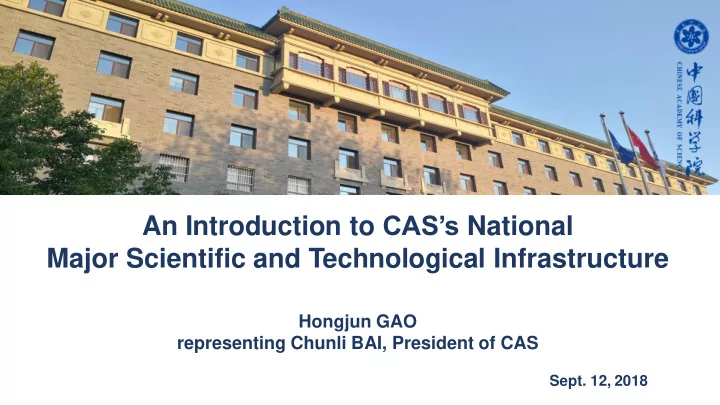
An Introduction to CAS’s National Major Scientific and Technological Infrastructure
Hongjun GAO representing Chunli BAI, President of CAS
- Sept. 12, 2018
Major Scientific and Technological Infrastructure Hongjun GAO - - PowerPoint PPT Presentation
An Introduction to CASs National Major Scientific and Technological Infrastructure Hongjun GAO representing Chunli BAI, President of CAS Sept. 12, 2018 1 Introduction to CAS 2 Planning of National S&T Infrastructure 3 Introduction to
An Introduction to CAS’s National Major Scientific and Technological Infrastructure
Hongjun GAO representing Chunli BAI, President of CAS
Planning of National S&T Infrastructure Introduction to CAS Introduction to CAS’s National Major S&T Infrastructure
2
Planning of National S&T Infrastructure Introduction to CAS Introduction to CAS’s National Major S&T Infrastructure
3
CAS: Cradle of Science and Innovation in China
CAS headquarters (1949-1979) CAS headquarters (1979-) 2011- Bai Chunli
1949 - 1978 Guo Moruo 1979 - 1981 Fang Yi 1981 - 1987 Lu Jiaxi 1987 - 1997 Zhou Guangzhao 1997 - 2011 Lu YongxiangAcademia Sinica (1928-1949)
4
Mission, Structure and Strategy
High-caliber Talent Trusted Ideas Scientific Excellence
Three integrated elements: a large number of institutes, a merit-based academy and higher education institutions Development Strategy: to run it with democracy, flourish it with openness and boost it with talent Committed to excellent S&T, high-caliber talent and offering strategic advice to decision-makers
Structure
Mission Mission Universities Institutes
Structure
Academy
5
Strategy
Planning of National S&T Infrastructure Introduction to CAS Introduction to CAS’s National Major S&T Infrastructure
6
National Planning and Layout
The Medium- and Long-term Plan (2012-2030) for Construction of National Major S&T Infrastructure was issued in 2013. Priority was given to 16 projects in 7 fields for the“12th Five-year Plan“ period (2011- 2015). Energy Science
China Initiative Accelerator Driven System High-Efficiency and Low-Carbon Gas Turbine Research Facility
Material Science
High Energy Photon Source Test Facility Synergetic Extreme Condition User Facility SSRF Phase II Beam-line Project Earth Systems &
Environmental
Sciences Ocean Observation Initiative Earth System Numerical Simulation Facility National Precise Gravity Measurement Facility
Partical Physics & Nuclear Physics
Large High Altitude Air Shower Observatory High Intensity Heavy-ion Accelerator Facility
Space & Astroscience
Ground Simulator for Space Environment Antarctic Observatory at Chinese Kunlun Station
Engineering & Technology Science
China Environment for Network Innovations Large Low Speed Wind Tunnel
Life Science
National Infrastructures for Translational Medicine National Research Facility for Phenotypic and Genetic Analysis of Model Animals
7
National Planning and Layout
The 13th Five-year Plan for Construction of National Major S&T Infrastructure was issued in 2016. Priority was given to 10 projects in 6 fields for the ”13th Five-year plan”period (2016-2020). Energy Science
China Fusion Engineering Testing Reactor
Material Science
High Energy Photon Source Hard X-ray Free Electron Laser Facility
Life Science
National Multimode Trans-scale Biomedical Imaging Center
Partical Physics & Nuclear Physics
Deep Underground and Ultra Low Radiation Background Facility for Frontier Physics Experiments
Space & Astroscience
Large Optical/Infrared Telescope High Precision Ground-based Time Service System Network for Space Environment Research and Forecast
Engineering & Technology Science
Large-scale Earthquake Engineering Simulation Research Facility Centrifugal Hypergravity and Interdisciplinary Experiment Facility
8
Planning of National S&T Infrastructure Introduction to CAS Introduction to CAS’s National Major S&T Infrastructure
9
Overview to CAS’s Infrastructure CAS takes the major force in the construction and
a proportion of 2/3. Recently , CAS has built a batch of major S&T infrastructure.
covering expanding fields providing strong support for S&T research forming a primary trend of cluster development of facilities
10
11
Lanzhou Shenzhen Beijing Xi’an Hefei Kunming Guangzhou Qingdao Shanghai
Operating Facilities of CAS
Germplasm Bank of Wild Species Experimental Advanced Superconducting Tokamak Heavy Ion Research Facility at Lanzhou BPL and BPM time service systems Large Sky Area Multi- Object Fiber Spectro- scopic Telescope Remote Sensing Airplanes China Remote Sensing Satellite Ground Station Meridian Space Weather Monitoring Project Shenguang-Ⅱ: High Power Laser Facility Shanghai Synchrotron Radiation Facility Science Research Vessel Shiyan1 Steady High Magnet Field Facility National Synchrotron Radiation Laboratory Daya Bay Reactor Neutrino Experiment Beijing Electron Positron Collider II Research Vessel KEXUE China Remote Sensing Ground Station Network
12
Facilities Under Construction of CAS
Beijing
Wuhan Biosafety Laboratory
Shanghai Wuhan
National Center for Protein Science Shanghai China Spallation Neutron Source
Guizhou Dongguan
Five-hundred-meter Aperture Spherical Radio Telescope Airborne Remote Sensing System Synergetic Extreme Condition User Facility
High Energy Photon Source Test Facility
SSRF Phase II Beam-line Project Soft X-ray Free Electron Laser
Earth System Numerical Simulation Facility Daocheng
Large High Altitude Air Shower Observatory Hard X-ray Free Electron Laser
13
Comprehensive National Science Centers
According to the “13th Five-year Plan” for construction of national major S&T infrastructure, China will build comprehensive national science centers in cities with integrating superior resources, such as Beijing, Shanghai and Hefei and make them cradles for original achievements, platform for basic sciences and foundation for cultivating young generation of scientists.
Comprehensive National Science Center in Hefei (Anhui) was approved in Jan., 2017. Comprehensive National Science Center in Huairou (Beijing) was approved in May, 2017. Comprehensive National Science Center in Pearl River Delta is in process. Comprehensive National Science Center in Zhangjiang (Shanghai) was approved in Feb., 2016.
Comprehensive National Science Centers
Comprehensive National Science Centers
14
International Cooperation
Large Hardon Collider ATLAS Detector CMS Detector
Cooperation with LHC
CAS cooperated with CERN since the 1970s and CAS has worked with ATLAS and CMS in High Energy Physics and so on.
Cooperation with ITER
China joined ITER in 2016 and CAS took a positive role in the work of ITER.
China’s participation in signing ITER Joint Implementation Agreement Conductor PF5, handed over to ITER Feeder System, delivered to ITER
15
International Cooperation
Cooperation with SKA
China joined SKA and pursued for scientific goals including searching for the first light in the universe and gravitational waves detecting with pulsars.
Cooperation on Ali Primordial Gravitational Waves
CAS and its international partners are cooperating at an altitude of 5250m in Ali of Tibet, aiming at detecting the primordial gravitational waves.
Preliminary design of AliCPT-1 receiver Observation Station for Ali Primordial Gravitational Waves 2500 dish antenna
16
130,0000 helical antenna
S&T Achievements
Precisely measuring of θ13 and finding of new pattern of neutrino
Neutrino Experiment, cooperating with the US partners. Discovering of Zc (3900) containing tetraquark with Beijing Electron Positron Collider II. EAST, achieving the longest (>100s) fully non-inductive current driven steady state high confinement plasma discharge. Discovering of fixed star of the highest Li abundance in the universe with LAMOST. Firstly discovering and verifying millisecond pulsar with FAST. SSRF, providing strong support for the firstly observed three-component fermions.
17
18
CAS will continue to develop major scientific and technological infrastructure, strengthen opening and sharing, actively participate in international cooperation and make contributions to scientific and technological exploration.