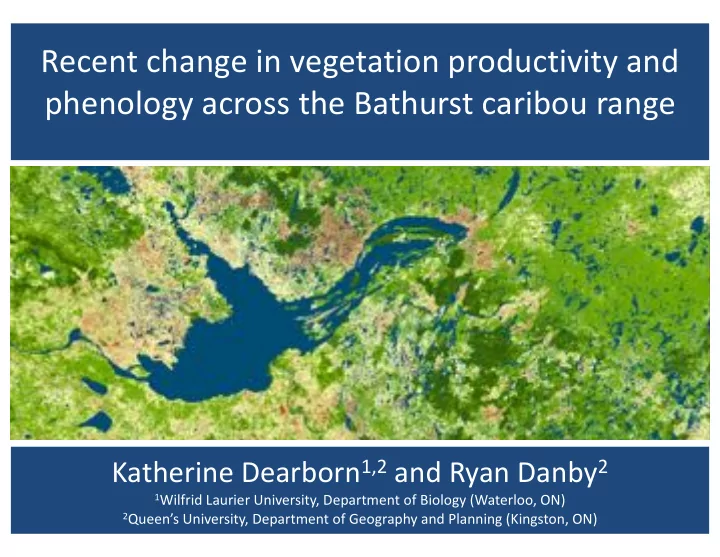
Recent change in vegetation productivity and phenology across the - - PowerPoint PPT Presentation

recent change in vegetation productivity and phenology
SMART_READER_LITE
LIVE PREVIEW

Recent change in vegetation productivity and phenology across the - - PowerPoint PPT Presentation

Recent change in vegetation productivity and phenology across the Bathurst caribou range Katherine Dearborn 1,2 and Ryan Danby 2 1 Wilfrid Laurier University, Department of Biology (Waterloo, ON) 2 Queens University, Department of Geography and


slide-1
SLIDE 1

Recent change in vegetation productivity and phenology across the Bathurst caribou range

Katherine Dearborn1,2 and Ryan Danby2

1Wilfrid Laurier University, Department of Biology (Waterloo, ON) 2Queen’s University, Department of Geography and Planning (Kingston, ON)

slide-2
SLIDE 2

Barren-Ground Caribou in Canada

Government of the Northwest Territories

slide-3
SLIDE 3

Bathurst Herd

Rapid decline

  • 2003: 180,000
  • 2015: 20,000
  • 2018: 8200

Many possible causes of this decline

slide-4
SLIDE 4

Northern Vegetation Change

  • Tundra “greening” and boreal “browning”

Beck and Goetz 2011. Env. Res. Letters

slide-5
SLIDE 5

Northern Vegetation Change

  • Earlier snowmelt, longer growing seasons

Park et al. 2016. Env. Res. Letters

slide-6
SLIDE 6

Vegetation Change & Caribou

  • “Greening” probably not good
  • More tall shrubs = decline in lichen and

cottongrass

  • Tall shrubs impede movement
  • “Browning” might be good
  • Thinning forests = increase in lichen?
  • Earlier start to growing season probably good
  • More forage available
slide-7
SLIDE 7

Research Questions

  • 1. How has vegetation productivity and

phenology changed within the Bathurst herd’s range over the past 18 years?

  • 2. How do the direction and magnitude of this

change vary between the calving grounds and the entire annual range?

slide-8
SLIDE 8

Methods – MODIS Data

  • Vegetation index

data

  • NDVI and EVI
  • 250-m resolution
  • 16-day composites
  • 406 images from
  • Feb. 2000 to Sep.

2017

  • 31,321,351 pixels in

each image

May 09, 2000 May 25, 2000 Jun 10, 2000 Jun 26, 2000 Jul 12, 2000 Jul 28, 2000

slide-9
SLIDE 9

Methods – Curve Fitting

2000 2005 2010 2015

  • Fit a curve to EVI values for each pixel
  • Raw values were weighted by pixel quality

Extracted slope and p-value of each regression

slide-10
SLIDE 10

Results – Change in Productivity

  • Sig. increase:

Annual – 13.5% Calving – 8.6%

  • Sig. decrease:

Annual – 1.3% Calving – 0.5%

slide-11
SLIDE 11

Results – Change in Length of Season

  • Sig. increase:

Annual – 15.9% Calving – 29.3%

  • Sig. decrease:

Annual – 0.0% Calving – 0.0%

slide-12
SLIDE 12

Summary

Spatial variability in type and rate of change:

  • 1. Greening has occurred in summer portions of

range, but not in calving grounds

  • 2. Length of season has increased substantially

in southern portion of calving grounds

  • 3. Virtually no browning or decrease in length
  • f growing season anywhere in the range
slide-13
SLIDE 13

Discussion & Implications

  • 1. Greening in summer range
  • Less suitable forage for caribou?
  • A response to absence of caribou?
  • 2. Longer growing season in calving grounds
  • Beneficial to caribou?
  • 3. Lack of browning trends
  • Trends in boreal forest productivity are largely

driven by wildfire

slide-14
SLIDE 14

Future Work

Why has change been so spatially variable and how is it affecting the Bathurst herd?

Photo: GNWT

  • 1. Field sampling & shrub

ring width analysis

  • 2. Caribou movement analysis

using GPS collar data

slide-15
SLIDE 15

Acknowledgements

Thanks to:

  • Greg King, Carolyn Bonta, Robin Mennell, Joel Koop, Danielle Lebre, and

Emily Grishaber for their contributions to the project

  • Lars Eklundh for help with Timesat software
  • Jennifer Baltzer for helpful suggestions along the way
  • GNWT for providing Bathurst herd range maps

This is part of Project #187 of the Government of the Northwest Territories Department of Environment and Natural Resources Cumulative Impact Monitoring Program

Visit rangechange.ca for more info!

slide-16
SLIDE 16

Thank-you!

Questions?