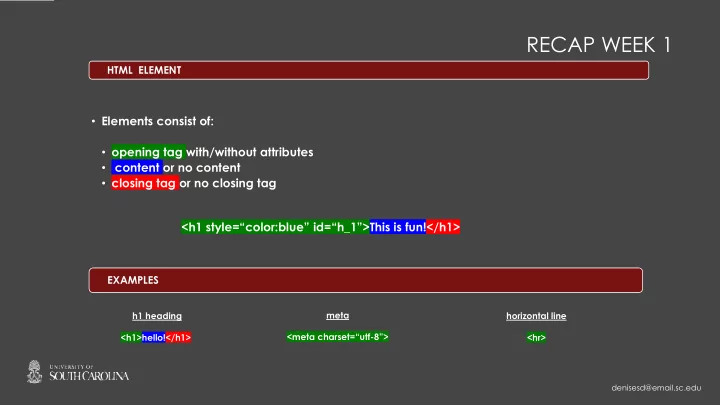
RECAP WEEK 1 HTML ELEMENT Elements consist of: opening tag - - PowerPoint PPT Presentation

recap week 1
SMART_READER_LITE
LIVE PREVIEW

RECAP WEEK 1 HTML ELEMENT Elements consist of: opening tag - - PowerPoint PPT Presentation

RECAP WEEK 1 HTML ELEMENT Elements consist of: opening tag with/without attributes content or no content closing tag or no closing tag <h1 style= color:blue id=h_1> This is fun!</h1> EXAMPLES meta h1


slide-1
SLIDE 1

RECAP WEEK 1

  • Elements consist of:
  • opening tag with/without attributes
  • content or no content
  • closing tag or no closing tag

HTML ELEMENT EXAMPLES

h1 heading <h1>hello!</h1> meta <meta charset=“utf-8”> horizontal line <hr>

<h1 style=“color:blue” id=“h_1”>This is fun!</h1>

denisesd@email.sc.edu

slide-2
SLIDE 2
  • Open angle bracket, <, then tag name followed by closing angle bracket, >
  • OPEN TAG ➔<p>
  • CLOSING TAG ➔</p>(indicated by a forward slash)

TAG <h1>

  • Control the appearance of an element and actions on/by an element
  • Contained within opening tag and the style element (deferred til CSS lectures)
  • Attribute=followed by equal sign then attribute value then enclosed by double quotes

ATTRIBUTES

RECAP WEEK 1

denisesd@email.sc.edu

slide-3
SLIDE 3

RECAP WEEK 1

<h1 style=“color:blue” id=“h_1”> This is fun!</h1> <a href= “https://sc.edu” target=“_blank” class=“select”><img src=“UofSClogo.svg” alt=“uofsc”></a> Text in blue indicates values you can change. There are many other attribute values and content that is modifiable. ATTRIBUTE VALUES and CONTENT

  • html, head, meta, title, body
  • Paragraph <p></p>
  • Preformatted Text <pre> </pre>
  • <hr> and <br>
  • Headings <h1> through <h6>
  • HTML Comments <!– This is Fun! -->
  • HTML5 TEMPLATE html5_template

ELEMENTS SO FAR: denisesd@email.sc.edu

slide-4
SLIDE 4

RECAP WEEK 1

CONTAINERS-BUILDING BLOCKS of HTML

denisesd@email.sc.edu

slide-5
SLIDE 5

WEEK 2

Hyperlinks: Redirects the user to “somewhere” else. Within a webpage, the user clicks the content linked to the next destination.

<a href=“All_Index_dd.html” target=“_blank”> GoTo Index </a>

Anchor Element-hyperlink

The next destination can be

  • an image, pdfs or other files
  • another webpage
  • a section of
  • the current webpage
  • another webpage

The content can be

  • text, “Go to Index”
  • an image,”UofSC logo”
  • or another html element

Where the user will visualize the next destination

denisesd@email.sc.edu

slide-6
SLIDE 6
  • Can link to another website
  • href=“https://sc.edu/”
  • href=“All_102_submissions/All_index_dd.html/”
  • Can link to a section in this webpage or to another webpage. Incorporates id

element within the destination html element

  • href=“All_102_submissions/lab_02_dd.html#links/”
  • href=“#favorites/”
  • Can link to a picture
  • href=“All_102_submissions/happy_face.jpg/”

HREF –specifies the address of the destination link 1.Create an id within the html element to jump to: a.<h1 id=“links”> My favorite Links </h1> b.The id is chosen by you and is unique. Id’s cannot start with a number! 2.Now, reference this id within your anchor element. a.<a href=“lab_2A_dd.html#links/”>Go to My Links</a> or b.<a href=“#links”>Go to My Links</a> HREF-Jump to a section within the current webpage or another webpage

denisesd@email.sc.edu

WEEK 2

slide-7
SLIDE 7
  • Default – opens in current tab overwriting current webpage or frame
  • _blank –opens in a new tab or window
  • _top
  • Iframe and _parent
  • You should familiarize yourself with the different target values. Create a hyperlink to UofSC

website and then modify target value and observe where the new webpage opens. TARGET –where to visualize the link

  • Go to this demo to practice and review the differences between absolute filepaths and

relative filepaths. You will see this frequently in lab.

  • W3 Schools File Path Demo

denisesd@email.sc.edu

WEEK 2

slide-8
SLIDE 8

denisesd@email.sc.edu

WEEK 2

LISTS in HTML5

  • List Container Elements
  • Unordered List <ul></ul>
  • Ordered List <ol></ol>
  • Description List <dl></dl>
  • The open and close tags indicate the start and end of the LIST structure
  • List content:
  • itemized with the list item element <li> for unordered lists <ul>
  • enumerated with list item element <li> for ordered lists <ol>
  • described with term element <dt> and data element <dd> for

description lists<dl>

  • <li> contains anchor tags, text, images and more
  • <dd> contains only text
  • Nesting lists (list within a list) are only applicable to unordered lists and
  • rdered lists. Nesting lists is similar to creating a multi-level outline.
slide-9
SLIDE 9

WEEK 2

Unordered List with hyperlinks: <a> contained within <li> <ul> <!--Start List--> <li><a href=“https://sc.edu” target=“_blank”> go to sc dot edu</a></li> <li><a href=“https://cse.sc.edu/~denisesd” target=“_blank”>goto 102</a></li> </ul> <!--End List-->

denisesd@email.sc.edu

LISTS EXAMPLES

Description List <dl><!--Start List--> <dt>Vegetables</dt> <dd>kale</dd> <dd>asparagus</dd> <dt>Fruits</dt> <dd>blueberries</dd> <dd>bananas</dd> </dl><!--End List--> Ordered List <h1>School Supplies</h1> <ol><!--Start List--> <li>Paper</li> <li>Pencils</li> <li>Pens</li> </ol><!--End List-->

slide-10
SLIDE 10

NESTING LISTS 4 lists or 4 leveled outline GOTO DEMO OF LISTS <h1>Nesting Lists</h1> <ul> <!-- Start Main List--> <li>Gamecock Coaches <ul> <!—Start List 2 → <li> Basketball <ul> <!-- Start List 3--> <li>Dawn Staley</li> <li>Frank Martin</li> </ul> <!--End List 3--> </li> <!--Close Basketball--> <li> Baseball/Softball <ul> <!-- Start List 4--> <li> Mark Kingston</li> <li> Beverly Smith</li> </ul> <!--End List 4--> </li> <!--Close Baseball--> </ul> <!--End List 2--> </li> <!--Close Gamecock Coaches--> </ul> <!--End Main List-->

WEEK 2

denisesd@sc.edu

LISTS EXAMPLES