SLIDE 1
Recap
Some very basic principles of proteins ... in case somebody forgot biochemistry 101.
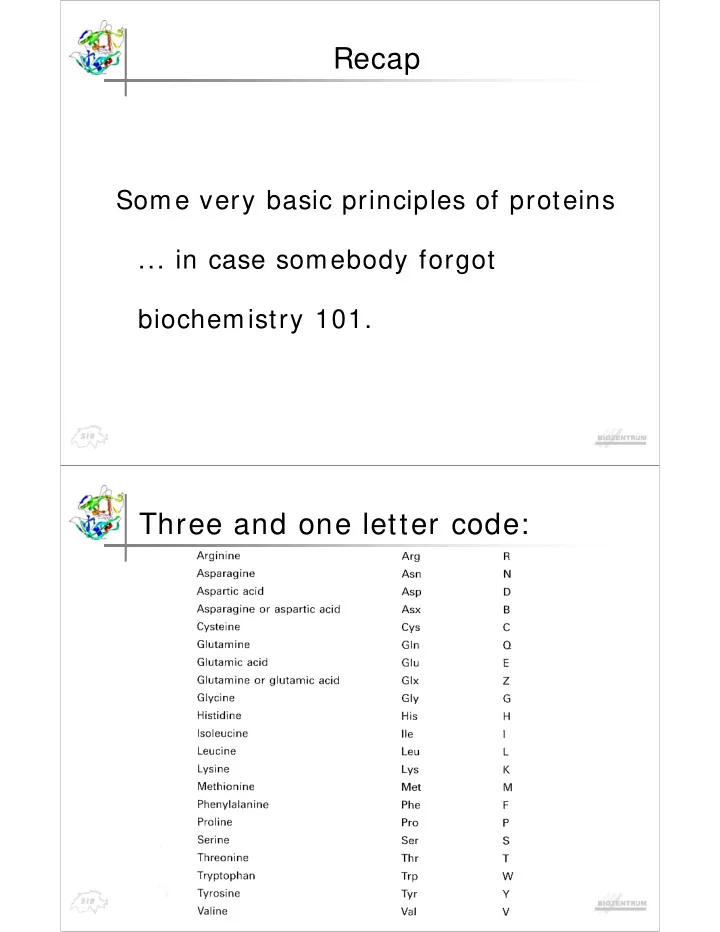
Three and one letter code:
SLIDE 2 http: / / courses.cm.utexas.edu/ jrobertus/ ch339k/ overheads-1/ ch5-amino-acids.jpg
Introduction
SLIDE 3 pH and pKa
pH Water ion product
[ ]
+
− = H pH log
[ ][ ] [ ] [ ]
14 10 log log log 10
14 14
= + = + = =
− − + − − +
pOH pH OH H OH H Kw
Dissociation of weak acids Henderson - Hasselbach Equation
[ ][ ]
[ ]
[ ]
[ ]
[ ] [ ]
[ ]
[ ] [ ] [ ]
[ ]
HA A K H A HA K H A HA K H HA A H K A H HA
a a a a − + − + − + − + − +
+ − = − + = = = + ↔ log log log log log log
pH and pKa
[ ]
[ ]
HA A log pK pH
a −
+ =
SLIDE 4 2 4 6 8 10 12 14 0.5 1 1.5 2
Equivalents of OH
pH
pK1 pK2 Isoelectric point
Glycine
NH3
+
COOH NH3
+
COO- NH2 COO- zwitterion +1
pH and pKa pH and pKa
Glu
SLIDE 5 pH and pKa
Lys
pH and pKa
Q1: Which amino-acid(s) carry a charge under physiological conditions? Q2: Enzymatic reactions often require proton
- transfer. Which amino-acid(s) are able to change
their protonation state under physiological conditions?
SLIDE 6 Anfinson’s paradigm
1957, Nobel Prize 1972
If a chain of a hundred amino acids is considered and it assumed each amino acid can exist in one of three conformations, extended, helical or loop, then there are 3100 possible ways to arrange this chain. This is roughly 1048 conformations. Bond rotation can be estimated to
- ccur at a rate of roughly 1014 s-1. This means that search for the right
conformation through random searching alone would take the order of 1034s or 1026 years, several orders of magnitudes greater than the age
Levinthal's Paradox (1968)
[J. Chim. Phys., 1968, 85, 44]
SLIDE 7 The protein sequence contains all information needed to create a correctly folded protein.
Many proteins fold spontaneously to their native structure Protein folding is relatively fast (nsec – sec) Chaperones speed up folding, but do not alter the structure
MNIFEMLRID EGLRLKIYKD TEGYYTIGIG HLLTKSPSLN AAKSELDKAI GRNCNGVITK DEAEKLFNQD VDAAVRGILR NAKLKPVYDS LDAVRRCALI NMVFQMGETG VAGFTNSLRM LQQKRWDEAA VNLAKSRWYN QTPNRAKRVI TTFRTGTWDA YKNL
Water molecules in bulk water are mobile and can form H-bonds in all directions. Hydrophobic surfaces don’t form H-bonds. The surrounding water molecules have to orient and become more ordered. The entropy loss can be minimized by gathering the hydrophobic surfaces together in the core of a protein and separating them from the solvent.
Hydrophobic Effects
main driving force for protein folding
SLIDE 8
Energetics of protein folding H-bonds hydrophobic effects salt bridges SS - bonds loss of solvation entropy change dispersion / VdW contacts conformational energy
ΔG = ΔH - TΔS
Energetics of protein folding
Difference of two very large energetic terms Low overall stabilization energy Change of energy state from unfolded to folded Folded state must have overall lower energy Let’s assume the folded state is the lowest possible state for this polypeptide
Why do proteins fold?
SLIDE 9
H R R H
Geometry of a peptide bond Dihedral angles ω
Q: Which values would you you expect for ω?
Φ, Ψ, and ω
SLIDE 10
Dihedral angles Φ and Ψ Dihedral angles Φ and Ψ
Φ = 0°, Ψ = 0°
SLIDE 11
Ramachandran Plots
Φ (deg) Ψ (deg) Amino acid preferences
Alanine and Arginine
ALA ARG
SLIDE 12
Amino acid preferences
Amino acid with special preferences:
GLY PRO
Alpha helices
SLIDE 13
Beta strands / beta sheets
Visualization of protein structures