Overview Information-driven modeling of biomolecular complexes ! - - PowerPoint PPT Presentation

overview information driven modeling of
SMART_READER_LITE
LIVE PREVIEW

Overview Information-driven modeling of biomolecular complexes ! - - PowerPoint PPT Presentation

Overview Information-driven modeling of biomolecular complexes ! Introduction ! Information sources ! General aspects of docking ! Information-driven docking with HADDOCK ! Protein-DNA HADDOCKing ! HADDOCKs adventures in CAPRI ! Small molecule


slide-1
SLIDE 1

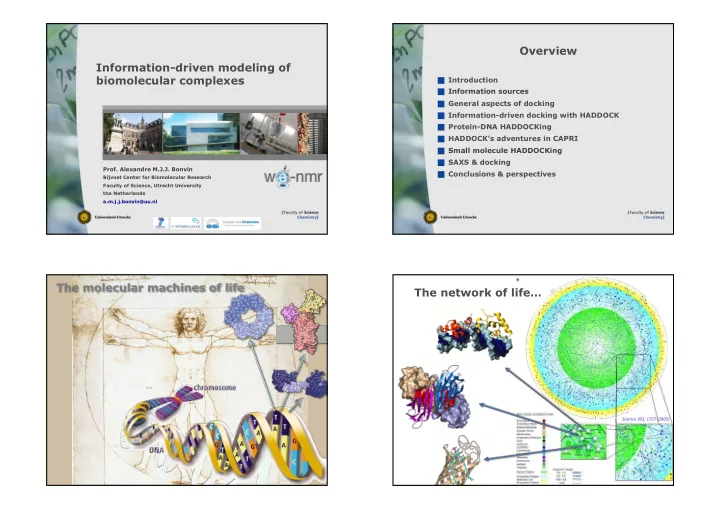
Information-driven modeling of biomolecular complexes

  • Prof. Alexandre M.J.J. Bonvin

Bijvoet Center for Biomolecular Research Faculty of Science, Utrecht University the Netherlands a.m.j.j.bonvin@uu.nl

Overview

! Introduction ! Information sources ! General aspects of docking ! Information-driven docking with HADDOCK ! Protein-DNA HADDOCKing ! HADDOCK’s adventures in CAPRI ! Small molecule HADDOCKing ! SAXS & docking ! Conclusions & perspectives

The molecular machines of life

!"#$%"$&'()*&+,),&-)(('.&

The network of life…

slide-2
SLIDE 2

[Faculty of Science Chemistry]

Study of biomolecular complexes

  • Classical NMR & X-ray crystallography approaches

can be time-consuming

  • Problems arise with “bad behaving”, weak and/or

transient complexes!

  • Complementary computational methods are

needed!

“Critical assessment of predicted interactions” http://capri.ebi.ac.uk

“docking” prediction of the structure of a complex based on the structures of its constituents

[Faculty of Science Chemistry]

What can we learn from 3D structures (models) of complexes?

  • Models provide structural insight

into function and mechanism of action

  • Models can drive and guide

experimental studies

  • Models can help understand and

rationalize the effect of disease- related mutations

  • Models provide a starting point for

drug design

[Faculty of Science Chemistry]

Data-driven docking

  • There is a wealth of (easily) available

experimental data on biomolecular interaction.

  • When classical structural studies fail, these are

however often not used and the step to modelling (docking) is most of the time not taken.

  • These data can be very useful to filter docking

solutions or even to drive the docking and thus limit the conformational search problem.

[Faculty of Science Chemistry]

Related reviews

  • van Dijk ADJ, Boelens R and Bonvin AMJJ (2005). Data-driven

docking for the study of biomolecular complexes. FEBS Journal 272 293-312.

  • de Vries SJ and Bonvin AMJJ (2008). How proteins get in touch:

Interface prediction in the study of biomolecular complexes. Curr.

  • Pept. and Prot. Research 9, 394-406.
  • de Vries SJ, de Vries M. and Bonvin AMJJ. The prediction of

macromolecular complexes by docking. In: Prediction of Protein Structures, Functions, and Interactions. Edited by J. Bujnicki Ed., John Wiley & Sons, Ltd, Chichester, UK (2009).

  • A.S.J. Melquiond and A.M.J.J. Bonvin. Data-driven docking: using

external information to spark the biomolecular rendez-vous. In: Protein-protein complexes: analysis, modelling and drug design. Edited by M. Zacharrias, Imperial College Press, 2010. p 183-209.

slide-3
SLIDE 3

Overview

! Introduction ! Information sources ! General aspects of docking ! Information-driven docking with HADDOCK ! Protein-DNA HADDOCKing ! HADDOCK’s adventures in CAPRI ! Small molecule HADDOCKing ! SAXS & docking ! Conclusions & perspectives

[Faculty of Science Chemistry]

Experimental sources:

mutagenesis

Advantages/disadvantages + Residue level information

  • Loss of native structure

should be checked Detection

  • Binding assays
  • Surface plasmon resonance
  • Mass spectrometry
  • Yeast two hybrid
  • Phage display libraries, …

[Faculty of Science Chemistry]

Experimental sources:

cross-linking and other chemical modifications

Advantages/disadvantages + Distance information between linker residues

  • Cross-linking reaction problematic
  • Detection difficult

Detection

  • Mass spectrometry

[Faculty of Science Chemistry]

Experimental sources:

H/D exchange

Advantages/disadvantages + Residue information

  • Direct vs indirect effects
  • Labeling needed for NMR

Detection

  • Mass spectrometry
  • NMR 15N HSQC
slide-4
SLIDE 4

[Faculty of Science Chemistry]

Experimental sources:

NMR chemical shift perturbations

Advantages/disadvantages + Residue/atomic level + No need for assignment if combined with a.a. selective labeling

  • Direct vs indirect effects
  • Labeling needed

Detection

  • NMR 15N or 13C HSQC

[Faculty of Science Chemistry]

Experimental sources:

NMR orientational data (RDCs, relaxation)

Advantages/disadvantages + Atomic level

  • Labeling needed

Detection

  • NMR

[Faculty of Science Chemistry]

Experimental sources:

NMR saturation transfer

Advantages/disadvantages + Residue/atomic level + No need for assignment if combined with a.a. selective labeling

  • Labeling (including deuteration) needed

Amide protons at interface are saturated ==> intensity decrease

[Faculty of Science Chemistry]

Other potential experimental sources

  • Paramagnetic probes in combination with NMR
  • Cryo-electron microscopy or tomography and

small angle X-ray scattering (SAXS) ==> shape information

  • Fluorescence quenching
  • Fluorescence resonance energy transfer (FRET)
  • Infrared spectroscopy combined with specific

labeling

slide-5
SLIDE 5

[Faculty of Science Chemistry]

Predicting interaction surfaces

  • In the absence of any experimental information

(other than the unbound 3D structures) we can try to predict interfaces from sequence information?

  • WHISCY:

WHat Information does Surface Conservation Yield?

http://www.nmr.chem.uu.nl/whiscy EFRGSFSHL EFKGAFQHV EFKVSWNHM LFRLTWHHV IYANKWAHV EFEPSYPHI Alignment

Surface smoothing

+

Propensities

predicted true

+

De Vries, van Dijk Bonvin. Proteins 2006

[Faculty of Science Chemistry]

AB/10-04

What is conservation?

  • Conservation occurs when residues are expected to

mutate, but do not mutate, or much more slowly

  • How to calculate conservation?

– Generate a sequence alignment – Calculate the expected mutation behavior – Calculate deviations from this behavior – Is there less change than expected?

  • The residue conservation score is the sum of all

deviations from expected behavior

[Faculty of Science Chemistry]

Sequence distance must be taken into account

AFRGTFSHL AFRGTFSHL EFRGSFSHL EFEPSYPHI

Near identical sequences No conservation Different sequences Conservation

How to calculate expected conservation?

[Faculty of Science Chemistry]

Ala Asp Glu Trp Ala 99 0.33 0.33 0.33 Asp 0.33 99 0.33 0.33 glu 0.33 0.33 99 0.33 Trp 0.33 0.33 0.33 99

Residue mutation matrix example

  • “Four residue world”: Ala, Asp, Glu, Trp
  • Sequence distance: 1 % mutation
slide-6
SLIDE 6

[Faculty of Science Chemistry]

Ala Asp Glu Trp Ala 98 0.67 0.67 0.67 Asp 0.33 99 0.33 0.33 glu 0.33 0.33 99 0.33 Trp 0.17 0.17 0.17 99.5

Residue mutation matrix example

  • Some residues mutate however faster than
  • thers

[Faculty of Science Chemistry]

Ala Asp Glu Trp Ala 98 0.67 0.67 0.67 Asp 0.17 99 0.67 0.17 glu 0.17 0.67 99 0.17 Trp 0.17 0.17 0.17 99.5

Residue mutation matrix example

  • Some mutations are more likely than others

[Faculty of Science Chemistry]

Ala Asp Glu Trp Ala 65.96 11.35 11.35 11.35 Asp 2.84 82 11.74 3.42 glu 2.84 11.74 82 3.42 Trp 2.84 3.42 3.42 90.32

Residue mutation matrix example

  • You can multiply the matrix by itself to

generate distance specific matrices

– E.g. result of 20 multiplications: 20 % mutation

[Faculty of Science Chemistry]

Residue mutation matrix

  • Several of such matrices exist
  • The best known is the Dayhoff (PAM)

matrix (Dayhoff et al. 1978)

  • This matrix is used in Whiscy
slide-7
SLIDE 7

[Faculty of Science Chemistry]

  • Take as input a 3D structure and a sequence alignment
  • protdist (Felsenstein et al.) used to calculate the sequence

distances

  • WHISCY compares the master sequence to every other

sequence

AFRGTFSHL

5 18 75 85 102 121

master distance

EFRGSFSHL EFKGAFQHV EFKVSWNHM LFRLTWHHV IYANKWAHV EFEPSYPHI

WHISCY calculation

[Faculty of Science Chemistry]

AFRGTFSHL EFRGSFSHL EFKGAFQHV EFKVSWNHM LFRLTWHHV IYANKWAHV EFEPSYPHI

5 18 75 85 102 121

master distance

WHISCY calculation

  • Each residue is scored independently

[Faculty of Science Chemistry]

R R K K R A E

5 Mutation matrix 18 Mutation matrix 75 Mutation matrix 85 Mutation matrix 102 Mutation matrix 121 Mutation matrix Compare with

  • bserved residue

Partial scores

... ... ... ... ... ...

+

Total score

The sequences are weighted so that the distance range is represented equally

WHISCY calculation

Master sequence residue distance

[Faculty of Science Chemistry]

Partial score

  • The partial score is equal to the probability

in the distance-dependent mutation matrix

  • A correction factor corresponding to the sum
  • f squares of all probabilities is subtracted
  • This makes sure that the average score is

zero

  • WHISCY score > 0 indicates conservation
slide-8
SLIDE 8

[Faculty of Science Chemistry]

Testing WHISCY with known complexes

  • Benchmark of 37 protein complexes (Chen et
  • al. 2003)
  • Sequence alignments from the HSSP

database (Sander et al. 1991)

– Some proteins were left out of prediction because of bad sequence alignments

  • Interface definitions by DIMPLOT (Wallace et
  • al. 1995)

– Residues making contacts across interface (hbond + non-bonded)

  • Surface definition by NACCESS (Hubbard &

Thornton 1993) (15 % accessibility cutoff)

[Faculty of Science Chemistry]

WHISCY raw performance

  • Fraction of correct versus incorrect predictions for

the benchmark

[Faculty of Science Chemistry]

Improving the score using amino acid interface propensities

  • Each amino acid has its own interface propensity

(from analysis of 3D structures of known complexes):

  • WHISCY score converted into a p-value and

divided by the a.a. interface propensity

frequency at the interface frequency at the surface

Residue X: score Residue Z: score p = 0.10 p = 0.10 / 2.5 / 0.4 p = 0.04 p = 0.25 higher score lower score

[Faculty of Science Chemistry]

Improving the score by surface smoothing

  • Interface residues are not spread over the surface

but form patches

  • Take the scores of the neighbors into account:

– Residues with high-scoring neighbors should get a bonus – Residues with low-scoring neighbors should get a penalty

=> Scores are smoothed over a 15Å radius using a Gaussian or optimized step function

unlikely interface likely interface

slide-9
SLIDE 9

[Faculty of Science Chemistry]

WHISCY optimized performance

  • Fraction of correct versus incorrect predictions for

the benchmark

[Faculty of Science Chemistry]

Distribution of predicted interface residues as a function of their distance from the true interface

10% cutoff indicates the WHISCY cutoff resulting in 10% of the true interface predicted

[Faculty of Science Chemistry]

Predicting interaction surfaces

  • Several other approaches have been described:

– HSSP (Sander & Schneider, 1993) – Evolutionary trace (Lichtarge et al., 1996) – Correlated mutations (Pazos et al., 1996) – ConsSurf (Armon et al., 2001) – Neural network (Zhou & Shan, 2001) (Fariselli et al., 2002) – Rate4Site (Pupko et al., 2002) – ProMate (Neuvirth et al., 2004) – PPI-PRED (Bradford & Westhead, 2005) – PPISP (Chen & Zhou, 2005) – PINUP (Liang et al., 2006) – SPPIDER (Kufareva et al, 2007) – PIER (Porolo & Meller, 2007) – SVM method (Dong et al., 2007) – ... – Our recent meta-server: CPORT (de Vries & Bonvin, 2011)

See review article (de Vries & Bonvin 2008)

[Faculty of Science Chemistry]

Interface prediction servers

  • PPISP (Zhou & Shan,2001; Chen & Zhou, 2005)

http://pipe.scs.fsu.edu/ppisp.html

  • ProMate (Neuvirth et al., 2004)

http://bioportal.weizmann.ac.il/promate

  • WHISCY (De Vries et al., 2005)

http://www.nmr.chem.uu.nl/whiscy

  • PINUP (Liang et al., 2006)

http://sparks.informatics.iupui.edu/PINUP

  • PIER (Kufareva et al., 2006)

http://abagyan.scripps.edu/PIER

  • SPPIDER (Porollo & Meller, 2007)

http://sppider.cchmc.org

Consensus interface prediction (CPORT)

haddock.chem.uu.nl/services/CPORT
slide-10
SLIDE 10

[Faculty of Science Chemistry]

CPORT webserver

haddock.chem.uu.nl/services/CPORT/

[Faculty of Science Chemistry]

Combining experimental or predicted data with docking

  • a posteriori: data-filtered docking

– Use standard docking approach – Filter/rescore solutions

  • a priori: data-directed docking

– Include data directly in the docking by adding an additional energy term

  • r limiting the search space

Overview

! Introduction ! Information sources ! General aspects of docking ! Information-driven docking with HADDOCK ! Protein-DNA HADDOCKing ! HADDOCK’s adventures in CAPRI ! Small molecule HADDOCKing ! SAXS & docking ! Conclusions & perspectives

[Faculty of Science Chemistry]

A few docking reviews

  • Halperin et al. (2002) “Principles of docking: an overview of

search algorithms and a guide to scoring functions”. PROTEINS: Struc. Funct. & Genetics 47, 409-443.

  • Special issues of PROTEINS: (2003) (2005) (2007) and (2010)

which are dedicated to CAPRI.

  • Brooijmans and Kuntz (2003) “Molecular recognition and

docking algorithms”. Annu. Rev. Biophys. Biomol. Struct. 32, 335-373.

  • Russell et al. (2004) “A structural perspective on protein-

protein interactions”. Curr. Opin. Struc. Biol. 14, 313-324.

  • Van Dijk et al. (2005) “Data-driven docking for the study of

biomolecular complexes.” FEBS J. 272, 293-312.

slide-11
SLIDE 11

[Faculty of Science Chemistry]

Docking

  • Choices to be made in docking:

– Representation of the system – Sampling method:

  • 3 rotations and 3 translations
  • Internal degrees of freedom?

– Scoring – Flexibility, conformational changes? – Use experimental information?

[Faculty of Science Chemistry]

Dealing with flexibility

  • Flexibility makes the docking problem harder!

– Increased number of degrees of freedom – Scoring more difficult

  • Difficult to predict a-priori conformational

changes

  • Current docking methodology can mainly deal

with small conformational changes

  • Treatment of flexibility depends on the chosen

representation of the system and the search method

[Faculty of Science Chemistry]

Scoring

  • The holy grail in docking!
  • Depends on the

representation of the system and treatment of flexibility

  • Depends on the type of

complexes

– e.g. antibody-antigen might behave differently than enzyme-inhibitors complexes

[Faculty of Science Chemistry]

Scoring

  • Score is often a combination of various (empirical)

terms such as – Intermolecular van der Waals energy – Intermolecular electrostatic energy – Hydrogen bonding – Buried surface area – Desolvation energy – Entropy loss – Amino-acid interface propensities – Statistical potentials such as pairwise residue contact matrices – …

  • Experimental filters sometimes applied a posteriori if

data available (e.g. NMR chemical shift perturbations, mutagenesis,..)

slide-12
SLIDE 12

Overview

! Introduction ! Information sources ! General aspects of docking ! Information-driven docking with HADDOCK ! Protein-DNA HADDOCKing ! HADDOCK’s adventures in CAPRI ! Small molecule HADDOCKing ! SAXS & docking ! Conclusions & perspectives

[Faculty of Science Chemistry]

Data-driven HADDOCKing

A B

i x y z j

HADDOCK

High Ambiguity Driven DOCKing

mutagenesis NMR titrations Cross-linking H/D exchange

EFRGSFSHL EFKGAFQHV EFKVSWNHM LFRLTWHHV IYANKWAHV EFEPSYPHI

Bioinformatic predictions NMR anisotropy data

RDCs, para-restraints, diffusion anisotropy

NMR crosssaturation Other sources

e.g. SAXS, cryoEM

diAB

eff =

1 dmnk

6 n k = 1 Nat o t o ms

!

k= 1 N r N resB

!

mi A

i A= 1

N a N a t o t o ms

!

" # $ $ $ % & ' ' '

( 1 6

Dominguez, Boelens & Bonvin. JACS 125, 173 (2003). [Faculty of Science Chemistry]

Data-driven docking with HADDOCK

A B i x y z j k

HADDOCK

High Ambiguity Driven DOCKing List of interface residues for protein A List of interface residues for protein B Ambiguous Interaction Restraint:

a residue must make contact with any residue from the other list Different fraction of restraints (typically 50%) randomly deleted for each docking trial to deal with inaccuracies and errors in the information used

(i,j,k) (x,y,z)

Effective distance diAB

eff

calculated as

diAB

eff =

1 dmnk

6 n k = 1 Nat o t o ms

!

k= 1 N r N resB

!

mi A

i A= 1

N a N a t o t o ms

!

" # $ $ $ % & ' ' '

( 1 6

(Nilges & Brunger 1991)

[Faculty of Science Chemistry]

AB/10-08

Ambiguous Interaction Restraints (AIRs)

  • Soft-square potential (Nilges) used to avoid large forces
  • Different fraction of restraints (typically 50%) randomly

deleted for each docking trial to deal with inaccuracies and errors in the information used

Force becomes constant >2Å violation

slide-13
SLIDE 13

[Faculty of Science Chemistry]

Searching the interaction space in HADDOCK

  • Experimental and/or predicted information is combined

with an empirical force field into an energy function whose minimum is searched for

  • Vpotential = Vbonds + Vangles

+ Vtorsion + Vnon-bonded + Vexp

  • Search is performed by a combination of gradient

driven energy minimization and molecular dynamics simulations

Van der Waals electrostatic

[Faculty of Science Chemistry]

Classical mechanics

  • Molecular dynamics: generates successive

configurations of the system by integrating Newton’s second law

d 2 dt 2 ! r

i =

! F

i

mi ! F

i = ! "V

"! r

i

with

t1 t2 t3

! r (t1) ! r (t2) ! v (t1) ! v (t2) ! F (t1)

[Faculty of Science Chemistry]

Torsion angle dynamics

  • dynamics time step

dictated by bond stretching: waste of CPU time

  • important motions are

around torsions

  • ~ 3 degrees of freedom

per AA (vs 3Natom for Cartesian dynamics)

  • Available in DYANA, X-

PLOR, CNS, X-PLOR-NIH

[Faculty of Science Chemistry]

HADDOCK docking protocol

slide-14
SLIDE 14

[Faculty of Science Chemistry]

HADDOCK & Flexibility

  • Several levels of flexibility:
  • Implicit:

– docking from ensembles of structures – Scaling down of intermolecular interactions

  • Explicit:

– semi-flexible refinement stage with both side- chain and backbone flexibility during in torsion angle dynamics – Final refinement in explicit solvent

[Faculty of Science Chemistry]

Energetics & Scoring

  • OPLS non-bonded parameters (Jorgensen, JACS 110, 1657 (1988))
  • 8.5Å non-bonded cutoff, switching function, e=10
  • Ranking of based on HADDOCK score defined as:

– Eair: ambiguous interaction restraint energy – Edesolv: desolvation energy using Atomic Solvation Parameters (Fernandez-Recio et al JMB 335, 843 (2004)) – BSA: buried surface area Rigid: Score = 0.01 Eair + 0.01 EvdW + 1.0 Eelec + 1.0 Edesolv – 0.01 BSA Flexible: Score = 0.1 Eair + 1.0 EvdW + 1.0 Eelec + 1.0 Edesolv – 0.01 BSA Water: Score = 0.1 Eair + 1.0 EvdW + 0.2 Eelec + 1.0 Edesolv

[Faculty of Science Chemistry]

The Not4 – UbcH5B complex

  • Not4: involved in the RNA

polymerase II regulation. Contains a N-terminal Ring finger domain (Hanzawa et al., 2000)

  • UbcH5B: involved in the

ubiquitination pathway

0.05 0.1 0.15 0.2 0.25 0.3 1 4 7 10 13 16 19 22 25 28 31 34 37 40 43 46 49 52 55 58 61

Residue Number comp (ppm)

0.05 0.1 0.15 0.2 0.25 0.3 1 6 11 16 21 26 31 36 41 46 51 56 61 66 71 76 81 86 91 96 101 106 111 116 121 126 131 136 141 146 Residue Number

Best Haddock solutions

K63 K66 K4 K8

UbcH5B Not4 Haddock directed mutagenesis ==> Altered specificity mutants!

D48 E49 D48 E49

Dominguez, Bonvin, Winkler, van Schaik, Timmers & Boelens. Structure 2004

[Faculty of Science Chemistry]

Accuracy <-> Data When does the model stop and the structure start?

slide-15
SLIDE 15

[Faculty of Science Chemistry]

Accuracy <-> Data: E2A-HPR

CSP only CSP + RDCs CSP + DANI NOEs + RDCs

[Faculty of Science Chemistry]

The HADDOCK web portal

haddock.chem.uu.nl

[Faculty of Science Chemistry]

The HADDOCK PDB structure gallery

74 entries – Nov. 2010

Image collage from http://www.pdb.org

[Faculty of Science Chemistry]

!"#$%&'(")*"+,%'-.,)-."/" !"0#123"4"45" !"0#123"/"45" ""4/"""/6478"""/6798"4":"""""""""";6;;;'<;;"";6;;'<;;"=""";"/8>?"/8?;";" ""4@"""/6798"""@64@;"4":"""""""""";6;;;'<;;"";6;;'<;;"=""";"/8?;"/8>/";" ""7/"""469@A"""@6@7/"4":"""""""""";6;;;'<;;"";6;;'<;;"=""";"//>A"//>8";" ""7?"""469@A"""764@7"4":"""""""""";6;;;'<;;"";6;;'<;;"=""";"//>A"/>98";" ""7A"""468?;"""@6@7/"4":"""""""""";6;;;'<;;"";6;;'<;;"=""";"//?;"//>8";" ""@;"""468?;"""469@A"4":"""""""""";6;;;'<;;"";6;;'<;;"=""";"//?;"//>A";" ""@7"""468?;"""764@7"4":"""""""""";6;;;'<;;"";6;;'<;;"=""";"//?;"/>98";" ""@?"""46?@A"""@6@7/"4":""""""""""46;7>'<;>"";6;;'<;;"(""";"/>97"//>8";" ""@8"""46?@A"""469@A"4":"""""""""";6;;;'<;;"";6;;'<;;"=""";"/>97"//>A";" assign ( resid 501 and name OO ) ( resid 501 and name Z ) ( resid 501 and name X ) ( resid 501 and name Y ) ( resid 2 and name CA ) -0.1400 0.15000 assign ( resid 501 and name OO ) ( resid 501 and name Z ) ( resid 501 and name X ) ( resid 501 and name Y ) ( resid 3 and name CA ) -0.0100 0.15000

!"#"$ %&#'()('#"*+&$

,#(-.#-('/$01&"2%.3$4$%&#'(".*+&3$ !$%2)".#$+&$('3'"(.5$"&0$5'"6#57$ = $+(%8%&$+9$0%3'"3'$ $:$0'3%8&$+9$&';$'<)'(%2'&#3$ $ $:$0(-8$0'3%8& $=$

><)6+%*&8$?@A!$('3+-(.'3$%&$3#(-.#-("6$B%+6+81=$

C+2)-#"*+&3$

DE@$0"#"$.+66'.*+&$"&0$)(+.'33%&8$$$$$$$$$$$$$$$,FG,$0"#"$"&"613%3$

slide-16
SLIDE 16

H'DE@$)6"I+(2$+)'("*+&"6$"&0$;'66$-3'0J$

  • K"(8'3#$86+B"6$LM$%&$#5'$6%9'$3.%'&.'3$
  • MN'($OPQ$('8%3#'('0$-3'(3$"&0$8(+;%&8$
  • RSQQQQ$CTU3$
  • RVQQ$CTU$1'"(3$+N'($#5'$$6"3#$SO$2+&#53$
  • WOQX$+9$K%9'$,.%'&.'3$+&$#5'$?(%0$
  • U3'(:9(%'&061$"..'33$#+$':A&9("3#(-.#-('$N%"$;'B$)+(#"63$

www.wenmr.eu

Y5'$$L@C$)+(#"67$$$;;;Z;'&2(Z'-$

Overview

! Introduction ! Information sources ! General aspects of docking ! Information-driven docking with HADDOCK ! Protein-DNA HADDOCKing ! HADDOCK’s adventures in CAPRI ! Small molecule HADDOCKing ! SAXS & docking ! Conclusions & perspectives

slide-17
SLIDE 17

[Faculty of Science Chemistry]

Modeling protein-DNA interactions: Bend and Twist it to make it fit

[Faculty of Science Chemistry]

Modelling of Protein-DNA complexes: a two-stage protocol

It0 It1 Water

1st docking run

Scoring Input structures:

  • canonical B-DNA
  • Protein (ensemble)

It0 It1 Water

2nd docking run

Scoring

It0: rigid body docking It1: semi-flexible refinement Water: final refinement in explicit solvent

Van Dijk et al. Nucl. Acid. Res. 2006

Cro - O1R

iRMSD = 1.62 Å

Lac - O1

iRMSD = 2.02 Å

Arc - operator

iRMSD = 1.90 Å

DNA library generation

[Faculty of Science Chemistry]

Generating (custom) nucleic acids structures

haddock.chem.uu.nl/dna

Generate A-DNA or B-DNA from sequence Full control over base-pair(step) parameters Control over global conformation (bend & twist) Uses 3DNA (Lu & Olson, NAR 2003)

Van Dijk & Bonvin NAR 2009

[Faculty of Science Chemistry]

Protein-DNA benchmark

Van Dijk et al. NAR 2008

“easy” “medium” “difficult” “difficult”

47 complexes with both free and bound structures

slide-18
SLIDE 18

[Faculty of Science Chemistry]

Assessment terminology

! i-RMSD: Interface RMSD ! l-RMSD: Ligand RMSD ! Fnat: Fraction of native contacts Fnat l-RMSD (Å) i-RMSD (Å) High (***) !0.5 "1 "1 Medium (**) !0.3 "5 "2 Acceptable (*) !0. 1 "10 "4 Incorrect <0. 1 >10 >4

Lensink et al. Proteins 2007

[Faculty of Science Chemistry]

Unbound-Unbound using canonical B-DNA and true interface restraints

Is the protein-DNA docking procedure able to account for conformation changes, and to what extend?

Van Dijk & Bonvin. NAR 2010

[Faculty of Science Chemistry]

Performance of rigid-body docking only

[Faculty of Science Chemistry]

Performance after flexible refinement (1 cycle)

slide-19
SLIDE 19

[Faculty of Science Chemistry]

Performance after the 2 steps protocol with custom DNA library

[Faculty of Science Chemistry]

Unbound-Unbound using canonical B-DNA with experimental information

How well does the procedure perform when knowledge-based restraints are used?

[Faculty of Science Chemistry]

1by4 ** fnat = 0.40 iRMSD = 3.55 Å dRMSD = 1.50 Å 3cro ** fnat = 0.50 iRMSD = 2.23 Å dRMSD = 1.93 Å

Retinoic acid receptor 434 Cro protein

“easy” cases

[Faculty of Science Chemistry]

1azp * fnat = 0.11 iRMSD = 3.44 Å dRMSD = 1.58 Å 1jj4 ** fnat = 0.44 iRMSD = 2.63 Å dRMSD = 2.26 Å

Hyperthermophile chromosomal protein SAC7D papillomavirus type 18 E2

“medium” cases

slide-20
SLIDE 20

[Faculty of Science Chemistry]

1zme * fnat = 0.15 iRMSD = 3.75 Å dRMSD = 3.23 Å 1a74 ** fnat = 0.31 iRMSD = 3.24 Å dRMSD = 3.70 Å

PUT3 1-PPOL homing endonuclease

“difficult” cases Overview

! Introduction ! Information sources ! General aspects of docking ! Information-driven docking with HADDOCK ! Protein-DNA HADDOCKing ! HADDOCK’s adventures in CAPRI ! Small molecule HADDOCKing ! SAXS & docking ! Conclusions & perspectives

[Faculty of Science Chemistry]

HADDOCK’s adventures in CAPRI

“Critical assessment of predicted interactions” http://capri.ebi.ac.uk

  • CAPRI is a blind test for protein-protein docking
  • Usually 3 weeks for a predictions, 10 models can be

submitted

  • We participated to rounds 4 to 19 for a total of 27 targets
  • For HADDOCK, we derived information to define AIRs

from literature and bioinformatic predictions

Van Dijk et al. Proteins 2005; de Vries et al. Proteins 2007,2010

[Faculty of Science Chemistry]

Performance of the HADDOCK team in CAPRI rounds 13-19

  • 29 [1, 1, 2, 1, 1, 1, 0, 0, 0, 0] BU
  • 30 [0, 0, 0, 0, 0, 0, 0, 0, 0, 0] UU
  • 32 [0, 0, 0, 0, 0, 0, 0, 0, 0, 0] UU
  • 33 [0, 0, 0, 0, 0, 0, 0, 0, 0, 0] UH
  • 34 [2, 2, 1, 2, 1, 1, 0, 0, 0, 0] UB
  • 35 [0, 0, 0, 0, 0, 0, 0, 0, 0, 0] HH
  • 36 [0, 0, 0, 0, 0, 0, 0, 0, 0, 0] BH
  • 37 [0, 0, 2, 2, 0, 0, 0, 0, 0, 0] UH (2 *** uploaded)
  • 38 [0, 0, 0, 0, 0, 0, 0, 0, 0, 0] UH
  • 39 [0, 0, 0, 0, 0, 0, 0, 0, 0, 0] UB
  • 40 [3, 3, 3, 3, 3, 3, 3, 3, 3, 3] UB
  • 41 [1, 1, 2, 2, 1, 1, 1, 1, 1, 1] UH
  • 42 [0, 0, 0, 0, 0, 0, 0, 0, 0, 1] HH(H)

1 ***, 4 **, 1 *, 12 stars

}

Two-domain protein – crystal structure incompatible with covalently linked domains!!!

slide-21
SLIDE 21

[Faculty of Science Chemistry]

Performance of the HADDOCK server in CAPRI rounds 15-19

  • 32 [0, 0, 0, 0, 0, 0, 0, 0, 0, 0] UU
  • 33 [0, 0, 0, 0, 0, 0, 0, 0, 0, 0] UH
  • 34 [1, 1, 1, 1, 1, 1, 0, 0, 0, 1] UB
  • 35 [0, 0, 0, 0, 0, 0, 0, 0, 0, 0] HH
  • 36 [0, 0, 0, 0, 0, 0, 0, 0, 0, 0] BH
  • 37 [0, 0, 0, 0, 0, 0, 0, 0, 0, 0] UH
  • 38 [0, 0, 0, 0, 0, 0, 0, 0, 0, 0] UH
  • 39 [0, 0, 0, 0, 0, 0, 0, 0, 0, 0] UB
  • 40 [0, 0, 3, 0, 0, 0, 0, 0, 0, 0] UB
  • 41 [1, 1, 2, 1, 0, 0, 0, 0, 0, 0] UH
  • 42 [0, 0, 0, 0, 0, 0, 0, 0, 1, 0] HH(H)

1 ***, 1 **, 2 *, 7 stars

}

Two-domain protein – crystal structure incompatible with covalently linked domains!!!

[Faculty of Science Chemistry]

HADDOCK’s performance in CAPRI

  • Overall performance:

– 3***, 9**, 3* 15 out of 25 (60%)

  • Unbound only performance:

– 6**, 2* 8 out of 13 (62%)

  • As good as it gets… (among the top performing

methods)

  • “wrong” solutions still often have correctly

predicted interfaces, but wrong orientations of the components

  • ==> still useful to direct the experimental work

Van Dijk et al. Proteins 2005; de Vries et al. Proteins 2007,2010

[Faculty of Science Chemistry]

Target Fraction true interface coverage Fraction overprediciton ligand receptor ligand receptor T29 0.92 0.88 0.11 0.20 T30 0.84 0.73 0.26 0.39 T32 0.87 0.75 0.25 0.31 T33 0.61 0.42 0.20 0.50 T34 0.61 0.87 0.17 0.10 T37 0.36 0.89 0.66 0.27 T40 0.90 0.96 0.05 0.03 T41 0.89 0.83 0.04 0.15 T42 0.87 0.87 0.14 0.14

Post-docking interface prediction

[Faculty of Science Chemistry]

HADDOCK’s weakness

(one of them)

Information-driven…

slide-22
SLIDE 22

[Faculty of Science Chemistry]

Our T32 failure… (the “easy” one)

[Faculty of Science Chemistry]

Our T32 failure… (the “easy” one)

Note: Three body docking does generate ** solutions…

[Faculty of Science Chemistry]

HADDOCK’s strength

(one of them)

Information-driven…

[Faculty of Science Chemistry]

T40 10x ***

slide-23
SLIDE 23

[Faculty of Science Chemistry]

T37

** submitted, *** uploaded

Overview

! Introduction ! Information sources ! General aspects of docking ! Information-driven docking with HADDOCK ! Protein-DNA HADDOCKing ! HADDOCK’s adventures in CAPRI ! Small molecule HADDOCKing ! SAXS & docking ! Conclusions & perspectives

[Faculty of Science Chemistry]

Small molecules docking with HADDOCK

  • Docking protocol issues:

– Pre-sample ligand conformations – use ensemble for docking – same for protein – If flexibility is expected to play an important role (e.g. docking of an unstructured peptide

  • nto a protein), perform a fully flexible docking

during the simulated annealing phase

[Faculty of Science Chemistry]

Fully flexible protein-ligand docking

Wu et al. Glycobiology 2007

slide-24
SLIDE 24

[Faculty of Science Chemistry]

HADDOCK-modelling of substrate binding in PagL, an outer-membrane enzyme involved in LPS-modification

PagL

  • Deacetylase (hydrolysis of

acylesterbond)

  • Activity found in S. typhimurium, B.

Bronchiseptica and P. aeruginosa

  • PagL homologues found in more

than 10 bacterial species

  • Crystal structure solved in Utrecht
  • Only three residues conserved

(Phe104, His126, Ser128)

  • Site directed mutagenesis: serine

hydrolase

Crystal and Structural Chemistry

  • Wietske Lambert
  • Lucy Vandeputte-Rutten
  • Piet Gros

[Faculty of Science Chemistry]

LPS (substrate) PagL catalytic triad PagL (oxyanion hole) Glu/Asp His Ser

PagL: serine hydrolase mechanism

Still open questions:

  • catalytic triad:

– His126, Ser128 (conserved) – Glu140 or Asp 106?

  • oxyanion hole:

– backbone nitrogens? – semi-conserved Asn136?

[Faculty of Science Chemistry]

Substrate recognition by PagL

[Faculty of Science Chemistry]

Lipid x docking onto PagL

  • Information for docking:

– reaction mechanism

  • carbonyl C of lipid x

close to active site Ser

  • f PagL
  • ester O of lipid x close

to active site His of PagL

– hydrophobicity

  • acyl chains of lipid x

should be in the membrane

slide-25
SLIDE 25

[Faculty of Science Chemistry]

HADDOCK best solution

New insights from docking:

Lipid x acyl chains bind in well-defined grooves Catalytic triad: Ser-His-Glu triad

Asp involved in specific (OH group) substrate recognition

[Faculty of Science Chemistry]

Gly Ala Asn Asp Ser His Glu

  • xyanion hole

Phe active site specificity for OH group substrate stabilizing acyl chain

PagL active site

Lutten et al. PNAS 2006

Overview

! Introduction ! Information sources ! General aspects of docking ! Information-driven docking with HADDOCK ! Protein-DNA HADDOCKing ! HADDOCK’s adventures in CAPRI ! Small molecule HADDOCKing ! SAXS & docking ! Conclusions & perspectives

[Faculty of Science Chemistry]

Combining SAXS and docking A possible strategy

Crysol

slide-26
SLIDE 26

[Faculty of Science Chemistry]

Fd binding loop

Combining SAXS & docking: one example

  • GltS catalyzes the formation of two

molecules of L-glutamate from L- glutamine and 2-oxoglutarate

  • X-ray structures with substrate and

inhibitor have been reported

  • SAXS data on GltS and its

physiological electron donor ferredoxin (Fd):

– Suggests an equimolar (1:1) complex. – Model based on crystal structure of Fd:Fd-GltS(1:1) fits the SAXS data with !2 = 1.3

[Faculty of Science Chemistry]

model_1

[Faculty of Science Chemistry]

model_30

[Faculty of Science Chemistry]

model_10000

slide-27
SLIDE 27

[Faculty of Science Chemistry]

Selection based on HADDOCK energy

[Faculty of Science Chemistry]

Selection based ! square

[Faculty of Science Chemistry]

SAXS driven HADDOCK model (one of them …)

  • (one of the) HADDOCK

model selected based on !2 has Ferredoxin close to the anticipated Fd-binding loop.

  • Fits well to the experimental

data (!2 = 0.8)

[Faculty of Science Chemistry]

!2 versus RMSD… a unique, well defined solution???

slide-28
SLIDE 28

Overview

! Introduction ! Information sources ! General aspects of docking ! Information-driven docking with HADDOCK ! Protein-DNA HADDOCKing ! HADDOCK’s adventures in CAPRI ! Small molecule HADDOCKing ! SAXS & docking ! Conclusions & perspectives

[Faculty of Science Chemistry]

Conclusions & Perspectives

  • Data-driven docking is useful to generate models of

biomolecular complexes, even when little information is available

  • While such models may not be fully accurate, they

provide working hypothesis and can still be sufficient to explain and drive the molecular biology behind the system under study

  • Data-driven docking is complementary to classical

structural methods

  • Many challenges however remain:

– Scoring – Predicting and dealing with conformational changes – Predicting binding affinities – …

[Faculty of Science Chemistry]

Acknowledgements

  • Cyril Dominguez
  • Aalt-Jan van Dijk
  • Sjoerd de Vries
  • Marc van Dijk
  • Mickaël Krzeminski
  • Ezgi Karaca
  • Panagiotis Kastritis
  • Joao Rodrigues
  • Annalisa Bordogna
  • Aurélien Thureau
  • Tsjerk Wassenaar
  • Adrien Melquiond
  • Christophe Schmitz
  • Victor Hsu (Oregon State U.)
  • Rolf Boelens
  • Alexandre Bonvin

The HADDOCK team

##:

Visitor grant VICI NCF (BigGrid) SPINE II Extend-NMR NDDP HPC-Europe BacABs e-NMR

Babis Kalodimos’lab Rutger University Marc Timmers lab Utrecht Medical Center Piet Gros lab Utrecht Science Faculty

[Faculty of Science Chemistry]

The End

Thank you for your attention!

HADDOCK online: http;//haddock.chem.uu.nl http://www.wenmr.eu