Recap CS 525: Advanced Database We have discussed - - PDF document

recap
SMART_READER_LITE
LIVE PREVIEW

Recap CS 525: Advanced Database We have discussed - - PDF document

2013-02-06 Recap CS 525: Advanced Database We have discussed Organization ConvenIonal Indices 06: Even more index B-trees structures Hashing Boris Glavic


slide-1
SLIDE 1

2013-­‑02-­‑06 ¡ 1 ¡ CS 525: Advanced Database Organization

Boris Glavic

06: Even more index structures

Slides: ¡adapted ¡from ¡a ¡course ¡taught ¡by ¡ ¡ Hector ¡Garcia-­‑Molina, ¡Stanford ¡InfoLab ¡ ¡

CS ¡525 ¡ Notes ¡6 ¡-­‑ ¡More ¡Indices ¡ 1 ¡

Recap ¡

  • We ¡have ¡discussed ¡

– ConvenIonal ¡Indices ¡ – B-­‑trees ¡ – Hashing ¡ – Trade-­‑offs ¡ – MulI-­‑key ¡indices ¡ – MulI-­‑dimensional ¡indices ¡

  • … ¡but ¡no ¡example ¡

CS ¡525 ¡ Notes ¡6 ¡-­‑ ¡More ¡Indices ¡ 2 ¡

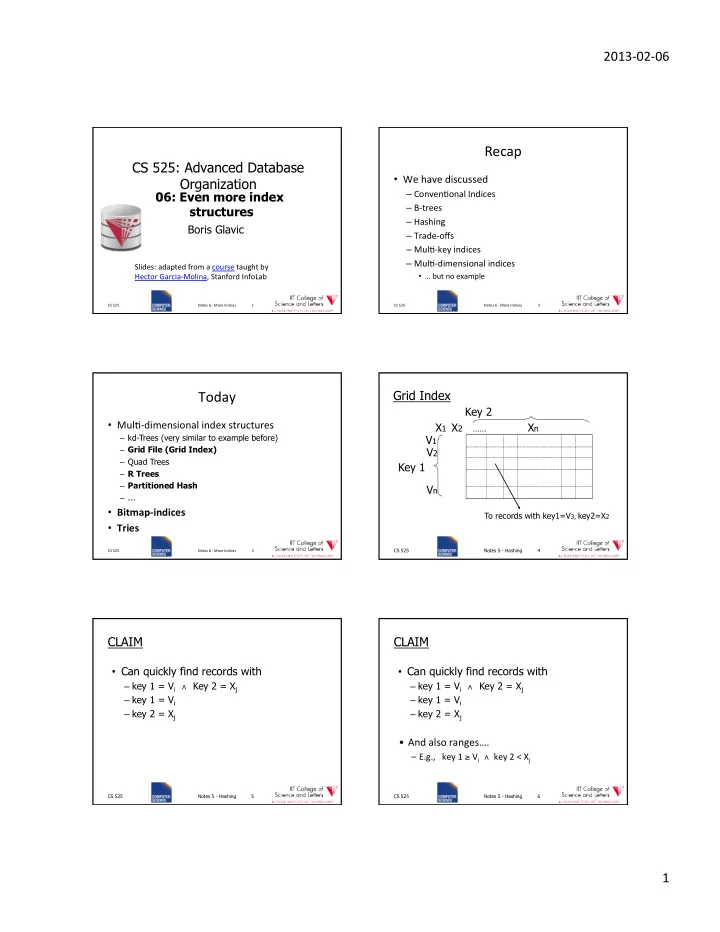
Today ¡

  • MulI-­‑dimensional ¡index ¡structures ¡

– kd-Trees (very similar to example before) – Grid File (Grid Index) – Quad Trees – R Trees – Partitioned Hash – ...

  • Bitmap-­‑indices ¡
  • Tries ¡

CS ¡525 ¡ Notes ¡6 ¡-­‑ ¡More ¡Indices ¡ 3 ¡

CS 525 Notes 5 - Hashing 4

Grid Index

Key 2 X1 X2 …… Xn

V1

V2 Key 1 Vn

To records with key1=V3, key2=X2

CS 525 Notes 5 - Hashing 5

CLAIM

  • Can quickly find records with

– key 1 = Vi ∧ Key 2 = Xj – key 1 = Vi – key 2 = Xj

CS 525 Notes 5 - Hashing 6

CLAIM

  • Can quickly find records with

– key 1 = Vi ∧ Key 2 = Xj – key 1 = Vi – key 2 = Xj

  • And ¡also ¡ranges…. ¡

– E.g., ¡ ¡ ¡key ¡1 ¡≥ ¡Vi ¡ ¡∧ ¡ ¡key ¡2 ¡< ¡Xj ¡

slide-2
SLIDE 2

2013-­‑02-­‑06 ¡ 2 ¡

  • How do we find entry i,j in linear structure?

CS 525 Notes 5 - Hashing 7

0, ¡0 0, ¡1 0, ¡2 0, ¡3 1, ¡0 1, ¡1 1, ¡2 1, ¡3 2, ¡0 2, ¡1 2, ¡2 2, ¡3 3, ¡0

i, j

position S+0 position S+1 position S+2 position S+3 position S+4 position S+9

pos(i, j) = max number of i values N=4

  • How do we find entry i,j in linear structure?

CS 525 Notes 5 - Hashing 8

0, ¡0 0, ¡1 0, ¡2 0, ¡3 1, ¡0 1, ¡1 1, ¡2 1, ¡3 2, ¡0 2, ¡1 2, ¡2 2, ¡3 3, ¡0

i, j

position S+0 position S+1 position S+2 position S+3 position S+4 position S+9

pos(i, j) = S + iN + j max number of i values N=4 Issue: Cells must be same size, and N must be constant! Issue: Some cells may overflow, some may be sparse...

CS 525 Notes 5 - Hashing 9

Solution: Use Indirection

Buckets V1 V2 V3 *Grid only V4 contains

pointers to buckets

Buckets

  • ­‑-­‑ ¡
  • ­‑-­‑ ¡
  • ­‑-­‑ ¡
  • ­‑-­‑ ¡
  • ­‑-­‑ ¡
  • ­‑-­‑ ¡
  • ­‑-­‑ ¡
  • ­‑-­‑ ¡
  • ­‑-­‑ ¡
  • ­‑-­‑ ¡
  • ­‑-­‑ ¡
  • ­‑-­‑ ¡
  • ­‑-­‑ ¡
  • ­‑-­‑ ¡
  • ­‑-­‑ ¡

X1 X2 X3

CS 525 Notes 5 - Hashing 10

With indirection:

  • Grid can be regular without wasting space
  • We do have price of indirection

CS 525 Notes 5 - Hashing 11

Can also index grid on value ranges

Salary Grid

Linear ¡Scale ¡

1 ¡ 2 ¡ 3 ¡ Toy ¡ Sales ¡ Personnel ¡ 0-­‑20K ¡ 1 ¡ 20K-­‑50K ¡ 2 ¡ 50K-­‑ ¡ 3 ¡

8

CS 525 Notes 5 - Hashing 12

Grid files

Good for multiple-key search Space, management overhead (nothing is free) Need partitioning ranges that evenly split keys

+ ¡

  • ­‑ ¡
  • ­‑ ¡
slide-3
SLIDE 3

2013-­‑02-­‑06 ¡ 3 ¡

CS 525 Notes 5 - Hashing 13

Idea: Key1 Key2

ParIIoned ¡hash ¡funcIon ¡

h1 ¡ h2 ¡

010110 ¡1110010 ¡

CS 525 Notes 5 - Hashing 14

<Fred,toy,10k>,<Joe,sales,10k> <Sally,art,30k>

EX:

Insert ¡

000 001 010 011 100 101 110 111

h1(toy) =0 h1(sales) =1 h1(art) =1 . h2(10k) =01 h2(20k) =11 h2(30k) =01 h2(40k) =00

.

CS 525 Notes 5 - Hashing 15

EX:

Insert ¡

000 001 010 011 100 101 110 111

<Fred> ¡ <Joe><Sally> ¡

<Fred,toy,10k>,<Joe,sales,10k> <Sally,art,30k>

h1(toy) =0 h1(sales) =1 h1(art) =1 . h2(10k) =01 h2(20k) =11 h2(30k) =01 h2(40k) =00

.

CS 525 Notes 5 - Hashing 16

EX:

000 001 010 011 100 101 110 111

<Joe><Jan> ¡ <Sally> ¡

h1(toy) =0 h1(sales) =1 h1(art) =1 . h2(10k) =01 h2(20k) =11 h2(30k) =01 h2(40k) =00

.

Find ¡Emp. ¡with ¡Dept. ¡= ¡Sales ¡ ¡∧ ¡ ¡Sal=40k ¡

<Fred> ¡ <Mary> ¡ <Tom><Bill> ¡ <Andy> ¡

CS 525 Notes 5 - Hashing 17

EX:

000 001 010 011 100 101 110 111

<Joe><Jan> ¡ <Sally> ¡

h1(toy) =0 h1(sales) =1 h1(art) =1 . h2(10k) =01 h2(20k) =11 h2(30k) =01 h2(40k) =00

.

Find ¡Emp. ¡with ¡Dept. ¡= ¡Sales ¡ ¡∧ ¡ ¡Sal=40k ¡

<Fred> ¡ <Mary> ¡ <Tom><Bill> ¡ <Andy> ¡

CS 525 Notes 5 - Hashing 18

EX:

000 001 010 011 100 101 110 111

<Joe><Jan> ¡ <Sally> ¡

h1(toy) =0 h1(sales) =1 h1(art) =1 . h2(10k) =01 h2(20k) =11 h2(30k) =01 h2(40k) =00

.

Find ¡Emp. ¡with ¡Sal=30k ¡

<Fred> ¡ <Mary> ¡ <Tom><Bill> ¡ <Andy> ¡

slide-4
SLIDE 4

2013-­‑02-­‑06 ¡ 4 ¡

CS 525 Notes 5 - Hashing 19

EX:

000 001 010 011 100 101 110 111

<Joe><Jan> ¡ <Sally> ¡

h1(toy) =0 h1(sales) =1 h1(art) =1 . h2(10k) =01 h2(20k) =11 h2(30k) =01 h2(40k) =00

.

Find ¡Emp. ¡with ¡Sal=30k ¡

<Fred> ¡ <Mary> ¡ <Tom><Bill> ¡ <Andy> ¡

CS 525 Notes 5 - Hashing 20

EX:

000 001 010 011 100 101 110 111

<Joe><Jan> ¡ <Sally> ¡

h1(toy) =0 h1(sales) =1 h1(art) =1 . h2(10k) =01 h2(20k) =11 h2(30k) =01 h2(40k) =00

.

Find ¡Emp. ¡with ¡Dept. ¡= ¡Sales ¡

<Fred> ¡ <Mary> ¡ <Tom><Bill> ¡ <Andy> ¡

CS 525 Notes 5 - Hashing 21

EX:

000 001 010 011 100 101 110 111

<Joe><Jan> ¡ <Sally> ¡

h1(toy) =0 h1(sales) =1 h1(art) =1 . h2(10k) =01 h2(20k) =11 h2(30k) =01 h2(40k) =00

.

Find ¡Emp. ¡with ¡Dept. ¡= ¡Sales ¡

<Fred> ¡ <Mary> ¡ <Tom><Bill> ¡ <Andy> ¡

R-­‑tree ¡

  • Nodes ¡can ¡store ¡up ¡to ¡M ¡entries ¡

– Minimum ¡fill ¡requirement ¡(depends ¡on ¡variant) ¡

  • Each ¡node ¡rectangle ¡in ¡n-­‑dimensional ¡space ¡

– Minimum ¡Bounding ¡Rectangle ¡(MBR) ¡of ¡its ¡ children ¡

  • MBRs ¡of ¡siblings ¡are ¡allowed ¡to ¡overlap ¡

– Different ¡from ¡B-­‑trees ¡

  • balanced ¡

CS ¡525 ¡ Notes ¡6 ¡-­‑ ¡More ¡Indices ¡ 22 ¡ CS ¡525 ¡ Notes ¡6 ¡-­‑ ¡More ¡Indices ¡ 23 ¡

Data ¡Space ¡

[5-­‑7] ¡ [9-­‑15] ¡ [13-­‑19] ¡ [20-­‑24] ¡ [12-­‑16] ¡ [2-­‑4] ¡ [5] ¡ [6] ¡ [7] ¡ [24] ¡ [20] ¡ [24] ¡ [9] ¡ [11] ¡ [15] ¡ [15] ¡ [16] ¡ [12] ¡ [13] ¡ [14] ¡ [18] ¡ [19] ¡ [4] ¡ [2] ¡ [2] ¡ [3] ¡

R-­‑tree ¡-­‑ ¡Search ¡

  • Point ¡Search ¡

– Search ¡for ¡p ¡= ¡<xi, ¡yi> ¡ – Keep ¡list ¡of ¡potenIal ¡nodes ¡

  • Needed ¡because ¡of ¡overlap ¡

– Traverse ¡to ¡child ¡if ¡MBR ¡of ¡ child ¡contains ¡p ¡

CS ¡525 ¡ Notes ¡6 ¡-­‑ ¡More ¡Indices ¡ 24 ¡

slide-5
SLIDE 5

2013-­‑02-­‑06 ¡ 5 ¡

R-­‑tree ¡-­‑ ¡Search ¡

  • Point ¡Search ¡

– Search ¡for ¡points ¡in ¡region ¡= ¡ <[xmin-­‑ ¡xmax], ¡[ymin ¡-­‑ymax]> ¡ – Keep ¡list ¡of ¡potenIal ¡nodes ¡ – Traverse ¡to ¡child ¡if ¡MBR ¡of ¡ child ¡overlaps ¡with ¡query ¡ region ¡

CS ¡525 ¡ Notes ¡6 ¡-­‑ ¡More ¡Indices ¡ 25 ¡ CS ¡525 ¡ Notes ¡6 ¡-­‑ ¡More ¡Indices ¡ 26 ¡

Data ¡Space ¡

[5-­‑7] ¡ [9-­‑15] ¡ [13-­‑19] ¡ [20-­‑24] ¡ [12-­‑16] ¡ [2-­‑4] ¡ [5] ¡ [6] ¡ [7] ¡ [24] ¡ [20] ¡ [24] ¡ [9] ¡ [11] ¡ [15] ¡ [15] ¡ [16] ¡ [12] ¡ [13] ¡ [14] ¡ [18] ¡ [19] ¡ [4] ¡ [2] ¡ [2] ¡ [3] ¡

Search ¡<5,24> ¡

R-­‑tree ¡-­‑ ¡Insert ¡

  • Similar ¡to ¡B-­‑tree, ¡but ¡more ¡complex ¡

– Overlap ¡-­‑> ¡mulIple ¡choice ¡where ¡to ¡add ¡entry ¡ – Split ¡harder ¡because ¡more ¡choice ¡how ¡to ¡split ¡ node ¡(compare ¡B-­‑tree ¡= ¡1 ¡choice) ¡

  • 1) ¡Find ¡potenIal ¡subtrees ¡for ¡current ¡node ¡

– Choose ¡one ¡for ¡insert ¡(heurisIc, ¡e.g., ¡the ¡one ¡the ¡ would ¡grow ¡the ¡least) ¡ – ConInue ¡unIl ¡leaf ¡is ¡found ¡

CS ¡525 ¡ Notes ¡6 ¡-­‑ ¡More ¡Indices ¡ 27 ¡

R-­‑tree ¡-­‑ ¡Insert ¡

  • 2) ¡Insert ¡into ¡leaf ¡
  • 3) ¡Leaf ¡is ¡full? ¡-­‑> ¡split ¡ ¡

– Find ¡best ¡split ¡(minimum ¡overlap ¡between ¡new ¡ nodes) ¡is ¡hard ¡(O(2M)) ¡ – Use ¡linear ¡or ¡quadraIc ¡heurisIcs ¡(original ¡paper) ¡

  • 4) ¡Adapt ¡parents ¡if ¡necessary ¡

CS ¡525 ¡ Notes ¡6 ¡-­‑ ¡More ¡Indices ¡ 28 ¡

R-­‑tree ¡-­‑ ¡Delete ¡

  • 1) ¡Find ¡leaf ¡node ¡that ¡contains ¡entry ¡
  • 2) ¡Delete ¡entry ¡
  • 3) ¡Leaf ¡node ¡underflow? ¡ ¡

– Remove ¡leaf ¡node ¡and ¡cache ¡entries ¡ – Adapt ¡parents ¡ – Reinsert ¡deleted ¡entries ¡

CS ¡525 ¡ Notes ¡6 ¡-­‑ ¡More ¡Indices ¡ 29 ¡

Bitmap ¡Index ¡

  • Domain ¡of ¡values ¡D ¡= ¡{d1, ¡…, ¡dn} ¡

– Gender ¡{male, ¡female} ¡ – Age ¡{1, ¡…, ¡120?} ¡

  • Use ¡one ¡vector ¡of ¡bits ¡for ¡each ¡value ¡

– One ¡bit ¡for ¡each ¡record ¡

  • 0: ¡record ¡has ¡different ¡value ¡in ¡this ¡arribute ¡
  • 1: ¡record ¡has ¡this ¡value ¡

CS ¡525 ¡ Notes ¡6 ¡-­‑ ¡More ¡Indices ¡ 30 ¡

slide-6
SLIDE 6

2013-­‑02-­‑06 ¡ 6 ¡

Bitmap ¡Index ¡Example ¡

CS ¡525 ¡ Notes ¡6 ¡-­‑ ¡More ¡Indices ¡ 31 ¡

Name ¡ Age ¡ Gender ¡ Peter ¡ 1 ¡ male ¡ Gertrud ¡ 2 ¡ female ¡ Joe ¡ 1 ¡ male ¡ Marry ¡ 3 ¡ female ¡ male ¡ female ¡ 1 ¡ 0 ¡ 0 ¡ 1 ¡ 1 ¡ 0 ¡ 0 ¡ 1 ¡ 1 ¡ 2 ¡ 3 ¡ 1 ¡ 0 ¡ 0 ¡ 0 ¡ 1 ¡ 0 ¡ 1 ¡ 0 ¡ 0 ¡ 0 ¡ 0 ¡ 1 ¡ Age ¡ Gender ¡ Todlers ¡

Bitmap ¡Index ¡Example ¡

CS ¡525 ¡ Notes ¡6 ¡-­‑ ¡More ¡Indices ¡ 32 ¡

Name ¡ Age ¡ Gender ¡ Peter ¡ 1 ¡ male ¡ Gertrud ¡ 2 ¡ female ¡ Joe ¡ 1 ¡ male ¡ Marry ¡ 3 ¡ female ¡ male ¡ female ¡ 1 ¡ 0 ¡ 0 ¡ 1 ¡ 1 ¡ 0 ¡ 0 ¡ 1 ¡ 1 ¡ 2 ¡ 3 ¡ 1 ¡ 0 ¡ 0 ¡ 0 ¡ 1 ¡ 0 ¡ 1 ¡ 0 ¡ 0 ¡ 0 ¡ 0 ¡ 1 ¡ Age ¡ Gender ¡ Todlers ¡

Find ¡all ¡todlers ¡with ¡age ¡2 ¡and ¡sex ¡female: ¡ Bitwise-­‑and ¡between ¡vectors ¡

0 ¡ 1 ¡ 0 ¡ 0 ¡

Bitmap ¡Index ¡Example ¡

CS ¡525 ¡ Notes ¡6 ¡-­‑ ¡More ¡Indices ¡ 33 ¡

Name ¡ Age ¡ Gender ¡ Peter ¡ 1 ¡ male ¡ Gertrud ¡ 2 ¡ female ¡ Joe ¡ 1 ¡ male ¡ Marry ¡ 3 ¡ female ¡ male ¡ female ¡ 1 ¡ 0 ¡ 0 ¡ 1 ¡ 1 ¡ 0 ¡ 0 ¡ 1 ¡ 1 ¡ 2 ¡ 3 ¡ 1 ¡ 0 ¡ 0 ¡ 0 ¡ 1 ¡ 0 ¡ 1 ¡ 0 ¡ 0 ¡ 0 ¡ 0 ¡ 1 ¡ Age ¡ Gender ¡ Todlers ¡

Find ¡all ¡todlers ¡with ¡age ¡2 ¡or ¡sex ¡female: ¡ Bitwise-­‑or ¡between ¡vectors ¡

0 ¡ 1 ¡ 0 ¡ 1 ¡

Compression ¡

  • ObservaIon: ¡

– Each ¡record ¡has ¡one ¡value ¡in ¡index ¡arribute ¡ – For ¡N ¡records ¡and ¡domain ¡of ¡size ¡|D| ¡

  • Only ¡1/|D| ¡bits ¡are ¡1 ¡

– -­‑> ¡waste ¡of ¡space ¡

  • SoluIon ¡

– Compress ¡data ¡ – Need ¡to ¡make ¡sure ¡that ¡and ¡and ¡or ¡is ¡sIll ¡fast ¡

CS ¡525 ¡ Notes ¡6 ¡-­‑ ¡More ¡Indices ¡ 34 ¡

Run ¡length ¡encoding ¡(RLE) ¡

  • Instead ¡of ¡actual ¡0-­‑1 ¡sequence ¡encode ¡length ¡
  • f ¡0 ¡or ¡1 ¡runs ¡
  • One ¡bit ¡to ¡indicate ¡whether ¡0/1 ¡run ¡+ ¡several ¡

bits ¡to ¡encode ¡run ¡length ¡

  • But ¡how ¡many ¡bits ¡to ¡use ¡to ¡encode ¡a ¡run ¡

length? ¡

– Gamma ¡codes ¡or ¡similar ¡to ¡have ¡variable ¡number ¡

  • f ¡bits ¡

CS ¡525 ¡ Notes ¡6 ¡-­‑ ¡More ¡Indices ¡ 35 ¡

RLE ¡Example ¡

CS ¡525 ¡ Notes ¡6 ¡-­‑ ¡More ¡Indices ¡ 36 ¡

  • 0001 ¡0000 ¡1110 ¡1111 ¡ ¡

¡ ¡(2 ¡bytes) ¡

  • 3, ¡ ¡ ¡1,4, ¡ ¡ ¡ ¡ ¡ ¡ ¡3, ¡ ¡ ¡1,4 ¡

¡ ¡ ¡(6 ¡bytes) ¡

  • -­‑> ¡if ¡we ¡use ¡one ¡byte ¡to ¡encode ¡a ¡run ¡we ¡have ¡

7 ¡bits ¡for ¡length ¡= ¡max ¡run ¡length ¡is ¡128(127) ¡ ¡ ¡

slide-7
SLIDE 7

2013-­‑02-­‑06 ¡ 7 ¡

Elias ¡Gamma ¡Codes ¡

CS ¡525 ¡ Notes ¡6 ¡-­‑ ¡More ¡Indices ¡ 37 ¡

  • X ¡= ¡2N ¡+ ¡(x ¡mod ¡2N) ¡

– Write ¡N ¡as ¡N ¡zeros ¡followed ¡by ¡one ¡1 ¡ – Write ¡(x ¡mod ¡2N) ¡as ¡N ¡bit ¡number ¡

  • 18 ¡= ¡24 ¡+ ¡2 ¡= ¡000010010 ¡
  • 0001 ¡0000 ¡1110 ¡1111 ¡ ¡

¡ ¡(2 ¡bytes) ¡

  • 3, ¡ ¡ ¡1,4, ¡ ¡ ¡ ¡ ¡ ¡ ¡3, ¡ ¡ ¡1,4 ¡

¡ ¡ ¡(6 ¡bytes) ¡

  • 0111 ¡0010 ¡0011 ¡1001 ¡00 ¡ ¡

¡(3 ¡bytes) ¡ ¡ ¡

Hybrid ¡Encoding ¡

CS ¡525 ¡ Notes ¡6 ¡-­‑ ¡More ¡Indices ¡ 38 ¡

  • Run ¡length ¡encoding ¡

– Can ¡waste ¡space ¡ – And/or ¡run ¡length ¡not ¡aligned ¡to ¡byte/word ¡ boundaries ¡

  • Encode ¡some ¡bytes ¡of ¡sequence ¡as ¡is ¡and ¡only ¡

store ¡long ¡runs ¡as ¡run ¡length ¡

– EWAH ¡ – BBC ¡(that’s ¡what ¡Oracle ¡uses) ¡

Extended ¡Word ¡aligned ¡Hybrid ¡ (EWAH) ¡

CS ¡525 ¡ Notes ¡6 ¡-­‑ ¡More ¡Indices ¡ 39 ¡

  • Segment ¡sequence ¡in ¡machine ¡words ¡(64bit) ¡
  • Use ¡two ¡types ¡of ¡words ¡to ¡encode ¡

– Literal ¡words, ¡taken ¡directly ¡from ¡input ¡sequence ¡ – Run ¡words ¡

  • ½ ¡word ¡is ¡used ¡to ¡encode ¡a ¡run ¡
  • ½ ¡word ¡is ¡used ¡to ¡encode ¡how ¡many ¡literals ¡follow ¡

0000 ¡0000 ¡ 0000 ¡0000 ¡ 0010 ¡1000 ¡ 1111 ¡1111 ¡ 1100 ¡0010 ¡ 0010 ¡0001 ¡ 0010 ¡1000 ¡ 1001 ¡0001 ¡ 1100 ¡0010 ¡

Bitmap ¡Indices ¡

CS ¡525 ¡ Notes ¡6 ¡-­‑ ¡More ¡Indices ¡ 40 ¡

  • Fast ¡for ¡read ¡intensive ¡workloads ¡

– Used ¡a ¡lot ¡in ¡datawarehousing ¡

  • Oxen ¡build ¡on ¡the ¡fly ¡during ¡query ¡processing ¡

– As ¡we ¡will ¡see ¡later ¡in ¡class ¡

Trie ¡

  • From ¡Retrieval ¡
  • Tree ¡index ¡structure ¡
  • Keys ¡are ¡sequences ¡of ¡values ¡from ¡a ¡domain ¡D ¡

– D ¡= ¡{0,1} ¡ – D ¡= ¡{a,b,c,….,z} ¡

  • Key ¡size ¡may ¡or ¡may ¡not ¡be ¡fixed ¡

– Store ¡4-­‑byte ¡integers ¡using ¡D ¡= ¡{0,1} ¡(32 ¡elements) ¡ – Strings ¡using ¡D={a,…,z} ¡(arbitrary ¡length) ¡

CS ¡525 ¡ Notes ¡6 ¡-­‑ ¡More ¡Indices ¡ 41 ¡

Trie ¡

  • Each ¡node ¡has ¡pointers ¡to ¡|D| ¡child ¡nodes ¡

– One ¡for ¡each ¡value ¡of ¡D ¡

  • Searching ¡for ¡a ¡key ¡k ¡= ¡[d1, ¡…, ¡dn] ¡

– Start ¡at ¡the ¡root ¡ – Follow ¡child ¡for ¡value ¡di ¡

CS ¡525 ¡ Notes ¡6 ¡-­‑ ¡More ¡Indices ¡ 42 ¡

slide-8
SLIDE 8

2013-­‑02-­‑06 ¡ 8 ¡

Trie ¡Example ¡

CS ¡525 ¡ Notes ¡6 ¡-­‑ ¡More ¡Indices ¡ 43 ¡

b ¡ a ¡ r ¡ l ¡ l ¡ i ¡ n ¡

Words: ¡bar, ¡ball, ¡in ¡

1 ¡ 2 ¡ 3 ¡

Search ¡for ¡bald ¡ Fail ¡! ¡

Tries ¡ImplementaIon ¡

  • 1) ¡Each ¡node ¡has ¡an ¡array ¡of ¡child ¡pointers ¡
  • 2) ¡Each ¡node ¡has ¡a ¡list ¡of ¡hash ¡table ¡of ¡child ¡

pointers ¡

  • 3) ¡array ¡compression ¡schemes ¡derived ¡from ¡

compressed ¡DFA ¡representaIons ¡

CS ¡525 ¡ Notes ¡6 ¡-­‑ ¡More ¡Indices ¡ 44 ¡

CS 525 Notes 5 - Hashing 45

Discussion:

  • Conventional Indices
  • B-trees
  • Hashing (extensible, linear)
  • SQL Index Definition
  • Index vs. Hash
  • Multiple Key Access
  • Multi Dimensional Indices

Variations: Grid, R-tree,

  • Partitioned Hash
  • Bitmap indices and compression
  • Tries

Summary ¡