Real Estate Finance Comparison with business finance Real estate - - PowerPoint PPT Presentation

real estate finance comparison with business finance real
SMART_READER_LITE
LIVE PREVIEW

Real Estate Finance Comparison with business finance Real estate - - PowerPoint PPT Presentation

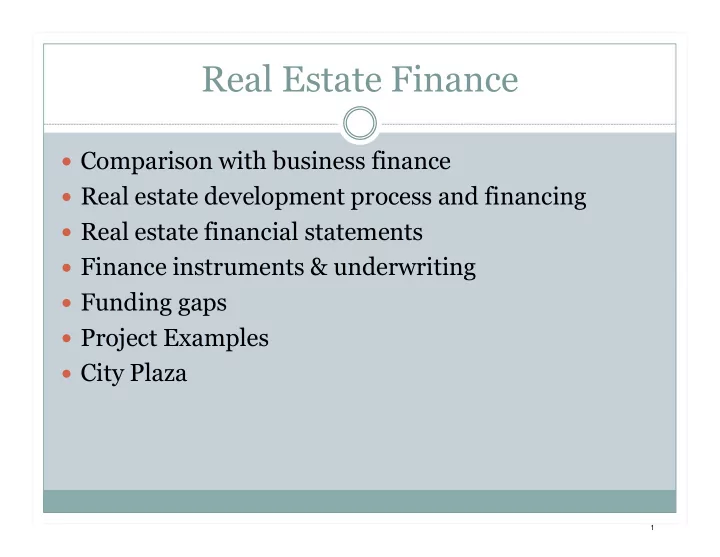
Real Estate Finance Comparison with business finance Real estate development process and financing Real estate financial statements Finance instruments & underwriting ing Funding gaps Project Examples City Plaza 1


slide-1
SLIDE 1

Real Estate Finance

  • Comparison with business finance
  • Real estate development process and financing
  • Real estate financial statements
  • Finance instruments & underwriting

ing

  • Funding gaps
  • Project Examples
  • City Plaza

1

slide-2
SLIDE 2

Real Estate vs. Business Finance

  • Similarities to business fixed asset financing

c Scale of investment is large c Financing of physical, fixed assets c Need for long­term financing

  • Diff

with b i fi

  • Differences with business finance

c More use of debt: 3:1 or 4:1 debt to equity ratio c Separate construction & permanent financing c Competition & markets are local or regional c More predictable income & expenses

  • Land development vs. building development
  • Development for lease vs. development for sale

2

slide-3
SLIDE 3

Three Phases of Development

  • Predevelopment

c Planning & design, site control, permitting, pre­

leasing/sales, securing financing

c Large costs with high risk and no revenue

=>requires equity, grants, deferred loans

  • C

t ti & d l t

  • Construction & development

c

Site acquisition, final design & contractor selection, construction

c

Limited risk => construction or mini­perm loan and equity, bridge loans

  • Occupancy and management

c

Asset management=> permanent debt take­out

c

Retire debt, realize equity returns

3

slide-4
SLIDE 4

RE Financial Statements: Development Budget

  • Sources and uses of funds statement
  • Analogous to a balance sheet

c Acquisition, hard costs, and soft costs c Contingencies and reserves c Per square foot basis useful for comparisons

  • Sources of funds

c Debt sources, equity investments, syndication/sale of tax

credits, grants

4

slide-5
SLIDE 5

RE Financial Statements: Operating Pro Forma

  • Revenue, expenses and net cash flow
  • CAM, escalators, and percentage rent

c Lease terms define revenue –key to analyze leases

  • Vacancy rates
  • Operating expenses
  • Operating expenses

c IREM, ULI comparable project data to analyze c Replacement and operating reserves

  • Cash flow, debt service and net cash flow
  • Supportable debt: PV of [cash flow/DSCR]
  • Supportable equity: PV of net cash flow &

expected gain on sale

5

slide-6
SLIDE 6

Sizing Real Estate Debt: Downtown Building Example

  • Start with lowest annual pro forma net cash flow

(54,299)

  • Calculate cash flow available for debt service

(CFADS):

c Divide by lender’s required debt service coverage ratio

(54,299/1.25 = 43,439)

  • Calculate Present Value of CFADS per loan terms:

c PV(.08/12, 240, 43,439/12) = 432,777

6

slide-7
SLIDE 7

Real Estate Finance Tools

Debt

  • Predevelopment loan
  • Acquisition loan
  • Construction loan
  • Real estate mortgage
  • Real estate mortgage
  • Mini­perm loan
  • Bridge loan

Equity

  • Developer and investor cash equity
  • Tax credit equity (historic, new market, LIHTC)

Grants

7

slide-8
SLIDE 8

Underwriting Real Estate Loans

  • Development Team Capacity

c Experience & ability of development team members c Management company deserves special attention

  • Project cash flow risk

c Initial lease­up risk: will property be occupied at target rent? c Tenant credit risk: will tenants pay their rent? c Re­leasing/market risk: will space be released at target rent? c Operating expense risk: are operating costs adequate?

  • Collateral value and appraisals

c Appraisals set the market value, LTV and maximum loan c Quality of construction c Quality of maintenance and replacement funding

8

slide-9
SLIDE 9

Real Estate Funding Gaps

  • Supply of pre­development and equity financing
  • Weak markets:

c Market rents do not support development costs c New development is needed to change market dynamics

Lith Bl k l

c Lithgow Block example:

  • Income supported 57.5% of development costs
  • Grant/subsidy for 42.5%

9

slide-10
SLIDE 10

Jamaica Plain Brewery Reuse

  • Closed brewery complex

acquired by neighborhood non­profit (JPNDC) in 1983

  • Renovated in phases over 25

years

  • Final phase: difficult and costly

c Interior demolition and entire

reconstruction of 68,000 square feet

c Reuse as fitness center, retail

restaurant and office space

  • Home to 50 small businesses

Courtesy of Ed Kopp on Flickr. CC BY-NC-SA.

10

slide-11
SLIDE 11

Credits (MHIC) New Market Tax Credits (MHIC) $2,160,000 City of Boston Loan $150,000 Developer loan & deferred fees $1,095,000

11

JP Brewery: Project Financing

Total Dev Costs $12,105,000 Senior Debt (Life Ins. Fund) $4,700,000 Hist storic Tax $4,000,000

slide-12
SLIDE 12

The Auburn Mixed­Use Development

Part of multi-project and investment strategy to attract new residents to Midtown Detroit neighborhood

  • Demolition and new construction project
  • 58 market rate apartments
  • 9,100 SF retail space
  • Completed in 2012
  • Hard to finance after Great Recession

12

slide-13
SLIDE 13

Total Development Cost $12.3 million

The Auburn: Financing Sources

CDFI Loan $3.7 million New Market Tax Credits $7.6 million S Gra $1.0 illi

  • 2nd local CDFI guaranteed retail rental income
  • Market rate project needed 70% subsidy
  • Due to low rents and low property values in Detroit

State Grant $1.0 million

13

slide-14
SLIDE 14

ReFresh Development Budget

Sources Amount Uses Amount Senior Debt­GS $3,000,000 Acquisition $2,400,000 Junior Debt­LIIF $1,558,000 Construction $12,421,638 Fresh Food Financing Initiative $1,000,000 Soft Costs $2,749754 New Orleans Redevelopment $900,000 Developer $610,436 A h it F Authority Fee NMTC Equity $5,491,200 Total $18,181,818 Whole Foods Build out $5,300,000 Uses PSG Foundation for LA Grant $500,000 Acquisition $37 Newman's Own Grant $250,000 Construction $191 Developers Equity $181,818 Soft Costs $42 Total $18,181,818 Developer Fee $9 Total $279

14

slide-15
SLIDE 15

15

ReFresh Proforma Year One

Tenant

BCC Rent Whole Foods Rent Liberty’s Kitchen Rent Tulane Rent First Line Rent Other Tenant Rent Tenant Reimbursements­Operating Cost Vacancy Allowance (10%) Total Income After Vacancy Management and Operating Expenses NOI Debt Service Net Cash Flow Percentage Rent on $15 million sales

Year 1

$6,250 $130,000 $73,883 $46,890 $56,250 $127,735 $186,624 $62,138 $559,244 $201,071 $358,173 $339,529 $18,644 $125,000

Year 5

$6,250 $130,000 $73,883 $46,890 $56,250 $127,735 $206.042 $64,170 $577,630 $226,307 $351,223 $339,529 $11,694 $125,000

slide-16
SLIDE 16

City Plaza: Supportable Debt and Financing Gap

Minimum Annual Cash Flow $144,550 Divide by Debt Service Coverage Ratio 1.25 = Cash Flow Available for Debt Service (144,550/1.25 ) $115,640 Supportable Mortgage Loan $1,152,105 uppor gage =PV(.08/12,240,115640/12) $1,152,105 Estimated Value at .11 cap rate (144,550/.11) $1,314,091 Maximum Senior Loan at .80 LTV (.80 * 1,314,091) $1,051,273 Senior Loan Amount Rounded 1,051,000 TDC (1,490,000) less grants (150,000) 1,340,000 Remaining Funding Gap (1,340,000- 1,051,000) 289,000

16

slide-17
SLIDE 17

City Plaza: Subordinate Loan Analysis

$144,550 Minimum Annual Cash Flow 1.10 Divide by Debt Combined Coverage Ratio $131,409 = Cash Flow Available for Debt Service $105,492 Less Senior Debt Service 12* pmt(.08/12, 240, p ( / , , 1,051,000) $105,492 =Cash Flow to Repay Subordinate Loan $25,917 Supportable Sub Loan per CF -pv(.09/12,240, 25,917/12) $240,045 LTV at .95 (.95*$1,314,091), rounded $1,248,000 Max Sub Loan per LTV (1,248,000-1,051,000) $197,000 Remaining Gap (1,340,000-1,248,000) $92,000

17

slide-18
SLIDE 18

MIT OpenCourseWare https://ocw.mit.edu

11.437 Financing Economic Development

Fall 2016 For information about citing these materials or our Terms of Use, visit: https://ocw.mit.edu/terms.