Reading Required: Foley, van Dam, section 15.10.4 Antialiased Ray - - PDF document

reading
SMART_READER_LITE
LIVE PREVIEW

Reading Required: Foley, van Dam, section 15.10.4 Antialiased Ray - - PDF document

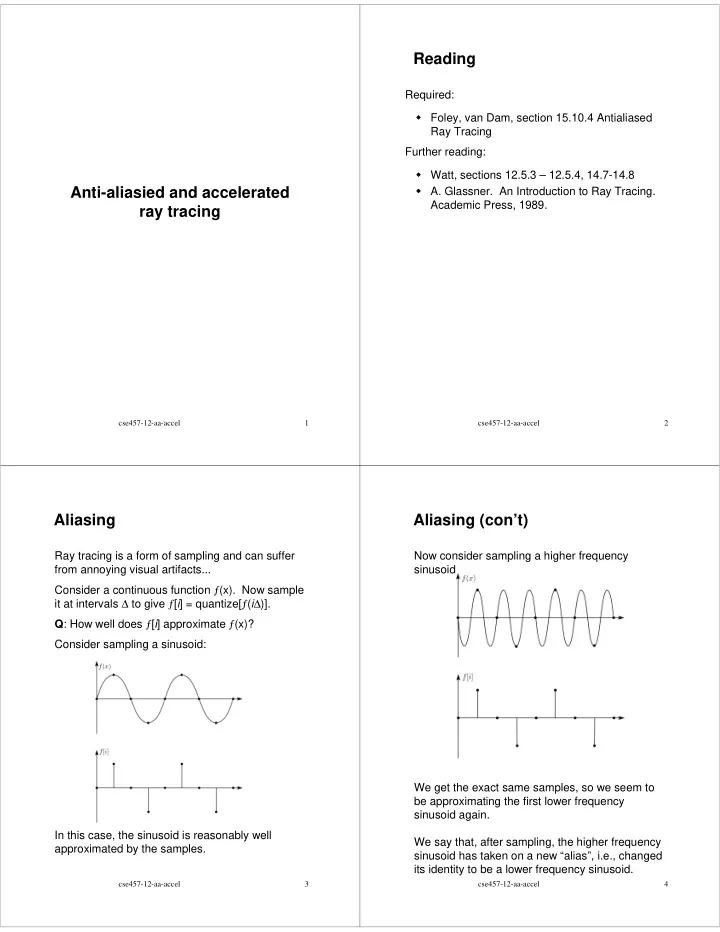
Reading Required: Foley, van Dam, section 15.10.4 Antialiased Ray Tracing Further reading: Watt, sections 12.5.3 12.5.4, 14.7-14.8 Anti-aliasied and accelerated A. Glassner. An Introduction to Ray Tracing. Academic Press, 1989.


slide-1
SLIDE 1

cse457-12-aa-accel 1

Anti-aliasied and accelerated ray tracing

cse457-12-aa-accel 2

Reading

Required: Foley, van Dam, section 15.10.4 Antialiased Ray Tracing Further reading: Watt, sections 12.5.3 – 12.5.4, 14.7-14.8

  • A. Glassner. An Introduction to Ray Tracing.

Academic Press, 1989.

cse457-12-aa-accel 3

Aliasing

Ray tracing is a form of sampling and can suffer from annoying visual artifacts... Consider a continuous function ƒ(x). Now sample it at intervals ∆ to give ƒ[i] = quantize[ƒ(i∆)]. Q: How well does ƒ[i] approximate ƒ(x)? Consider sampling a sinusoid: In this case, the sinusoid is reasonably well approximated by the samples.

cse457-12-aa-accel 4

Aliasing (con’t)

Now consider sampling a higher frequency sinusoid We get the exact same samples, so we seem to be approximating the first lower frequency sinusoid again. We say that, after sampling, the higher frequency sinusoid has taken on a new “alias”, i.e., changed its identity to be a lower frequency sinusoid.

slide-2
SLIDE 2

cse457-12-aa-accel 5

sin(5r)=0 sin(25r)=0

cse457-12-aa-accel 6

Aliasing in rendering

One of the most common rendering artifacts is the “jaggies”. Consider rendering a white polygon against a black background: We would instead like to get a smoother transition:

cse457-12-aa-accel 7

Anti-aliasing

Q: How do we avoid aliasing artifacts?

  • Sampling:
  • Pre-filtering:
  • Combination:

Example - polygon:

cse457-12-aa-accel 8

Polygon anti-aliasing

slide-3
SLIDE 3

cse457-12-aa-accel 9

Antialiasing in a ray tracer

We would like to compute the average intensity in the neighborhood of each pixel. When casting one ray per pixel, we are likely to have aliasing artifacts. To improve matters, we can cast more than one ray per pixel and average the result. A.k.a., super-sampling and averaging down.

cse457-12-aa-accel 10

Speeding it up

Vanilla ray tracing is really slow! Consider: m x m pixels, k x k supersampling, and n primitives, average ray path length of d, with 2 rays cast recursively per intersection. Complexity = For m=1,000, k = 5, n = 100,000, d=8…very expensive!! In practice, some acceleration technique is almost always used. We’ve already looked at reducing d with adaptive ray termination. Now we look at reducing the effect of the k and n terms.

cse457-12-aa-accel 11

Antialiasing by adaptive sampling

Casting many rays per pixel can be unnecessarily costly. For example, if there are no rapid changes in intensity at the pixel, maybe only a few samples are needed. Solution: adaptive sampling. Q: When do we decide to cast more rays in a particular area?

cse457-12-aa-accel 12

Faster ray-polyhedron intersection

Let’s say you were intersecting a ray with a polyhedron: Straightforward method intersect the ray with each triangle return the intersection with the smallest t- value. Q: How might you speed this up?

slide-4
SLIDE 4

cse457-12-aa-accel 13

Hierarchical bounding volumes

We can generalize the idea of bounding volume acceleration with hierarchical bounding volumes. Key: build balanced trees with tight bounding volumes.

cse457-12-aa-accel 14

Uniform spatial subdivision

Another approach is uniform spatial subdivision. Idea: Partition space into cells (voxels) Associate each primitive with the cells it

  • verlaps

Trace ray through voxel array using fast incremental arithmetic to step from cell to cell

cse457-12-aa-accel 15

Non-uniform spatial subdivision

Still another approach is non-uniform spatial subdivision. Other variants include k-d trees and BSP trees. Various combinations of these ray intersections techniques are also possible.

cse457-12-aa-accel 16

Summary

What to take home from this lecture:

  • The meanings of all the boldfaced terms.
  • An intuition for what aliasing is.
  • How to reduce aliasing artifacts in a ray

tracer

  • An intuition for how ray tracers can be

accelerated.