Reading List for Econ 342 - World Economic History This - - PDF document

reading list for econ 342 world economic history
SMART_READER_LITE
LIVE PREVIEW

Reading List for Econ 342 - World Economic History This - - PDF document

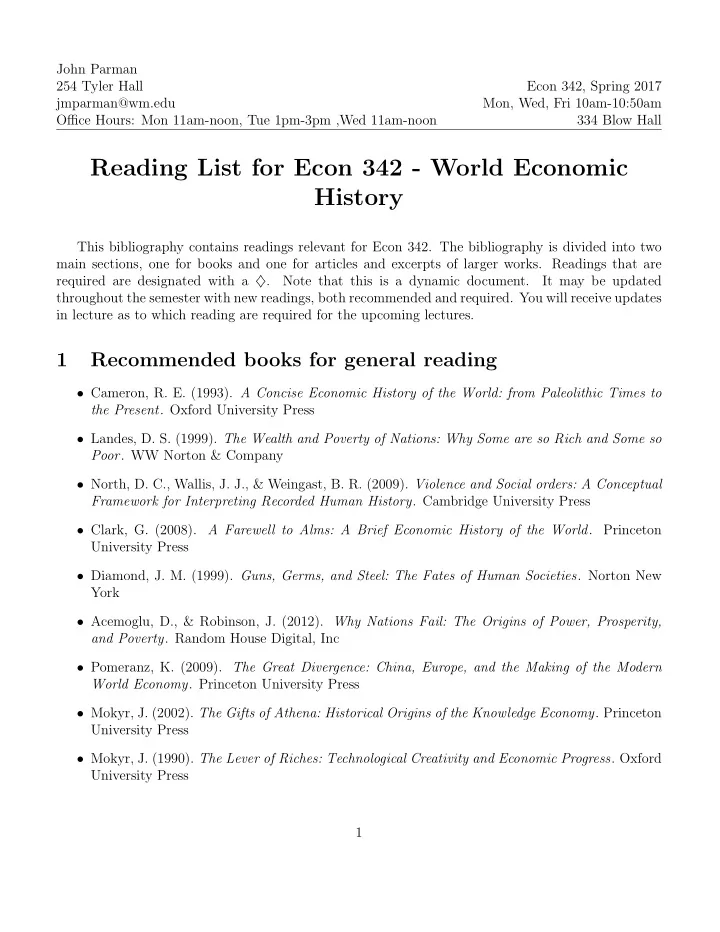
John Parman 254 Tyler Hall Econ 342, Spring 2017 jmparman@wm.edu Mon, Wed, Fri 10am-10:50am Office Hours: Mon 11am-noon, Tue 1pm-3pm ,Wed 11am-noon 334 Blow Hall Reading List for Econ 342 - World Economic History This bibliography contains


slide-1
SLIDE 1

John Parman 254 Tyler Hall jmparman@wm.edu Office Hours: Mon 11am-noon, Tue 1pm-3pm ,Wed 11am-noon Econ 342, Spring 2017 Mon, Wed, Fri 10am-10:50am 334 Blow Hall

Reading List for Econ 342 - World Economic History

This bibliography contains readings relevant for Econ 342. The bibliography is divided into two main sections, one for books and one for articles and excerpts of larger works. Readings that are required are designated with a ♦. Note that this is a dynamic document. It may be updated throughout the semester with new readings, both recommended and required. You will receive updates in lecture as to which reading are required for the upcoming lectures.

1 Recommended books for general reading

  • Cameron, R. E. (1993). A Concise Economic History of the World: from Paleolithic Times to

the Present. Oxford University Press

  • Landes, D. S. (1999). The Wealth and Poverty of Nations: Why Some are so Rich and Some so
  • Poor. WW Norton & Company
  • North, D. C., Wallis, J. J., & Weingast, B. R. (2009). Violence and Social orders: A Conceptual

Framework for Interpreting Recorded Human History. Cambridge University Press

  • Clark, G. (2008). A Farewell to Alms: A Brief Economic History of the World. Princeton

University Press

  • Diamond, J. M. (1999). Guns, Germs, and Steel: The Fates of Human Societies. Norton New

York

  • Acemoglu, D., & Robinson, J. (2012). Why Nations Fail: The Origins of Power, Prosperity,

and Poverty. Random House Digital, Inc

  • Pomeranz, K. (2009). The Great Divergence: China, Europe, and the Making of the Modern

World Economy. Princeton University Press

  • Mokyr, J. (2002). The Gifts of Athena: Historical Origins of the Knowledge Economy. Princeton

University Press

  • Mokyr, J. (1990). The Lever of Riches: Technological Creativity and Economic Progress. Oxford

University Press 1

slide-2
SLIDE 2

John Parman 254 Tyler Hall jmparman@wm.edu Office Hours: Mon 11am-noon, Tue 1pm-3pm ,Wed 11am-noon Econ 342, Spring 2017 Mon, Wed, Fri 10am-10:50am 334 Blow Hall

  • North, D. C. (1973). The Rise of the Western World: A New Economic History. Cambridge

University Press

  • North, D. C. (1990). Institutions, Istitutional Change and Economic Performance. Cambridge

University Press

  • Deaton, A. (2013). The Great Escape: Health, Wealth, and the Origins of Inequality. Princeton

University Press

2 Articles and book excerpts for class

2.1 The Pre-Industrial Economy

  • ♦ Clark, G. (2008). A Farewell to Alms: A Brief Economic History of the World. Princeton

University Press (Chapter 3 excerpt)

  • Federico, G., & Malanima, P. (2004). Progress, decline, growth: product and productivity in

italian agriculture, 1000–2000. The Economic History Review, 57(3), 437–464

  • Farber, H. (1978). A Price and Wage Study for Northern Babylonia during the Old Babylo-

nian Period. Journal of the Economic and Social History of the Orient/Journal de l’histoire economique et sociale de l’Orient, (pp. 1–51)

  • ♦ Steckel, R. H. (2008). Biological Measures of the Standard of Living. The Journal of Economic

Perspectives, 22(1), 129–152

  • Steckel, R. H. (1995). Stature and the Standard of Living. Journal of Economic Literature,

33(4), 1903–1940

  • ♦ Bocquet-Appel, J.-P. (2011b). When the World’s Population Took Off: The Springboard of

the Neolithic Demographic Transition. Science, 333(6042), 560–561

  • Bocquet-Appel, J.-P. (2011a). The Agricultural Demographic Transition during and after the

Agriculture Inventions. Current Anthropology, 52(S4), S497–S510

  • Steckel, R. H., & Wallis, J. (2007). Stones, Bones and States: A New Approach to the Neolithic
  • Revolution. NBER Working Paper Series
  • Malthus, T. R. (1888). An Essay on the Principle of Population: or, A View of its Past and

Present Effects on Human Happiness. Reeves & Turner 2

slide-3
SLIDE 3

John Parman 254 Tyler Hall jmparman@wm.edu Office Hours: Mon 11am-noon, Tue 1pm-3pm ,Wed 11am-noon Econ 342, Spring 2017 Mon, Wed, Fri 10am-10:50am 334 Blow Hall

2.2 The Industrial Revolution

  • ♦ Mokyr, J. (2008). The Contribution of Economic History to the Study of Innovation and

Technical Change: 1750-1914. In B. Hall, & N. Rosenberg (Eds.) Handbook of the Economics

  • f Innovation. Elsevier
  • Mokyr, J. (1999). Editor’s Introduction: The New Economic History and the Industrial Revo-
  • lution. The British Industrial Revolution: An Economic Perspective, 2, 1–127
  • Clark, G. (2008). A Farewell to Alms: A Brief Economic History of the World. Princeton

University Press (Chapter 12)

  • Temin, P. (1997). Two Views of the British Industrial Revolution. Journal of Economic History,

57, 63–82

  • ♦ De Vries, J. (1994). The Industrial Revolution and the Industrious Revolution. Journal of

Economic History, 54(2), 249–70

  • Voth, H.-J. (1998).

Time and Work in Eighteenth-century London. Journal of Economic History, 58, 29–58

  • Voth, H.-J. (2000). Time and Work in England 1750-1830. Clarendon Press Oxford, UK

2.3 The Why and Where of the Industrial Revolution

  • North, D. C. (1990). Institutions, Istitutional Change and Economic Performance. Cambridge

University Press

  • ♦ North, D. C., & Thomas, R. P. (1970). An Economic Theory of the Growth of the Western
  • World. The Economic History Review, 23(1), 1–17
  • Acemoglu, D., Johnson, S., & Robinson, J. A. (2002). Reversal of Fortune: Geography and

Institutions in the Making of the Modern World Income Distribution. The Quarterly Journal

  • f Economics, 117(4), 1231–1294
  • ♦ Acemoglu, D., Johnson, S., & Robinson, J. (2001). The Colonial Origins of Comparative

Development: An Empirical Investigation. The American Economic Review, 91(5), 1369–1401

  • Dittmar, J. E., & Meisenzahl, R. R. (2016). State Capacity and Public Goods: Institutional

Change, Human Capital, and Growth in Early Modern Germany. FEDS Working Paper 3

slide-4
SLIDE 4

John Parman 254 Tyler Hall jmparman@wm.edu Office Hours: Mon 11am-noon, Tue 1pm-3pm ,Wed 11am-noon Econ 342, Spring 2017 Mon, Wed, Fri 10am-10:50am 334 Blow Hall

  • Nunn, N. (2008). The Long-term Effects of Africa’s Slave Trades. The Quarterly Journal of

Economics, 123(1), 139–176

  • Voigtl¨

ander, N., & Voth, H.-J. (2012). Persecution Perpetuated: The Medieval Origins of Anti- Semitic Violence in Nazi Germany. Quarterly Journal of Economics, 127(3), 1339–1392

  • Becker, S. O., Boeckh, K., Hainz, C., & Woessmann, L. (2016). The Empire is Dead, Long

Live the Empire! Long-run Persistence of Trust and Corruption in the Bureaucracy. Economic Journal, 126(590), 40–74

  • Pomeranz, K. (2009). The Great Divergence: China, Europe, and the Making of the Modern

World Economy. Princeton University Press

  • Diamond, J. M. (1999). Guns, Germs, and Steel: The Fates of Human Societies. Norton New

York

  • ♦ Diamond, J. (2004). Economics: The Wealth of Nations. Nature, 429(6992), 616–617
  • Jha, S. (2013). Trade, Institutions, and Ethnic Tolerance: Evidence from South Asia. American

Political Science Review, 107(04), 806–832

  • Bleakley, H., & Lin, J. (2012).

Portage and Path Dependence. The Quarterly Journal of Economics, 127(2), 587

  • Reyes-Garcia, V., Godoy, R., Huanca, T., Leonard, W. R., McDade, T., Tanner, S., & Vadez,
  • V. (2007). The Origins of Monetary Income Inequality: Patience, Human Capital, and Division
  • f Labor. Evolution and Human Behavior, 28(1), 37–47
  • ♦ Clark, G. (2008). A Farewell to Alms: A Brief Economic History of the World. Princeton

University Press (Chapter 13 excerpt)

  • McCloskey, D. N. (2010). Bourgeois Dignity: Why Economics Can’t Explain the Modern World.

University of Chicago Press

2.4 The Mixed Benefits of Industrialization

  • ♦ Bleakley, H. (2007). Disease and Development: Evidence from Hookworm Eradication in the

American South. The Quarterly Journal of Economics, 122(1), 73–117

  • Almond, D. (2006). Is the 1918 Influenza Pandemic Over? Long-term Effects of in utero Influenza

Exposure in the Post-1940 US Population. Journal of Political Economy, 114(4), 672–712 4

slide-5
SLIDE 5

John Parman 254 Tyler Hall jmparman@wm.edu Office Hours: Mon 11am-noon, Tue 1pm-3pm ,Wed 11am-noon Econ 342, Spring 2017 Mon, Wed, Fri 10am-10:50am 334 Blow Hall

  • Bleakley, H. (2010). Malaria Eradication in the Americas: A Retrospective Analysis of Childhood
  • Exposure. American Economic Journal: Applied Economics, 2(2)
  • ♦ Goldin, C., & Katz, L. F. (1998). The Origins of Technology-skill Complementarity. The

Quarterly Journal of Economics, 113(3), 693–732

  • Gray, R. (2013). Taking Technology to Task: The Skill Content of Technological Change in

Early Twentieth Century United States. Explorations in Economic History, 50(3), 351–367

  • Goldin, C. D., & Katz, L. F. (2009). The Race Between Education and Technology. Harvard

University Press

  • ♦ Long, J., & Ferrie, J. (2013). Intergenerational occupational mobility in great britain and the

united states since 1850. The American Economic Review, 103(4), 1109–1137

  • Corak, M. (2013). Income inequality, equality of opportunity, and intergenerational mobility.

The Journal of Economic Perspectives, 27(3), 79–102

  • Easterlin, R. A. (1995). Will Raising the Incomes of All Increase the Happiness of All? Journal
  • f Economic Behavior & Organization, 27(1), 35–47
  • Veenhoven, R., & Hagerty, M. (2006). Rising Happiness in Nations 1946–2004: A Reply to
  • Easterlin. Social Indicators Research, 79(3), 421–436
  • Easterly, W., & Easterly, W. R. (2001). The elusive quest for growth: economists’ adventures

and misadventures in the tropics. MIT press

  • Deaton, A. (2013). The Great Escape: Health, Wealth, and the Origins of Inequality. Princeton

University Press 5

slide-6
SLIDE 6

John Parman 254 Tyler Hall jmparman@wm.edu Office Hours: Mon 11am-noon, Tue 1pm-3pm ,Wed 11am-noon Econ 342, Spring 2017 Mon, Wed, Fri 10am-10:50am 334 Blow Hall

References

Acemoglu, D., Johnson, S., & Robinson, J. (2001). The Colonial Origins of Comparative Development: An Empirical Investigation. The American Economic Review, 91(5), 1369–1401. Acemoglu, D., Johnson, S., & Robinson, J. A. (2002). Reversal of Fortune: Geography and Institutions in the Making of the Modern World Income Distribution. The Quarterly Journal of Economics, 117(4), 1231–1294. Acemoglu, D., & Robinson, J. (2012). Why Nations Fail: The Origins of Power, Prosperity, and

  • Poverty. Random House Digital, Inc.

Almond, D. (2006). Is the 1918 Influenza Pandemic Over? Long-term Effects of in utero Influenza Exposure in the Post-1940 US Population. Journal of Political Economy, 114(4), 672–712. Becker, S. O., Boeckh, K., Hainz, C., & Woessmann, L. (2016). The Empire is Dead, Long Live the Empire! Long-run Persistence of Trust and Corruption in the Bureaucracy. Economic Journal, 126(590), 40–74. Bleakley, H. (2007). Disease and Development: Evidence from Hookworm Eradication in the American

  • South. The Quarterly Journal of Economics, 122(1), 73–117.

Bleakley, H. (2010). Malaria Eradication in the Americas: A Retrospective Analysis of Childhood

  • Exposure. American Economic Journal: Applied Economics, 2(2).

Bleakley, H., & Lin, J. (2012). Portage and Path Dependence. The Quarterly Journal of Economics, 127(2), 587. Bocquet-Appel, J.-P. (2011a). The Agricultural Demographic Transition during and after the Agri- culture Inventions. Current Anthropology, 52(S4), S497–S510. Bocquet-Appel, J.-P. (2011b). When the World’s Population Took Off: The Springboard of the Neolithic Demographic Transition. Science, 333(6042), 560–561. Cameron, R. E. (1993). A Concise Economic History of the World: from Paleolithic Times to the

  • Present. Oxford University Press.

Clark, G. (2008). A Farewell to Alms: A Brief Economic History of the World. Princeton University Press. Corak, M. (2013). Income inequality, equality of opportunity, and intergenerational mobility. The Journal of Economic Perspectives, 27(3), 79–102. 6

slide-7
SLIDE 7

John Parman 254 Tyler Hall jmparman@wm.edu Office Hours: Mon 11am-noon, Tue 1pm-3pm ,Wed 11am-noon Econ 342, Spring 2017 Mon, Wed, Fri 10am-10:50am 334 Blow Hall De Vries, J. (1994). The Industrial Revolution and the Industrious Revolution. Journal of Economic History, 54(2), 249–70. Deaton, A. (2013). The Great Escape: Health, Wealth, and the Origins of Inequality. Princeton University Press. Diamond, J. (2004). Economics: The Wealth of Nations. Nature, 429(6992), 616–617. Diamond, J. M. (1999). Guns, Germs, and Steel: The Fates of Human Societies. Norton New York. Dittmar, J. E., & Meisenzahl, R. R. (2016). State Capacity and Public Goods: Institutional Change, Human Capital, and Growth in Early Modern Germany. FEDS Working Paper. Easterlin, R. A. (1995). Will Raising the Incomes of All Increase the Happiness of All? Journal of Economic Behavior & Organization, 27(1), 35–47. Easterly, W., & Easterly, W. R. (2001). The elusive quest for growth: economists’ adventures and misadventures in the tropics. MIT press. Farber, H. (1978). A Price and Wage Study for Northern Babylonia during the Old Babylonian

  • Period. Journal of the Economic and Social History of the Orient/Journal de l’histoire economique

et sociale de l’Orient, (pp. 1–51). Federico, G., & Malanima, P. (2004). Progress, decline, growth: product and productivity in italian agriculture, 1000–2000. The Economic History Review, 57(3), 437–464. Goldin, C., & Katz, L. F. (1998). The Origins of Technology-skill Complementarity. The Quarterly Journal of Economics, 113(3), 693–732. Goldin, C. D., & Katz, L. F. (2009). The Race Between Education and Technology. Harvard University Press. Gray, R. (2013). Taking Technology to Task: The Skill Content of Technological Change in Early Twentieth Century United States. Explorations in Economic History, 50(3), 351–367. Jha, S. (2013). Trade, Institutions, and Ethnic Tolerance: Evidence from South Asia. American Political Science Review, 107(04), 806–832. Landes, D. S. (1999). The Wealth and Poverty of Nations: Why Some are so Rich and Some so Poor. WW Norton & Company. Long, J., & Ferrie, J. (2013). Intergenerational occupational mobility in great britain and the united states since 1850. The American Economic Review, 103(4), 1109–1137. 7

slide-8
SLIDE 8

John Parman 254 Tyler Hall jmparman@wm.edu Office Hours: Mon 11am-noon, Tue 1pm-3pm ,Wed 11am-noon Econ 342, Spring 2017 Mon, Wed, Fri 10am-10:50am 334 Blow Hall Malthus, T. R. (1888). An Essay on the Principle of Population: or, A View of its Past and Present Effects on Human Happiness. Reeves & Turner. McCloskey, D. N. (2010). Bourgeois Dignity: Why Economics Can’t Explain the Modern World. University of Chicago Press. Mokyr, J. (1990). The Lever of Riches: Technological Creativity and Economic Progress. Oxford University Press. Mokyr, J. (1999). Editor’s Introduction: The New Economic History and the Industrial Revolution. The British Industrial Revolution: An Economic Perspective, 2, 1–127. Mokyr, J. (2002). The Gifts of Athena: Historical Origins of the Knowledge Economy. Princeton University Press. Mokyr, J. (2008). The Contribution of Economic History to the Study of Innovation and Technical Change: 1750-1914. In B. Hall, & N. Rosenberg (Eds.) Handbook of the Economics of Innovation. Elsevier. North, D. C. (1973). The Rise of the Western World: A New Economic History. Cambridge University Press. North, D. C. (1990). Institutions, Istitutional Change and Economic Performance. Cambridge Uni- versity Press. North, D. C., & Thomas, R. P. (1970). An Economic Theory of the Growth of the Western World. The Economic History Review, 23(1), 1–17. North, D. C., Wallis, J. J., & Weingast, B. R. (2009). Violence and Social orders: A Conceptual Framework for Interpreting Recorded Human History. Cambridge University Press. Nunn, N. (2008). The Long-term Effects of Africa’s Slave Trades. The Quarterly Journal of Eco- nomics, 123(1), 139–176. Pomeranz, K. (2009). The Great Divergence: China, Europe, and the Making of the Modern World

  • Economy. Princeton University Press.

Reyes-Garcia, V., Godoy, R., Huanca, T., Leonard, W. R., McDade, T., Tanner, S., & Vadez, V. (2007). The Origins of Monetary Income Inequality: Patience, Human Capital, and Division of

  • Labor. Evolution and Human Behavior, 28(1), 37–47.

8

slide-9
SLIDE 9

John Parman 254 Tyler Hall jmparman@wm.edu Office Hours: Mon 11am-noon, Tue 1pm-3pm ,Wed 11am-noon Econ 342, Spring 2017 Mon, Wed, Fri 10am-10:50am 334 Blow Hall Steckel, R. H. (1995). Stature and the Standard of Living. Journal of Economic Literature, 33(4), 1903–1940. Steckel, R. H. (2008). Biological Measures of the Standard of Living. The Journal of Economic Perspectives, 22(1), 129–152. Steckel, R. H., & Wallis, J. (2007). Stones, Bones and States: A New Approach to the Neolithic

  • Revolution. NBER Working Paper Series.

Temin, P. (1997). Two Views of the British Industrial Revolution. Journal of Economic History, 57, 63–82. Veenhoven, R., & Hagerty, M. (2006). Rising Happiness in Nations 1946–2004: A Reply to Easterlin. Social Indicators Research, 79(3), 421–436. Voigtl¨ ander, N., & Voth, H.-J. (2012). Persecution Perpetuated: The Medieval Origins of Anti-Semitic Violence in Nazi Germany. Quarterly Journal of Economics, 127(3), 1339–1392. Voth, H.-J. (1998). Time and Work in Eighteenth-century London. Journal of Economic History, 58, 29–58. Voth, H.-J. (2000). Time and Work in England 1750-1830. Clarendon Press Oxford, UK. 9