RBAPS Results Based Agri- Environment Payment Schemes Management - - PowerPoint PPT Presentation

rbaps results based agri environment payment schemes
SMART_READER_LITE
LIVE PREVIEW

RBAPS Results Based Agri- Environment Payment Schemes Management - - PowerPoint PPT Presentation

RBAPS Results Based Agri- Environment Payment Schemes Management based approach payment linked to undertaking prescribed management e.g. fixed mowing dates, nutrient inputs Fixed payment rate Require proof that management has


slide-1
SLIDE 1

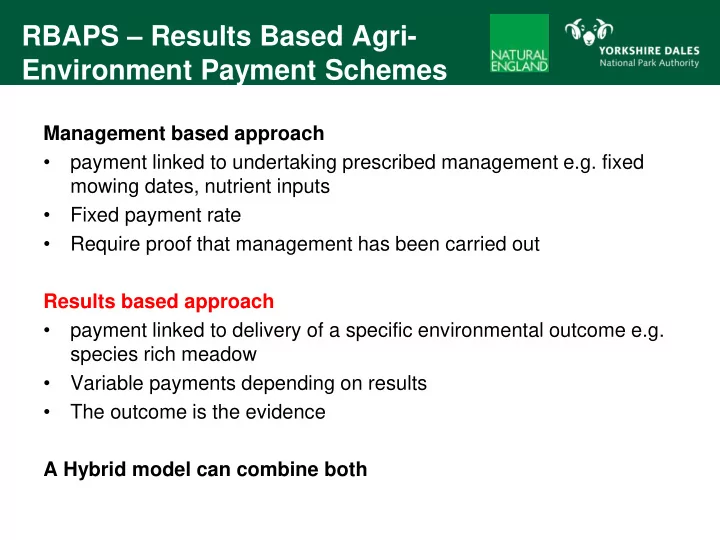
RBAPS – Results Based Agri- Environment Payment Schemes

Management based approach

  • payment linked to undertaking prescribed management e.g. fixed

mowing dates, nutrient inputs

  • Fixed payment rate
  • Require proof that management has been carried out

Results based approach

  • payment linked to delivery of a specific environmental outcome e.g.

species rich meadow

  • Variable payments depending on results
  • The outcome is the evidence

A Hybrid model can combine both

slide-2
SLIDE 2

England: arable & grassland Ireland

(grassland) &

Spain

(permanent crops)

Romania: hay

meadows

slide-3
SLIDE 3

Potential advantages of RBAPS

 Flexibility (“freedom to farm”) to meet the outcomes on a site  Provides motivation to succeed, gain recognition & reward  Verification is by the results, not record keeping etc  Can incentivise maintenance of good habitats & enhancement of

  • thers

 More cost-effective (?) as payment linked to quality

slide-4
SLIDE 4

RBAPS in England

Pilot scheme is testing RBAPS on 4 objectives in 2 contrasting situations:

  • Upland grassland – Wensleydale, North Yorkshire
  • Habitat for breeding waders
  • Species rich hay meadow
  • Arable – Norfolk & Suffolk, Eastern England
  • Winter bird food
  • Pollen & nectar mix

3 year EU funded pilot from January 2016 (€714,000) Co-delivered by Natural England & YDNPA YDNPA are leading on behalf of the NUCLNP

slide-5
SLIDE 5

Aims of the pilot

 assess the environmental performance of habitats under RBAPS agreements  compare the RBAPS approach to control sites within the pilot boundary  test accuracy of farmer self-assessment of results  test cost effectiveness of RBAPS approach  explore agreement holder and stakeholder attitudes to RBAPS

slide-6
SLIDE 6

Pilot

2016

  • Developing result measures, thresholds, payment rates
  • Recruitment of participants/baseline assessments

2017

  • Delivery
  • Monitoring and evaluation
  • Control comparisons

2018

  • Delivery
  • Monitoring and evaluation
  • Reporting, dissemination etc
slide-7
SLIDE 7

Developing results criteria and methodology

Key attributes:  representative of what we want/don’t want to see  easy to identify  easy to survey  present for a significant period (not transitory/short-lived)  within farmer’s control  sensitive to management change Positive and negative indicators give farmers a clear message on the type of management necessary to improve the score and payment Assessment methodology must be representative of the habitat, repeatable and not subjective. Need time to develop and test.

slide-8
SLIDE 8

Wensleydale – Grassland pilot

19 agreements

Both options have 5 tiers of payment based on a Total score Baseline condition was assessed spring/summer 2016 Controls have been selected from comparable sites in Wensleydale under conventional, management-based schemes

slide-9
SLIDE 9
slide-10
SLIDE 10

Farmer support

  • Training & guidance – fitting this to farmers needs:

hay meadow restoration techniques plant identification wading bird habitat management peer to peer learning

  • Field assessments
  • Regular whole group meetings
slide-11
SLIDE 11

Annual farmer assessments

slide-12
SLIDE 12

Payment bands for meadows

  • Score of 146 = £260/ha

Score / Total points 1

40 -79 points

2

80-119 points

3

120-159 points

4

160-199 points

5

200+ points

£/ha 112 186 260 334 371

slide-13
SLIDE 13

Vegetation height Rush cover Scale of wet features Quality of wet features

10 – 30% cover, well scattered with local areas of dense rush 10 >30% rush cover, large areas of dense rush and tall vegetation 5 Absent or sparse <5% 1 Field is damp across the majority of the area with a number of wet areas scattered across the field 10 Damp areas are contained to approximately 10% of the field, eg springs, remainder of field is dry 5 Damp areas are rarely seen 1 Wet features contain a mix of shallow pools and wet vegetation, gently sloping edges, 50%

  • f the edge is mud with less than 25% rush or tall vegetation

10 A number of wet features on the site but not meeting all criteria above 5 Steep sided, no muddy edge, dense rush cover, inaccessible to birds 1 Mixed sward height where between 25 - 75% of the field is short and the rest varied, tussocks frequently seen and well distributed 10 Over 75% long. Short swards confined to very small parts of fields (eg gateways, sup feed sites only) Tussocks indistinguishable from other tall vegetation 5 Over 75% short with little to no variation in height. Tussocks rare or absent 5 No difference in height – either all short, or all long with no variation 1

Breeding wader Scoring Criteria

Tier Total points 1 <9 points 2 10-19 points 3 20 – 29 points 4 30 – 39 points 5 40 points Grant £/ha 35 69 104 139 174

slide-14
SLIDE 14

Grassland assessments

Species rich meadows Breeding wader habitat Diagonal transect survey of indicator species before hay cut + Overall assessment of damaging activities Field level assessment of:

  • vegetation height
  • cover of rush
  • extent and quality of wet features
  • extent of any damage to the sward

Includes negative scores as well as positive to actively discourage poor management 5 payment tiers

slide-15
SLIDE 15

Baseline and Year 1 scores - Waders

Habitat Average base line score Average year 1 score (farmer) Average Year 1 score (advisor) Score range Breeding waders 32 33 27 7 - 40 Wader habitat (22 sites) Average payment - £139/ha 5 fields went up a payment band, 5 fields went down a payment band and 11 remained within the same payment band as the baseline assessment Increase in habitat quality (and score) – rush control and creating better quality wet areas. Reduction in habitat quality – increase in rush and poor sward management No sward damage recorded 16 of 21 wader scores were different when compared against advisor assessment:

  • subjective measures
  • highly sensitive payment bands
slide-16
SLIDE 16

Baseline and Year 1 scores - meadows

Habitat Average base line score Average year 1 score (farmer) Average Year 1 score (advisor) Score range Hay meadows 84 92 92 42 - 156 Meadow habitat (19 sites) Average payment: £186/ha 3 farmers required direct support from the advisers in completing their assessment. The rest of the farmers carried it out independently. 5 fields went up a payment band, none went down and 14 maintained their original payment band score 6 of 19 meadow scores were significantly different between farmer assessment and advisor:

  • mistaken ID of meadow species
  • different stop points along transect

Meadow scores generally showed only minor differences between advisor and farmer – an indication that farmers have picked up species identification skills relatively quickly

slide-17
SLIDE 17

What farmers have told us - grassland

  • Training considered to be a very important part of the project.
  • Farmers are ‘quite confident’ about the management required.
  • Farmers are quite confident about their ability to undertake

the scoring.

  • All are actively working towards improving the habitat from the

baseline score by up to 1 or 2 payment bands by the end of year 2.

ADVANTAGES OF PBR DISADVANTAGES OF PBR

  • Increased understanding of the ask
  • Flexible
  • Nature is at the heart of the scheme
  • Simple to understand
  • Clear payment structure designed

to incentivise

  • Weather conditions could affect

score

  • More work on the farmers part
  • Payment rate could go up or down
  • Resource intensive
  • Costly to deliver
slide-18
SLIDE 18

Accuracy of farmer assessments

slide-19
SLIDE 19

Positives

  • Shift from paperwork to fieldwork
  • Flexibility is highly valued
  • Big sense of ownership & control
  • Far better understanding of the ask
  • Freedom outweighs risk of low/no payment (?)
  • Taps into pride and competitiveness (“I want top marks”)
  • Know the relative value of their site
  • Different attitude – given the care and attention of a crop
  • Keen to move up the scale
  • Are their expectations too high?
slide-20
SLIDE 20

Looking to the future…

  • Lots of interest from Defra, EU & stakeholders
  • DEFRA have approved extension of the pilot with £540k for 2.5 years
  • Does require significant effort upfront to develop
  • Need to consider:
  • which habitats/species/objectives are most suited
  • whether it’s practical at a large scale for individual farmers (many

fields, objectives, assessments at different times)

  • how to manage risk – hybrid approach? insurance?

Lots to consider, lots of potential! Keep up to date with the website:

https://www.gov.uk/government/publications/results-based-agri-environment- payment-scheme-rbaps-pilot-study-in-england