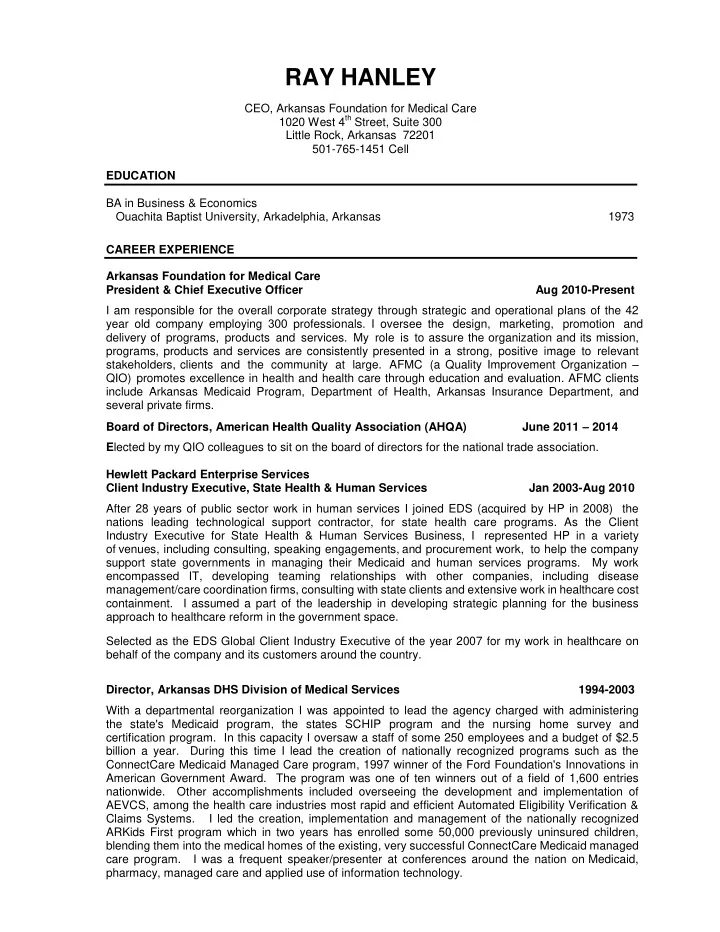
RAY HANLEY CEO, Arkansas Foundation for Medical Care 1020 West 4 th - - PDF document

ray hanley
SMART_READER_LITE
LIVE PREVIEW

RAY HANLEY CEO, Arkansas Foundation for Medical Care 1020 West 4 th - - PDF document

RAY HANLEY CEO, Arkansas Foundation for Medical Care 1020 West 4 th Street, Suite 300 Little Rock, Arkansas 72201 501-765-1451 Cell EDUCATION BA in Business & Economics Ouachita Baptist University, Arkadelphia, Arkansas 1973 CAREER


slide-1
SLIDE 1

RAY HANLEY

CEO, Arkansas Foundation for Medical Care 1020 West 4th Street, Suite 300 Little Rock, Arkansas 72201 501-765-1451 Cell EDUCATION BA in Business & Economics Ouachita Baptist University, Arkadelphia, Arkansas 1973 CAREER EXPERIENCE Arkansas Foundation for Medical Care President & Chief Executive Officer Aug 2010-Present I am responsible for the overall corporate strategy through strategic and operational plans of the 42 year old company employing 300 professionals. I oversee the design, marketing, promotion and delivery of programs, products and services. My role is to assure the organization and its mission, programs, products and services are consistently presented in a strong, positive image to relevant stakeholders, clients and the community at large. AFMC (a Quality Improvement Organization – QIO) promotes excellence in health and health care through education and evaluation. AFMC clients include Arkansas Medicaid Program, Department of Health, Arkansas Insurance Department, and several private firms. Board of Directors, American Health Quality Association (AHQA) June 2011 – 2014 Elected by my QIO colleagues to sit on the board of directors for the national trade association. Hewlett Packard Enterprise Services Client Industry Executive, State Health & Human Services Jan 2003-Aug 2010 After 28 years of public sector work in human services I joined EDS (acquired by HP in 2008) the nations leading technological support contractor, for state health care programs. As the Client Industry Executive for State Health & Human Services Business, I represented HP in a variety

  • f venues, including consulting, speaking engagements, and procurement work, to help the company

support state governments in managing their Medicaid and human services programs. My work encompassed IT, developing teaming relationships with other companies, including disease management/care coordination firms, consulting with state clients and extensive work in healthcare cost

  • containment. I assumed a part of the leadership in developing strategic planning for the business

approach to healthcare reform in the government space. Selected as the EDS Global Client Industry Executive of the year 2007 for my work in healthcare on behalf of the company and its customers around the country. Director, Arkansas DHS Division of Medical Services 1994-2003 With a departmental reorganization I was appointed to lead the agency charged with administering the state's Medicaid program, the states SCHIP program and the nursing home survey and certification program. In this capacity I oversaw a staff of some 250 employees and a budget of $2.5 billion a year. During this time I lead the creation of nationally recognized programs such as the ConnectCare Medicaid Managed Care program, 1997 winner of the Ford Foundation's Innovations in American Government Award. The program was one of ten winners out of a field of 1,600 entries

  • nationwide. Other accomplishments included overseeing the development and implementation of

AEVCS, among the health care industries most rapid and efficient Automated Eligibility Verification & Claims Systems. I led the creation, implementation and management of the nationally recognized ARKids First program which in two years has enrolled some 50,000 previously uninsured children, blending them into the medical homes of the existing, very successful ConnectCare Medicaid managed care program. I was a frequent speaker/presenter at conferences around the nation on Medicaid, pharmacy, managed care and applied use of information technology.

slide-2
SLIDE 2

Ray Hanley, October 2017 Page 2 of 2 Chairman, National Association of Medicaid Directors (NAMD, formerly National Association

  • f State Medicaid Directors, NASMD)

May 2002—2003 Elected by my Medicaid Director colleagues to lead the National Association of State Medicaid Directors, a position I previously served in for four years from 1990 to 1994. 1990 to 1994 In this role I served two elected terms as the leader of the Medicaid Directors Association during which time I represented my colleagues before Congress, in the national health reform debates, speaking at numerous national meetings and before a wide variety of news media ranging from the New York Times to CNN and National Public Radio. Aside from serving as the NASMD Chairman I have held a number of other leadership roles, with

  • NASMD. As a member of the Executive Committee, co-chairing the CHIP implementation work group

and beginning in early 2000 as the Chairman of the Pharmacy Technical Advisory Group. In this latter role I represented the Medicaid Directors with the Health Care Financing Administration, media such as the NYT’s and Wall Street Journal, an array of forums around the nation and in other venues as we work to contain the rapid growth in prescription drug costs. Board of Directors, American Public Welfare Association (APWA) (American Public Human Services Administrators Association) I served on the APWA Board of Directors from 1990 to 1994, working on both health and welfare issues. Director, Office of Medical Services DHS Division of Economic and Medical Services 1986-1994 In this role I served as the state’s Medicaid Director during a time of considerable growth and progress in expanding coverage for pregnant women and children, streamlining computer systems and working closely with the entire health care community. I oversaw the procurement and implementation of the state’s first certified claims processing system, worked closely with legislators, advocates and others who were interested in the largest program in state government, which was, and remains the Medicaid program. Arkansas Department of Human Services 1975-1986 During this period I worked in a number of capacities, covering almost the entire range of programs in the department. This included service as an eligibility caseworker for AFDC and food stamps, a child welfare worker, and three years as the Foster Care Supervisor for the southern half of Pulaski County, which includes Little Rock. AWARDS AND OUTSIDE ACTIVITIES

Person of the Year by the Campaign for Healthier Babies, 1997 Past Chairman of the Central Arkansas Sierra Club Completed 14 Marathons in five years and biked on 5 continents Selected EDS Client Industry Executive of the year, 2007 Angels Women’s and Children’s Health Champion, 2011 Arkansas Children's Hospital Person of the Year, 2012 Author/co-author of twenty books on Arkansas history

slide-3
SLIDE 3

A Brief History of Medicaid

NY NYIT IT COLLEGE E OF F OSTEOPATHIC HIC MED MEDIC ICINE INE - AR AR | OC OCTOB OBER 2017

RAY HANLEY, PRESIDENT AND CEO

slide-4
SLIDE 4

El El Do Dorado, 1911 “Know you wonder why you don’t hear from me, but child my hands are too full to write. Amos has a spell of tonsillitis, Elizabeth has the measles, and Henry has been in bed for a week with

  • neuralgia. Please write and tell me

all the news and especially about the infantile paralysis.”

slide-5
SLIDE 5

Medically Underserved Arkansas

slide-6
SLIDE 6

Access to care in rural areas has long been a challenge.

slide-7
SLIDE 7

Access to care is especially a challenge in the Delta, and in much of South Arkansas.

slide-8
SLIDE 8

“I’m afraid that when another 400,000 people get an insurance card, it will be like having confederate money with no place to spend it.” Darren Caldwell, CEO, DeWitt Hospital

Coverage doesn’t equal access if there aren’t accessible providers of care.

slide-9
SLIDE 9

Arkansas definitely has an unhealthy population when compared to most states …

Source: Commonwealth Fund Scorecard on State Health Performance

slide-10
SLIDE 10

In Arkansas, 25 percent of adults still smoke. We lead the nation in obesity. This strains health care system budgets.

slide-11
SLIDE 11

“19 is the new 60”

A commentary on the sedentary lifestyle of today’s young people who are increasingly obese.

slide-12
SLIDE 12

Workforce Challenges Loom

2014 2014

§ 300,000 added to Medicaid § 200,000 through the exchange

Fe Fewer enrolling health care pr professio ionals nals (ph physicians icians, nur nurses, de dentis ists, the herapis apists, etc.) .)

§ 1999: 41,000 med students § 2011: 42,000 med students

slide-13
SLIDE 13

1912

The first president to propose universal health coverage was Teddy Roosevelt.

slide-14
SLIDE 14

President Truman proposed federal government run universal coverage, in part to provide incentives for more physicians and hospitals to come to rural areas. The AMA opposed and the proposal died in Congress.

1945

slide-15
SLIDE 15

Health care reform and a path to universal (greatly expanded?) coverage.

“HillaryCare” would have ended Medicaid

slide-16
SLIDE 16

Medicaid’s History

slide-17
SLIDE 17

Medicare’s stepchild Born: 1965 Begun in Arkansas: 1970 Includes: § ConnectCare § ARKids First § Arkansas Works

slide-18
SLIDE 18

1987

Arkansas was the first state to raise Medicaid eligibility limit for pregnant women to 200 percent

  • f the federal poverty table (was at 17 percent).
slide-19
SLIDE 19

Medicaid was conceived to cover mothers, children and the poor. Medicaid and AFDC “de- linked.” AFDC became TANF and its roles plunged, but Medicaid on the other hand …

1997

slide-20
SLIDE 20

1997

ARKids First extended Medicaid for children to 200 percent of poverty.

slide-21
SLIDE 21

1997

ConnectCare wins the Innovations in American Government Award sponsored by the Ford Foundation and the John F. Kennedy School of Government at Harvard.

slide-22
SLIDE 22

2014

Medicaid essentially covered only children, pregnant women and the aged/blind/disabled. “Medicaid covers some people, some of the time, under some conditions.”

slide-23
SLIDE 23

The Path to Medicaid Expansion

(Private Option)

slide-24
SLIDE 24

§ Democrats, mostly Confederate soldiers, could not vote until citizenship was restored. § Republicans control legislature.

1874

slide-25
SLIDE 25

2012

U.S. Supreme Court saves “Obamacare” by ruling it’s a tax, but

but makes Medicaid expansion optional

for states.

slide-26
SLIDE 26

The Arkansas Times tracked chances of passing the expansion …

“I put it this year’s session at 5 percent.”

Max Brantley, February 2013

slide-27
SLIDE 27

The Obstacles

Majority vote for the enabling legislation, but but … required “super majority” vote for the necessary appropriation.

75 75 of

  • f 100 vot
  • tes

s in in the Hou

  • use

se 27 27 of

  • f 35 vot
  • tes

s in in the Sen Senate

slide-28
SLIDE 28

Th The votes at crunch ti time … …

Se Senate 28

(we needed 27)

Ho House 77 use 77

(we needed 75)

slide-29
SLIDE 29

Wha What the he Private Op Option n woul uld d do do

Allow DHS to purchase a private “silver” insurance plan within the state’s Health Insurance Exchange for any uninsured adult below 138 percent* of the poverty level.

*(approximately $15,000 for one; $32,000 for a family of four)

slide-30
SLIDE 30

2014 Medicaid Eligibility Floor

Family Size Monthly Income 1 $1,293 2 1,743 3 2,193 4 2,643 5 2,901 6 3,325 Family Size Monthly Income 7 $3,748 8 4,171 9 4,595 10 5,018 11 5,441 12 5,865

Figures above used for Medical Assistance for Children (MAC)

133% Federal Poverty Level

slide-31
SLIDE 31

2016

31 percent (1.1 million) of the states population enrolled

*In 2010, there 26 percent (771,918 ) enrolled.

Primary coverage for: § Long-term care § Mental health § Obstetrics § Children

slide-32
SLIDE 32

Medicaid’s coverage of the frailest, sickest and most expensive among our population

slide-33
SLIDE 33

§ Community Mental Health Centers § Inpatient and residential treatment § Youth Home § The BridgeWay § Centers for Youth & Families § Pinnacle Pointe § Many other public and private providers

Pr Primary Payer for Mental Health Health

slide-34
SLIDE 34

75 percent of nursing home residents plus thousands of elderly patients in the community

Lo Long-Te Term Care

slide-35
SLIDE 35

Medicaid funding has made possible one of the 20 largest children’s hospitals in the nation.

Source: Arkansas Children’s

slide-36
SLIDE 36

Medicaid will always be under budget pressure. As practitioners, you will be a part of holding down costs where medically appropriate.

slide-37
SLIDE 37

Health care cost wasn’t always a huge concern …

slide-38
SLIDE 38

Challenged to make medically appropriate use

  • f ever more expensive technology
slide-39
SLIDE 39

You will deal with patients demanding expensive drugs “as seen on TV”

slide-40
SLIDE 40

A major Medicaid cost containment vehicle you will hopefully enlist in is the Patient-Centered Medical Home (PCMH).

slide-41
SLIDE 41

Wha What is s PCMH?

Team-based care delivery model led by primary care physician who comprehensively manages a patient’s health needs with an emphasis on health care value

slide-42
SLIDE 42

A successful PCMH qualifies for extra payments but requires extra investment and commitment. § Same-day appointments § After-hours access § Demonstrated proficiency with EHR

slide-43
SLIDE 43

Arkansas Medicaid and AFMC are working together to help providers move to EHR, which will reduce errors, improve quality and save money.

slide-44
SLIDE 44

Are changes to Medicaid

  • n the horizon?
slide-45
SLIDE 45

Medicaid Block Grants?

§ More flexibility? § What would Arkansas change? § Adjusted for inflation? § Would a block grant be set at a level to maintain the program?

slide-46
SLIDE 46

Medicaid-for-all? (not likely)

slide-47
SLIDE 47

At this point in it’s history, Medicaid is in the midst of months-long ACA “repeal and replace” drama, but has emerged with new respect & public support.

slide-48
SLIDE 48

“The hard thing about real change is … it requires real change.”

Newt Gingrich

slide-49
SLIDE 49

Ray Hanley, President and CEO 501-765-1451 rhanley@afmc.org