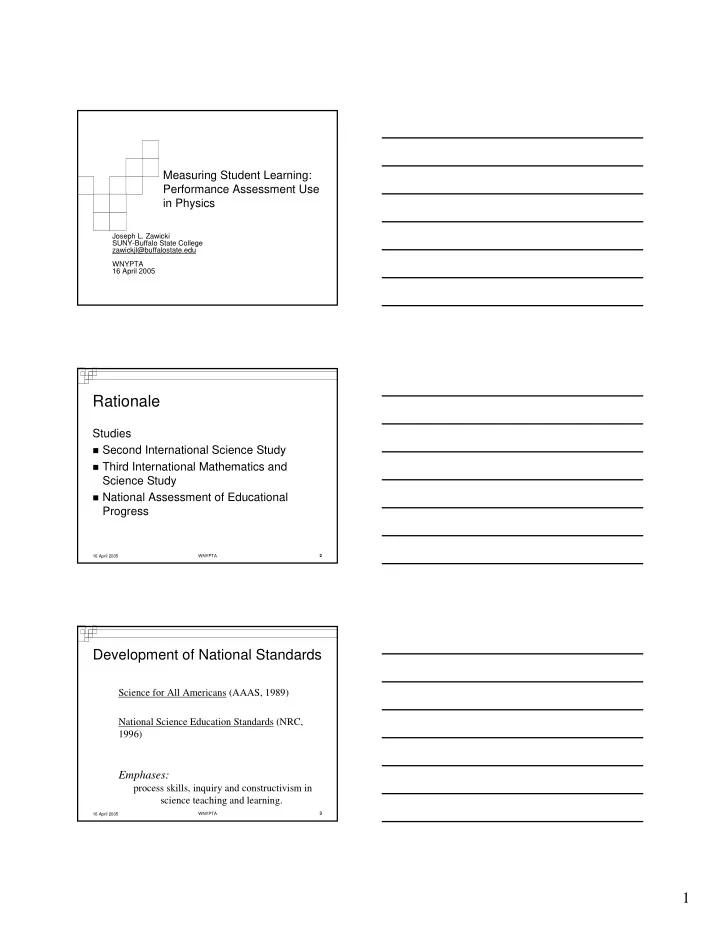
Rationale Studies Second International Science Study Third - - PDF document

rationale
SMART_READER_LITE
LIVE PREVIEW

Rationale Studies Second International Science Study Third - - PDF document

Measuring Student Learning: Performance Assessment Use in Physics Joseph L. Zawicki SUNY-Buffalo State College zawickjl@buffalostate.edu WNYPTA 16 April 2005 Rationale Studies Second International Science Study Third International


slide-1
SLIDE 1

1

Measuring Student Learning: Performance Assessment Use in Physics

Joseph L. Zawicki SUNY-Buffalo State College zawickjl@buffalostate.edu WNYPTA 16 April 2005

WNYPTA 2 16 April 2005

Rationale

Studies

Second International Science Study Third International Mathematics and

Science Study

National Assessment of Educational

Progress

WNYPTA 3 16 April 2005

Development of National Standards

Science for All Americans (AAAS, 1989) National Science Education Standards (NRC, 1996)

Emphases:

process skills, inquiry and constructivism in science teaching and learning.

slide-2
SLIDE 2

2

WNYPTA 4 16 April 2005

Problem Solving Model*

Plan Obtain data Organize data Analyze data Generalize from the data Make decisions based upon the data

*New York State Regents Physics Syllabus, Appendix A (1988)

WNYPTA 5 16 April 2005

Process Skills Models

Lunetta and Tamir (1979) - four foci:

Planning Performing Analyzing and interpreting Application

WNYPTA 6 16 April 2005

Development of NYS Standards

NYS Learning Standards in Mathematics,

Science and Technology (NYSED, 1996)

Developed from the NSES and SFAA Standards: 1 – Analysis, Inquiry and

Design, Scientific Inquiry, 2 – Information Systems, 3 – Math, 4 – Science, 5 – Technology, 6 – Common Themes, 7 – Interdisciplinary Problem Solving

slide-3
SLIDE 3

3

WNYPTA 7 16 April 2005

  • Frameworks
  • Syllabi
  • Guides
  • Blueprints
  • Benchmarks
  • Objective tests
  • Performance assessments
  • Portfolios
  • Teacher Observations
  • Group Activities
  • Program Evaluations

Curriculum Standards Assessment/Evaluation System Instructional Program

alignment validit y correlation

  • Instructional styles
  • Print materials
  • Equipment
  • Facilities
  • Technology
  • Community

WNYPTA 8 16 April 2005 WNYPTA 9 16 April 2005

NYS Assessments

Multifaceted – Multiple Choice, Constructed

Response, Extended Constructed Response

Performance Assessment Component – Part “D” Various organizations

Integrated (Physics, Chemistry) Independent (Earth Science) Surrogate (Biology)

slide-4
SLIDE 4

4

WNYPTA 10 16 April 2005

Dimensions of Performance Assessment

Doran and Reynolds (1996):

Novelty Structure Sequence Level

Proposed: Organization

WNYPTA 11 16 April 2005

The Independent Model -- Features

Usually several stations Separate foci (within general area/topic) Several skills are tested Less time per task (station) Less “double jeopardy”

WNYPTA 12 16 April 2005

The Surrogate Model -- Features

Assessment is a follow-up to a (prior) hands-on,

in-class activity

Assessment calls for students to critique

evidence (data/conclusions/plans) from other students

Assessment requires students to extend

conclusions stated/predict to new investigation

Students use their prior experiences No demand for equipment and materials No safety concerns

slide-5
SLIDE 5

5

WNYPTA 13 16 April 2005

The Integrated Model – Features

Usually single location (lab site) A single overarching focus (context) A family of skills assessed Often a complete investigation

WNYPTA 14 16 April 2005

Today’s Agenda

Overview of Performance Assessment

formats

Examples from

NORC Performance Assessment Task

Collection

Sample task following current thinking for

NYS Physical Setting: Physics

Questions/Concerns/Comments

WNYPTA 15 16 April 2005

Thank you for your time and patience! Please feel free to contact me with questions, concerns or comments:

Joseph L. Zawicki, STANYS Physics DAL

Assistant Professor, Science Education Science #130, Buffalo State College 1300 Elmwood Avenue Buffalo, NY 14222-1095 Office: (716) 878-3800; Fax: (716) 878-4524