Rapid Loss Appraisal Tool (RLAT) for agribusiness value chains - - PowerPoint PPT Presentation

rapid loss appraisal tool rlat for agribusiness value
SMART_READER_LITE
LIVE PREVIEW

Rapid Loss Appraisal Tool (RLAT) for agribusiness value chains - - PowerPoint PPT Presentation

Implemented by Rapid Loss Appraisal Tool (RLAT) for agribusiness value chains Charlie Moosmann, Bruno Schuler, Tanja Pickardt; GIZ Sector Project Sustainable Agriculture Heike Ostermann, Margret Will, Kerstin Hell Global Strategy Training &


slide-1
SLIDE 1

Page 1 26/10/2016

Implemented by
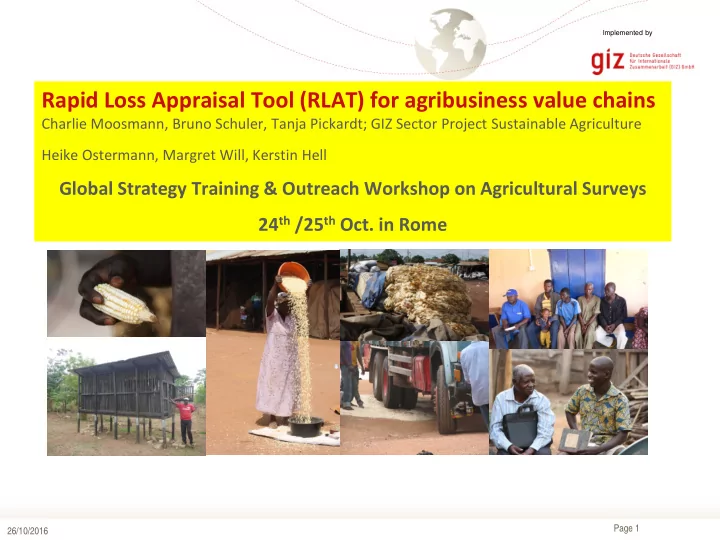
Rapid Loss Appraisal Tool (RLAT) for agribusiness value chains

Charlie Moosmann, Bruno Schuler, Tanja Pickardt; GIZ Sector Project Sustainable Agriculture Heike Ostermann, Margret Will, Kerstin Hell

Global Strategy Training & Outreach Workshop on Agricultural Surveys 24th /25th Oct. in Rome

slide-2
SLIDE 2

Page 2

Practical challenges on the ground

26/10/2016

  • GIZ implements a large number of projects on value

chain (VC) support worldwide; strong focus on agricultural value chains

  • Food losses (including aflatoxin contamination) are not

adequately (or even not at all) addressed so far

  • 1st step: Create awareness on the necessity to reduce

food losses

  • Need for a rapid and cost-effective approach to identify

the most important loss points within a VC and get a first idea about the extent (without quantifying / measuring)

slide-3
SLIDE 3

Page 3 26/10/2016

Rapid Loss Appraisal Tool (RLAT)

Limitations: The Rapid Loss Appraisal Tool alone does not intend to provide sufficient data for evidence-based policy or enterprise decision making Objectives:

  • pre-screening of quantitative and qualitative losses along specific VCs
  • finding leverage points for reducing losses along VCs with sufficient evidence for

initiating further interventions

  • identification of information gaps to support planning of further detailed studies
  • n losses and loss reduction measures
  • create willingness to address food losses

Target group: Bilateral programmes, development organisations and NGOs supporting VC development

slide-4
SLIDE 4

Page 4 26/10/2016

Definition of losses and scope of the tool

Plant product intended for food or feed Food / feed Inedible / not used for main purpose

  • Pre-harvest losses
  • Harvest losses
  • Transport losses
  • Storage losses
  • Processing losses (incl. drying)
  • Marketing losses
  • e.g. maize stems

Food/ feed for consumption By-products

Absolute losses Animal Organic Bioenergy Other feed fertilizer uses

Spillage, spoilage, abnormal reduction in quality such as bruising or wilting or other losses before food/ feed is used

LOSSES

slide-5
SLIDE 5

Page 5

Process Steps of RLAT > see User Guide

26/10/2016

Preparation (up to 12 days) Process step 1: scheduling the rapid appraisal Process step 2: training of RLAT users and facilitators Process step 3: desktop study Field-research phase (up to 24 days) Process step 4: key expert roundtable Process step 5: stakeholder workshop Process step 6: focus group meetings and processor meetings Process step 7: key informant meetings Follow-up phase (up to 12 days) Process step 8: assessment of results Process step 9: conclusions and recommendations Process step 10: reporting

slide-6
SLIDE 6

Page 6

Methods > see Toolbox

26/10/2016

Preparation: Selection/ sampling criteria Checklists,

  • General information
  • 1. Seasons when product is grown and their importance in regard to losses
  • 2. Average field size of product
  • 3. Average yield
  • 4. Relevance of maize in household economy

(Relevance: not important, one activity amongst others, most important activity)

  • 5. Home consumption/commercialization (%)
  • 6. Where/to whom do the farmers sell to?
  • 7. Lowest and highest prices achievable on local market/with trader, Do farmers achieve it?
  • 8. Organizational structures on farmer´s level, their role in

transport/storage/processing/marketing?

  • 9. Women in agriculture, if applicable specific roles in VC steps
  • Quality Awareness
  • 10. Farmer´s definition of good and bad quality
  • 11. Causes for bad quality
  • 12. Price differentials at farmer´s level for different product qualities
  • 13. Usage of bad quality product
  • 14. Measures applied to improve quality and their efficiency (A)

1

  • 15. Measures known but not applied, reason for not applying

(As a reminder for later more in-depth discussions, the interviewer ticks the likely loss category.) Are quality issues an important loss factor? ฀ No ; ฀ Negligible ; ฀ Concern ; ฀ Intolerable ; ฀ Total loss

slide-7
SLIDE 7

Page 7

Methods > see Toolbox

26/10/2016

Field-research phase - participatory methods

  • Loss Hot Spot Analysis
  • Key Expert Roundtable
  • Stakeholder Workshop
  • Focus Group Meetings and Processor Meetings
  • Farm Transect Walk
  • Market Transect Walk and Trader’s Place Transect Walk
  • Loss Categories and Loss Ranking Matrix

Field-research phase – biophysical measurements

slide-8
SLIDE 8

Page 8 XXX 26/10/2016 SNRD Conference Addis Ababa, Ethiopia, March 15-20 2015

WG AGRIBUSINESS & FOOD SECURITY

Sector Network Rural Development, Africa

Example: Loss Ranking Matrix

VC Function (cf. VC map) Immediate effect Likely later effect Step 2: Relevance (0-3) Step 3: Importance (0-3) Step 4: Hot spot (6-9) Input supplies

Pre-harvest

Harvest

Aggregation

Transport

Same approach for Wholesale Trade, Processing, Retail Trade … Loss occurrence & effect at same VC stage Missed

  • pportunities

Probability

  • f event (0-3):

„how many people suffer?” Severity

  • f event (0-3):

“how much do people suffer?” Hot spot if “Relevance x Importance” = 6 or 9

slide-9
SLIDE 9

Page 9 26/10/2016

Example: Loss perception matrix in focus group discussions

slide-10
SLIDE 10

Page 10

Example: Transect Walk

26/10/2016

slide-11
SLIDE 11

Page 11

Methods > see Toolbox

26/10/2016

Biophysical measurements and Methods for Aflatoxin Assessment e.g. Count No. of insects per 500 grains after sieving through a household sieve, Count the No. of grains that are discolored, Grain moisture measured with rapid grain moisture tester, sampling for laboratory analysis Follow-up phase: Evaluation sheets Mostly for Aflatoxin risk assessment with farmers, traders, and processors focus groups Forms for documenting results Mostly data collection sheets and proposed outline for final reporting

slide-12
SLIDE 12

Page 12

Integrating Aflatoxin Risk Assessment

26/10/2016

Aflatoxin checklist:

  • Points of increased risk for aflatoxin contamination along the production

to consumption chain

  • Risk evaluated as percentage of positive responses
  • List has to be specifically conceived for every commodity

Bio-physical measurements:

  • Indication of aflatoxin risk via number of discoloured grains (which has no

direct relationship with aflatoxin, but indicates a higher risk)

  • Use of blue-light as aflatoxin indicator not successful – high rate of

instrumentation needed in the field, including access to POWER

  • Laboratory testing is too lengthy and complicated (sampling !) for RLAT,

but should be recommended as a follow up if a high risk has been detected by the number of discoloured grains

slide-13
SLIDE 13

Page 13

RLAT and value chain analysis

26/10/2016

slide-14
SLIDE 14

Page 14

Lessons learnt so far

26/10/2016

  • Narrowing the scope to PHL is not useful for VC actors
  • Include pre-harvest losses and lost opportunities (i.e. choice of

inappropriate seed). This is also a result of previous case studies on rice in Nigeria and potatoes in Kenya !

  • Temporal variability of food losses
  • Carefully determine and plan the schedule
  • Spatial and process-related variability of food losses
  • A reasonable scale is crucial, i.e. a specific value chain
  • (The integration of an Aflatoxin risk assessment)
  • In this context, the definition of “loss” has to be rethought, as

contaminated grains continue to be consumed, with very negative effects on human health (and the related costs)

slide-15
SLIDE 15

Page 15

Conclusions

26/10/2016

Based on a sound analysis of a selected value chain, the Rapid Loss Appraisal Tool provides:  Identified loss hotspots  Loss estimates in terms of quantity and in economic terms  Understanding of Causes & Losses relationships  Adaptability in orientation (Food security; VC intervention points for upgrades; energy input sinks etc.)  Flexible use of methodology based on a clear understanding of the value chain in question, the use of participatory tools and facilitation skills

slide-16
SLIDE 16

Page 16

Thank you for your attention!

26/10/2016

Donor Platform - Rapid Loss Appraisal Tool (RLAT) See also library on post-harvest publications: https://www.donorplatform.org/postharvest- losses-and-food-waste/on-common-ground