Rangeland Management and Biodiversity Farming system & Farming - - PDF document

rangeland management and biodiversity
SMART_READER_LITE
LIVE PREVIEW

Rangeland Management and Biodiversity Farming system & Farming - - PDF document

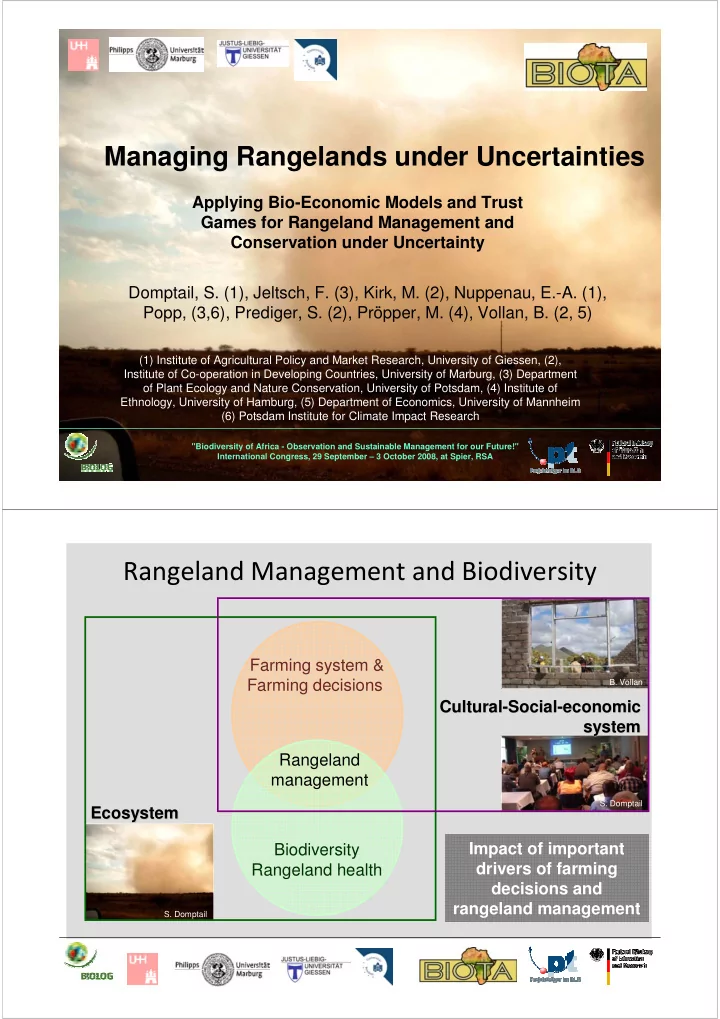
Managing Rangelands under Uncertainties Applying Bio-Economic Models and Trust Games for Rangeland Management and Conservation under Uncertainty Domptail, S. (1), Jeltsch, F. (3), Kirk, M. (2), Nuppenau, E.-A. (1), Popp, (3,6), Prediger, S.


slide-1
SLIDE 1

Domptail, S. (1), Jeltsch, F. (3), Kirk, M. (2), Nuppenau, E.-A. (1), Popp, (3,6), Prediger, S. (2), Pröpper, M. (4), Vollan, B. (2, 5) Applying Bio-Economic Models and Trust Games for Rangeland Management and Conservation under Uncertainty

"Biodiversity of Africa - Observation and Sustainable Management for our Future!" International Congress, 29 September – 3 October 2008, at Spier, RSA

Managing Rangelands under Uncertainties

(1) Institute of Agricultural Policy and Market Research, University of Giessen, (2), Institute of Co-operation in Developing Countries, University of Marburg, (3) Department

  • f Plant Ecology and Nature Conservation, University of Potsdam, (4) Institute of

Ethnology, University of Hamburg, (5) Department of Economics, University of Mannheim (6) Potsdam Institute for Climate Impact Research

Rangeland Management and Biodiversity

Biodiversity Rangeland health Rangeland management Farming system & Farming decisions Ecosystem Ecosystem Cultural Cultural-

  • Social

Social-

  • economic

economic system system Impact of important drivers of farming decisions and rangeland management

  • B. Vollan
  • S. Domptail
  • S. Domptail
slide-2
SLIDE 2

ADD pictures

  • f

Michael

Income losses of 50 M Euros in central Namibia

  • Bush encroachment
  • Desertification
  • Vegetation clearing
  • M. Pröpper
  • S. Domptail
  • S. Domptail

H.J. Buß

Land use, managers and study sites

Mutompo 50 participants 2 ha per hh Namaland 60 participants

  • Av. 2000 ha per hh

Keetmanshoop 25 commercial farmers

  • Av. 10000 ha per hh

Namaqualand 60 communal farmers

  • Av. 2000 ha per hh
  • B. Vollan
  • M. Pröpper
  • S. Domptail
  • S. Domptail
  • S. Domptail
  • S. Domptail
slide-3
SLIDE 3

Managing rangelands under uncertainties

  • Which role do these uncertainties play in the adequate management
  • f biodiversity and rangeland resources among farmers ?
  • How can they be managed or reduced in order to enhance good

rangeland management and conservation?

ERRACTIC AND LOW RAINFALLS (CV=0.6) Determining rangeland condition and income HIGH PRICES VARIABILITY due to limited markets and market accessibility TRUST and COOPERATION essential for functional rangeland management local institutions

  • Stocking

density Costs Biomass (grass/bush) Lamb sales Income Rainfall Rangeland condition

  • S. Domptail

Price

  • Bio-economic
  • Recursive

(uncertainty) with expectations for prices and rainfall

! "

#$ % !&' (

? ?

Modeling decision making under uncertainty

Parametrization: farm data (2005- 2006) and literature

  • Dynamic
  • ptimization over

30 years (indicative – not predictive)

slide-4
SLIDE 4

Price stochasticity and price expectations

  • Stochasticity of prices

determines herd composition and diversification

Price stability is a major driver for dorper adoption

500 1000 1500 2000

baseline (low variation) price- tracking static real prices

goats dorper (meat-big) karakul (skins) damara (meat-small)

)

* +,

  • .
  • /

00+. 0,12 01,1

2000 2200 2400 2600 2800 3000 3200 3400 3600 3800

*

  • !"

farm area (ha)

30 45

Incom e per ha

average per ha income average area in good state

3

Stochastic real prices

Rainfall expectations and ecological consequences

500 1000 1500 2000 baseline (realistic) precautious risk-taking

goats dorper (meat-big) karakul (skins) damara (meat-small)

  • Precautionary attitude has

the highest E-E payoff

  • Expectations over rainfall

have the highest impact on rangeland conservation

4" *

  • Light sheep such as

Karkaul and Damara seem

  • ptimal in precautionary

approaches (lower rainfall)

) ) 3

  • *
  • 5
  • 5
  • /

,0.+ 0552 01,1

2000 2500 3000 3500 4000

  • "!"

fa rm a re a (h a )

30 45

In c

  • m

e p e r h a average per ha income average area in good state

! 026

slide-5
SLIDE 5

Uncertainty in cooperation for rangeland management

  • How to measure trust as

a pre-condition for cooperation?

  • How to evaluate the

impact of rules on the success of cooperation?

  • M. Pröpper
  • B. Vollan
  • S. Prediger

Uncertainty in cooperation for rangeland management: Trust game methodology

Rules: Players A and B both receive 8R each.

Players do not directly interact, rather they decide anonymously. A – the ‚Truster‘ - can give a share of that sum – if he thinks that he can trust an unknown B... That share will be tripled on the way to be (e.g. A gives 3N$ then B receives 12R) B – the trustee - can reciprocate A‘s move by sharing and sending money back to A.

  • Game reveals the trust levels related to

the social history of the community

  • B. Vollan
  • B. Vollan

1 USD = 8 Rand

slide-6
SLIDE 6

Uncertainty in cooperation : trust game results

0,00 0,10 0,20 0,30 0,40 0,50 0,60

Namaqualand (RSA) Karas (Namibia) Kavango (Namibia) Zimbabwe Kenya Uganda Kwazulu Natal (RSA) Tanzania

7

  • Role of education:

One additional year of schooling raises the amount sent by 13%

  • Overall trust levels are

low: ‘small scale reciprocity‘

  • Trust in communities of

Namaqualand is

  • utstandingly limited

=> Limits the potential for cooperation

Mann-Whitney test South-Africa/Namibia: Z=3.43; p<0.1

  • Uncertainty in cooperation for rangeland

management: The grazing game

Rules- Players choose among two

grazing areas [A or B] Choose the intensity for farming [0, 1, 2] Dependent on the condition [good, bad] people get payoffs according to payoff matrix 10 rounds of decision making

Intensity Condition

1 2 Good

7 8

Bad

2 3

Based on Janssen et al. Project: http://www.public.asu.edu/~majansse/dor/nsfhsd.htm

Characteristics

  • non-linearity in ecological dynamic
  • The

game reveals the internalized norms for resource management of the community

  • B. Vollan
slide-7
SLIDE 7

Cooperation for NRM: country differences and introduction of rules

  • The introduction of rules

improves rangeland quality, although its efficiency declines slightly over time

20 40 60 80 100 1 2 3 4 5 6 7 8 9 10 rounds % good quality Namibia (A) Namibia (B) RSA (A) RSA (B)

  • In Namibia a higher share of the land

is maintained in a good condition (42% vs 4% for RSA) => Nomadism in the recent past

20 40 60 80 100 1 3 5 7 9 11 13 15 17 19 rounds % good quality Private property (NAM) Communication (RSA)

  • *

Results 2007 Results 2008

  • Conclusion: towards sustainable management
  • f rangeland
  • Modeling makes apparent for farmers the impact of their knowledge

about rainfall on the efficiency of their management

Reduce uncertainty and reduces degradation risks by:

  • Monitoring of rainfall patterns under climate change
  • Farmers need to be integrated in the analysis of data generated
  • Cultural norms and rules of interaction influence levels of trust.

Understanding them and taking them into account is crucial for the success of implementation of rangeland management institutions Ex: Functioning cooperation norms/customs in Namibia exist => basis for updated management institutions (e.g. co-management scheme)?

  • Any clarification of property rights (rules) improves cooperative

management of rangeland resources

slide-8
SLIDE 8

Perspectives

  • Jointly consider economic, ecological and social costs of land use options
  • Monitor social capital and cooperation in times of institutional change
  • Deepen the link between biodiversity and ecosystem services by

considering biodiversity as an element for socio-ecological resilience Ex: Investigate how biodiversity supports diversification of production on farms (complex grassland systems, integrated bio-diversity production systems)

Gains

  • Integration of disciplines and tools: Field experiments and bio-

economic modeling

  • With time and cooperation, we have built capacities in

interdisciplinary communication, created common vocabulary which enables us to carry better holistic research as time goes by

Thank you for your attention and to

Richard Isaaks (para-ecologist)

Jonette Moller

Matheus Kohima (field assistsant) Pandu Petrus Rural Water Supply (Karas) Millie Saul (field assistant) Johan van der Merwe Hendrick Knouds Leon van Wyk All interviewed farmers for their collaboration BMBF and BIOTA for funding and support

  • S. Prediger