
SLIDE 1
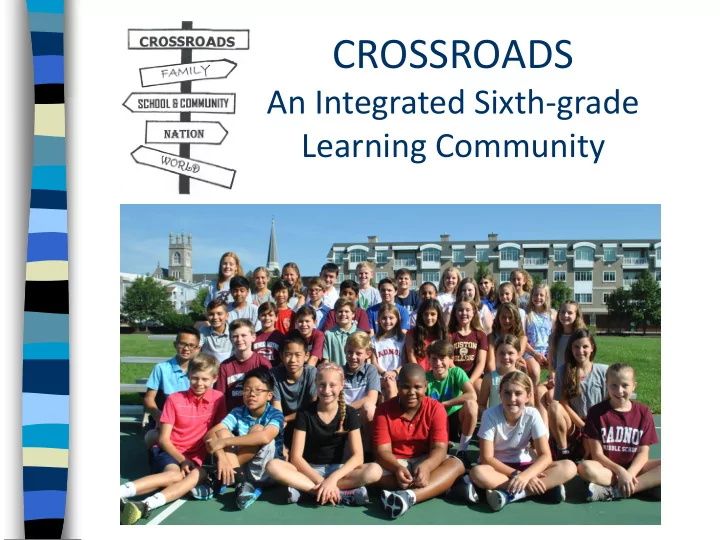
CROSSROADS An Integrated Sixth-grade Learning Community What is - - PowerPoint PPT Presentation
CROSSROADS An Integrated Sixth-grade Learning Community What is Crossroads? A year-long program, combining the study of: - language arts - social studies - science around our theme, CULTURE! How does Crossroads work? 40
Highlights from September - December
Family culture project Full-class Novel: Tuck Everlasting, Community literature circles Writing: A family vignette Powering Up: Natural Resources
group project
Immigrant Perspectives: interview
and essay
American Experiences (immigrant
group) literature circles and presentation
Rock Transformations And much more!
Geography and Cultures of each of the following continents: – The Americas – Europe – Africa – Asia Some Associated Activities:
Dynamic Earth Project
European Cities Project
Sonnet Study and Writing
Study of Opera
Poetry
Weather – Group Project
Biography Project
Two African novellas & Project
Asian culture group study and literature circle
Persuasive essay
Astronomy and Rocketry
Field trips – about seven
Curriculum Connections Associated writing tasks
SAMPLE TRIPS:
Miners’ Village
New York City
174 school days NOT on Crossroads field trips!
Code for
Community
Cooperative games
and activities
Many opportunities to
interact with others while you learn
Self Assessments – Approximately six/year – Student generated – Teachers respond – Parents comment and sign Student-led Parent Conference – November Mid-Year Parent-Teacher Conference – Late January – Early February End-of-year Evaluation – 8-page document written by teachers Evening Expositions – Two per year
Double-sized room Big class library 40 Chromebooks
We won’t have lockers. NOT TRUE! We won’t see non- Crossroads friends. NOT TRUE! We don’t change classes. NOT TRUE! We have less chance of getting into Watershed, Soundings, and Gateways. NOT TRUE!
Period
Proposed Crossroads Schedule Proposed 6
th Grade Team Schedule
Adv
Advisory (orchestra band, chorus, etc.) Advisory (orchestra band, chorus, etc.)
1
Tech Ed/FACS/lang Tech Ed/FACS/lang
2
Crossroads Science
3
Crossroads Social Studies
4
Lunch Lunch
5
Art/Music/Phys. Ed. Art/Music/Phys. Ed
6
Crossroads Language Arts
7
Math Math
8 Crossroads / Math (Extended Learning Time) Sci/SS/LA/Math (Extended Learning Time) SOS
Pack up Pack up
Crossroads is right for students who…
Work and learn well in groups and/or want to get better at it
(not those who allow others to do the work or like to control all the work)
Like to explore and “dig deeper” when learning Seek some independence and choice in their learning Prefer to demonstrate learning through projects, presentations,
and writing assignments
Are interested in how they fit into their community and culture Are not motivated only by A-B-C-D-F grades CROSSROADS IS FOR STUDENTS OF
ALL ABILITY LEVELS (with few exceptions)
Some Similarities
– Same Core Curriculum and skills are taught – All levels of math available – Encore classes are the same – Special Ed. And Gifted support – Lockers – Lunch
Some Differences
– L.A., Social Studies, and Science integrated around study of culture – Emphasis on projects, presentations, and writing (with fewer tests) – Many cooperative and group learning projects – Students set yearly and weekly goals for themselves. – Assessed but not graded – Greater need for parent involvement