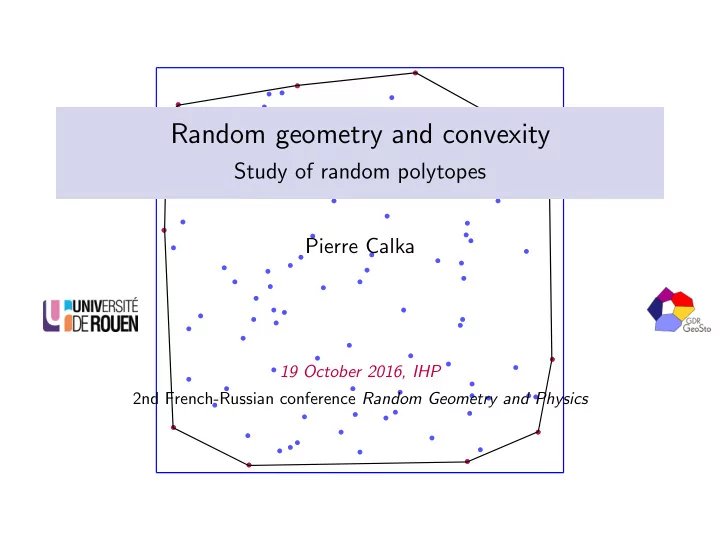
SLIDE 1
Random geometry and convexity
Study of random polytopes
Pierre Calka
19 October 2016, IHP 2nd French-Russian conference Random Geometry and Physics
SLIDE 2 default
Point process
Point process : random locally finite set of Rd
0.0 0.1 0.2 0.3 0.4 0.5 0.6 0.7 0.8 0.9 1.0 0.0 0.1 0.2 0.3 0.4 0.5 0.6 0.7 0.8 0.9 1.0 0.0 0.1 0.2 0.3 0.4 0.5 0.6 0.7 0.8 0.9 1.0 0.0 0.1 0.2 0.3 0.4 0.5 0.6 0.7 0.8 0.9 1.0 0.0 0.1 0.2 0.3 0.4 0.5 0.6 0.7 0.8 0.9 1.0 0.0 0.1 0.2 0.3 0.4 0.5 0.6 0.7 0.8 0.9 1.0
SLIDE 3 default
Point process without interaction
B2 B3 B4
Binomial point process µ probability measure on Rd X1, · · · , Xn i.i.d. with law µ E := {X1, · · · , Xn} ◮ #(E ∩ B1) binomial r.v. (n, µ(B1)) ◮ #(E ∩ B1), · · · , #(E ∩ Bℓ) not independent Poisson point process µ σ-finite measure on Rd µ := intensity of the process P locally finite set s.t. ◮ #(P ∩ B1) Poisson r.v. (µ(B1)) ◮ #(P ∩ B1), · · · , #(P ∩ Bℓ) independent
SLIDE 4
default
Uniform case
Binomial model K := convex body of Rd (Xk,k ∈ N∗):= independent and uniformly distributed in K K n := Conv(X1, · · · , Xn), n ≥ 1 K 50, K disk K 50, K square
SLIDE 5
default
Uniform case
Binomial model K := convex body of Rd (Xk,k ∈ N∗):= independent and uniformly distributed in K K n := Conv(X1, · · · , Xn), n ≥ 1 K 100, K disk K 100, K square
SLIDE 6
default
Uniform case
Binomial model K := convex body of Rd (Xk,k ∈ N∗):= independent and uniformly distributed in K K n := Conv(X1, · · · , Xn), n ≥ 1 K 500, K disk K 500, K square
SLIDE 7
default
Uniform case
Poisson model K := convex body of Rd Pλ, λ > 0:= Poisson point process of intensity measure λdx Kλ := Conv(Pλ ∩ K) K 500, K disk K 500, K square
SLIDE 8
default
Gaussian case
Poisson model ϕd(x) :=
1 (2π)d/2 e−x2/2, x ∈ Rd, d ≥ 2
Pλ, λ > 0:= Poisson point process of intensity measure λϕd(x)dx Kλ := Conv(Pλ) K100 K500
SLIDE 9
default
Plan
Random polytopes: survey and new variance calculations Cases of the disk and the square: sketch of proof by scaling limit Poisson-Voronoi tessellation and isolated points Based on joint works with Joseph Yukich (Lehigh University, USA) and also Tomasz Schreiber (Toru´ n University, Poland), Yann Demichel & Nathana¨ el Enriquez (Paris Ouest)
SLIDE 10
default
Plan
Random polytopes: survey and new variance calculations Known expectation asymptotics Known second-order asymptotic results Main new results: exact limiting variances Cases of the disk and the square: sketch of proof by scaling limit Poisson-Voronoi tessellation and isolated points
SLIDE 11 default
Known expectation asymptotics
fk(·) := number of k-dimensional faces, Vol(·) := volume Efron’s relation (1965)
Ef0(K n) = n
Vol(K)
E[fk(Kλ)] ∼
λ→∞ cd,k
1 d+1
s
ds λ
d−1 d+1
κs := Gaussian curvature of ∂K
Uniform, K polytope E[fk(Kλ)] ∼
λ→∞ c′
d,kF(K) logd−1(λ)
F(K) := number of flags of K
Gaussian E[fk(Kλ)] ∼
λ→∞ c′′
d,k log d−1 2 (λ)
enyi & R. Sulanke (1963), H. Raynaud (1970), R. Schneider & J. Wieacker (1978), F. Affentranger & R. Schneider (1992)
SLIDE 12 default
Known second-order asymptotic results
◮ Central limit theorems ◮ Variance bounds Uniform, K smooth Var[fk(Kλ)] =
λ→∞ Θ(λ
d−1 d+1 )
Uniform, K polytope Var[fk(Kλ)] =
λ→∞ Θ(logd−1(λ))
Gaussian Var[fk(Kλ)] =
λ→∞ Θ(log
d−1 2 (λ))
- M. Reitzner (2005), I. B´
ar´ any & V. Vu (2007), I. B´ ar´ any & M. Reitzner (2010)
SLIDE 13 default
Main new results: exact limiting variances
Uniform, K smooth Var[fk(Kλ)] ∼
λ→∞ cd,k
1 d+1
s
ds λ
d−1 d+1
κs := Gaussian curvature of ∂K
Uniform, K simple polytope Var[fk(Kλ)] ∼
λ→∞ c′
d,kf0(K) logd−1(λ)
Gaussian Var[fk(Kλ)] ∼
λ→∞ c′′
d,k log d−1 2 (λ)
Remarks ◮ Depoissonnization in the uniform smooth and Gaussian cases ◮ Central limit theorems ◮ Uniform in the ball and Gaussian cases: invariance principle for the volume
SLIDE 14
default
Plan
Random polytopes: survey and new variance calculations Cases of the disk and the square: sketch of proof by scaling limit Calculation of the variance of fk(Kλ) Rescaling Floating body Dual characterization of extreme points Action of the scaling transform Convergence of the covariances of scores Poisson-Voronoi tessellation and isolated points
SLIDE 15 default
Calculation of the expectation fk(Kλ)
Decomposition E[fk(Kλ)] = E
x∈Pλ
ξ(x, Pλ) ξ(x, Pλ) :=
k+1#k-face containing x
if x extreme if not Mecke-Slivnyak’s formula E[fk(Kλ)] = λ
E[ξ(x, Pλ ∪ {x})]dx
SLIDE 16 default
Calculation of the variance of fk(Kλ)
Var[fk(Kλ)] = E
x∈Pλ
ξ2(x, Pλ) +
ξ(x, Pλ)ξ(y, Pλ) − (E[fk(Kλ)])2 = λ
E[ξ2(x, Pλ ∪ {x})]dx + λ2
- D2 E[ξ(x, Pλ ∪ {x, y})ξ(y, Pλ ∪ {x, y})]dxdy
− λ2
- D2 E[ξ(x, Pλ ∪ {x})]E[ξ(y, Pλ ∪ {y})]dxdy
= λ
E[ξ2(x, Pλ ∪ {x})]dx + λ2
- D2 Cov(ξ(x, Pλ ∪ {x}), ξ(y, Pλ ∪ {y}))dxdy
SLIDE 17
default
Rescaling
Question Limits of E[ξ(x, Pλ)] and Cov(ξ(x, Pλ), ξ(y, Pλ))? Definition of limit scores in a new rescaled space Construction of the scaling transform Requires to understand the typical shape of Kλ: the floating body.
SLIDE 18
default
Floating body
V (x) := inf{Vol(K ∩ H+) : H+ half-plane containing x}, x ∈ K Floating body: K(V ≥ t) := {x ∈ K : V (x) ≥ t} K(V ≥ t) is a convex body and K(V ≥ 1/λ) is close to Kλ.
SLIDE 19 default
Floating body
V (x) := inf{Vol(K ∩ H+) : H+ half-plane containing x}, x ∈ K Floating body : K(V ≥ t) := {x ∈ K : V (x) ≥ t} K(V ≥ t) is a convex body and K(V ≥ 1/λ) is close to Kλ. D(V ≥ 1/λ) = (1 − f (λ))D
f (λ) ∼ cλ− 2
3
K(V ≥ 1/λ) = {(x1, x2) : x1x2 ≥
1 2λ}
SLIDE 20 default
Comparison between Kλ and the floating body
◮ Expectation
B´ ar´ any & Larman (1988):
cVol(K(V ≤ 1/λ)) ≤ Vol(K)−E[Vol(Kλ)] ≤ CVol(K(V ≤ 1/λ)) ◮ Variance
B´ ar´ any & Reitzner (2010):
cλ−1Vol(K(V ≤ 1/λ)) ≤ Var[Vol(Kλ)] ◮ Sandwiching
B´ ar´ any & Reitzner (2010b):
P[∂Kλ ⊂ [K(V ≥ s) \ K(V ≥ T)]] = O
s :=
c λ(log(λ))17 , T := c′ log(log(λ)) λ
SLIDE 21 default
Construction of the scaling transform
Rules of the scaling transform ◮ One depth-coordinate provided by the family of floating bodies: λ
2 3(1 − r) for the disk, λx1x2 for the quadrant
◮ One spatial-coordinate on the corresponding floating body ◮ A rescaling to guarantee Θ(1) points per unit area K = D T λ :
− → R × R+ (r, θ) − → (λ
1 3θ, λ 2 3(1 − r))
K = (0, ∞)2 T (λ) : (0, ∞)2 − → L × R (x1, x2) − →
2 log(λx1x2)
- where L = {(x1, x2) ∈ R2 : x1 + x2 = 0}
SLIDE 22 default
Dual characterization of extreme points
Each point x generates a petal S(x), i.e. the set of all tangency points of curves K(V = t
λ), t > 0, with the lines containing x.
x is extreme if and only if its petal is not fully covered by the other petals.
Bd
SLIDE 23 default
Action of the scaling transform in the disk
Π↑ := {(v, h) ∈ R × R+ : h ≥ v 2
2 }, Π↓ := {(v, h) ∈ R × R+ : h ≤ − v 2 2 }
Half-plane Translate of Π↓ Boundary of the hull Union of portions of down-parabolas Petal Translate of ∂Π↑ Extreme point (x + Π↑) not covered Process Pλ Process P of intensity dvdh Score ξ(x, Pλ) Score ξ(∞)((v, h), P)
Bd
− →
SLIDE 24 default
Action of the scaling transform in the quadrant
G(v) := log
√ 2)
v ∈ V Π↑ := {(v, h) ∈ R × R : h ≥ G(v)}, Π↓ := {(v, h) ∈ R × R : h ≤ −G(v)}
Floating bodies Horizontal half-planes Boundary of the hull Union of portions of pseudo-cones Petal Translate of ∂Π↑ Extreme point (x + Π↑) not covered Process Pλ Process P of intensity √ 2e2hdvdh Score ξ(x, Pλ) Score ξ(∞)((v, h), P) − →
SLIDE 25 default
Convergence of the covariances of scores
◮ Scores ξ(λ)(·, ·) defined by ξ(λ)(T λ(x), T λ(Pλ)) := ξ(x, Pλ) ◮ Scores ξ(∞)(w, P), w = (v, h) ∈ R × R, defined in the limit model ◮ These scores stabilize exponentially. Stabilization radius R(w, P) : smallest r > 0 such that ξ(∞)(w, P) = ξ(∞)(w, P ∩ Cyl(w, r)) P[R(w, P) > t] ≤ ce− t
c ,
t > 0 ◮ Convergence point by point in the integral E[ξ(λ)(w, T λ(Pλ))] → E[ξ(∞)(w, P)] and Cov(ξ(λ)(w, T λ(Pλ)), ξ(λ)(w′, T λ(Pλ))) → Cov(ξ(∞)(w, P), ξ(∞)(w′, P))
SLIDE 26
default
Outline
Random polytopes: survey and new variance calculations Cases of the disk and the square: sketch of proof by scaling limit Poisson-Voronoi tessellation and isolated points Poisson-Voronoi tessellation Approximation of a convex body from the outside
SLIDE 27
default
Poisson-Voronoi tessellation
◮ Pλ Poisson point process in Rd of intensity λ ◮ For every nucleus x ∈ Pλ, the cell associated is C(x|Pλ) := {y ∈ Rd : y − x ≤ y − x′ ∀x′ ∈ Pλ} ◮ Tessellation: set of cells C(x|Pλ)
SLIDE 28 default
Probability to belong to the zero-cell
C0 K F0(K)
K convex body containing 0, C0 Voronoi cell C(0|Pλ ∪ {0}) P(K ⊂ C0) = exp(−λVol(F0(K))) where Vd is the volume and F0(K) = ∪x∈KB(x, x) flower of K
SLIDE 29
default
Approximation of a convex body from the outside
◮ K convex body in the plane R2 ◮ An origin 0 is chosen inside K (not intrinsic!) ◮ Pλ conditional on the event that the Voronoi tessellation associated with Pλ ∪ {0} does not intersect K ◮ Question. Limit of the geometric characteristics of the cell Kλ ⊃ K when λ → ∞?
SLIDE 30 default
Approximation of a convex body from the outside
- ◮ K convex body in the plane R2
◮ An origin 0 is chosen inside K (not intrinsic!) ◮ Pλ conditional on the event that the Voronoi tessellation associated with Pλ ∪ {0} does not intersect K ◮ Question. Limit of the geometric characteristics of the cell Kλ ⊃ K when λ → ∞?
SLIDE 31 default
Approximation of a convex body from the outside
- ◮ K convex body in the plane R2
◮ An origin 0 is chosen inside K (not intrinsic!) ◮ Pλ conditional on the event that the Voronoi tessellation associated with Pλ ∪ {0} does not intersect K ◮ Question. Limit of the geometric characteristics of the cell Kλ ⊃ K when λ → ∞?
SLIDE 32 default
Approximation of a convex body from the outside
- ◮ K convex body in the plane R2
◮ An origin 0 is chosen inside K (not intrinsic!) ◮ Pλ conditional on the event that the Voronoi tessellation associated with Pλ ∪ {0} does not intersect K ◮ Question. Limit of the geometric characteristics of the cell Kλ ⊃ K when λ → ∞?
SLIDE 33
default
Approximation of a convex body from the outside
◮ K convex body in the plane R2 ◮ An origin 0 is chosen inside K (not intrinsic!) ◮ Pλ conditional on the event that the Voronoi tessellation associated with Pλ ∪ {0} does not intersect K ◮ Question. Limit of the geometric characteristics of the cell Kλ ⊃ K when λ → ∞?
SLIDE 34 default
Approximation of a convex body from the outside
E[f0(Kλ)] ∼
λ→∞ 223− 4
3 Γ
3 ∂K
κ
2 3
s s, ns
1 3 ds λ
1 3
κs := curvature at s ns := normal vector at s
K polygon E[f0(Kλ)] ∼
λ→∞ 2 · 3−1f0(K) log(λ)
SLIDE 35 default
Reverse question
R large planar region containing 0, Pλ point process outside R
- Question. Geometry of the cell containing 0 when λ → ∞?
◮ Consider the maximal flower F included in R and the unique convex body K included in R and whose flower is F ◮ Apply the previous results with K and 0
SLIDE 36
default Thank you for your attention!