Rancher Provider The Rancher provider is used to interact with the - - PDF document

rancher provider
SMART_READER_LITE
LIVE PREVIEW

Rancher Provider The Rancher provider is used to interact with the - - PDF document

Rancher Provider The Rancher provider is used to interact with the resources supported by Rancher. The provider needs to be congured with the URL of the Rancher server at minimum and API credentials if access control is enabled on the server.


slide-1
SLIDE 1

Rancher Provider

The Rancher provider is used to interact with the resources supported by Rancher. The provider needs to be congured with the URL of the Rancher server at minimum and API credentials if access control is enabled on the server.

Example Usage

provider "rancher" { api_url = = "http://rancher.my-domain.com:8080" access_key = = "${var.rancher_access_key}" secret_key = = "${var.rancher_secret_key}" }

Argument Reference

The following arguments are supported:

api_url - (Required) Rancher API url. It must be provided, but it can also be sourced from the RANCHER_URL

environment variable.

access_key - (Optional) Rancher API access key. It can also be sourced from the RANCHER_ACCESS_KEY environment

variable.

secret_key - (Optional) Rancher API access key. It can also be sourced from the RANCHER_SECRET_KEY environment

variable.

slide-2
SLIDE 2

Rancher2 Provider

The Rancher2 provider is used to interact with the resources supported by Rancher v2. The provider can be congured in 2 modes: - Admin: this is the default mode, indeed to manage rancher2 resources. It should be congured with the api_url of the Rancher server and API credentials, token_key or access_key and

secret_key . - Bootstrap: this mode is indeed to bootstrap a rancher2 system. It is enabled if bootstrap = true . In this

mode, token_key or access_key and secret_key can not be provided. More info at rancher2_bootstrap resource (/docs/providers/rancher2/r/bootstrap.html)

Example Usage

provider "rancher2" { api_url = = "https://rancher.my-domain.com" access_key = = "${var.rancher2_access_key}" secret_key = = "${var.rancher2_secret_key}" } provider "rancher2" { api_url = = "https://rancher.my-domain.com" bootstrap = = true true }

slide-3
SLIDE 3

provider "rancher2" { alias alias = = "bootstrap" api_url = = "https://rancher.my-domain.com" bootstrap = = true true } resource "rancher2_bootstrap" "admin" { provider = = "rancher2.bootstrap" password = = "blahblah" telemetry = = true true } provider "rancher2" { alias alias = = "admin" api_url = = "${rancher2_bootstrap.admin.url}" token_key = = "${rancher2_bootstrap.admin.token}" insecure = = true true } resource "rancher2_catalog" "foo" { provider = = "rancher2.admin" name = = "test" url = = "http://foo.com:8080" }

Argument Reference

The following arguments are supported:

api_url - (Required) Rancher API url. It must be provided, but it can also be sourced from the RANCHER_URL

environment variable.

access_key - (Optional/Sensitive) Rancher API access key to connect to rancher. It can also be sourced from the RANCHER_ACCESS_KEY environment variable. secret_key - (Optional/Sensitive) Rancher API secret key to connect to rancher. It can also be sourced from the RANCHER_SECRET_KEY environment variable. token_key - (Optional/Sensitive) Rancher API token key to connect to rancher. It can also be sourced from the RANCHER_TOKEN_KEY environment variable. Could be used instead access_key and secret_key . ca_certs - CA certicates used to sign Rancher server tls certicates. Mandatory if self signed tls and insecure option

  • false. It can also be sourced from the RANCHER_CA_CERTS environment variable.

insecure - (Optional) Allow insecure connection to Rancher. Mandatory if self signed tls and not ca_certs provided. It

slide-4
SLIDE 4

can also be sourced from the RANCHER_INSECURE environment variable.

bootstrap - (Optional) Enable bootstrap mode to manage rancher2_bootstrap resource. It can also be sourced

from the RANCHER_BOOTSTRAP environment variable. Default: false

slide-5
SLIDE 5

rancher2_app

Use this data source to retrieve information about a Rancher v2 app.

Example Usage

data "rancher2_app" "rancher2" { name = "foo" project_id = "<project_id>" target_namespace = "<namespace_name>" }

Argument Reference

name - (Required) The app name (string) project_id - (Required) The id of the project where the app is deployed (string) target_namespace - (Optional/Computed) The namespace name where the app is deployed (string)

Attributes Reference

id - (Computed) The ID of the resource (string) catalog_name - (Computed) Catalog name of the app (string) answers - (Computed) Answers for the app (map) description - (Computed) Description for the app (string) external_id - (Computed) The URL of the helm catalog app (string) revision_id - (Computed) Current revision id for the app (string) template_name - (Computed) Template name of the app (string) template_version - (Computed) Template version of the app (string) values_yaml - (Computed) values.yaml base64 encoded le content for the app (string) annotations - (Computed) Annotations for the catalog (map) labels - (Computed) Labels for the catalog (map)

slide-6
SLIDE 6

rancher2_catalog

Use this data source to retrieve information about a Rancher v2 catalog.

Example Usage

data "rancher2_catalog" "library" { name = "catalog" }

Argument Reference

name - (Required) The catalog name. scope - (Optional) The scope of the catalog. cluster , global , and project are supported. Default global

(string)

Attributes Reference

id - (Computed) The ID of the resource (string) branch - (Computed) The branch of the catalog repo to use (string) cluster_id - (Computed) The cluster id of the catalog (string) description - (Computed) A catalog description (string) kind - (Computed) The kind of the catalog. Just helm by the moment (string) password - (Computed/Sensitive) The password to access the catalog if needed (string) project_id - (Computed) The project id of the catalog (string) username - (Computed/Sensitive) The username to access the catalog if needed (string) url - (Computed) The url of the catalog repo (string) annotations - (Computed) Annotations for the catalog (map) labels - (Computed) Labels for the catalog (map)

slide-7
SLIDE 7

rancher2_certicate

Use this data source to retrieve information about a Rancher v2 certicate. Depending of the availability, there are 2 types of Rancher v2 certicates: - Project certicate: Available to all namespaces in the project_id - Namespaced certicate: Available to just namespace_id in the project_id

Example Usage

data "rancher2_certificate" "foo" { name = = "<name>" project_id = = "<project_id>" } data "rancher2_certificate" "foo" { name = = "<name>" project_id = = "<project_id>" namespace_id = = "<namespace_id>" }

Argument Reference

The following arguments are supported:

name - (Required) The name of the certicate (string) project_id - (Required) The project id where to assign the certicate (string) namespace_id - (Optional) The namespace id where to assign the namespaced certicate (string)

Attributes Reference

The following attributes are exported:

id - (Computed) The ID of the resource (string) certs - (Computed) Base64 encoded certs (string) description - (Computed) A certicate description (string) annotations - (Computed) Annotations for certicate object (map) labels - (Computed) Labels for certicate object (map)

slide-8
SLIDE 8

rancher2_cloud_credential

Use this data source to retrieve information about a Rancher v2 Cloud Credential.

Example Usage

data "rancher2_cloud_credential" "test" { name = "test" }

Argument Reference

name - (Required) The Cloud Credential name.

Attributes Reference

id - (Computed) The ID of the resource (string) annotations - (Computed) Annotations for the Cloud Credential (map) labels - (Computed) Labels for the Cloud Credential (map)

slide-9
SLIDE 9

rancher2_cluster_alert_group

Use this data source to retrieve information about a Rancher v2 cluster alert group.

Example Usage

data "rancher2_cluster_alert_group" "foo" { cluster_id = "<cluster_id>" name = "<cluster_alert_group_name>" }

Argument Reference

cluster_id - (Required) The cluster id where create cluster alert group (string) name - (Required) The cluster alert group name (string)

Attributes Reference

description - (Computed) The cluster alert group description (string) group_interval_seconds - (Computed) The cluster alert group interval seconds. Default: 180 (int) group_wait_seconds - (Computed) The cluster alert group wait seconds. Default: 180 (int) recipients - (Computed) The cluster alert group recipients (list) repeat_interval_seconds - (Computed) The cluster alert group wait seconds. Default: 3600 (int) annotations - (Computed) The cluster alert group annotations (map) labels - (Computed) The cluster alert group labels (map)

slide-10
SLIDE 10

rancher2_cluster_alert_rule

Use this data source to retrieve information about a Rancher v2 cluster alert rule.

Example Usage

data "rancher2_cluster_alert_rule" "foo" { cluster_id = "<cluster_id>" name = "<cluster_alert_rule_name>" }

Argument Reference

cluster_id - (Required) The cluster id where create cluster alert rule (string) name - (Required) The cluster alert rule name (string)

Attributes Reference

group_id - (Computed) The cluster alert rule alert group ID (string) event_rule - (Computed) The cluster alert rule event rule. ConictsWith: "metric_rule", "node_rule", "system_service_rule" ` (list Maxitems:1) group_interval_seconds - (Computed) The cluster alert rule group interval seconds. Default: 180 (int) group_wait_seconds - (Computed) The cluster alert rule group wait seconds. Default: 180 (int) inherited - (Computed) The cluster alert rule inherited. Default: true (bool) metric_rule - (Computed) The cluster alert rule metric rule. ConictsWith: "event_rule", "node_rule", "system_service_rule" ` (list Maxitems:1) node_rule - (Computed) The cluster alert rule node rule. ConictsWith: "event_rule", "metric_rule", "system_service_rule" ` (list Maxitems:1) repeat_interval_seconds - (Optional) The cluster alert rule wait seconds. Default: 3600 (int) severity - (Computed) The cluster alert rule severity. Supported values : "critical" | "info" | "warning".

Default: critical (string)

system_service_rule - (Computed) The cluster alert rule system service rule. ConictsWith: "event_rule", "metric_rule", "node_rule" ` (list Maxitems:1) annotations - (Computed) The cluster alert rule annotations (map) labels - (Computed) The cluster alert rule labels (map)

slide-11
SLIDE 11

rancher2_cluster_driver

Use this data source to retrieve information about a Rancher v2 Cluster Driver resource.

Example Usage

data "rancher2_cluster_driver" "foo" { name = = "foo" }

Argument Reference

name - (Required) Name of the cluster driver (string) url - (Optional/Computed) The URL to download the machine driver binary for 64-bit Linux (string)

Attributes Reference

id - (Computed) The ID of the resource (string) active - (Computed) Specify if the cluster driver state (bool) builtin - (Computed) Specify whether the cluster driver is an internal cluster driver or not (bool) actual_url - (Computed) Actual url of the cluster driver (string) checksum - (Computed) Verify that the downloaded driver matches the expected checksum (string) ui_url - (Computed) The URL to load for customized Add Clusters screen for this driver (string) whitelist_domains - (Computed) Domains to whitelist for the ui (list) annotations - (Computed) Annotations of the resource (map) labels - (Computed) Labels of the resource (map)

slide-12
SLIDE 12

rancher2_cluster

Use this data source to retrieve information about a Rancher v2 cluster.

Example Usage

data "rancher2_cluster" "foo-custom" { name = = "foo-custom" }

Argument Reference

The following arguments are supported:

name - (Required) The name of the Cluster (string)

Attributes Reference

The following attributes are exported:

id - (Computed) The ID of the resource (string) cluster_registration_token - (Computed) Cluster Registration Token generated for the cluster (list maxitems:1) default_project_id - (Computed) Default project ID for the cluster (string) driver - (Computed) The driver used for the Cluster. imported , azurekubernetesservice , amazonelasticcontainerservice , googlekubernetesengine and rancherKubernetesEngine are supported

(string)

kube_config - (Computed) Kube Cong generated for the cluster (string) system_project_id - (Computed) System project ID for the cluster (string) rke_config - (Computed) The RKE conguration for rke Clusters. Conicts with aks_config , eks_config and gke_config (list maxitems:1) aks_config - (Computed) The Azure aks conguration for aks Clusters. Conicts with eks_config , gke_config

and rke_config (list maxitems:1)

eks_config - (Computed) The Amazon eks conguration for eks Clusters. Conicts with aks_config , gke_config

and rke_config (list maxitems:1)

gke_config - (Computed) The Google gke conguration for gke Clusters. Conicts with aks_config , eks_config

and rke_config (list maxitems:1)

description - (Computed) The description for Cluster (string) cluster_auth_endpoint - (Computed) Enabling the local cluster authorized endpoint

slide-13
SLIDE 13

(https://rancher.com/docs/rancher/v2.x/en/cluster-provisioning/rke-clusters/options/#local-cluster-auth-endpoint) allows direct communication with the cluster, bypassing the Rancher API proxy. (list maxitems:1)

cluster_monitoring_input - (Computed) Cluster monitoring cong (list maxitems:1) cluster_template_answers - (Computed) Cluster template answers (list maxitems:1) cluster_template_id - (Computed) Cluster template ID (string) cluster_template_questions - (Computed) Cluster template questions (list) cluster_template_revision_id - (Computed) Cluster template revision ID (string) default_pod_security_policy_template_id - (Optional/Computed) Default pod security policy template id

(https://rancher.com/docs/rancher/v2.x/en/cluster-provisioning/rke-clusters/options/#pod-security-policy-support) (string)

enable_cluster_monitoring - (Computed) Enable built-in cluster monitoring. Default false (bool) enable_network_policy - (Computed) Enable project network isolation. Default false (bool) enable_cluster_istio - (Computed) Enable built-in cluster istio. Default false (bool) annotations - (Computed) Annotations for Node Pool object (map) labels - (Computed) Labels for Node Pool object (map)

slide-14
SLIDE 14

rancher2_cluster_logging

Use this data source to retrieve information about a Rancher v2 Cluster Logging.

Example Usage

data "rancher2_cluster_logging" "foo" { cluster_id = = "<cluster_id>" }

Argument Reference

The following arguments are supported:

cluster_id - (Required) The cluster id to congure logging (string)

Attributes Reference

The following attributes are exported:

id - (Computed) The ID of the resource (string) kind - (Computed) The kind of the Cluster Logging. elasticsearch , fluentd , kafka , splunk and syslog are

supported (string)

elasticsearch_config - (Computed) The elasticsearch cong for Cluster Logging. For kind = elasticsearch (list

maxitems:1)

fluentd_config - (Computed) The uentd cong for Cluster Logging. For kind = fluentd (list maxitems:1) kafka_config - (Computed) The kafka cong for Cluster Logging. For kind = kafka (list maxitems:1) name - (Computed) The name of the cluster logging cong (string) namespace_id - (Computed) The namespace id from cluster logging (string)

  • utput_flush_interval - (Computed) How often buered logs would be ushed. Default: 3 seconds (int)
  • utput_tags - (computed) The output tags for Cluster Logging (map)

splunk_config - (Computed) The splunk cong for Cluster Logging. For kind = splunk (list maxitems:1) syslog_config - (Computed) The syslog cong for Cluster Logging. For kind = syslog (list maxitems:1) annotations - (Computed) Annotations for Cluster Logging object (map) labels - (Computed) Labels for Cluster Logging object (map)

slide-15
SLIDE 15

rancher2_cluster_role_template_binding

Use this data source to retrieve information about a Rancher v2 cluster role template binding.

Example Usage

data "rancher2_cluster_role_template_binding" "foo" { name = "foo" cluster_id = "foo_id" }

Argument Reference

name - (Required) The name of the cluster role template binding (string) cluster_id - (Required) The cluster id where bind cluster role template (string) role_template_id - (Optional/Computed) The role template id from create cluster role template binding (string)

Attributes Reference

id - (Computed) The ID of the resource (string) group_id - (Computed) The group ID to assign cluster role template binding (string) group_principal_id - (Computed) The group_principal ID to assign cluster role template binding (string) user_id - (Computed) The user ID to assign cluster role template binding (string) user_principal_id - (Computed) The user_principal ID to assign cluster role template binding (string) annotations - (Computed) Annotations of the resource (map) labels - (Computed) Labels of the resource (map)

slide-16
SLIDE 16

rancher2_cluster_template

Use this data source to retrieve information about a Rancher v2 cluster template. Cluster Templates are available from Rancher v2.3.x and above.

Example Usage

data "rancher2_cluster_template" "foo" { name = "foo" }

Argument Reference

name - (Required) The cluster template name (string) decription - (Optional/Computed) The cluster template description (string)

Attributes Reference

id - (Computed) The ID of the resource (string) default_revision_id - (Computed) Default cluster template revision ID (string) members - (Computed) Cluster template members (list) template_revisions - (Computed) Cluster template revisions (list) annotations - (Computed) Annotations for the cluster template (map) labels - (Computed) Labels for the cluster template (map)

slide-17
SLIDE 17

rancher2_etcd_backup

Use this data source to retrieve information about a Rancher v2 etcd backup.

Example Usage

data "rancher2_etcd_backup" "foo" { cluster_id = = "<CLUSTER_ID>" name = = "foo" }

Argument Reference

cluster_id - (Required) Cluster ID to cong Etcd Backup (string) name - (Required) The name of the Etcd Backup (string)

Attributes Reference

id - (Computed) The ID of the resource (string) backup_config - (Computed) Backup cong for etcd backup (list maxitems:1) filename - (Computed) Filename of the Etcd Backup (string) manual - (Computed) Manual execution of the Etcd Backup. Default false (bool) namespace_id - (Computed) Description for the Etcd Backup (string) annotations - (Computed) Annotations for Etcd Backup object (map) labels - (Computed) Labels for Etcd Backup object (map)

slide-18
SLIDE 18

rancher2_global_role_binding

Use this data source to retrieve information about a Rancher v2 global role binding.

Example Usage

data "rancher2_global_role_binding" "foo" { name = "foo" global_role_id = "foo_id" }

Argument Reference

name - (Required) The name of the global role binding (string) global_role_id - (Optional/Computed) The global role id (string)

Attributes Reference

id - (Computed) The ID of the resource (string) user_id - (Computed) The user ID to assign global role binding (string) annotations - (Computed) Annotations of the resource (map) labels - (Computed) Labels of the resource (map)

slide-19
SLIDE 19

rancher2_multi_cluster_app

Use this data source to retrieve information about a Rancher v2 multi cluster app.

Example Usage

data "rancher2_multi_cluster_app" "foo" { name = "foo" }

Argument Reference

name - (Required) The multi cluster app name (string)

Attributes Reference

catalog_name - (Computed) The multi cluster app catalog name (string) id - (Computed) The ID of the resource (string) roles - (Computed) The multi cluster app roles (list) targets - (Computed) The multi cluster app target projects (list) template_name - (Computed) The multi cluster app template name (string) template_version - (Computed) The multi cluster app template version (string) template_version_id - (Computed) The multi cluster app template version ID (string) answers - (Computed) The multi cluster app answers (list) members - (Computed) The multi cluster app members (list) revision_history_limit - (Computed) The multi cluster app revision history limit (int) revision_id - (Computed) Current revision id for the multi cluster app (string) upgrade_strategy - (Computed) The multi cluster app upgrade strategy (list) annotations - (Computed) Annotations for multi cluster app object (map) labels - (Computed) Labels for multi cluster app object (map)

slide-20
SLIDE 20

rancher2_namespace

Use this data source to retrieve information about a Rancher v2 namespace.

Example Usage

data "rancher2_namespace" "foo" { name = = "foo" project_id = = "${rancher2_cluster.foo-custom.default_project_id}" }

Argument Reference

name - (Required) The name of the namespace (string) project_id - (Required) The project id where namespace is assigned (string)

Attributes Reference

id - (Computed) The ID of the resource (string) container_resource_limit - (Computed) Default containers resource limits on namespace (List maxitem:1) description - (Computed) A namespace description (string) resource_quota - (Computed) Resource quota for namespace. Rancher v2.1.x or higher (list maxitems:1) annotations - (Computed) Annotations for Node Pool object (map) labels - (Computed) Labels for Node Pool object (map)

slide-21
SLIDE 21

rancher2_node_driver

Use this data source to retrieve information about a Rancher v2 Node Driver resource.

Example Usage

data "rancher2_node_driver" "foo" { name = = "foo" }

Argument Reference

name - (Required) Name of the node driver (string) url - (Optional/Computed) The URL to download the machine driver binary for 64-bit Linux (string)

Attributes Reference

id - (Computed) The ID of the resource (string) active - (Computed) Specify if the node driver state (bool) builtin - (Computed) Specify wheter the node driver is an internal cluster driver or not (bool) checksum - (Computed) Verify that the downloaded driver matches the expected checksum (string) description - (Computed) Description of the node driver (string) external_id - (Computed) External ID (string) ui_url - (Computed) The URL to load for customized Add Node screen for this driver (string) whitelist_domains - (Computed) Domains to whitelist for the ui (list) annotations - (Computed) Annotations of the resource (map) labels - (Computed) Labels of the resource (map)

slide-22
SLIDE 22

rancher2_node_pool

Use this data source to retrieve information about a Rancher v2 Node Pool resource.

Example Usage

data "rancher2_node_pool" "foo" { cluster_id = = "${rancher2_cluster.foo-custom.id}" name = = "foo" }

Argument Reference

cluster_id - (Required) The RKE cluster id to use Node Pool (string) name - (Required) The name of the Node Pool (string) node_template_id - (Optional/Computed) The Node Template ID to use for node creation (string)

Attributes Reference

id - (Computed) The ID of the resource (string) hostname_prefix - (Computed) The prex for created nodes of the Node Pool (string) quantity - (Computed) The number of nodes to create on Node Pool (int) control_plane - (Computed) RKE control plane role for created nodes (bool) etcd - (Computed) RKE etcd role for created nodes (bool) worker - (Computed) RKE role role for created nodes (bool) annotations - (Computed) Annotations for Node Pool object (map) labels - (Computed) Labels for Node Pool object (map)

slide-23
SLIDE 23

rancher2_node_template

Use this data source to retrieve information about a Rancher v2 Node Template resource.

Example Usage

data "rancher2_node_template" "foo" { name = = "foo" }

Argument Reference

The following arguments are supported:

name - (Required) The name of the Node Template (string)

Attributes Reference

The following attributes are exported:

id - (Computed) The ID of the resource (string) cloud_credential_id - (Computed) Cloud credential ID for the Node Template. Required from Rancher v2.2.x (string) description - (Computed) Description for the Node Template (string) driver - (Computed) The driver of the node template (string) engine_env - (Computed) Engine environment for the node template (string) engine_insecure_registry - (Computed) Insecure registry for the node template (list) engine_install_url - (Computed) Docker engine install URL for the node template (string) engine_label - (Computed) Engine label for the node template (string) engine_opt - (Computed) Engine options for the node template (map) engine_registry_mirror - (Computed) Engine registry mirror for the node template (list) engine_storage_driver - (Computed) Engine storage driver for the node template (string) use_internal_ip_address - (Computed) Engine storage driver for the node template (bool) annotations - (Computed) Annotations for Node Template object (map) labels - (Computed) Labels for Node Template object (map)

slide-24
SLIDE 24

rancher2_notier

Use this data source to retrieve information about a Rancher v2 notier.

Example Usage

data "rancher2_notifier" "foo" { name = "foo" cluster_id = "<cluster_id>" }

Argument Reference

name - (Required) The name of the notier (string) cluster_id - (Required) The cluster id where create notier (string)

Attributes Reference

id - (Computed) The ID of the resource (string) description - (Computed) The notier description (string) pagerduty_config - (Computed) Pagerduty cong for notier (list maxitems:1) slack_config - (Computed) Slack cong for notier (list maxitems:1) smtp_config - (Computed) SMTP cong for notier (list maxitems:1) webhook_config - (Computed) Webhook cong for notier (list maxitems:1) wechat_config - (Computed) Wechat cong for notier (list maxitems:1) annotations - (Computed) Annotations for notier object (map) labels - (Computed) Labels for notier object (map)

slide-25
SLIDE 25

rancher2_project_alert_group

Use this data source to retrieve information about a Rancher v2 project alert group.

Example Usage

data "rancher2_project_alert_group" "foo" { project_id = "<project_id>" name = "<project_alert_group_name>" }

Argument Reference

project_id - (Required) The project id where create project alert group (string) name - (Required) The project alert group name (string)

Attributes Reference

description - (Computed) The project alert group description (string) group_interval_seconds - (Computed) The project alert group interval seconds. Default: 180 (int) group_wait_seconds - (Computed) The project alert group wait seconds. Default: 180 (int) recipients - (Computed) The project alert group recipients (list) repeat_interval_seconds - (Computed) The project alert group wait seconds. Default: 3600 (int) annotations - (Computed) The project alert group annotations (map) labels - (Computed) The project alert group labels (map)

slide-26
SLIDE 26

rancher2_project_alert_rule

Use this data source to retrieve information about a Rancher v2 project alert rule.

Example Usage

data "rancher2_project_alert_rule" "foo" { project_id = "<project_id>" name = "<project_alert_rule_name>" }

Argument Reference

project_id - (Required) The project id where create project alert rule (string) name - (Required) The project alert rule name (string)

Attributes Reference

group_id - (Computed) The project alert rule alert group ID (string) group_interval_seconds - (Computed) The project alert rule group interval seconds. Default: 180 (int) group_wait_seconds - (Computed) The project alert rule group wait seconds. Default: 180 (int) inherited - (Computed) The project alert rule inherited. Default: true (bool) metric_rule - (Computed) The project alert rule metric rule. ConictsWith: "pod_rule", "workload_rule" ` (list

Maxitems:1)

pod_rule - (Computed) The project alert rule pod rule. ConictsWith: "metric_rule", "workload_rule" ` (list

Maxitems:1)

repeat_interval_seconds - (Computed) The project alert rule wait seconds. Default: 3600 (int) severity - (Computed) The project alert rule severity. Supported values : "critical" | "info" | "warning".

Default: critical (string)

workload_rule - (Computed) The project alert rule workload rule. ConictsWith: "metric_rule", "pod_rule" ` (list

Maxitems:1)

annotations - (Computed) The project alert rule annotations (map) labels - (Computed) The project alert rule labels (map)

slide-27
SLIDE 27

rancher2_project

Use this data source to retrieve information about a Rancher v2 project. This data source can be used in conjunction with the Terraform Kubernetes provider (https://www.terraform.io/docs/providers/kubernetes/) to associate Namespaces with projects.

Example Usage

data "rancher2_project" "system" { cluster_id = "${var.my_cluster_id}" name = "System" } resource "kubernetes_namespace" "my_namespace" { metadata { annotations { "field.cattle.io/projectId" = "${data.rancher2_project.system.id}" } name = "my-namespace" } }

Argument Reference

cluster_id - (Required) ID of the Rancher 2 cluster (string) name - (Required) The project name (string)

Attributes Reference

id - (Computed) Cluster-wide unique ID of the Rancher 2 project (string) container_resource_limit - (Computed) Default containers resource limits on project (List maxitem:1) enable_project_monitoring - (Computed) Enable built-in project monitoring. Default false (bool) pod_security_policy_template_id - (Computed) Default Pod Security Policy ID for the project (string) resource_quota - (Computed) Resource quota for project. Rancher v2.1.x or higher (list maxitems:1) uuid - (Computed) UUID of the project as stored by Rancher 2 (string) description - (Computed) The project's description (string) annotations - (Computed) Annotations of the rancher2 project (map) labels - (Computed) Labels of the rancher2 project (map)

slide-28
SLIDE 28

rancher2_project_logging

Use this data source to retrieve information about a Rancher v2 Project Logging.

Example Usage

data "rancher2_project_logging" "foo" { project_id = = "<project_id>" }

Argument Reference

The following arguments are supported:

project_id - (Required) The project id to congure logging (string)

Attributes Reference

The following attributes are exported:

id - (Computed) The ID of the resource (string) kind - (Computed) The kind of the Cluster Logging. elasticsearch , fluentd , kafka , splunk and syslog are

supported (string)

elasticsearch_config - (Computed) The elasticsearch cong for Cluster Logging. For kind = elasticsearch (list

maxitems:1)

fluentd_config - (Computed) The uentd cong for Cluster Logging. For kind = fluentd (list maxitems:1) kafka_config - (Computed) The kafka cong for Cluster Logging. For kind = kafka (list maxitems:1) name - (Computed) The name of the cluster logging cong (string) namespace_id - (Computed) The namespace id from cluster logging (string)

  • utput_flush_interval - (Computed) How often buered logs would be ushed. Default: 3 seconds (int)
  • utput_tags - (computed) The output tags for Cluster Logging (map)

splunk_config - (Computed) The splunk cong for Cluster Logging. For kind = splunk (list maxitems:1) syslog_config - (Computed) The syslog cong for Cluster Logging. For kind = syslog (list maxitems:1) annotations - (Computed) Annotations for Cluster Logging object (map) labels - (Computed) Labels for Cluster Logging object (map)

slide-29
SLIDE 29

rancher2_project_role_template_binding

Use this data source to retrieve information about a Rancher v2 project role template binding.

Example Usage

data "rancher2_project_role_template_binding" "foo" { name = "foo" project_id = "foo_id" }

Argument Reference

name - (Required) The name of the project role template binding (string) project_id - (Required) The project id where bind project role template (string) role_template_id - (Optional/Computed) The role template id from create project role template binding (string)

Attributes Reference

id - (Computed) The ID of the resource (string) group_id - (Computed) The group ID to assign project role template binding (string) group_principal_id - (Computed) The group_principal ID to assign project role template binding (string) user_id - (Computed) The user ID to assign project role template binding (string) user_principal_id - (Computed) The user_principal ID to assign project role template binding (string) annotations - (Computed) Annotations of the resource (map) labels - (Computed) Labels of the resource (map)

slide-30
SLIDE 30

rancher2_registry

Use this data source to retrieve information about a Rancher v2 docker registry. Depending of the availability, there are 2 types of Rancher v2 docker registries: - Project registry: Available to all namespaces in the project_id - Namespaced registry: Available to just namespace_id in the project_id

Example Usage

data "rancher2_registry" "foo" { name = = "<name>" project_id = = "<project_id>" } data "rancher2_registry" "foo" { name = = "<name>" project_id = = "<project_id>" namespace_id = = "<namespace_id>" }

Argument Reference

The following arguments are supported:

name - (Required) The name of the registry (string) project_id - (Required) The project id where to assign the registry (string) namespace_id - (Optional) The namespace id where to assign the namespaced registry (string)

Attributes Reference

The following attributes are exported:

id - (Computed) The ID of the resource (string) registries - (Computed) Registries data for registry (list) description - (Computed) A registry description (string) annotations - (Computed) Annotations for Registry object (map) labels - (Computed) Labels for Registry object (map)

slide-31
SLIDE 31

rancher2_role_template

Use this data source to retrieve information about a Rancher v2 role template resource.

Example Usage

data "rancher2_role_template" "foo" { name = = "foo" }

Argument Reference

The following arguments are supported:

name - (Required) The name of the Node Template (string) context - (Optional/Computed) Role template context. cluster and project values are supported (string)

Attributes Reference

The following attributes are exported:

id - (Computed) The ID of the resource (string) builtin - (Computed) Builtin role template (string) administrative - (Computed) Administrative role template (bool) default_role - (Computed) Default role template for new created cluster or project (bool) description - (Computed) Role template description (string) external - (Computed) External role template (bool) hidden - (Computed) Hidden role template (bool) locked - (Computed) Locked role template (bool) role_template_ids - (Computed) Inherit role template IDs (list) rules - (Computed) Role template policy rules (list) annotations - (Computed) Annotations for role template object (map) labels - (Computed) Labels for role template object (map)

slide-32
SLIDE 32

rancher2_secret

Use this data source to retrieve information about a Rancher v2 secret. Depending of the availability, there are 2 types of Rancher v2 secrets: - Project secret: Available to all namespaces in the

project_id - Namespaced secret: Available to just namespace_id in the project_id

Example Usage

data "rancher2_secret" "foo" { name = = "<name>" project_id = = "<project_id>" } data "rancher2_secret" "foo" { name = = "<name>" project_id = = "<project_id>" namespace_id = = "<namespace_id>" }

Argument Reference

The following arguments are supported:

name - (Required) The name of the secret (string) project_id - (Required) The project id where to assign the secret (string) namespace_id - (Optional) The namespace id where to assign the namespaced secret (string)

Attributes Reference

The following attributes are exported:

id - (Computed) The ID of the resource (string) data - (Computed) Secret key/value data. Base64 encoding required for values (map) description - (Computed) A secret description (string) annotations - (Computed) Annotations for secret object (map) labels - (Computed) Labels for secret object (map)

slide-33
SLIDE 33

rancher2_setting

Use this data source to retrieve information about a Rancher v2 setting.

Example Usage

data "rancher2_setting" "server-image" { name = "server-image" }

Argument Reference

name - (Required) The setting name.

Attributes Reference

value - the settting's value.

slide-34
SLIDE 34

rancher2_user

Use this data source to retrieve information about a Rancher v2 user

Example Usage

data "rancher2_user" "foo" { username = "foo" }

Argument Reference

username - (Required) The name of the user (string)

Attributes Reference

id - (Computed) The ID of the resource (string) name - (Computed) The user common name (string) annotations - (Computed) Annotations of the resource (map) enabled - (Computed) The user is enabled (bool) principal_ids - (Computed) The user principal IDs (list) labels - (Computed) Labels of the resource (map)

slide-35
SLIDE 35

rancher2_app

Provides a Rancher v2 app resource. This can be used to deploy apps within Rancher v2 projects. This resource can also modify Rancher v2 apps in 3 ways: - Update : If description , annotations or labels arguments are modied the app will be updated. No new revision_id will be generated in Rancher. - Upgrade : If answers ,

catalog_name , template_name , template_version or values_yaml arguments are modied, the app will be upgraded.

A new revision_id will be generated in Rancher. - Rollback : If revision_id argument is provided or modied the app will be rolled back accordingly. A new revision_id will be generated in Rancher. It will also generate a non-empty terraform plan that will require manual .tf le intervention. Use carefully. Note: In case of multiple resource modications in a row, rollback has preference over upgrade .

Example Usage

resource "rancher2_app" "foo" { catalog_name = = "<catalog_name>" name = = "foo" description = = "Foo app" project_id = = "<project_id>" template_name = = "<template_name>" template_version = = "<template_version>" target_namespace = = "<namespace_name>" answers = = { "ingress_host" = = "test.xip.io" "foo" = = "bar" "ingress.annotations.nginx.ingress.kubernetes.io/force-ssl-redirect" = = true true } }

slide-36
SLIDE 36

resource "rancher2_namespace" "foo" { name = = "foo" description = = "Foo namespace" project_id = = "<project_id>" resource_quota { limit { limits_cpu = = "100m" limits_memory = = "100Mi" requests_storage = = "1Gi" } } } resource "rancher2_app" "foo" { catalog_name = = "<catalog_name>" name = = "foo" description = = "Foo app" project_id = = "<project_id>" template_name = = "<template_name>" template_version = = "<template_version>" target_namespace = = "${rancher2_namespace.foo.name}" answers = = { "ingress_host" = = "test.xip.io" "foo" = = "bar" "ingress.annotations.nginx.ingress.kubernetes.io/force-ssl-redirect" = = true true } }

Argument Reference

The following arguments are supported:

catalog_name - (Required) Catalog name of the app. If modied, app will be upgraded. For use scoped catalogs:

add cluster ID before name, c-XXXXX:<name> add project ID before name, p-XXXXX:<name>

name - (Required/ForceNew) The name of the app (string) project_id - (Required/ForceNew) The project id where the app will be installed (string) target_namespace - (Required/ForceNew) The namespace name where the app will be installed (string) template_name - (Required) Template name of the app. If modied, app will be upgraded (string) answers - (Optional) Answers for the app template. If modied, app will be upgraded (map) description - (Optional/Computed) Description for the app (string) force_upgrade - (Optional) Force app upgrade (string) revision_id - (Optional/Computed) Current revision id for the app. If modied, If this argument is provided or

modied, app will be rollbacked to revision_id (string)

slide-37
SLIDE 37

template_version - (Optional/Computed) Template version of the app. If modied, app will be upgraded. Default: latest (string) values_yaml - (Optional) values.yaml base64 encoded le content for the app template. If modied, app will be

upgraded (string)

annotations - (Optional/Computed) Annotations for App object (map) labels - (Optional/Computed) Labels for App object (map)

Attributes Reference

The following attributes are exported:

id - (Computed) The ID of the resource (string) external_id - (Computed) The url of the app template on a catalog (string)

Timeouts

rancher2_app provides the following Timeouts (https://www.terraform.io/docs/conguration/resources.html#operation-

timeouts) conguration options:

create - (Default 10 minutes ) Used for creating apps. update - (Default 10 minutes ) Used for app modications. delete - (Default 10 minutes ) Used for deleting apps.

Import

Apps can be imported using the app ID in the format <project_id>:<app_name>

$ terraform import rancher2_app.foo <project_id>:<app_name>

slide-38
SLIDE 38

rancher2_auth_cong_activedirectory

Provides a Rancher v2 Auth Cong ActiveDirectory resource. This can be used to congure and enable Auth Cong ActiveDirectory for Rancher v2 RKE clusters and retrieve their information. In addition to the built-in local auth, only one external auth cong provider can be enabled at a time.

Example Usage

resource "rancher2_auth_config_activedirectory" "activedirectory" { servers = = ["<ACTIVEDIRECTORY_SERVER>"] service_account_username = = "<SERVICE_DN>" service_account_password = = "<SERVICE_PASSWORD>" user_search_base = = "<SEARCH_BASE>" port = = < <ACTIVEDIRECTORY_PORT> > }

Argument Reference

The following arguments are supported:

servers - (Required) ActiveDirectory servers list (list) service_account_username - (Required/Sensitive) Service account DN for access ActiveDirectory service (string) service_account_password - (Required/Sensitive) Service account password for access ActiveDirectory service

(string)

user_search_base - (Required) User search base DN (string) access_mode - (Optional) Access mode for auth. required , restricted , unrestricted are supported. Default unrestricted (string) allowed_principal_ids - (Optional) Allowed principal ids for auth. Required if access_mode is required or restricted . Ex: activedirectory_user://<DN> activedirectory_group://<DN> (list) certificate - (Optional/Sensitive) CA certicate for TLS if selfsigned (string) connection_timeout - (Optional) ActiveDirectory connection timeout. Default 5000 (int) default_login_domain - (Optional) ActiveDirectory defult lgoin domain (string) enabled - (Optional) Enable auth cong provider. Default true (bool) group_dn_attribute - (Optional/Computed) Group DN attribute. Default distinguishedName (string) group_member_mapping_attribute - (Optional/Computed) Group member mapping attribute. Default member

(string)

group_member_user_attribute - (Optional/Computed) Group member user attribute. Default distinguishedName

slide-39
SLIDE 39

(string)

group_name_attribute - (Optional/Computed) Group name attribute. Default name (string) group_object_class - (Optional/Computed) Group object class. Default group (string) group_search_attribute - (Optional/Computed) Group search attribute. Default sAMAccountName (string) group_search_base - (Optional/Computed) Group search base (string) group_search_filter - (Optional/Computed) Group search lter (string) nested_group_membership_enabled - (Optional/Computed) Nested group membership enable. Default false

(bool)

port - (Optional) ActiveDirectory port. Default 389 (int) user_disabled_bit_mask - (Optional) User disabled bit mask. Default 2 (int) user_enabled_attribute - (Optional/Computed) User enable attribute (string) user_login_attribute - (Optional/Computed) User login attribute. Default sAMAccountName (string) user_name_attribute - (Optional/Computed) User name attribute. Default name (string) user_object_class - (Optional/Computed) User object class. Default person (string) user_search_attribute - (Optional/Computed) User search attribute. Default sAMAccountName|sn|givenName

(string)

user_search_filter - (Optional/Computed) User search lter (string) tls - (Optional/Computed) Enable TLS connection (bool) annotations - (Optional/Computed) Annotations of the resource (map) labels - (Optional/Computed) Labels of the resource (map)

Attributes Reference

The following attributes are exported:

id - (Computed) The ID of the resource (string) name - (Computed) The name of the resource (string) type - (Computed) The type of the resource (string)

slide-40
SLIDE 40

rancher2_auth_cong_adfs

Provides a Rancher v2 Auth Cong ADFS resource. This can be used to congure and enable Auth Cong ADFS for Rancher v2 RKE clusters and retrieve their information. In addition to the built-in local auth, only one external auth cong provider can be enabled at a time.

Example Usage

resource "rancher2_auth_config_adfs" "adfs" { display_name_field = = "<DISPLAY_NAME_FIELD>" groups_field = = "<GROUPS_FIELD>" idp_metadata_content = = "<IDP_METADATA_CONTENT>" rancher_api_host = = "https://<RANCHER_API_HOST>" sp_cert = = "<SP_CERT>" sp_key = = "<SP_KEY>" uid_field = = "<UID_FIELD>" user_name_field = = "<USER_NAME_FIELD>" }

Argument Reference

The following arguments are supported:

display_name_field - (Required) ADFS display name eld (string) groups_field - (Required) ADFS group eld (string) idp_metadata_content - (Required/Sensitive) ADFS IDP metadata content (string) rancher_api_host - (Required) Rancher url. Schema needs to be specied, https://<RANCHER_API_HOST> (string) sp_cert - (Required/Sensitive) ADFS SP cert (string) sp_key - (Required/Sensitive) ADFS SP key (string) uid_field - (Required) ADFS UID eld (string) user_name_field - (Required) ADFS user name eld (string) access_mode - (Optional) Access mode for auth. required , restricted , unrestricted are supported. Default unrestricted (string) allowed_principal_ids - (Optional) Allowed principal ids for auth. Required if access_mode is required or restricted . Ex: adfs_user://<USER_ID> adfs_group://<GROUP_ID> (list) enabled - (Optional) Enable auth cong provider. Default true (bool) annotations - (Optional/Computed) Annotations of the resource (map) labels - (Optional/Computed) Labels of the resource (map)

slide-41
SLIDE 41

Attributes Reference

The following attributes are exported:

id - (Computed) The ID of the resource (string) name - (Computed) The name of the resource (string) type - (Computed) The type of the resource (string)

slide-42
SLIDE 42

rancher2_auth_cong_azuread

Provides a Rancher v2 Auth Cong AzureAD resource. This can be used to congure and enable Auth Cong AzureAD for Rancher v2 RKE clusters and retrieve their information. In addition to the built-in local auth, only one external auth cong provider can be enabled at a time.

Example Usage

resource "rancher2_auth_config_azuread" "azuread" { application_id = = "<AZUREAD_APP_ID>" application_secret = = "<AZUREAD_APP_SECRET>" auth_endpoint = = "<AZUREAD_AUTH_ENDPOINT>" graph_endpoint = = "<AZUREAD_GRAPH_ENDPOINT>" rancher_url = = "<RANCHER_URL>" tenant_id = = "<AZUREAD_TENANT_ID>" token_endpoint = = "<AZUREAD_TOKEN_ENDPOINT>" }

Argument Reference

The following arguments are supported:

application_id - (Required/Sensitive) AzureAD auth application ID (string) application_secret - (Required/Sensitive) AzureAD auth application secret (string) auth_endpoint - (Required) AzureAD auth endpoint (string) graph_endpoint - (Required) AzureAD graph endpoint (string) rancher_url - (Required) Rancher URL (string). "/verify-auth-azure" tenant_id - (Required) AzureAD tenant ID (string) token_endpoint - (Required) AzureAD token endpoint (string) endpoint - (Optional) AzureAD endpoint. Default https://login.microsoftonline.com/ (string) access_mode - (Optional) Access mode for auth. required , restricted , unrestricted are supported. Default unrestricted (string) allowed_principal_ids - (Optional) Allowed principal ids for auth. Required if access_mode is required or restricted . Ex: azuread_user://<USER_ID> azuread_group://<GROUP_ID> (list) enabled - (Optional) Enable auth cong provider. Default true (bool) tls - (Optional) Enable TLS connection. Default true (bool) annotations - (Optional/Computed) Annotations of the resource (map)

slide-43
SLIDE 43

labels - (Optional/Computed) Labels of the resource (map)

Attributes Reference

The following attributes are exported:

id - (Computed) The ID of the resource (string) name - (Computed) The name of the resource (string) type - (Computed) The type of the resource (string)

slide-44
SLIDE 44

rancher2_auth_cong_freeipa

Provides a Rancher v2 Auth Cong FreeIpa resource. This can be used to congure and enable Auth Cong FreeIpa for Rancher v2 RKE clusters and retrieve their information. In addition to the built-in local auth, only one external auth cong provider can be enabled at a time.

Example Usage

resource "rancher2_auth_config_freeipa" "freeipa" { servers = = ["<FREEIPA_SERVER>"] service_account_distinguished_name = = "<SERVICE_DN>" service_account_password = = "<SERVICE_PASSWORD>" user_search_base = = "<SEARCH_BASE>" port = = < <FREEIPA_PORT> > }

Argument Reference

The following arguments are supported:

servers - (Required) FreeIpa servers list (list) service_account_distinguished_name - (Required/Sensitive) Service account DN for access FreeIpa service (string) service_account_password - (Required/Sensitive) Service account password for access FreeIpa service (string) user_search_base - (Required) User search base DN (string) access_mode - (Optional) Access mode for auth. required , restricted , unrestricted are supported. Default unrestricted (string) allowed_principal_ids - (Optional) Allowed principal ids for auth. Required if access_mode is required or restricted . Ex: freeipa_user://<DN> freeipa_group://<DN> (list) certificate - (Optional/Sensitive) Base64 encoded CA certicate for TLS if self-signed. Use lebase64() for encoding

le (string)

connection_timeout - (Optional) FreeIpa connection timeout. Default 5000 (int) enabled - (Optional) Enable auth cong provider. Default true (bool) group_dn_attribute - (Optional/Computed) Group DN attribute. Default entryDN (string) group_member_mapping_attribute - (Optional/Computed) Group member mapping attribute. Default member

(string)

group_member_user_attribute - (Optional/Computed) Group member user attribute. Default entryDN (string) group_name_attribute - (Optional/Computed) Group name attribute. Default cn (string)

slide-45
SLIDE 45

group_object_class - (Optional/Computed) Group object class. Default groupOfNames (string) group_search_attribute - (Optional/Computed) Group search attribute. Default cn (string) group_search_base - (Optional/Computed) Group search base (string) nested_group_membership_enabled - (Optional/Computed) Nested group membership enable. Default false

(bool)

port - (Optional) FreeIpa port. Default 389 (int) user_disabled_bit_mask - (Optional/Computed) User disabled bit mask (int) user_enabled_attribute - (Optional/Computed) User enable attribute (string) user_login_attribute - (Optional/Computed) User login attribute. Default uid (string) user_member_attribute - (Optional/Computed) User member attribute. Default memberOf (string) user_name_attribute - (Optional/Computed) User name attribute. Default givenName (string) user_object_class - (Optional/Computed) User object class. Default inetorgperson (string) user_search_attribute - (Optional/Computed) User search attribute. Default uid|sn|givenName (string) tls - (Optional/Computed) Enable TLS connection (bool) annotations - (Optional/Computed) Annotations of the resource (map) labels - (Optional/Computed) Labels of the resource (map)

Attributes Reference

The following attributes are exported:

id - (Computed) The ID of the resource (string) name - (Computed) The name of the resource (string) type - (Computed) The type of the resource (string)

slide-46
SLIDE 46

rancher2_auth_cong_github

Provides a Rancher v2 Auth Cong Github resource. This can be used to congure and enable Auth Cong Github for Rancher v2 RKE clusters and retrieve their information. In addition to the built-in local auth, only one external auth cong provider can be enabled at a time.

Example Usage

resource "rancher2_auth_config_github" "github" { client_id = = "<GITHUB_CLIENT_ID>" client_secret = = "<GITHUB_CLIENT_SECRET>" }

Argument Reference

The following arguments are supported:

client_id - (Required/Sensitive) Github auth Client ID (string) client_secret - (Required/Sensitive) Github auth Client secret (string) hostname - (Optional) Github hostname to connect. Default github.com (string) access_mode - (Optional) Access mode for auth. required , restricted , unrestricted are supported. Default unrestricted (string) allowed_principal_ids - (Optional) Allowed principal ids for auth. Required if access_mode is required or restricted . Ex: github_user://<USER_ID> github_team://<GROUP_ID> github_org://<ORG_ID> (list) enabled - (Optional) Enable auth cong provider. Default true (bool) tls - (Optional) Enable TLS connection. Default true (bool) annotations - (Optional/Computed) Annotations of the resource (map) labels - (Optional/Computed) Labels of the resource (map)

Attributes Reference

The following attributes are exported:

id - (Computed) The ID of the resource (string) name - (Computed) The name of the resource (string) type - (Computed) The type of the resource (string)

slide-47
SLIDE 47

rancher2_auth_cong_keycloak

Provides a Rancher v2 Auth Cong KeyCloak resource. This can be used to congure and enable Auth Cong KeyCloak for Rancher v2 RKE clusters and retrieve their information. In addition to the built-in local auth, only one external auth cong provider can be enabled at a time.

Example Usage

resource "rancher2_auth_config_keycloak" "keycloak" { display_name_field = = "<DISPLAY_NAME_FIELD>" groups_field = = "<GROUPS_FIELD>" idp_metadata_content = = "<IDP_METADATA_CONTENT>" rancher_api_host = = "https://<RANCHER_API_HOST>" sp_cert = = "<SP_CERT>" sp_key = = "<SP_KEY>" uid_field = = "<UID_FIELD>" user_name_field = = "<USER_NAME_FIELD>" }

Argument Reference

The following arguments are supported:

display_name_field - (Required) KeyCloak display name eld (string) groups_field - (Required) KeyCloak group eld (string) idp_metadata_content - (Required/Sensitive) KeyCloak IDP metadata content (string) rancher_api_host - (Required) Rancher url. Schema needs to be specied, https://<RANCHER_API_HOST> (string) sp_cert - (Required/Sensitive) KeyCloak SP cert (string) sp_key - (Required/Sensitive) KeyCloak SP key (string) uid_field - (Required) KeyCloak UID eld (string) user_name_field - (Required) KeyCloak user name eld (string) access_mode - (Optional) Access mode for auth. required , restricted , unrestricted are supported. Default unrestricted (string) allowed_principal_ids - (Optional) Allowed principal ids for auth. Required if access_mode is required or restricted . Ex: keycloak_user://<USER_ID> keycloak_group://<GROUP_ID> (list) enabled - (Optional) Enable auth cong provider. Default true (bool) annotations - (Optional/Computed) Annotations of the resource (map) labels - (Optional/Computed) Labels of the resource (map)

slide-48
SLIDE 48

Attributes Reference

The following attributes are exported:

id - (Computed) The ID of the resource (string) name - (Computed) The name of the resource (string) type - (Computed) The type of the resource (string)

slide-49
SLIDE 49

rancher2_auth_cong_okta

Provides a Rancher v2 Auth Cong OKTA resource. This can be used to congure and enable Auth Cong OKTA for Rancher v2 RKE clusters and retrieve their information. In addition to the built-in local auth, only one external auth cong provider can be enabled at a time.

Example Usage

resource "rancher2_auth_config_okta" "okta" { display_name_field = = "<DISPLAY_NAME_FIELD>" groups_field = = "<GROUPS_FIELD>" idp_metadata_content = = "<IDP_METADATA_CONTENT>" rancher_api_host = = "https://<RANCHER_API_HOST>" sp_cert = = "<SP_CERT>" sp_key = = "<SP_KEY>" uid_field = = "<UID_FIELD>" user_name_field = = "<USER_NAME_FIELD>" }

Argument Reference

The following arguments are supported:

display_name_field - (Required) OKTA display name eld (string) groups_field - (Required) OKTA group eld (string) idp_metadata_content - (Required/Sensitive) OKTA IDP metadata content (string) rancher_api_host - (Required) Rancher url. Schema needs to be specied, https://<RANCHER_API_HOST> (string) sp_cert - (Required/Sensitive) OKTA SP cert (string) sp_key - (Required/Sensitive) OKTA SP key (string) uid_field - (Required) OKTA UID eld (string) user_name_field - (Required) OKTA user name eld (string) access_mode - (Optional) Access mode for auth. required , restricted , unrestricted are supported. Default unrestricted (string) allowed_principal_ids - (Optional) Allowed principal ids for auth. Required if access_mode is required or restricted . Ex: okta_user://<USER_ID> okta_group://<GROUP_ID> (list) enabled - (Optional) Enable auth cong provider. Default true (bool) annotations - (Optional/Computed) Annotations of the resource (map) labels - (Optional/Computed) Labels of the resource (map)

slide-50
SLIDE 50

Attributes Reference

The following attributes are exported:

id - (Computed) The ID of the resource (string) name - (Computed) The name of the resource (string) type - (Computed) The type of the resource (string)

slide-51
SLIDE 51

rancher2_auth_cong_openldap

Provides a Rancher v2 Auth Cong OpenLdap resource. This can be used to congure and enable Auth Cong OpenLdap for Rancher v2 RKE clusters and retrieve their information. In addition to the built-in local auth, only one external auth cong provider can be enabled at a time.

Example Usage

resource "rancher2_auth_config_openldap" "openldap" { servers = = ["<OPENLDAP_SERVER>"] service_account_distinguished_name = = "<SERVICE_DN>" service_account_password = = "<SERVICE_PASSWORD>" user_search_base = = "<SEARCH_BASE>" port = = < <OPENLDAP_PORT> > }

Argument Reference

The following arguments are supported:

servers - (Required) OpenLdap servers list (list) service_account_distinguished_name - (Required/Sensitive) Service account DN for access OpenLdap service

(string)

service_account_password - (Required/Sensitive) Service account password for access OpenLdap service (string) user_search_base - (Required) User search base DN (string) access_mode - (Optional) Access mode for auth. required , restricted , unrestricted are supported. Default unrestricted (string) allowed_principal_ids - (Optional) Allowed principal ids for auth. Required if access_mode is required or restricted . Ex: openldap_user://<DN> openldap_group://<DN> (list) certificate - (Optional/Sensitive) Base64 encoded CA certicate for TLS if self-signed. Use lebase64() for encoding

le (string)

connection_timeout - (Optional) OpenLdap connection timeout. Default 5000 (int) enabled - (Optional) Enable auth cong provider. Default true (bool) group_dn_attribute - (Optional/Computed) Group DN attribute. Default entryDN (string) group_member_mapping_attribute - (Optional/Computed) Group member mapping attribute. Default member

(string)

group_member_user_attribute - (Optional/Computed) Group member user attribute. Default entryDN (string)

slide-52
SLIDE 52

group_name_attribute - (Optional/Computed) Group name attribute. Default cn (string) group_object_class - (Optional/Computed) Group object class. Default groupOfNames (string) group_search_attribute - (Optional/Computed) Group search attribute. Default cn (string) group_search_base - (Optional/Computed) Group search base (string) nested_group_membership_enabled - (Optional/Computed) Nested group membership enable. Default false

(bool)

port - (Optional) OpenLdap port. Default 389 (int) user_disabled_bit_mask - (Optional/Computed) User disabled bit mask (int) user_enabled_attribute - (Optional/Computed) User enable attribute (string) user_login_attribute - (Optional/Computed) User login attribute. Default uid (string) user_member_attribute - (Optional/Computed) User member attribute. Default memberOf (string) user_name_attribute - (Optional/Computed) User name attribute. Default givenName (string) user_object_class - (Optional/Computed) User object class. Default inetorgperson (string) user_search_attribute - (Optional/Computed) User search attribute. Default uid|sn|givenName (string) tls - (Optional/Computed) Enable TLS connection (bool) annotations - (Optional/Computed) Annotations of the resource (map) labels - (Optional/Computed) Labels of the resource (map)

Attributes Reference

The following attributes are exported:

id - (Computed) The ID of the resource (string) name - (Computed) The name of the resource (string) type - (Computed) The type of the resource (string)

slide-53
SLIDE 53

rancher2_auth_cong_ping

Provides a Rancher v2 Auth Cong Ping resource. This can be used to congure and enable Auth Cong Ping for Rancher v2 RKE clusters and retrieve their information. In addition to the built-in local auth, only one external auth cong provider can be enabled at a time.

Example Usage

resource "rancher2_auth_config_ping" "ping" { display_name_field = = "<DISPLAY_NAME_FIELD>" groups_field = = "<GROUPS_FIELD>" idp_metadata_content = = "<IDP_METADATA_CONTENT>" rancher_api_host = = "https://<RANCHER_API_HOST>" sp_cert = = "<SP_CERT>" sp_key = = "<SP_KEY>" uid_field = = "<UID_FIELD>" user_name_field = = "<USER_NAME_FIELD>" }

Argument Reference

The following arguments are supported:

display_name_field - (Required) Ping display name eld (string) groups_field - (Required) Ping group eld (string) idp_metadata_content - (Required/Sensitive) Ping IDP metadata content (string) rancher_api_host - (Required) Rancher url. Schema needs to be specied, https://<RANCHER_API_HOST> (string) sp_cert - (Required/Sensitive) Ping SP cert (string) sp_key - (Required/Sensitive) Ping SP key (string) uid_field - (Required) Ping UID eld (string) user_name_field - (Required) Ping user name eld (string) access_mode - (Optional) Access mode for auth. required , restricted , unrestricted are supported. Default unrestricted (string) allowed_principal_ids - (Optional) Allowed principal ids for auth. Required if access_mode is required or restricted . Ex: ping_user://<USER_ID> ping_group://<GROUP_ID> (list) enabled - (Optional) Enable auth cong provider. Default true (bool) annotations - (Optional/Computed) Annotations of the resource (map) labels - (Optional/Computed) Labels of the resource (map)

slide-54
SLIDE 54

Attributes Reference

The following attributes are exported:

id - (Computed) The ID of the resource (string) name - (Computed) The name of the resource (string) type - (Computed) The type of the resource (string)

slide-55
SLIDE 55

rancher2_bootstrap

Provides a Rancher v2 bootstrap resource. This can be used to bootstrap Rancher v2 environments and output information. It just works if bootstrap provider cong is added to the .tf le. More info at rancher2 provider (/docs/providers/rancher2/index.html) This resource bootstraps a Rancher system by performing the following tasks: - Updates the default admin password, provided by setting password or generating a random one. - Sets server-url setting, based on api_url . - Sets

telemetry-opt setting. - Creates a token for admin user with concrete TTL.

Rancher2 admin password can be updated after the initial run of terraform by setting password eld and applying this resource again. Rancher2 admin token can also be regenerated if token_update is set to true. Refresh resource function will check if token is expired. If it is expired, token_update will be set to true to force token regeneration on next terraform apply . Login to Rancher2 is done by trying to use token rst. If it fails, it uses admin current_password . If admin password has been changed outside of terraform and the terraform token is expired, current_password eld can be specied to allow terraform to manage admin password and token again.

Example Usage

provider "rancher2" { api_url = = "https://rancher.my-domain.com" bootstrap = = true true } resource "rancher2_bootstrap" "admin" { password = = "blahblah" telemetry = = true true } provider "rancher2" { alias alias = = "bootstrap" api_url = = "https://rancher.my-domain.com" bootstrap = = true true } resource "rancher2_bootstrap" "admin" { provider = = "rancher2.bootstrap" password = = "blahblah" telemetry = = true true }

slide-56
SLIDE 56

Argument Reference

The following arguments are supported:

current_password - (Optional/computed/sensitive) Current password for Admin user. Just needed for recover if

admin password has been changed from other resources and token is expired (string)

password - (Optional/computed/sensitive) Password for Admin user or random generated if empty (string) telemetry - (Optional) Send telemetry anonymous data. Default: false (bool) token_ttl - (Optional) TTL in seconds for generated admin token. Default: 0 (int) token_update - (Optional) Regenerate admin token. Default: false (bool)

Attributes Reference

The following attributes are exported:

id - (Computed) The ID of the resource (string) token - (Computed) Generated API token for Admin User (string) token_id - (Computed) Generated API token id for Admin User (string) url - (Computed) URL set as server-url (string) user - (Computed) Admin username (string) temp_token - (Computed) Generated API temporary token as helper. Should be empty (string) temp_token_id - (Computed) Generated API temporary token id as helper. Should be empty (string)

slide-57
SLIDE 57

rancher2_catalog

Provides a Rancher v2 Catalog resource. This can be used to create cluster, global and/or project catalogs for Rancher v2 environments and retrieve their information.

Example Usage

resource "rancher2_catalog" "foo-global" { name = = "foo-global" url = = "https://<CATALOG_URL>" } resource "rancher2_catalog" "foo-cluster" { name = = "foo-cluster" url = = "https://<CATALOG_URL>" scope = = "cluster" } resource "rancher2_catalog" "foo-project" { name = = "foo-project" url = = "https://<CATALOG_URL>" scope = = "project" }

Argument Reference

The following arguments are supported:

name - (Required) The name of the catalog (string) url - (Required) The url of the catalog repo (string) branch - (Optional) The branch of the catalog repo to use. Default master (string) cluster_id - (Optional/ForceNew) The cluster id of the catalog. Mandatory if scope = cluster (string) description - (Optional) A catalog description (string) kind - (Optional) The kind of the catalog. Just helm by the moment (string) password - (Optional/Sensitive) The password to access the catalog if needed (string) project_id - (Optional/ForceNew) The project id of the catalog. Mandatory if scope = project (string) scope - (Optional) The scope of the catalog. cluster , global , and project are supported. Default global

(string)

username - (Optional/Sensitive) The username to access the catalog if needed (string) annotations - (Optional/Computed) Annotations for the catalog (map)

slide-58
SLIDE 58

labels - (Optional/Computed) Labels for the catalog (map)

Attributes Reference

The following attributes are exported:

id - (Computed) The ID of the resource (string)

Timeouts

rancher2_catalog provides the following Timeouts

(https://www.terraform.io/docs/conguration/resources.html#operation-timeouts) conguration options:

create - (Default 10 minutes ) Used for creating catalogs. update - (Default 10 minutes ) Used for catalog modications. delete - (Default 10 minutes ) Used for deleting catalogs.

Import

Catalogs can be imported using the Rancher Catalog ID and its scope.

$ terraform import rancher2_catalog.foo <scope>.<catalog_id>

slide-59
SLIDE 59

rancher2_certicate

Provides a Rancher v2 certicate resource. This can be used to create certicates for Rancher v2 environments and retrieve their information. There are 2 types of Rancher v2 certicates: - Project certicate: Available to all namespaces in the project_id - Namespaced certicate: Available to just namespace_id in the project_id

Example Usage

resource "rancher2_certificate" "foo" { certs = = base64encode(< <PUBLIC_CERTS> >) key = = base64encode(< <PRIVATE_KEY> >) name = = "foo" description = = "Terraform certificate foo" project_id = = "<project_id>" } resource "rancher2_certificate" "foo" { certs = = base64encode(< <PUBLIC_CERTS> >) key = = base64encode(< <PRIVATE_KEY> >) name = = "foo" description = = "Terraform certificate foo" project_id = = "<project_id>" namespace_id = = "<namespace_id>" }

Argument Reference

The following arguments are supported:

certs - (Required) Base64 encoded public certs (string) key - (Required) Base64 encoded private key (string) project_id - (Required/ForceNew) The project id where the certicate should be created (string) description - (Optional) A certicate description (string) name - (Optional/ForceNew) The name of the certicate (string) namespace_id - (Optional/ForceNew) The namespace id where the namespaced certicate should be created (string) annotations - (Optional/Computed) Annotations for certicate object (map) labels - (Optional/Computed) Labels for certicate object (map)

slide-60
SLIDE 60

Attributes Reference

The following attributes are exported:

id - (Computed) The ID of the resource (string)

Timeouts

rancher2_certificate provides the following Timeouts

(https://www.terraform.io/docs/conguration/resources.html#operation-timeouts) conguration options:

create - (Default 10 minutes ) Used for creating registries. update - (Default 10 minutes ) Used for certicate modications. delete - (Default 10 minutes ) Used for deleting registries.

slide-61
SLIDE 61

rancher2_cloud_credential

Provides a Rancher v2 Cloud Credential resource. This can be used to create Cloud Credential for Rancher v2.2.x and retrieve their information. amazonec2, azure, digitalocean, openstack and vsphere credentials cong are supported for Cloud Credential.

Example Usage

resource "rancher2_cloud_credential" "foo" { name = = "foo" description = = "foo test" amazonec2_credential_config { access_key = = "<AWS_ACCESS_KEY>" secret_key = = "<AWS_SECRET_KEY>" } }

Argument Reference

The following arguments are supported:

name - (Required) The name of the Cloud Credential (string) amazonec2_credential_config - (Optional) AWS cong for the Cloud Credential (list maxitems:1) azure_credential_config - (Optional) Azure cong for the Cloud Credential (list maxitems:1) description - (Optional) Description for the Cloud Credential (string) digitalocean_credential_config - (Optional) DigitalOcean cong for the Cloud Credential (list maxitems:1)

  • penstack_credential_config - (Optional) OpenStack cong for the Cloud Credential (list maxitems:1)

vsphere_credential_config - (Optional) vSphere cong for the Cloud Credential (list maxitems:1) annotations - (Optional) Annotations for Cloud Credential object (map) labels - (Optional/Computed) Labels for Cloud Credential object (map)

Attributes Reference

The following attributes are exported:

id - (Computed) The ID of the resource (string) driver - (Computed) The driver of the Cloud Credential (string)

slide-62
SLIDE 62

Nested blocks

amazonec2_credential_config

Arguments

access_key - (Required/Sensitive) AWS access key (string) secret_key - (Required/Sensitive) AWS secret key (string)

azure_credential_config

Arguments

client_id - (Required/Sensitive) Azure Service Principal Account ID (string) client_secret - (Required/Sensitive) Azure Service Principal Account password (string) subscription_id - (Required/Sensitive) Azure Subscription ID (string)

digitalocean_credential_config

Arguments

access_token - (Required/Sensitive) DigitalOcean access token (string)

  • penstack_credential_config

Arguments

password - (Required/Sensitive) OpenStack password (string)

vsphere_credential_config

Arguments

password - (Required/Sensitive) vSphere password (string) username - (Required) vSphere username (string) vcenter - (Required) vSphere IP/hostname for vCenter (string)

slide-63
SLIDE 63

vcenter_port - (Optional) vSphere Port for vCenter. Default 443 (string)

Timeouts

rancher2_cloud_credential provides the following Timeouts

(https://www.terraform.io/docs/conguration/resources.html#operation-timeouts) conguration options:

create - (Default 10 minutes ) Used for creating cloud credentials. update - (Default 10 minutes ) Used for cloud credential modications. delete - (Default 10 minutes ) Used for deleting cloud credentials.

slide-64
SLIDE 64

rancher2_cluster_alert_group

Provides a Rancher v2 Cluster Alert Group resource. This can be used to create Cluster Alert Group for Rancher v2 environments and retrieve their information.

Example Usage

resource "rancher2_cluster_alert_group" "foo" { cluster_id = = "<cluster_id>" name = = "foo" description = = "Terraform cluster alert group" group_interval_seconds = = 300 repeat_interval_seconds = = 3600 }

Argument Reference

The following arguments are supported:

cluster_id - (Required) The cluster id where create cluster alert group (string) name - (Required) The cluster alert group name (string) description - (Optional) The cluster alert group description (string) group_interval_seconds - (Optional) The cluster alert group interval seconds. Default: 180 (int) group_wait_seconds - (Optional) The cluster alert group wait seconds. Default: 180 (int) recipients - (Optional) The cluster alert group recipients (list) repeat_interval_seconds - (Optional) The cluster alert group wait seconds. Default: 3600 (int) annotations - (Optional/Computed) The cluster alert group annotations (map) labels - (Optional/Computed) The cluster alert group labels (map)

Attributes Reference

The following attributes are exported:

id - (Computed) The ID of the resource (string)

Nested blocks

slide-65
SLIDE 65

recipients

Arguments

notifier_id - (Required) Recipient notier ID (string) recipient - (Optional/Computed) Recipient (string)

Attributes

notifier_type - (Computed) Recipient notier ID. Supported values : "pagerduty" | "slack" | "email" | "webhook" | "wechat" (string)

Timeouts

rancher2_cluster_alert_group provides the following Timeouts

(https://www.terraform.io/docs/conguration/resources.html#operation-timeouts) conguration options:

create - (Default 10 minutes ) Used for creating cluster alert groups. update - (Default 10 minutes ) Used for cluster alert group modications. delete - (Default 10 minutes ) Used for deleting cluster alert groups.

Import

Cluster Alert Group can be imported using the Rancher cluster alert group ID

$ terraform import rancher2_cluster_alert_group.foo <rancher2_cluster_alert_group_id>

slide-66
SLIDE 66

rancher2_cluster_alert_rule

Provides a Rancher v2 Cluster Alert Rule resource. This can be used to create Cluster Alert Rule for Rancher v2 environments and retrieve their information.

Example Usage

resource "rancher2_cluster_alert_group" "foo" { cluster_id = = "<cluster_id>" name = = "foo" description = = "Terraform cluster alert group" group_interval_seconds = = 300 repeat_interval_seconds = = 3600 } resource "rancher2_cluster_alert_rule" "foo" { cluster_id = = "${rancher2_cluster_alert_group.foo.cluster_id}" group_id = = "${rancher2_cluster_alert_group.foo.id}" name = = "foo" group_interval_seconds = = 600 repeat_interval_seconds = = 6000 }

Argument Reference

The following arguments are supported:

cluster_id - (Required) The cluster id where create cluster alert rule (string) group_id - (Required) The cluster alert rule alert group ID (string) name - (Required) The cluster alert rule name (string) event_rule - (Optional) The cluster alert rule event rule. ConictsWith: "metric_rule", "node_rule", "system_service_rule" ` (list Maxitems:1) group_interval_seconds - (Optional) The cluster alert rule group interval seconds. Default: 180 (int) group_wait_seconds - (Optional) The cluster alert rule group wait seconds. Default: 180 (int) inherited - (Optional) The cluster alert rule inherited. Default: true (bool) metric_rule - (Optional) The cluster alert rule metric rule. ConictsWith: "event_rule", "node_rule", "system_service_rule" ` (list Maxitems:1) node_rule - (Optional) The cluster alert rule node rule. ConictsWith: "event_rule", "metric_rule", "system_service_rule" ` (list Maxitems:1) repeat_interval_seconds - (Optional) The cluster alert rule wait seconds. Default: 3600 (int)

slide-67
SLIDE 67

severity - (Optional) The cluster alert rule severity. Supported values : "critical" | "info" | "warning".

Default: critical (string)

system_service_rule - (Optional) The cluster alert rule system service rule. ConictsWith: "event_rule", "metric_rule", "node_rule" ` (list Maxitems:1) annotations - (Optional/Computed) The cluster alert rule annotations (map) labels - (Optional/Computed) The cluster alert rule labels (map)

Attributes Reference

The following attributes are exported:

id - (Computed) The ID of the resource (string)

Nested blocks

event_rule

Arguments

resource_kind - (Required) Resource kind. Supported values : "DaemonSet" | "Deployment" | "Node" | "Pod" | "StatefulSet" (string) event_type - (Optional) Event type. Supported values : "Warning" | "Normal" . Default: Warning (string)

metric_rule

Arguments

duration - (Required) Metric rule duration (string) expression - (Required) Metric rule expression (string) threshold_value - (Required) Metric rule threshold value (oat64) comparison - (Optional) Metric rule comparison. Supported values : "equal" | "greater-or-equal" | "greater- than" | "less-or-equal" | "less-than" | "not-equal" . Default: equal (string) description - (Optional) Metric rule description (string)

node_rule

slide-68
SLIDE 68

Arguments

cpu_threshold - (Optional) Node rule cpu threshold. Default: 70 (int) condition - (Optional) Node rule condition. Supported values : "cpu" | "mem" | "notready". Default: notready

(string)

mem_threshold - (Optional) Node rule mem threshold. Default: 70 (int) node_id - (Optional) Node ID (string) selector - (Optional) Node rule selector (map)

system_service_rule

Arguments

condition - (Optional) System service rule condition. Supported values : "controller-manager" | "etcd" | "scheduler" . Default: scheduler (string)

Timeouts

rancher2_cluster_alert_rule provides the following Timeouts

(https://www.terraform.io/docs/conguration/resources.html#operation-timeouts) conguration options:

create - (Default 10 minutes ) Used for creating cluster alert rules. update - (Default 10 minutes ) Used for cluster alert rule modications. delete - (Default 10 minutes ) Used for deleting cluster alert rules.

Import

Cluster Alert Rule can be imported using the Rancher cluster alert rule ID

$ terraform import rancher2_cluster_alert_rule.foo <rancher2_cluster_alert_rule_id>

slide-69
SLIDE 69

rancher2_cluster_driver

Provides a Rancher v2 Cluster Driver resource. This can be used to create Cluster Driver for Rancher v2.2.x Kontainer Engine clusters and retrieve their information.

Example Usage

resource "rancher2_cluster_driver" "foo" { active = = true true builtin = = false false checksum = = "0x0" description = = "Foo description" external_id = = "foo_external" name = = "foo" ui_url = = "local://ui" url = = "local://" whitelist_domains = = ["*.foo.com"] }

Argument Reference

The following arguments are supported:

active - (Required) Specify the cluster driver state (bool) builtin - (Required) Specify whether the cluster driver is an internal cluster driver or not (bool) name - (Required) Name of the cluster driver (string) url - (Required) The URL to download the machine driver binary for 64-bit Linux (string) actual_url - (Optional) Actual url of the cluster driver (string) checksum - (Optional) Verify that the downloaded driver matches the expected checksum (string) ui_url - (Optional) The URL to load for customized Add Clusters screen for this driver (string) whitelist_domains - (Optional) Domains to whitelist for the ui (list) annotations - (Optional/Computed) Annotations of the resource (map) labels - (Optional/Computed) Labels of the resource (map)

Attributes Reference

The following attributes are exported:

id - (Computed) The ID of the resource (string)

slide-70
SLIDE 70

Timeouts

rancher2_cluster_driver provides the following Timeouts

(https://www.terraform.io/docs/conguration/resources.html#operation-timeouts) conguration options:

create - (Default 10 minutes ) Used for creating cluster drivers. update - (Default 10 minutes ) Used for cluster driver modications. delete - (Default 10 minutes ) Used for deleting cluster drivers.

Import

Cluster Driver can be imported using the Rancher Cluster Driver ID

$ terraform import rancher2_cluster_driver.foo <cluster_driver_id>

slide-71
SLIDE 71

rancher2_cluster

Provides a Rancher v2 Cluster resource. This can be used to create Clusters for Rancher v2 environments and retrieve their information.

Example Usage

Creating Rancher v2 imported cluster

resource "rancher2_cluster" "foo-imported" { name = = "foo-imported" description = = "Foo rancher2 imported cluster" }

Creating Rancher v2 RKE cluster

resource "rancher2_cluster" "foo-custom" { name = = "foo-custom" description = = "Foo rancher2 custom cluster" rke_config { network { plugin = = "canal" } } }

Creating Rancher v2 RKE cluster enabling and customizing monitoring

slide-72
SLIDE 72

resource "rancher2_cluster" "foo-custom" { name = = "foo-custom" description = = "Foo rancher2 custom cluster" rke_config { network { plugin = = "canal" } } enable_cluster_monitoring = = true true cluster_monitoring_input { answers = = { "exporter-kubelets.https" = = true true "exporter-node.enabled" = = true true "exporter-node.ports.metrics.port" = = 9796 "exporter-node.resources.limits.cpu" = = "200m" "exporter-node.resources.limits.memory" = = "200Mi" "grafana.persistence.enabled" = = false false "grafana.persistence.size" = = "10Gi" "grafana.persistence.storageClass" = = "default" "operator.resources.limits.memory" = = "500Mi" "prometheus.persistence.enabled" = = "false" "prometheus.persistence.size" = = "50Gi" "prometheus.persistence.storageClass" = = "default" "prometheus.persistent.useReleaseName" = = "true" "prometheus.resources.core.limits.cpu" = = "1000m", "prometheus.resources.core.limits.memory" = = "1500Mi" "prometheus.resources.core.requests.cpu" = = "750m" "prometheus.resources.core.requests.memory" = = "750Mi" "prometheus.retention" = = "12h" } } }

Creating Rancher v2 RKE cluster assigning a node pool (overlapped planes)

slide-73
SLIDE 73

resource "rancher2_cluster" "foo-custom" { name = = "foo-custom" description = = "Foo rancher2 custom cluster" rke_config { network { plugin = = "canal" } } } resource "rancher2_node_template" "foo" { name = = "foo" description = = "foo test" amazonec2_config { access_key = = "AWS_ACCESS_KEY" secret_key = = "<AWS_SECRET_KEY>" ami = = "<AMI_ID>" region = = "<REGION>" security_group = = ["<AWS_SECURITY_GROUP>"] subnet_id = = "<SUBNET_ID>" vpc_id = = "<VPC_ID>" zone = = "<ZONE>" } } resource "rancher2_node_pool" "foo" { cluster_id = = "${rancher2_cluster.foo-custom.id}" name = = "foo" hostname_prefix = = "foo-cluster-0" node_template_id = = "${rancher2_node_template.foo.id}" quantity = = 3 control_plane = = true true etcd = = true true worker = = true true }

Creating Rancher v2 RKE cluster from template. For Rancher v2.3.x or above.

slide-74
SLIDE 74

resource "rancher2_cluster_template" "foo" { name = = "foo" members { access_type = = "owner" user_principal_id = = "local://user-XXXXX" } template_revisions { name = = "V1" cluster_config { rke_config { network { plugin = = "canal" } services { etcd { creation = = "6h" retention = = "24h" } } } } default = = true true } description = = "Test cluster template v2" } resource "rancher2_cluster" "foo" { name = = "foo" cluster_template_id = = "${rancher2_cluster_template.foo.id}" cluster_template_revision_id = = "${rancher2_cluster_template.foo.default_revision_id}" }

Argument Reference

The following arguments are supported:

name - (Required) The name of the Cluster (string) rke_config - (Optional/Computed) The RKE conguration for rke Clusters. Conicts with aks_config , eks_config and gke_config (list maxitems:1) aks_config - (Optional) The Azure AKS conguration for aks Clusters. Conicts with eks_config , gke_config and rke_config (list maxitems:1) eks_config - (Optional) The Amazon EKS conguration for eks Clusters. Conicts with aks_config , gke_config

and rke_config (list maxitems:1)

gke_config - (Optional) The Google GKE conguration for gke Clusters. Conicts with aks_config , eks_config

and rke_config (list maxitems:1)

description - (Optional) The description for Cluster (string) cluster_auth_endpoint - (Optional/Computed) Enabling the local cluster authorized endpoint

slide-75
SLIDE 75

(https://rancher.com/docs/rancher/v2.x/en/cluster-provisioning/rke-clusters/options/#local-cluster-auth-endpoint) allows direct communication with the cluster, bypassing the Rancher API proxy. (list maxitems:1)

cluster_monitoring_input - (Optional/Computed) Cluster monitoring cong. Any parameter dened in rancher-

monitoring charts (https://github.com/rancher/system-charts/tree/dev/charts/rancher-monitoring) could be congured (list maxitems:1)

cluster_template_answers - (Optional) Cluster template answers. Just for Rancher v2.3.x and above (list

maxitems:1)

cluster_template_id - (Optional) Cluster template ID. Just for Rancher v2.3.x and above (string) cluster_template_questions - (Optional) Cluster template questions. Just for Rancher v2.3.x and above (list) cluster_template_revision_id - (Optional) Cluster template revision ID. Just for Rancher v2.3.x and above (string) default_pod_security_policy_template_id - (Optional/Computed) Default pod security policy template id

(https://rancher.com/docs/rancher/v2.x/en/cluster-provisioning/rke-clusters/options/#pod-security-policy-support) (string)

desired_agent_image - (Optional/Computed) Desired agent image. Just for Rancher v2.3.x and above (string) desired_auth_image - (Optional/Computed) Desired auth image. Just for Rancher v2.3.x and above (string) docker_root_dir - (Optional/Computed) Desired auth image. Just for Rancher v2.3.x and above (string) enable_cluster_alerting - (Optional) Enable built-in cluster alerting. Default false (bool) enable_cluster_monitoring - (Optional) Enable built-in cluster monitoring. Default false (bool) enable_cluster_istio - (Optional) Enable built-in cluster istio. Default false . Just for Rancher v2.3.x and above

(bool)

enable_network_policy - (Optional) Enable project network isolation. Default false (bool) annotations - (Optional/Computed) Annotations for Node Pool object (map) labels - (Optional/Computed) Labels for Node Pool object (map)

Attributes Reference

The following attributes are exported:

id - (Computed) The ID of the resource (string) cluster_registration_token - (Computed) Cluster Registration Token generated for the cluster (list maxitems:1) default_project_id - (Computed) Default project ID for the cluster (string) driver - (Computed) The driver used for the Cluster. imported , azurekubernetesservice , amazonelasticcontainerservice , googlekubernetesengine and rancherKubernetesEngine are supported

(string)

kube_config - (Computed) Kube Cong generated for the cluster (string) system_project_id - (Computed) System project ID for the cluster (string)

slide-76
SLIDE 76

Nested blocks

rke_config

Arguments

addon_job_timeout - (Optional/Computed) Duration in seconds of addon job (int) addons - (Optional) Addons descripton to deploy on RKE cluster. addons_include - (Optional) Addons yaml manisfests to deploy on RKE cluster (list) authentication - (Optional/Computed) Kubernetes cluster authentication (list maxitems:1) authorization - (Optional/Computed) Kubernetes cluster authorization (list maxitems:1) bastion_host - (Optional/Computed) RKE bastion host (list maxitems:1) cloud_provider - (Optional/Computed) RKE cloud provider rke-cloud-providers

(https://rancher.com/docs/rke/v0.1.x/en/cong-options/cloud-providers/) (list maxitems:1)

dns - (Optional/Computed) RKE dns add-on. Just for Rancher v2.2.x (list maxitems:1) ignore_docker_version - (Optional) Ignore docker version. Default true (bool) ingress - (Optional/Computed) Kubernetes ingress conguration (list maxitems:1) kubernetes_version - (Optional/Computed) Kubernetes version to deploy (string) monitoring - (Optional/Computed) Kubernetes cluster monitoring (list maxitems:1) network - (Optional/Computed) Kubernetes cluster networking (list maxitems:1) nodes - (Optional) RKE cluster nodes (list) prefix_path - (Optional/Computed) Prex to customize Kubernetes path (string) private_registries - (Optional) private registries for docker images (list) services - (Optional/Computed) Kubernetes cluster services (list maxitems:1) ssh_agent_auth - (Optional) Use ssh agent auth. Default false ssh_key_path - (Optional/Computed) Cluster level SSH private key path (string)

authentication

Arguments sans - (Optional/Computed) RKE sans for authentication ([]string) strategy - (Optional/Computed) RKE strategy for authentication (string)

authorization

slide-77
SLIDE 77

Arguments mode - (Optional) RKE mode for authorization. rbac and none modes are available. Default rbac (string)

  • ptions - (Optional/Computed) RKE options for authorization (map)

bastion_host

Arguments address - (Required) Address ip for the bastion host (string) user - (Required) User to connect bastion host (string) port - (Optional) Port for bastion host. Default 22 (string) ssh_agent_auth - (Optional) Use ssh agent auth. Default false (bool) ssh_key - (Optional/Computed/Sensitive) Bastion host SSH private key (string) ssh_key_path - (Optional/Computed) Bastion host SSH private key path (string)

cloud_provider

Arguments aws_cloud_provider - (Optional/Computed) RKE AWS Cloud Provider cong for Cloud Provider rke-aws-cloud-

provider (https://rancher.com/docs/rke/latest/en/cong-options/cloud-providers/aws/) (list maxitems:1)

azure_cloud_provider - (Optional/Computed) RKE Azure Cloud Provider cong for Cloud Provider rke-azure-cloud-

provider (https://rancher.com/docs/rke/latest/en/cong-options/cloud-providers/azure/) (list maxitems:1)

custom_cloud_provider - (Optional/Computed) RKE Custom Cloud Provider cong for Cloud Provider (string) (string) name - (Optional/Computed) RKE sans for Cloud Provider. aws , azure , custom , openstack , vsphere are

  • supported. (string)
  • penstack_cloud_provider - (Optional/Computed) RKE Openstack Cloud Provider cong for Cloud Provider rke-
  • penstack-cloud-provider (https://rancher.com/docs/rke/latest/en/cong-options/cloud-providers/openstack/) (list

maxitems:1)

vsphere_cloud_provider - (Optional/Computed) RKE Vsphere Cloud Provider cong for Cloud Provider rke-vsphere-

cloud-provider (https://rancher.com/docs/rke/latest/en/cong-options/cloud-providers/vsphere/) Extra argument

name is required on virtual_center conguration. (list maxitems:1)

aws_cloud_provider

Arguments

global - (Optional) (list maxitems:1) service_override - (Optional) (list)

global

Arguments

disable_security_group_ingress - (Optional) Default false (bool) disable_strict_zone_check - (Optional) Default false (bool) elb_security_group - (Optional/Computed) (string)

slide-78
SLIDE 78

kubernetes_cluster_id - (Optional/Computed) (string) kubernetes_cluster_tag - (Optional/Computed) (string) role_arn - (Optional/Computed) (string) route_table_id - (Optional/Computed/Sensitive) (string) subnet_id - (Optional/Computed) (string) vpc - (Optional/Computed) (string) zone - (Optional/Computed) (string)

service_override

Arguments

service - (Required) (string) region - (Optional/Computed) (string) signing_method - (Optional/Computed) (string) signing_name - (Optional/Computed) (string) signing_region - (Optional/Computed) (string) url - (Optional/Computed) (string)

azure_cloud_provider

Arguments

aad_client_id - (Required/Sensitive) (string) aad_client_secret - (Required/Sensitive) (string) subscription_id - (Required/Sensitive) (string) tenant_id - (Required/Sensitive) (string) aad_client_cert_password - (Optional/Computed/Sensitive) (string) aad_client_cert_path - (Optional/Computed) (string) cloud - (Optional/Computed) (string) cloud_provider_backoff - (Optional/Computed) (bool) cloud_provider_backoff_duration - (Optional/Computed) (int) cloud_provider_backoff_exponent - (Optional/Computed) (int) cloud_provider_backoff_jitter - (Optional/Computed) (int) cloud_provider_backoff_retries - (Optional/Computed) (int) cloud_provider_rate_limit - (Optional/Computed) (bool) cloud_provider_rate_limit_bucket - (Optional/Computed) (int) cloud_provider_rate_limit_qps - (Optional/Computed) (int)

slide-79
SLIDE 79

location - (Optional/Computed) (string) maximum_load_balancer_rule_count - (Optional/Computed) (int) primary_availability_set_name - (Optional/Computed) (string) primary_scale_set_name - (Optional/Computed) (string) resource_group - (Optional/Computed) (string) route_table_name - (Optional/Computed) (string) security_group_name - (Optional/Computed) (string) subnet_name - (Optional/Computed) (string) use_instance_metadata - (Optional/Computed) (bool) use_managed_identity_extension - (Optional/Computed) (bool) vm_type - (Optional/Computed) (string) vnet_name - (Optional/Computed) (string) vnet_resource_group - (Optional/Computed) (string)

  • penstack_cloud_provider

Arguments

global - (Required) (list maxitems:1) block_storage - (Optional/Computed) (list maxitems:1) load_balancer - (Optional/Computed) (list maxitems:1) metadata - (Optional/Computed) (list maxitems:1) route - (Optional/Computed) (list maxitems:1)

global

Arguments

auth_url - (Required) (string) password - (Required/Sensitive) (string) username - (Required/Sensitive) (string) ca_file - (Optional/Computed) (string) domain_id - (Optional/Computed/Sensitive) Required if domain_name not provided. (string) domain_name - (Optional/Computed) Required if domain_id not provided. (string) region - (Optional/Computed) (string) tenant_id - (Optional/Computed/Sensitive) Required if tenant_name not provided. (string) tenant_name - (Optional/Computed) Required if tenant_id not provided. (string) trust_id - (Optional/Computed/Sensitive) (string)

block_storage

slide-80
SLIDE 80

Arguments

bs_version - (Optional/Computed) (string) ignore_volume_az - (Optional/Computed) (string) trust_device_path - (Optional/Computed) (string)

load_balancer

Arguments

create_monitor - (Optional/Computed) (bool) floating_network_id - (Optional/Computed) (string) lb_method - (Optional/Computed) (string) lb_provider - (Optional/Computed) (string) lb_version - (Optional/Computed) (string) manage_security_groups - (Optional/Computed) (bool) monitor_delay - (Optional/Computed) Default 60s (string) monitor_max_retries - (Optional/Computed) Default 5 (int) monitor_timeout - (Optional/Computed) Default 30s (string) subnet_id - (Optional/Computed) (string) use_octavia - (Optional/Computed) (bool)

metadata

Arguments

request_timeout - (Optional/Computed) (int) search_order - (Optional/Computed) (string)

route

Arguments

router_id - (Optional/Computed) (string)

vsphere_cloud_provider

Arguments

virtual_center - (Required) (List) workspace - (Required) (list maxitems:1) disk - (Optional/Computed) (list maxitems:1) global - (Optional/Computed) (list maxitems:1) network - (Optional/Computed) (list maxitems:1)

virtual_center

Arguments

datacenters - (Required) (string) name - (Required) Name of virtualcenter cong for Vsphere Cloud Provider cong (string)

slide-81
SLIDE 81

password - (Required/Sensitive) (string) user - (Required/Sensitive) (string) port - (Optional/Computed) (string) soap_roundtrip_count - (Optional/Computed) (int)

workspace

Arguments

datacenter - (Required) (string) folder - (Required) (string) server - (Required) (string) default_datastore - (Optional/Computed) (string) resourcepool_path - (Optional/Computed) (string)

disk

Arguments

scsi_controller_type - (Optional/Computed) (string)

global

Arguments

datacenters - (Optional/Computed) (string) insecure_flag - (Optional/Computed) (bool) password - (Optional/Computed) (string) user - (Optional/Computed) (string) port - (Optional/Computed) (string) soap_roundtrip_count - (Optional/Computed) (int)

network

Arguments

public_network - (Optional/Computed) (string)

dns

Arguments node_selector - (Optional/Computed) DNS add-on node selector (map) provider - (Optional) DNS add-on provider. kube-dns , coredns (default), and none are supported (string) reverse_cidrs - (Optional/Computed) DNS add-on reverse cidr (list) upstream_nameservers - (Optional/Computed) DNS add-on upstream nameservers (list)

ingress

Arguments

slide-82
SLIDE 82

extra_args - (Optional/Computed) Extra arguments for RKE Ingress (map) node_selector - (Optional/Computed) Node selector for RKE Ingress (map)

  • ptions - (Optional/Computed) RKE options for Ingress (map)

provider - (Optional/Computed) Provider for RKE Ingress (string)

monitoring

Arguments

  • ptions - (Optional/Computed) RKE options for monitoring (map)

provider - (Optional/Computed) Provider for RKE monitoring (string)

network

Arguments calico_network_provider - (Optional/Computed) Calico provider cong for RKE network (list maxitems:1) canal_network_provider - (Optional/Computed) Canal provider cong for RKE network (list maxitems:1) flannel_network_provider - (Optional/Computed) Flannel provider cong for RKE network (list maxitems:1) weave_network_provider - (Optional/Computed) Weave provider cong for RKE network (list maxitems:1)

  • ptions - (Optional/Computed) RKE options for network (map)

plugin - (Optional/Computed) Plugin for RKE network. canal (default), flannel , calico and weave are

  • supported. (string)

calico_network_provider

Arguments

cloud_provider - (Optional/Computed) RKE options for Calico network provider (string)

canal_network_provider

Arguments

iface - (Optional/Computed) Iface cong Canal network provider (string)

flannel_network_provider

Arguments

iface - (Optional/Computed) Iface cong Flannel network provider (string)

weave_network_provider

Arguments

password - (Optional/Computed) Password cong Weave network provider (string)

nodes

Arguments address - (Required) Address ip for node (string) role - (Requires) Roles for the node. controlplane , etcd and worker are supported. (list)

slide-83
SLIDE 83

user - (Required/Sensitive) User to connect node (string) docker_socket - (Optional/Computed) Docker socket for node (string) hostname_override - (Optional) Hostname override for node (string) internal_address - (Optional) Internal ip for node (string) labels - (Optional) Labels for the node (map) node_id - (Optional) Id for the node (string) port - (Optional) Port for node. Default 22 (string) ssh_agent_auth - (Optional) Use ssh agent auth. Default false (bool) ssh_key - (Optional/Computed/Sensitive) Node SSH private key (string) ssh_key_path - (Optional/Computed) Node SSH private key path (string)

private_registries

Arguments url - (Required) Registry URL (string) is_default - (Optional) Set as default registry. Default false (bool) password - (Optional/Sensitive) Registry password (string) user - (Optional/Sensitive) Registry user (string)

services

Arguments etcd - (Optional/Computed) Etcd options for RKE services (list maxitems:1) kube_api - (Optional/Computed) Kube API options for RKE services (list maxitems:1) kube_controller - (Optional/Computed) Kube Controller options for RKE services (list maxitems:1) kubelet - (Optional/Computed) Kubelet options for RKE services (list maxitems:1) kubeproxy - (Optional/Computed) Kubeproxy options for RKE services (list maxitems:1) scheduler - (Optional/Computed) Scheduler options for RKE services (list maxitems:1)

etcd

Arguments

backup_config - (Optional/Computed) Backup options for etcd service. Just for Rancher v2.2.x (list maxitems:1) ca_cert - (Optional/Computed) TLS CA certicate for etcd service (string) cert - (Optional/Computed/Sensitive) TLS certicate for etcd service (string) creation - (Optional/Computed) Creation option for etcd service (string) external_urls - (Optional) External urls for etcd service (list)

slide-84
SLIDE 84

extra_args - (Optional/Computed) Extra arguments for etcd service (map) extra_binds - (Optional) Extra binds for etcd service (list) extra_env - (Optional) Extra environment for etcd service (list) gid - (Optional) Etcd service GID. Default: 0 . For Rancher v2.3.x or above (int) image - (Optional/Computed) Docker image for etcd service (string) key - (Optional/Computed/Sensitive) TLS key for etcd service (string) path - (Optional/Computed) Path for etcd service (string) retention - (Optional/Computed) Retention option for etcd service (string) snapshot - (Optional/Computed) Snapshot option for etcd service (bool) uid - (Optional) Etcd service UID. Default: 0 . For Rancher v2.3.x or above (int)

backup_config

Arguments

enabled - (Optional) Enable etcd backup (bool) interval_hours - (Optional) Interval hours for etcd backup. Default 12 (int) retention - (Optional) Retention for etcd backup. Default 6 (int) s3_backup_config - (Optional) S3 cong options for etcd backup (list maxitems:1)

s3_backup_config

Arguments

access_key - (Optional/Sensitive) Access key for S3 service (string) bucket_name - (Required) Bucket name for S3 service (string) custom_ca - (Optional) Base64 encoded custom CA for S3 service. Use lebase64() for encoding le. Available from

Rancher v2.2.5 (string)

endpoint - (Required) Endpoint for S3 service (string) folder - (Optional) Folder for S3 service. Available from Rancher v2.2.7 (string) region - (Optional) Region for S3 service (string) secret_key - (Optional/Sensitive) Secret key for S3 service (string)

kube_api

Arguments

extra_args - (Optional/Computed) Extra arguments for kube API service (map) extra_binds - (Optional) Extra binds for kube API service (list) extra_env - (Optional) Extra environment for kube API service (list) image - (Optional/Computed) Docker image for kube API service (string) pod_security_policy - (Optional) Pod Security Policy option for kube API service. Default false (bool) service_cluster_ip_range - (Optional/Computed) Service Cluster IP Range option for kube API service (string)

slide-85
SLIDE 85

service_node_port_range - (Optional/Computed) Service Node Port Range option for kube API service (string)

kube_controller

Arguments

cluster_cidr - (Optional/Computed) Cluster CIDR option for kube controller service (string) extra_args - (Optional/Computed) Extra arguments for kube controller service (map) extra_binds - (Optional) Extra binds for kube controller service (list) extra_env - (Optional) Extra environment for kube controller service (list) image - (Optional/Computed) Docker image for kube controller service (string) service_cluster_ip_range - (Optional/Computed) Service Cluster ip Range option for kube controller service

(string)

kubelet

Arguments

cluster_dns_server - (Optional/Computed) Cluster DNS Server option for kubelet service (string) cluster_domain - (Optional/Computed) Cluster Domain option for kubelet service (string) extra_args - (Optional/Computed) Extra arguments for kubelet service (map) extra_binds - (Optional) Extra binds for kubelet service (list) extra_env - (Optional) Extra environment for kubelet service (list) fail_swap_on - (Optional/Computed) Enable or disable failing when swap on is not supported (bool) image - (Optional/Computed) Docker image for kubelet service (string) infra_container_image - (Optional/Computed) Infra container image for kubelet service (string)

kubeproxy

Arguments

extra_args - (Optional/Computed) Extra arguments for kubeproxy service (map) extra_binds - (Optional) Extra binds for kubeproxy service (list) extra_env - (Optional) Extra environment for kubeproxy service (list) image - (Optional/Computed) Docker image for kubeproxy service (string)

scheduler

Arguments

extra_args - (Optional/Computed) Extra arguments for scheduler service (map) extra_binds - (Optional) Extra binds for scheduler service (list) extra_env - (Optional) Extra environment for scheduler service (list) image - (Optional/Computed) Docker image for scheduler service (string)

aks_config

slide-86
SLIDE 86

Arguments

The following arguments are supported:

agent_dns_prefix - (Required) DNS prex to be used to create the FQDN for the agent pool (string) client_id - (Required/Sensitive) Azure client ID to use (string) client_secret - (Required/Sensitive) Azure client secret associated with the \"client id\" (string) kubernetes_version - (Required) Specify the version of Kubernetes. To check available versions exec az aks get- versions -l eastus -o table (string) master_dns_prefix - (Required) DNS prex to use the Kubernetes cluster control pane (string) resource_group - (Required) The name of the Cluster resource group (string) ssh_public_key_contents - (Required) Contents of the SSH public key used to authenticate with Linux hosts (string) subnet - (Required) The name of an existing Azure Virtual Subnet. Composite of agent virtual network subnet ID

(string)

subscription_id - (Required) Subscription credentials which uniquely identify Microsoft Azure subscription (string) tenant_id - (Required) Azure tenant ID to use (string) virtual_network - (Required) The name of an existing Azure Virtual Network. Composite of agent virtual network

subnet ID (string)

virtual_network_resource_group - (Required) The resource group of an existing Azure Virtual Network. Composite

  • f agent virtual network subnet ID (string)

add_client_app_id - (Optional/Sensitive) The ID of an Azure Active Directory client application of type \"Native\". This

application is for user login via kubectl (string)

add_server_app_id - (Optional/Sensitive) The ID of an Azure Active Directory server application of type \"Web

app/API\". This application represents the managed cluster's apiserver (Server application) (string)

aad_server_app_secret - (Optional/Sensitive) The secret of an Azure Active Directory server application (string) aad_tenant_id - (Optional/Sensitive) The ID of an Azure Active Directory tenant (string) admin_username - (Optional) The administrator username to use for Linux hosts. Default azureuser (string) agent_os_disk_size - (Optional) GB size to be used to specify the disk for every machine in the agent pool. If you

specify 0, it will apply the default according to the \"agent vm size\" specied. Default 0 (int)

agent_pool_name - (Optional) Name for the agent pool, upto 12 alphanumeric characters. Default agentpool0

(string)

agent_storage_profile - (Optional) Storage prole species what kind of storage used on machine in the agent

  • pool. Chooses from [ManagedDisks StorageAccount]. Default ManagedDisks (string)

agent_vm_size - (Optional) Size of machine in the agent pool. Default Standard_D1_v2 (string) auth_base_url - (Optional) Dierent authentication API url to use. Default https://login.microsoftonline.com/

(string)

base_url - (Optional) Dierent resource management API url to use. Default https://management.azure.com/

slide-87
SLIDE 87

(string)

count - (Optional) Number of machines (VMs) in the agent pool. Allowed values must be in the range of 1 to 100

(inclusive). Default 1 (int)

dns_service_ip - (Optional) An IP address assigned to the Kubernetes DNS service. It must be within the Kubernetes

Service address range specied in \"service cidr\". Default 10.0.0.10 (string)

docker_bridge_cidr - (Required) A CIDR notation IP range assigned to the Docker bridge network. It must not

  • verlap with any Subnet IP ranges or the Kubernetes Service address range specied in \"service cidr\". Default

172.17.0.1/16 (string) enable_http_application_routing - (Optional) Enable the Kubernetes ingress with automatic public DNS name

  • creation. Default false (bool)

enable_monitoring - (Optional) Turn on Azure Log Analytics monitoring. Uses the Log Analytics \"Default\"

workspace if it exists, else creates one. if using an existing workspace, species \"log analytics workspace resource id\". Default true (bool)

location - (Optional) Azure Kubernetes cluster location. Default eastus (string) log_analytics_workspace - (Optional) The name of an existing Azure Log Analytics Workspace to use for storing

monitoring data. If not specied, uses '{resource group}-{subscription id}-{location code}' (string)

log_analytics_workspace_resource_group - (Optional) The resource group of an existing Azure Log Analytics

Workspace to use for storing monitoring data. If not specied, uses the 'Cluster' resource group (string)

max_pods - (Optional) Maximum number of pods that can run on a node. Default 110 (int) network_plugin - (Optional) Network plugin used for building Kubernetes network. Chooses from azure or kubenet . Default azure (string) network_policy - (Optional) Network policy used for building Kubernetes network. Chooses from calico (string) pod_cidr - (Optional) A CIDR notation IP range from which to assign Kubernetes Pod IPs when \"network plugin\" is

specied in \"kubenet\". Default 172.244.0.0/16 (string)

service_cidr - (Optional) A CIDR notation IP range from which to assign Kubernetes Service cluster IPs. It must not

  • verlap with any Subnet IP ranges. Default 10.0.0.0/16 (string)

tag - (Optional/Computed) Tags for Kubernetes cluster. For example, foo=bar (map)

eks_config

Arguments

The following arguments are supported:

access_key - (Required/Sensitive) The AWS Client ID to use (string) kubernetes_version - (Required) The Kubernetes master version (string) secret_key - (Required/Sensitive) The AWS Client Secret associated with the Client ID (string)
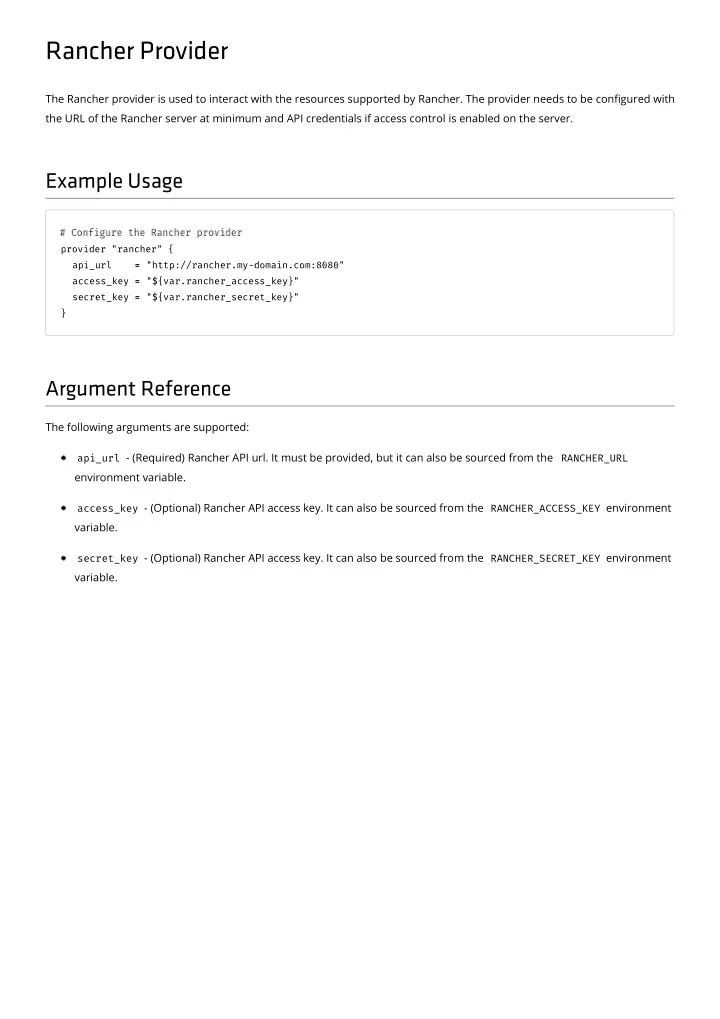
slide-88
SLIDE 88

ami - (Optional) AMI ID to use for the worker nodes instead of the default (string) associate_worker_node_public_ip - (Optional) Associate public ip EKS worker nodes. Default true (bool) instance_type - (Optional) The type of machine to use for worker nodes. Default t2.medium (string) key_pair_name - (Optional) Allow user to specify key name to use. Just for Rancher v2.2.7 and above (string) maximum_nodes - (Optional) The maximum number of worker nodes. Default 3 (int) minimum_nodes - (Optional) The minimum number of worker nodes. Default 1 (int) node_volume_size - (Optional) The volume size for each node. Default 20 (int) region - (Optional) The AWS Region to create the EKS cluster in. Default us-west-2 (string) security_groups -

(Optional) List of security groups to use for the cluster. If it's not specied Rancher will create a new security group (list)

service_role - (Optional) The service role to use to perform the cluster operations in AWS. If it's not specied

Rancher will create a new service role (string)

session_token - (Optional/Sensitive) A session token to use with the client key and secret if applicable (string) subnets - (Optional) List of subnets in the virtual network to use. If it's not specied Rancher will create 3 news

subnets (list)

user_data - (Optional/Computed) Pass user-data to the nodes to perform automated conguration tasks (string) virtual_network - (Optional) The name of the virtual network to use. If it's not specied Rancher will create a new

VPC (string)

gke_config

Arguments

The following arguments are supported:

cluster_ipv4_cidr - (Required) The IP address range of the container pods (string) credential - (Required/Sensitive) The contents of the GC credential le (string) disk_type - (Required) Type of the disk attached to each node (string) image_type - (Required) The image to use for the worker nodes (string) ip_policy_cluster_ipv4_cidr_block - (Required) The IP address range for the cluster pod IPs (string) ip_policy_cluster_secondary_range_name - (Required) The name of the secondary range to be used for the

cluster CIDR block (string)

ip_policy_node_ipv4_cidr_block - (Required) The IP address range of the instance IPs in this cluster (string) ip_policy_services_ipv4_cidr_block - (Required) The IP address range of the services IPs in this cluster (string) ip_policy_services_secondary_range_name - (Required) The name of the secondary range to be used for the

services CIDR block (string)

slide-89
SLIDE 89

ip_policy_subnetwork_name - (Required) A custom subnetwork name to be used if createSubnetwork is true (string) locations - (Required) Locations for GKE cluster (list) machine_type - (Required) Machine type for GKE cluster (string) maintenance_window - (Required) Maintenance window for GKE cluster (string) master_ipv4_cidr_block - (Required) The IP range in CIDR notation to use for the hosted master network (string) master_version - (Required) Master version for GKE cluster (string) network - (Required) Network for GKE cluster (string) node_pool - (Required) The ID of the cluster node pool (string) node_version - (Required) Node version for GKE cluster (string)

  • auth_scopes - (Required) The set of Google API scopes to be made available on all of the node VMs under the

default service account (list)

project_id - (Required) Project ID for GKE cluster (string) service_account - (Required) The Google Cloud Platform Service Account to be used by the node VMs (string) sub_network - (Required) Subnetwork for GKE cluster (string) description - (Optional) An optional description of this cluster (string) disk_size_gb - (Optional) Size of the disk attached to each node. Default 100 (int) enable_alpha_feature - (Optional) To enable Kubernetes alpha feature. Default true (bool) enable_auto_repair - (Optional) Species whether the node auto-repair is enabled for the node pool. Default false (bool) enable_auto_upgrade - (Optional) Species whether node auto-upgrade is enabled for the node pool. Default false (bool) enable_horizontal_pod_autoscaling - (Optional) Enable horizontal pod autoscaling for the cluster. Default true

(bool)

enable_http_load_balancing - (Optional) Enable HTTP load balancing on GKE cluster. Default true (bool) enable_kubernetes_dashboard - (Optional) Whether to enable the Kubernetes dashboard. Default false (bool) enable_legacy_abac - (Optional) Whether to enable legacy abac on the cluster. Default false (bool) enable_network_policy_config - (Optional) Enable stackdriver logging. Default true (bool) enable_nodepool_autoscaling - (Optional) Enable nodepool autoscaling. Default false (bool) enable_private_endpoint - (Optional) Whether the master's internal IP address is used as the cluster endpoint.

Default false (bool)

enable_private_nodes - (Optional) Whether nodes have internal IP address only. Default false (bool) enable_stackdriver_logging - (Optional) Enable stackdriver monitoring. Default true (bool) enable_stackdriver_monitoring - (Optional) Enable stackdriver monitoring on GKE cluster (bool)

slide-90
SLIDE 90

ip_policy_create_subnetwork - (Optional) Whether a new subnetwork will be created automatically for the cluster.

Default false (bool)

issue_client_certificate - (Optional) Issue a client certicate. Default false (bool) kubernetes_dashboard - (Optional) Enable the Kubernetes dashboard. Default false (bool) labels - (Optional/Computed) The map of Kubernetes labels to be applied to each node (map) local_ssd_count - (Optional) The number of local SSD disks to be attached to the node. Default 0 (int) master_authorized_network_cidr_blocks - (Optional) Dene up to 10 external networks that could access

Kubernetes master through HTTPS (list)

max_node_count - (Optional) Maximum number of nodes in the NodePool. Must be >= minNodeCount. There has to

enough quota to scale up the cluster. Default 0 (int)

min_node_count - (Optional) Minimmum number of nodes in the NodePool. Must be >= 1 and <= maxNodeCount.

Default 0 (int)

node_count - (Optional) Node count for GKE cluster. Default 3 (int) preemptible - (Optional) Whether the nodes are created as preemptible VM instances. Default false (bool) resource_labels - (Optional/Computed) The map of Kubernetes labels to be applied to each cluster (map) use_ip_aliases - (Optional) Whether alias IPs will be used for pod IPs in the cluster. Default false (bool) taints - (Required) List of Kubernetes taints to be applied to each node (list) zone - (Required) Zone GKE cluster (string)

cluster_auth_endpoint

Arguments

ca_certs - (Optional) CA certs for the authorized cluster endpoint (string) enabled - (Optional) Enable the authorized cluster endpoint. Default true (bool) fqdn - (Optional) FQDN for the authorized cluster endpoint (string)

<<<<<<< HEAD

cluster_monitoring_input

Arguments

* answers - (Optional/Computed) Key/value answers for monitor input (map)

slide-91
SLIDE 91

cluster_template_answers

Arguments

cluster_id - (Optional) Cluster ID to apply answer (string) project_id - (Optional) Project ID to apply answer (string) values - (Optional) Key/values for answer (map)

cluster_template_questions

Arguments

default - (Required) Default variable value (string) required - (Optional) Required variable. Default false (bool) type - (Optional) Variable type. boolean , int and string are allowed. Default string (string) variable - (Optional) Variable name (string) >>>>>>> c6a2cbc... Feat: added rancher2_cluster_template datasource

and resource. For rancher V2.3.x. Doc les

cluster_registration_token

Attributes

cluster_id - (Computed) Cluster ID (string) name - (Computed) Name of cluster registration token (string) command - (Computed) Command to execute in a imported k8s cluster (string) insecure_command - (Computed) Insecure command to execute in a imported k8s cluster (string) manifest_url - (Computed) K8s manifest url to execute with kubectl to import an existing k8s cluster (string) node_command - (Computed) Node command to execute in linux nodes for custom k8s cluster (string) token - (Computed) Token for cluster registration token object (string) windows_node_command - (Computed) Node command to execute in windows nodes for custom k8s cluster (string) annotations - (Computed) Annotations for cluster registration token object (map) labels - (Computed) Labels for cluster registration token object (map)

Timeouts

slide-92
SLIDE 92

rancher2_cluster provides the following Timeouts

(https://www.terraform.io/docs/conguration/resources.html#operation-timeouts) conguration options:

create - (Default 30 minutes ) Used for creating clusters. update - (Default 30 minutes ) Used for cluster modications. delete - (Default 30 minutes ) Used for deleting clusters.

Import

Clusters can be imported using the Rancher Cluster ID

$ terraform import rancher2_cluster.foo <cluster>

slide-93
SLIDE 93

rancher2_cluster_logging

Provides a Rancher v2 Cluster Logging resource. This can be used to congure Cluster Logging for Rancher v2 environments and retrieve their information.

Example Usage

resource "rancher2_cluster_logging" "foo" { name = = "foo" cluster_id = = "<cluster_id>" kind = = "syslog" syslog_config { endpoint = = "<syslog_endpoint>" protocol = = "udp" severity = = "notice" ssl_verify = = false false } }

Argument Reference

The following arguments are supported:

cluster_id - (Required) The cluster id to congure logging (string) name - (Required) The name of the cluster logging cong (string) kind - (Required) The kind of the Cluster Logging. elasticsearch , fluentd , kafka , splunk and syslog are

supported (string)

elasticsearch_config - (Optional) The elasticsearch cong for Cluster Logging. For kind = elasticsearch .

Conicts with fluentd_config , kafka_config , splunk_config and syslog_config (list maxitems:1)

fluentd_config - (Optional) The uentd cong for Cluster Logging. For kind = fluentd . Conicts with elasticsearch_config , kafka_config , splunk_config and syslog_config (list maxitems:1) kafka_config - (Optional) The kafka cong for Cluster Logging. For kind = kafka . Conicts with elasticsearch_config , fluentd_config , splunk_config and syslog_config (list maxitems:1) namespace_id - (Optional) The namespace id from cluster logging (string)

  • utput_flush_interval - (Optional) How often buered logs would be ushed. Default: 3 seconds (int)
  • utput_tags - (Optional/computed) The output tags for Cluster Logging (map)

splunk_config - (Optional) The splunk cong for Cluster Logging. For kind = splunk . Conicts with elasticsearch_config , fluentd_config , kafka_config , and syslog_config (list maxitems:1) syslog_config - (Optional) The syslog cong for Cluster Logging. For kind = syslog . Conicts with elasticsearch_config , fluentd_config , kafka_config , and splunk_config (list maxitems:1)

slide-94
SLIDE 94

annotations - (Optional/Computed) Annotations for Cluster Logging object (map) labels - (Optional/Computed) Labels for Cluster Logging object (map)

Attributes Reference

The following attributes are exported:

id - (Computed) The ID of the resource (string)

Nested blocks

elasticsearch_config

Arguments

endpoint - (Required) Endpoint of the elascticsearch service. Must include protocol, http:// or https:// (string) auth_password - (Optional/Sensitive) User password for the elascticsearch service (string) auth_username - (Optional/Sensitive) Username for the elascticsearch service (string) certificate - (Optional/Sensitive) SSL certicate for the elascticsearch service (string) client_cert - (Optional/Sensitive) SSL client certicate for the elascticsearch service (string) client_key - (Optional/Sensitive) SSL client key for the elascticsearch service (string) client_key_pass - (Optional/Sensitive) SSL client key password for the elascticsearch service (string) date_format - (Optional) Date format for the elascticsearch logs. Default: YYYY-MM-DD (string) index_prefix - (Optional) Index prex for the elascticsearch logs. Default: local (string) ssl_verify - (Optional) SSL verify for the elascticsearch service (bool) ssl_version - (Optional) SSL version for the elascticsearch service (string)

fluentd_config

Arguments

fluent_servers - (Required) Servers for the uentd service (list) certificate - (Optional/Sensitive) SSL certicate for the uentd service (string) compress - (Optional) Compress data for the uentd service (bool)

slide-95
SLIDE 95

enable_tls - (Optional) Enable TLS for the uentd service (bool)

fluent_servers

Arguments endpoint - (Required) Endpoint of the uentd service (string) hostname - (Optional) Hostname of the uentd service (string) password - (Optional/Sensitive) User password of the uentd service (string) shared_key - (Optional/Sensitive) Shared key of the uentd service (string) standby - (Optional) Standby server of the uentd service (bool) username - (Optional/Sensitive) Username of the uentd service (string) weight - (Optional) Weight of the uentd server (int)

kafka_config

Arguments

topic - (Required) Topic to publish on the kafka service (string) broker_endpoints - (Optional) Kafka endpoints for kafka service. Conicts with zookeeper_endpoint (list) certificate - (Optional/Sensitive) SSL certicate for the kafka service (string) client_cert - (Optional/Sensitive) SSL client certicate for the kafka service (string) client_key - (Optional/Sensitive) SSL client key for the kafka service (string) zookeeper_endpoint - (Optional) Zookeeper endpoint for kafka service. Conicts with broker_endpoints (string)

splunk_config

Arguments

endpoint - (Required) Endpoint of the splunk service. Must include protocol, http:// or https:// (string) token - (Required/Sensitive) Token for the splunk service (string) certificate - (Optional/Sensitive) SSL certicate for the splunk service (string) client_cert - (Optional/Sensitive) SSL client certicate for the splunk service (string) client_key - (Optional/Sensitive) SSL client key for the splunk service (string) client_key_pass - (Optional/Sensitive) SSL client key password for the splunk service (string) index - (Optional) Index prex for the splunk logs (string)

slide-96
SLIDE 96

source - (Optional) Date format for the splunk logs (string) ssl_verify - (Optional) SSL verify for the splunk service (bool)

syslog_config

Arguments

endpoint - (Required) Endpoint of the syslog service (string) certificate - (Optional/Sensitive) SSL certicate for the syslog service (string) client_cert - (Optional/Sensitive) SSL client certicate for the syslog service (string) client_key - (Optional/Sensitive) SSL client key for the syslog service (string) program - (Optional) Program for the syslog service (string) protocol - (Optional) Protocol for the syslog service. tcp and udp are supported. Default: udp (string) severity - (Optional) Date format for the syslog logs. emergency , alert , critical , error , warning , notice , info and debug are supported. Default: notice (string) ssl_verify - (Optional) SSL verify for the syslog service (bool) token - (Optional/Sensitive) Token for the syslog service (string)

Timeouts

rancher2_cluster_logging provides the following Timeouts

(https://www.terraform.io/docs/conguration/resources.html#operation-timeouts) conguration options:

create - (Default 10 minutes ) Used for creating cluster logging congurations. update - (Default 10 minutes ) Used for cluster logging conguration modications. delete - (Default 10 minutes ) Used for deleting cluster logging congurations.

Import

Cluster Logging can be imported using the Rancher Cluster Logging ID

$ terraform import rancher2_cluster_logging.foo <cluster_logging_id>

slide-97
SLIDE 97

rancher2_cluster_role_template_binding

Provides a Rancher v2 Cluster Role Template Binding resource. This can be used to create Cluster Role Template Bindings for Rancher v2 environments and retrieve their information.

Example Usage

resource "rancher2_cluster_role_template_binding" "foo" { name = = "foo" cluster_id = = "<cluster_id>" role_template_id = = "<role_template_id>" user_id = = "<user_id>" }

Argument Reference

The following arguments are supported:

cluster_id - (Required) The cluster id where bind cluster role template binding (string) role_template_id - (Required) The role template id from create cluster role template binding (string) name - (Required) The name of the cluster role template binding (string) group_id - (Optional) The group ID to assign cluster role template binding (string) group_principal_id - (Optional) The group_principal ID to assign cluster role template binding (string) user_id - (Optional) The user ID to assign cluster role template binding (string) user_principal_id - (Optional) The user_principal ID to assign cluster role template binding (string) annotations - (Optional/Computed) Annotations for cluster role template binding (map) labels - (Optional/Computed) Labels for cluster role template binding (map)

Attributes Reference

The following attributes are exported:

id - (Computed) The ID of the resource (string)

Timeouts

rancher2_cluster_role_template_binding provides the following Timeouts

(https://www.terraform.io/docs/conguration/resources.html#operation-timeouts) conguration options:

slide-98
SLIDE 98

create - (Default 10 minutes ) Used for creating cluster role template bindings. update - (Default 10 minutes ) Used for cluster role template binding modications. delete - (Default 10 minutes ) Used for deleting cluster role template bindings.

Import

Cluster Role Template Bindings can be imported using the Rancher cluster Role Template Binding ID

$ terraform import rancher2_cluster_role_template_binding.foo <cluster_role_template_binding_id>

slide-99
SLIDE 99

rancher2_cluster_sync

Provides a Rancher v2 Cluster Sync dummy resource. This can be used to create a Cluster Sync to wait for a Rancher v2 Cluster resource active state. This dummy resource doesn't create anything at Rancher side. It's used to sync terraform resources that depends of Rancher v2 Cluster resource in active state. This resource will wait until cluster_id is active on terraform apply . It also helps to sync terraform destroy dependencies, specially useful if cluster is using node pools. This resource will also compute attributes with useful cluster related data (see Attributes Reference section).

Example Usage

resource "rancher2_cluster" "foo-custom" { name = = "foo-custom" description = = "Foo rancher2 custom cluster" rke_config { network { plugin = = "canal" } } } resource "rancher2_node_template" "foo" { name = = "foo" description = = "foo test" amazonec2_config { access_key = = "AWS_ACCESS_KEY" secret_key = = "<AWS_SECRET_KEY>" ami = = "<AMI_ID>" region = = "<REGION>" security_group = = ["<AWS_SECURITY_GROUP>"] subnet_id = = "<SUBNET_ID>" vpc_id = = "<VPC_ID>" zone = = "<ZONE>" } } resource "rancher2_node_pool" "foo" { cluster_id = = "${rancher2_cluster.foo-custom.id}" name = = "foo" hostname_prefix = = "foo-cluster-0" node_template_id = = "${rancher2_node_template.foo.id}" quantity = = 3 control_plane = = true true etcd = = true true worker = = true true } resource "rancher2_cluster_sync" "foo-custom" { cluster_id = = "${rancher2_cluster.foo-custom.id}" node_pool_ids = = ["${rancher2_node_pool.foo.id}"] }

slide-100
SLIDE 100

resource "rancher2_project" "foo" { name = = "foo" cluster_id = = "${rancher2_cluster_sync.foo-custom.id}" description = = "Terraform namespace acceptance test" resource_quota { project_limit { limits_cpu = = "2000m" limits_memory = = "2000Mi" requests_storage = = "2Gi" } namespace_default_limit { limits_cpu = = "500m" limits_memory = = "500Mi" requests_storage = = "1Gi" } } container_resource_limit { limits_cpu = = "20m" limits_memory = = "20Mi" requests_cpu = = "1m" requests_memory = = "1Mi" } }

Argument Reference

The following arguments are supported:

cluster_id - (Required/ForceNew) The cluster ID that is syncing (string) node_pool_ids - (Optional) The node pool IDs used by the cluster id (list)

Attributes Reference

The following attributes are exported:

id - (Computed) The ID of the resource. Same as cluster_id (string) default_project_id - (Computed) Default project ID for the cluster sync (string) kube_config - (Computed) Kube Cong generated for the cluster sync (string) system_project_id - (Computed) System project ID for the cluster sync (string)

Timeouts

rancher2_cluster_sync provides the following Timeouts

(https://www.terraform.io/docs/conguration/resources.html#operation-timeouts) conguration options:

create - (Default 30 minutes ) Used for creating cluster sync.

slide-101
SLIDE 101

update - (Default 30 minutes ) Used for cluster sync modications. delete - (Default 30 minutes ) Used for deleting cluster sync.

slide-102
SLIDE 102

rancher2_cluster_template

Provides a Rancher v2 Cluster Template resource. This can be used to create Cluster Templates for Rancher v2 RKE clusters and retrieve their information. Cluster Templates are available from Rancher v2.3.x and above.

Example Usage

resource "rancher2_cluster_template" "foo" { name = = "foo" members { access_type = = "owner" user_principal_id = = "local://user-XXXXX" } template_revisions { name = = "V1" cluster_config { rke_config { network { plugin = = "canal" } services { etcd { creation = = "6h" retention = = "24h" } } } } default = = true true } description = = "Terraform cluster template foo" }

Argument Reference

name - (Required) The cluster template name (string) decription - (Optional) The cluster template description (string) members - (Optional) Cluster template members (list) template_revisions - (Optional/Computed) Cluster template revisions (list) annotations - (Optional/Computed) Annotations for the cluster template (map) labels - (Optional/Computed) Labels for the cluster template (map)

slide-103
SLIDE 103

Attributes Reference

id - (Computed) The ID of the resource (string) default_revision_id - (Computed) Default cluster template revision ID (string)

Nested blocks

members

Arguments

access_type - (Optional) Member access type. Valid values: ["read-only" | "owner"] (string) group_principal_id - (Optional) Member group principal id (string) user_principal_id - (Optional) Member user principal id (string)

template_revisions

Arguments

name - (Required) The cluster template revision name (string) cluster_config - (Optional) Cluster conguration (list maxitem: 1) default - (Optional) Default cluster template revision. Default false (bool) enabled - (Optional) Enable cluster template revision. Default true (bool) questions - (Optional) Cluster template questions (list) annotations - (Optional/Computed) Annotations for the cluster template revision (map) labels - (Optional/Computed) Labels for the cluster template revision (map)

Attributes

id - (Computed) The cluster template revision ID (string) cluster_template_id - (Computed) Cluster template ID (string)

cluster_config

Arguments cluster_auth_endpoint - (Optional/Computed) Local cluster auth endpoint (list maxitems: 1)

slide-104
SLIDE 104

default_cluster_role_for_project_members - (Optional/Computed) Default cluster role for project members

(string)

default_pod_security_policy_template_id - (Optional/Computed) Default pod security policy template ID (string) desired_agent_image - (Optional/Computed) Desired agent image (string) desired_auth_image - (Optional/Computed) Desired auth image (string) docker_root_dir - (Optional/Computed) Desired auth image (string) enable_cluster_alerting - (Optional) Enable built-in cluster alerting. Default: false (bool) enable_cluster_monitoring - (Optional) Enable built-in cluster monitoring. Default: false (bool) enable_network_policy - (Optional) Enable project network isolation. Default: false (bool) rke_config - (Optional/Computed) Rancher Kubernetes Engine Cong (list maxitems: 1) windows_prefered_cluster - (Optional) Windows prefered cluster. Default: false (bool)

questions

Arguments default - (Required) Default variable value (string) required - (Optional) Required variable. Default false (bool) type - (Optional) Variable type. boolean , int and string are allowed. Default string (string) variable - (Optional) Variable name (string)

Timeouts

rancher2_cluster_template provides the following Timeouts

(https://www.terraform.io/docs/conguration/resources.html#operation-timeouts) conguration options:

create - (Default 10 minutes ) Used for creating cluster templates. update - (Default 10 minutes ) Used for cluster template modications. delete - (Default 10 minutes ) Used for deleting cluster templates.

Import

Cluster Template can be imported using the rancher Cluster Template ID

$ terraform import rancher2_cluster_template.foo <cluster_template_id>

slide-105
SLIDE 105

rancher2_etcd_backup

Provides a Rancher v2 Etcd Backup resource. This can be used to create Etcd Backup for Rancher v2.2.x and retrieve their information.

Example Usage

resource "rancher2_etcd_backup" "foo" { backup_config { enabled = = true true interval_hours = = 20 retention = = 10 s3_backup_config { access_key = = "access_key" bucket_name = = "bucket_name" endpoint = = "endpoint" folder = = "/folder" region = = "region" secret_key = = "secret_key" } } cluster_id = = "<CLUSTER_ID>" name = = "foo" filename = = "<FILENAME>" }

Argument Reference

The following arguments are supported:

cluster_id - (Required) Cluster ID to cong Etcd Backup (string) backup_config - (Optional/Computed) Backup cong for etcd backup (list maxitems:1) filename - (Optional/Computed) Filename of the Etcd Backup (string) manual - (Optional) Manual execution of the Etcd Backup. Default false (bool) name - (Required) The name of the Etcd Backup (string) namespace_id - (Optional/Computed) Description for the Etcd Backup (string) annotations - (Optional) Annotations for Etcd Backup object (map) labels - (Optional/Computed) Labels for Etcd Backup object (map)

Attributes Reference

slide-106
SLIDE 106

The following attributes are exported:

id - (Computed) The ID of the resource (string)

Nested blocks

backup_config

Arguments

enabled - (Optional) Enable etcd backup (bool) interval_hours - (Optional) Interval hours for etcd backup. Default 12 (int) retention - (Optional) Retention for etcd backup. Default 6 (int) s3_backup_config - (Optional) S3 cong options for etcd backup. Valid for imported and rke clusters. (list

maxitems:1)

s3_backup_config

Arguments access_key - (Optional/Sensitive) Access key for S3 service (string) bucket_name - (Required) Bucket name for S3 service (string) custom_ca - (Optional) Base64 encoded custom CA for S3 service. Use lebase64() for encoding le. Available from

Rancher v2.2.5 (string)

endpoint - (Required) Endpoint for S3 service (string) folder - (Optional) Folder for S3 service. Available from Rancher v2.2.7 (string) region - (Optional) Region for S3 service (string) secret_key - (Optional/Sensitive) Secret key for S3 service (string)

Timeouts

rancher2_etcd_backup provides the following Timeouts

(https://www.terraform.io/docs/conguration/resources.html#operation-timeouts) conguration options:

create - (Default 10 minutes ) Used for creating cloud credentials. update - (Default 10 minutes ) Used for cloud credential modications. delete - (Default 10 minutes ) Used for deleting cloud credentials.

slide-107
SLIDE 107

Import

Etcd Backup can be imported using the Rancher etcd backup ID

$ terraform import rancher2_etcd_backup.foo <etcd_backup_id>

slide-108
SLIDE 108

rancher2_global_role_binding

Provides a Rancher v2 Global Role Binding resource. This can be used to create Global Role Bindings for Rancher v2 environments and retrieve their information.

Example Usage

resource "rancher2_global_role_binding" "foo" { name = = "foo" global_role_id = = "<global_role_id>" user_id = = "<user_id>" }

Argument Reference

The following arguments are supported:

global_role_id - (Required/ForceNew) The role id from create global role binding (string) user_id - (Required/ForceNew) The user ID to assign global role binding (string) name - (Optional/Computed/ForceNew) The name of the global role binding (string) annotations - (Optional/Computed) Annotations for global role binding (map) labels - (Optional/Computed) Labels for global role binding (map)

Attributes Reference

The following attributes are exported:

id - (Computed) The ID of the resource (string)

Timeouts

rancher2_global_role_binding provides the following Timeouts

(https://www.terraform.io/docs/conguration/resources.html#operation-timeouts) conguration options:

create - (Default 5 minutes ) Used for creating global role bindings. update - (Default 5 minutes ) Used for global role binding modications. delete - (Default 5 minutes ) Used for deleting global role bindings.

slide-109
SLIDE 109

Import

Global Role Bindings can be imported using the Rancher Global Role Binding ID

$ terraform import rancher2_global_role_binding.foo <global_role_binding_id>

slide-110
SLIDE 110

rancher2_multi_cluster_app

Provides a Rancher v2 multi_cluster_app resource. This can be used to deploy multi_cluster_app on Rancher v2. This resource can also modify Rancher v2 multi cluster apps in 3 ways: - Add/Remove targets : If targets arguments is modied, the multi cluster app targets will be updated. - Rollback : If revision_id argument is provided or modied the app will be rolled back accordingly. A new revision_id will be generated in Rancher. It will also generate a non-empty terraform plan that will require manual .tf le intervention. Use carefully. - Update : If any other argument is modied the app will be upgraded. Note: In case of multiple resource modication in a row, rollback has preference.

Example Usage

resource "rancher2_multi_cluster_app" "foo" { catalog_name = = "<catalog_name>" name = = "foo" targets { project_id = = "<project_id>" } template_name = = "<template_name>" template_version = = "<template_version>" answers { values = = { "ingress_host" = = "test.xip.io" } } roles = = ["project-member"] }

slide-111
SLIDE 111

resource "rancher2_multi_cluster_app" "foo" { catalog_name = = "<catalog_name>" name = = "foo" targets { project_id = = "<project_id1>" } targets { project_id = = "<project_id2>" } template_name = = "<template_name>" template_version = = "<template_version>" answers { values = = { "ingress_host" = = "test.xip.io" } } answers { project_id = = "<project_id2>" values = = { "ingress_host" = = "test2.xip.io" } } roles = = ["project-member"] }

Argument Reference

The following arguments are supported:

catalog_name - (Required) The multi cluster app catalog name (string) name - (Required/ForceNew) The multi cluster app name (string) roles - (Required) The multi cluster app roles (list) targets - (Required) The multi cluster app target projects (list) template_name - (Required) The multi cluster app template name (string) answers - (Optional/Computed) The multi cluster app answers (list) members - (Optional) The multi cluster app answers (list) revision_history_limit - (Computed) The multi cluster app revision history limit. Default 10 (int) revision_id - (Optional/Computed) Current revision id for the multi cluster app (string) template_version - (Optional/Computed) The multi cluster app template version. Default: latest (string) upgrade_strategy - (Optional/Computed) The multi cluster app upgrade strategy (list MaxItems:1) wait - (Optional) Wait until the multi cluster app is active. Default true (bool) annotations - (Optional/Computed) Annotations for multi cluster app object (map)

slide-112
SLIDE 112

labels - (Optional/Computed) Labels for multi cluster app object (map)

Attributes Reference

The following attributes are exported:

id - (Computed) The ID of the resource (string) template_version_id - (Computed) The multi cluster app template version ID (string)

Nested blocks

targets

Arguments

project_id - (Required) Project ID for target (string) app_id - (Computed) App ID for target (string) health_state - (Computed) App health state for target (string) state - (Computed) App state for target (string)

answers

Arguments

cluster_id - (Optional) Cluster ID for answer (string) project_id - (Optional) Project ID for target (string) values - (Optional) Key/values for answer (map)

members

Arguments

access_type - (Optional) Member access type. Valid values: ["member" | "owner" | "read-only"] (string) group_principal_id - (Optional) Member group principal id (string) user_principal_id - (Optional) Member user principal id (string)

slide-113
SLIDE 113

upgrade_strategy

Arguments

rolling_update - (Optional) Upgrade strategy rolling update (list MaxItems:1)

rolling_update

Arguments batch_size - (Optional) Rolling update batch size. Default 1 (int) interval - (Optional) Rolling update interval. Default 1 (int)

Timeouts

rancher2_app provides the following Timeouts (https://www.terraform.io/docs/conguration/resources.html#operation-

timeouts) conguration options:

create - (Default 10 minutes ) Used for creating apps. update - (Default 10 minutes ) Used for app modications. delete - (Default 10 minutes ) Used for deleting apps.

Import

Multi cluster app can be imported using the multi cluster app ID in the format <multi_cluster_app_name>

$ terraform import rancher2_multi_cluster_app.foo <multi_cluster_app_name>

slide-114
SLIDE 114

rancher2_namespace

Provides a Rancher v2 Namespace resource. This can be used to create namespaces for Rancher v2 environments and retrieve their information.

Example Usage

resource "rancher2_namespace" "foo" { name = = "foo" project_id = = "<PROJECT_ID>" description = = "foo namespace" resource_quota { limit { limits_cpu = = "100m" limits_memory = = "100Mi" requests_storage = = "1Gi" } } container_resource_limit { limits_cpu = = "20m" limits_memory = = "20Mi" requests_cpu = = "1m" requests_memory = = "1Mi" } }

slide-115
SLIDE 115

resource "rancher2_cluster" "foo-custom" { name = = "foo-custom" description = = "Foo rancher2 custom cluster" rke_config { network { plugin = = "canal" } } } resource "rancher2_namespace" "foo" { name = = "foo" project_id = = "${rancher2_cluster.foo-custom.default_project_id}" description = = "foo namespace" resource_quota { limit { limits_cpu = = "100m" limits_memory = = "100Mi" requests_storage = = "1Gi" } } container_resource_limit { limits_cpu = = "20m" limits_memory = = "20Mi" requests_cpu = = "1m" requests_memory = = "1Mi" } }

Argument Reference

The following arguments are supported:

name - (Required) The name of the namespace (string) project_id - (Required) The project id where assign namespace. It's on the form project_id=<cluster_id>:<id> .

Updating <id> part on same <cluster_id> namespace will be moved between projects (string)

container_resource_limit - (Optional/Computed) Default containers resource limits on namespace (List

maxitem:1)

description - (Optional) A namespace description (string) resource_quota - (Optional/Computed) Resource quota for namespace. Rancher v2.1.x or higher (list maxitems:1) wait_for_cluster - (Optional) Wait for cluster becomes active. Default false (bool) annotations - (Optional/Computed) Annotations for Node Pool object (map) labels - (Optional/Computed) Labels for Node Pool object (map)

Attributes Reference

slide-116
SLIDE 116

The following attributes are exported:

id - (Computed) The ID of the resource (string)

Nested blocks

container_resource_limit

Arguments

limits_cpu - (Optional) CPU limit for containers (string) limits_memory - (Optional) Memory limit for containers (string) requests_cpu - (Optional) CPU reservation for containers (string) requests_memory - (Optional) Memory reservation for containers (string)

resource_quota

Arguments

limit - (Required) Resource quota limit for namespace (list maxitems:1)

limit

Arguments config_maps - (Optional) Limit for cong maps in namespace (string) limits_cpu - (Optional) Limit for limits cpu in namespace (string) limits_memory - (Optional) Limit for limits memory in namespace (string) persistent_volume_claims - (Optional) Limit for persistent volume claims in namespace (string) pods - (Optional) Limit for pods in namespace (string) replication_controllers - (Optional) Limit for replication controllers in namespace (string) requests_cpu - (Optional) Limit for requests cpu in namespace (string) requests_memory - (Optional) Limit for requests memory in namespace (string) requests_storage - (Optional) Limit for requests storage in namespace (string) secrets - (Optional) Limit for secrets in namespace (string) services_load_balancers - (Optional) Limit for services load balancers in namespace (string)

slide-117
SLIDE 117

services_node_ports - (Optional) Limit for services node ports in namespace (string)

More info at resource-quotas (https://rancher.com/docs/rancher/v2.x/en/k8s-in-rancher/projects-and- namespaces/resource-quotas/)

Timeouts

rancher2_namespace provides the following Timeouts

(https://www.terraform.io/docs/conguration/resources.html#operation-timeouts) conguration options:

create - (Default 10 minutes ) Used for creating namespaces. update - (Default 10 minutes ) Used for namespace modications. delete - (Default 10 minutes ) Used for deleting namespaces.

Import

Namespaces can be imported using the namespace ID in the format <project_id>.<namespace_id>

$ terraform import rancher2_namespace.foo <project_id>.<namespace_id>

<project_id> is in the format <cluster_id>:<id> , but part is optional:

If full project_id is provided, <project_id>=<cluster_id>:<id> , the namespace'll be assigned to corresponding cluster project once it's imported. If <id> part is omitted <project_id>=<cluster_id> , the namespace'll not be assigned to any project. To move it into a project, <project_id>=<cluster_id>:<id> needs to be updated in tf le. Namespace movement is only supported inside same cluster_id .

slide-118
SLIDE 118

rancher2_node_driver

Provides a Rancher v2 Node Driver resource. This can be used to create Node Driver for Rancher v2 RKE clusters and retrieve their information.

Example Usage

resource "rancher2_node_driver" "foo" { active = = true true builtin = = false false checksum = = "0x0" description = = "Foo description" external_id = = "foo_external" name = = "foo" ui_url = = "local://ui" url = = "local://" whitelist_domains = = ["*.foo.com"] }

Argument Reference

The following arguments are supported:

active - (Required) Specify if the node driver state (bool) builtin - (Required) Specify wheter the node driver is an internal node driver or not (bool) name - (Required) Name of the node driver (string) url - (Required) The URL to download the machine driver binary for 64-bit Linux (string) checksum - (Optional) Verify that the downloaded driver matches the expected checksum (string) description - (Optional) Description of the node driver (string) external_id - (Optional) External ID (string) ui_url - (Optional) The URL to load for customized Add Nodes screen for this driver (string) whitelist_domains - (Optional) Domains to whitelist for the ui (list) annotations - (Optional/Computed) Annotations of the resource (map) labels - (Optional/Computed) Labels of the resource (map)

Attributes Reference

The following attributes are exported:

slide-119
SLIDE 119

id - (Computed) The ID of the resource (string)

Timeouts

rancher2_node_driver provides the following Timeouts

(https://www.terraform.io/docs/conguration/resources.html#operation-timeouts) conguration options:

create - (Default 10 minutes ) Used for creating node drivers. update - (Default 10 minutes ) Used for node driver modications. delete - (Default 10 minutes ) Used for deleting node drivers.

Import

Node Driver can be imported using the Rancher Node Driver ID

$ terraform import rancher2_node_driver.foo <node_driver_id>

slide-120
SLIDE 120

rancher2_node_pool

Provides a Rancher v2 Node Pool resource. This can be used to create Node Pool, using Node template for Rancher v2 RKE clusters and retrieve their information.

Example Usage

resource "rancher2_cluster" "foo-custom" { name = = "foo-custom" description = = "Foo rancher2 custom cluster" kind = = "rke" rke_config { network { plugin = = "canal" } } } resource "rancher2_cloud_credential" "foo" { name = = "foo" description= = "Terraform cloudCredential acceptance test" amazonec2_credential_config { access_key = = "XXXXXXXXXXXXXXXXXXXX" secret_key = = "XXXXXXXXXXXXXXXXXXXXXXXXXXXXXXXXXXXXXXXX" } } resource "rancher2_node_template" "foo" { name = = "foo" description = = "foo test" cloud_credential_id = = "${rancher2_cloud_credential.foo.id}" amazonec2_config { ami = = "<AMI_ID>" region = = "<REGION>" security_group = = ["<AWS_SECURITY_GROUP>"] subnet_id = = "<SUBNET_ID>" vpc_id = = "<VPC_ID>" zone = = "<ZONE>" } } resource "rancher2_node_pool" "foo" { cluster_id = = "${rancher2_cluster.foo-custom.id}" name = = "foo" hostname_prefix = = "foo-cluster-0" node_template_id = = "${rancher2_node_template.foo.id}" quantity = = 1 control_plane = = true true etcd = = true true worker = = true true }

slide-121
SLIDE 121

Argument Reference

The following arguments are supported:

cluster_id - (Required) The RKE cluster id to use Node Pool (string) name - (Required) The name of the Node Pool (string) hostname_prefix - (Required) The prex for created nodes of the Node Pool (string) node_template_id - (Required) The Node Template ID to use for node creation (string) control_plane - (Optional) RKE control plane role for created nodes (bool) etcd - (Optional) RKE etcd role for created nodes (bool) quantity - (Optional) The number of nodes to create on Node Pool. Default 1 . Only values >= 1 allowed (int) worker - (Optional) RKE role role for created nodes (bool) annotations - (Optional/Computed) Annotations for Node Pool object (map) labels - (Optional/Computed) Labels for Node Pool object (map)

Attributes Reference

The following attributes are exported:

id - (Computed) The ID of the resource (string)

Timeouts

rancher2_node_pool provides the following Timeouts

(https://www.terraform.io/docs/conguration/resources.html#operation-timeouts) conguration options:

create - (Default 10 minutes ) Used for creating node pools. update - (Default 10 minutes ) Used for node pool modications. delete - (Default 10 minutes ) Used for deleting node pools.

Import

Node Pool can be imported using the Rancher Node Pool ID

$ terraform import rancher2_node_pool.foo <node_pool_id>

slide-122
SLIDE 122

rancher2_node_template

Provides a Rancher v2 Node Template resource. This can be used to create Node Template for Rancher v2 and retrieve their information. amazonec2, azure, digitalocean, openstack and vsphere drivers are supported for node templates.

Example Usage

resource "rancher2_node_template" "foo" { name = = "foo" description = = "foo test" amazonec2_config { access_key = = "AWS_ACCESS_KEY" secret_key = = "<AWS_SECRET_KEY>" ami = = "<AMI_ID>" region = = "<REGION>" security_group = = ["<AWS_SECURITY_GROUP>"] subnet_id = = "<SUBNET_ID>" vpc_id = = "<VPC_ID>" zone = = "<ZONE>" } } resource "rancher2_cloud_credential" "foo" { name = = "foo" description = = "foo test" amazonec2_credential_config { access_key = = "<AWS_ACCESS_KEY>" secret_key = = "<AWS_SECRET_KEY>" } } resource "rancher2_node_template" "foo" { name = = "foo" description = = "foo test" cloud_credential_id = = "${rancher2_cloud_credential.foo.id}" amazonec2_config { ami = = "<AMI_ID>" region = = "<REGION>" security_group = = ["<AWS_SECURITY_GROUP>"] subnet_id = = "<SUBNET_ID>" vpc_id = = "<VPC_ID>" zone = = "<ZONE>" } }

Argument Reference

slide-123
SLIDE 123

The following arguments are supported:

name - (Required) The name of the Node Template (string) amazonec2_config - (Optional) AWS cong for the Node Template (list maxitems:1) auth_certificate_authority - (Optional/Sensitive) Auth certicate authority for the Node Template (string) auth_key - (Optional/Sensitive) Auth key for the Node Template (string) azure_config - (Optional) Azure cong for the Node Template (list maxitems:1) cloud_credential_id - (Optional) Cloud credential ID for the Node Template. Required from Rancher v2.2.x (string) description - (Optional) Description for the Node Template (string) digitalocean_config - (Optional) Digitalocean cong for the Node Template (list maxitems:1) engine_env - (Optional) Engine environment for the node template (string) engine_insecure_registry - (Optional) Insecure registry for the node template (list) engine_install_url - (Optional) Docker engine install URL for the node template. Default https://releases.rancher.com/install-docker/18.09.sh . Available install docker versions at https://github.com/rancher/install-docker (string) engine_label - (Optional) Engine label for the node template (string) engine_opt - (Optional) Engine options for the node template (map) engine_registry_mirror - (Optional) Engine registry mirror for the node template (list) engine_storage_driver - (Optional) Engine storage driver for the node template (string)

  • penstack_config - (Optional) Openstack cong for the Node Template (list maxitems:1)

use_internal_ip_address - (Optional) Engine storage driver for the node template (bool) vsphere_config - (Optional) vSphere cong for the Node Template (list maxitems:1) annotations - (Optional) Annotations for Node Template object (map) labels - (Optional/Computed) Labels for Node Template object (map)

Attributes Reference

The following attributes are exported:

id - (Computed) The ID of the resource (string) driver - (Computed) The driver of the node template (string)

Nested blocks

slide-124
SLIDE 124

amazonec2_config

Arguments

ami - (Required) AWS machine image (string) region - (Required) AWS region. (string) security_group - (Required) AWS VPC security group. (list) subnet_id - (Required) AWS VPC subnet id (string) vpc_id - (Required) AWS VPC id. (string) zone - (Required) AWS zone for instance (i.e. a,b,c,d,e) (string) access_key - (Optional/Sensitive) AWS access key. Required on Rancher v2.0.x and v2.1.x. Use rancher2_cloud_credential from Rancher v2.2.x (string) block_duration_minutes - (Optional) AWS spot instance duration in minutes (60, 120, 180, 240, 300, or 360). Default 0 (string) device_name - (Optional) AWS root device name. Default /dev/sda1 (string) endpoint - (Optional) Optional endpoint URL (hostname only or fully qualied URI) (string) iam_instance_profile - (Optional) AWS IAM Instance Prole (string) insecure_transport - (Optional) Disable SSL when sending requests (bool) instance_type - (Optional) AWS instance type. Default t2.micro (string) keypair_name - (Optional) AWS keypair to use; requires --amazonec2-ssh-keypath (string) monitoring - (Optional) Set this ag to enable CloudWatch monitoring. Deafult false (bool)

  • pen_port - (Optional) Make the specied port number accessible from the Internet. (list)

private_address_only - (Optional) Only use a private IP address. Default false (bool) request_spot_instance - (Optional) Set this ag to request spot instance. Default false (bool) retries - (Optional) Set retry count for recoverable failures (use -1 to disable). Default 5 (string) root_size - (Optional) AWS root disk size (in GB). Default 16 (string) secret_key - (Optional/Sensitive) AWS secret key. Required on Rancher v2.0.x and v2.1.x. Use rancher2_cloud_credential from Rancher v2.2.x (string) security_group_readonly - (Optional) Skip adding default rules to security groups (bool) session_token - (Optional/Sensitive) AWS Session Token (string) spot_price - (Optional) AWS spot instance bid price (in dollar). Default 0.50 (string) ssh_keypath - (Optional) SSH Key for Instance (string) ssh_user - (Optional) Set the name of the ssh user (string)

slide-125
SLIDE 125

tags - (Optional) AWS Tags (e.g. key1,value1,key2,value2) (string) use_ebs_optimized_instance - (Optional) Create an EBS optimized instance. Default false (bool) use_private_address - (Optional) Force the usage of private IP address. Default false (bool) userdata - (Optional) Path to le with cloud-init user data (string) volume_type - (Optional) Amazon EBS volume type. Default gp2 (string)

azure_config

Arguments

client_id - (Optional/Sensitive) Azure Service Principal Account ID. Mandatory on Rancher v2.0.x and v2.1.x. Use rancher2_cloud_credential from Rancher v2.2.x (string) client_secret - (Optional/Sensitive) Azure Service Principal Account password. Mandatory on Rancher v2.0.x and

v2.1.x. Use rancher2_cloud_credential from Rancher v2.2.x (string)

subscription_id - (Optional/Sensitive) Azure Subscription ID. Mandatory on Rancher v2.0.x and v2.1.x. Use rancher2_cloud_credential from Rancher v2.2.x (string) availability_set - (Optional) Azure Availability Set to place the virtual machine into. Default docker-machine

(string)

custom_data - (Optional) Path to le with custom-data (string) dns - (Optional) A unique DNS label for the public IP adddress (string) docker_port - (Optional) Port number for Docker engine. Default 2376 (string) environment - (Optional) Azure environment (e.g. AzurePublicCloud, AzureChinaCloud). Default AzurePublicCloud

(string)

image - (Optional) Azure virtual machine OS image. Default canonical:UbuntuServer:18.04-LTS:latest (string) location - (Optional) Azure region to create the virtual machine. Default westus (string) no_public_ip - (Optional) Do not create a public IP address for the machine. Default false (bool)

  • pen_port - (Optional) Make the specied port number accessible from the Internet. (list)

private_ip_address - (Optional) Specify a static private IP address for the machine. (string) resource_group - (Optional) Azure Resource Group name (will be created if missing). Default docker-machine

(string)

size - (Optional) Size for Azure Virtual Machine. Default Standard_A2 (string) ssh_user - (Optional) Username for SSH login (string) static_public_ip - (Optional) Assign a static public IP address to the machine. Default false (bool) storage_type - (Optional) Type of Storage Account to host the OS Disk for the machine. Default Standard_LRS

(string)

slide-126
SLIDE 126

subnet - (Optional) Azure Subnet Name to be used within the Virtual Network. Default docker-machine (string) subnet_prefix - (Optional) Private CIDR block to be used for the new subnet, should comply RFC 1918. Default 192.168.0.0/16 (string) use_private_ip - (Optional) Use private IP address of the machine to connect. Default false (string) vnet - (Optional) Azure Virtual Network name to connect the virtual machine (in [resourcegroup:]name format).

Default docker-machine-vnet (string)

digitalocean_config

Arguments

access_token - (Optional/Sensitive) Digital Ocean access token. Mandatory on Rancher v2.0.x and v2.1.x. Use rancher2_cloud_credential from Rancher v2.2.x (string) backups - (Optional) Enable backups for droplet. Default false (bool) image - (Optional) Digital Ocean Image. Default ubuntu-16-04-x64 (string) ipv6 - (Optional) Enable ipv6 for droplet. Default false (bool) monitoring - (Optional) Enable monitoring for droplet. Default false (bool) private_networking - (Optional) Enable private networking for droplet. Default false (bool) region - (Optional) Digital Ocean region. Default nyc3 (string) size - (Optional) Digital Ocean size. Default s-1vcpu-1gb (string) ssh_key_fingerprint - (Optional/Sensitive) SSH key ngerprint (string) ssh_key_path - (Optional) SSH private key path (string) ssh_port - (Optional) SSH port. Default 22 (string) ssh_user - (Optional) SSH username. Default root (string) tags - (Optional) Comma-separated list of tags to apply to the Droplet (string) userdata - (Optional) Path to le with cloud-init user-data (string)

  • penstack_config

Arguments

auth_url - (Required) OpenStack authentication URL (string) availability_zone - (Required) OpenStack availability zone (string) region - (Required) OpenStack region name (string)

slide-127
SLIDE 127

username - (Required) OpenStack username (string) active_timeout - (Optional) OpenStack active timeout Default 200 (string) cacert - (Optional) CA certicate bundle to verify against (string) config_drive - (Optional) Enables the OpenStack cong drive for the instance. Default false (bool) domain_id - (Required*) OpenStack domain ID. Identity v3 only. Conicts with domain_name (string) domain_name - (Required*) OpenStack domain name. Identity v3 only. Conicts with domain_id (string) endpoint_type - (Optional) OpenStack endpoint type. adminURL, internalURL or publicURL (string) flavor_id - (Required*) OpenStack avor id to use for the instance. Conicts with flavor_name (string) flavor_name - (Required*) OpenStack avor name to use for the instance. Conicts with flavor_id (string) floating_ip_pool - (Optional) OpenStack oating IP pool to get an IP from to assign to the instance (string) image_id - (Required*) OpenStack image id to use for the instance. Conicts with image_name (string) image_name - (Required*) OpenStack image name to use for the instance. Conicts with image_id (string) insecure - (Optional) Disable TLS credential checking. Default false (bool) ip_version - (Optional) OpenStack version of IP address assigned for the machine Default 4 (string) keypair_name - (Optional) OpenStack keypair to use to SSH to the instance (string) net_id - (Required*) OpenStack network id the machine will be connected on. Conicts with net_name (string) net_name - (Required*) OpenStack network name the machine will be connected on. Conicts with net_id (string) nova_network - (Optional) Use the nova networking services instead of neutron (string) password - (Optional/Sensitive) OpenStack password. Mandatory on Rancher v2.0.x and v2.1.x. Use rancher2_cloud_credential from Rancher v2.2.x (string) private_key_file - (Optional) Private keyle absolute path to use for SSH (string) sec_groups - (Optional) OpenStack comma separated security groups for the machine (string) ssh_port - (Optional) OpenStack SSH port * Default 22 (string) ssh_user - (Optional) OpenStack SSH user * Default: root (string) tenant_id - (Required*) OpenStack tenant id. Conicts with tenant_name (string) tenant_name - (Required*) OpenStack tenant name. Conicts with tenant_id (string) user_data_file - (Optional) File containing an openstack userdata script (string)

Note: Required* denotes that either the _name or _id is required but you cannot use both.

vsphere_config

slide-128
SLIDE 128

Arguments

boot2docker_url - (Optional) vSphere URL for boot2docker iso image. Default https://releases.rancher.com/os/latest/rancheros-vmware.iso (string) cfgparam - (Optional) vSphere vm conguration parameters (used for guestinfo) (list) cloudinit - (Optional) vSphere cloud-init le or url to set in the guestinfo (string) cpu_count - (Optional) vSphere CPU number for docker VM. Default 2 (string) datacenter - (Optional) vSphere datacenter for docker VM (string) datastore - (Optional) vSphere datastore for docker VM (string) disk_size - (Optional) vSphere size of disk for docker VM (in MB). Default 20480 (string) folder - (Optional) vSphere folder for the docker VM. This folder must already exist in the datacenter (string) hostsystem - (Optional) vSphere compute resource where the docker VM will be instantiated. This can be omitted if

using a cluster with DRS (string)

memory_size - (Optional) vSphere size of memory for docker VM (in MB). Default 2048 (string) network - (Optional) vSphere network where the docker VM will be attached (list) password - (Optional/Sensitive) vSphere password. Mandatory on Rancher v2.0.x and v2.1.x. Use rancher2_cloud_credential from Rancher v2.2.x (string) pool - (Optional) vSphere resource pool for docker VM (string) username - (Optional/Sensitive) vSphere username. Mandatory on Rancher v2.0.x and v2.1.x. Use rancher2_cloud_credential from Rancher v2.2.x (string) vapp_ip_allocation_policy - (Optional) vSphere vApp IP allocation policy. Supported values are: dhcp , fixed , transient and fixedAllocated (string) vapp_ip_protocol - (Optional) vSphere vApp IP protocol for this deployment. Supported values are: IPv4 and IPv6 (string) vapp_property - (Optional) vSphere vApp properties (list) vapp_transport - (Optional) vSphere OVF environment transports to use for properties. Supported values are: iso

and com.vmware.guestInfo (string)

vcenter - (Optional/Sensitive) vSphere IP/hostname for vCenter. Mandatory on Rancher v2.0.x and v2.1.x. Use rancher2_cloud_credential from Rancher v2.2.x (string) vcenter_port - (Optional/Sensitive) vSphere Port for vCenter. Mandatory on Rancher v2.0.x and v2.1.x. Use rancher2_cloud_credential from Rancher v2.2.x. Default 443 (string)

Timeouts

rancher2_node_template provides the following Timeouts

(https://www.terraform.io/docs/conguration/resources.html#operation-timeouts) conguration options:

slide-129
SLIDE 129

create - (Default 10 minutes ) Used for creating node templates. update - (Default 10 minutes ) Used for node template modications. delete - (Default 10 minutes ) Used for deleting node templates.

Import

Node Template can be imported using the Rancher Node Template ID

$ terraform import rancher2_node_template.foo <node_template_id>

slide-130
SLIDE 130

rancher2_notier

Provides a Rancher v2 Notier resource. This can be used to create notiers for Rancher v2 environments and retrieve their information.

Example Usage

resource "rancher2_notifier" "foo" { name = = "foo" cluster_id = = "<cluster_id>" description = = "Terraform notifier acceptance test" pagerduty_config { service_key = = "XXXXXXXX" proxy_url = = "http://proxy.test.io" } }

Argument Reference

The following arguments are supported:

name - (Required) The name of the notier (string) cluster_id - (Required/ForceNew) The cluster id where create notier (string) description - (Optional) The notier description (string) pagerduty_config - (Optional) Pagerduty cong for notier (list maxitems:1) slack_config - (Optional) Slack cong for notier (list maxitems:1) smtp_config - (Optional) SMTP cong for notier (list maxitems:1) webhook_config - (Optional) Webhook cong for notier (list maxitems:1) wechat_config - (Optional) Wechat cong for notier (list maxitems:1) annotations - (Optional/Computed) Annotations for notier object (map) labels - (Optional/Computed) Labels for notier object (map)

Attributes Reference

The following attributes are exported:

id - (Computed) The ID of the resource (string)

slide-131
SLIDE 131

Nested blocks

pagerduty_config

Arguments

service_key - (Required) Pagerduty service key (string) proxy_url - (Optional) Pagerduty proxy url (string)

slack_config

Arguments

default_recipient - (Required) Slack default recipient (string) url - (Required) Slack url (string) proxy_url - (Optional) Slack proxy url (string)

smtp_config

default_recipient - (Required) SMTP default recipient (string) host - (Required) SMTP host (string) port - (Required) SMTP port (int) sender - (Required) SMTP sender (string) password - (Optional/Sensitive) SMTP password (string) tls - (Optional/Sensitive) SMTP tls. Default true (bool) username - (Optional/Sensitive) SMTP username (string)

Arguments

webhook_config

url - (Required) Webhook url (string) proxy_url - (Optional) Webhook proxy url (string)

Arguments

slide-132
SLIDE 132

wechat_config

Arguments

agent - (Required) Wechat agent ID (string) corp - (Required) Wechat corporation ID (string) default_recipient - (Required) Wechat default recipient (string) secret - (Required/Sensitive) Wechat agent ID (string) proxy_url - (Optional) Wechat proxy url (string) recipient_type - (Optional) Wechat recipient type. Allowed values: party | tag | user (string)

Timeouts

rancher2_notifier provides the following Timeouts

(https://www.terraform.io/docs/conguration/resources.html#operation-timeouts) conguration options:

create - (Default 10 minutes ) Used for creating notiers. update - (Default 10 minutes ) Used for notier modications. delete - (Default 10 minutes ) Used for deleting notiers.

Import

Notiers can be imported using the Rancher nNtier ID

$ terraform import rancher2_notifier.foo <notifier_id>

slide-133
SLIDE 133

rancher2_project_alert_group

Provides a Rancher v2 Project Alert Group resource. This can be used to create Project Alert Group for Rancher v2 environments and retrieve their information.

Example Usage

resource "rancher2_project_alert_group" "foo" { name = = "foo" description = = "Terraform project alert group" project_id = = "<project_id>" group_interval_seconds = = 300 repeat_interval_seconds = = 3600 }

Argument Reference

The following arguments are supported:

name - (Required) The project alert group name (string) project_id - (Required) The project id where create project alert group (string) description - (Optional) The project alert group description (string) group_interval_seconds - (Optional) The project alert group interval seconds. Default: 180 (int) group_wait_seconds - (Optional) The project alert group wait seconds. Default: 180 (int) recipients - (Optional) The project alert group recipients (list) repeat_interval_seconds - (Optional) The project alert group wait seconds. Default: 3600 (int) annotations - (Optional/Computed) The project alert group annotations (map) labels - (Optional/Computed) The project alert group labels (map)

Attributes Reference

The following attributes are exported:

id - (Computed) The ID of the resource (string)

Nested blocks

slide-134
SLIDE 134

recipients

Arguments

notifier_id - (Required) Recipient notier ID (string) recipient - (Optional/Computed) Recipient (string)

Attributes

notifier_type - (Computed) Recipient notier ID. Supported values : "pagerduty" | "slack" | "email" | "webhook" | "wechat" (string)

Timeouts

rancher2_project_alert_group provides the following Timeouts

(https://www.terraform.io/docs/conguration/resources.html#operation-timeouts) conguration options:

create - (Default 10 minutes ) Used for creating project alert groups. update - (Default 10 minutes ) Used for project alert group modications. delete - (Default 10 minutes ) Used for deleting project alert groups.

Import

Project Alert Group can be imported using the Rancher project alert group ID

$ terraform import rancher2_project_alert_group.foo <rancher2_project_alert_group_id>

slide-135
SLIDE 135

rancher2_project_alert_rule

Provides a Rancher v2 Project Alert Rule resource. This can be used to create Project Alert Rule for Rancher v2 environments and retrieve their information.

Example Usage

resource "rancher2_project" "foo" { name = = "foo" cluster_id = = "<cluster_id>" description = = "Terraform project " resource_quota { project_limit { limits_cpu = = "2000m" limits_memory = = "2000Mi" requests_storage = = "2Gi" } namespace_default_limit { limits_cpu = = "500m" limits_memory = = "500Mi" requests_storage = = "1Gi" } } container_resource_limit { limits_cpu = = "20m" limits_memory = = "20Mi" requests_cpu = = "1m" requests_memory = = "1Mi" } } resource "rancher2_project_alert_group" "foo" { name = = "foo" description = = "Terraform project alert group" project_id = = "${rancher2_project.foo.id}" group_interval_seconds = = 300 repeat_interval_seconds = = 3600 } resource "rancher2_project_alert_rule" "foo" { project_id = = "${rancher2_project_alert_group.foo.project_id}" group_id = = "${rancher2_project_alert_group.foo.id}" name = = "foo" group_interval_seconds = = 600 repeat_interval_seconds = = 6000 }

Argument Reference

The following arguments are supported:

slide-136
SLIDE 136

project_id - (Required) The project id where create project alert rule (string) group_id - (Required) The project alert rule alert group ID (string) name - (Required) The project alert rule name (string) group_interval_seconds - (Optional) The project alert rule group interval seconds. Default: 180 (int) group_wait_seconds - (Optional) The project alert rule group wait seconds. Default: 180 (int) inherited - (Optional) The project alert rule inherited. Default: true (bool) metric_rule - (Optional) The project alert rule metric rule. ConictsWith: "pod_rule", "workload_rule" ` (list

Maxitems:1)

pod_rule - (Optional) The project alert rule pod rule. ConictsWith: "metric_rule", "workload_rule" ` (list

Maxitems:1)

repeat_interval_seconds - (Optional) The project alert rule wait seconds. Default: 3600 (int) severity - (Optional) The project alert rule severity. Supported values : "critical" | "info" | "warning".

Default: critical (string)

workload_rule - (Optional) The project alert rule workload rule. ConictsWith: "metric_rule", "pod_rule" ` (list

Maxitems:1)

annotations - (Optional/Computed) The project alert rule annotations (map) labels - (Optional/Computed) The project alert rule labels (map)

Attributes Reference

The following attributes are exported:

id - (Computed) The ID of the resource (string)

Nested blocks

metric_rule

Arguments

duration - (Required) Metric rule duration (string) expression - (Required) Metric rule expression (string) threshold_value - (Required) Metric rule threshold value (oat64) comparison - (Optional) Metric rule comparison. Supported values : "equal" | "greater-or-equal" | "greater- than" | "less-or-equal" | "less-than" | "not-equal" . Default: equal (string)

slide-137
SLIDE 137

description - (Optional) Metric rule description (string)

pod_rule

Arguments

pod_id - (Required) Pod ID (string) condition - (Optional) Pod rule condition. Supported values : "notrunning" | "notscheduled" | "restarts".

Default: notrunning (string)

restart_interval_seconds - (Optional) Pod rule restart interval seconds. Default: 300 (int) restart_times - (Optional) Pod rule restart times. Default: 3 (int)

workload_rule

Arguments

available_percentage - (Optional) Workload rule available percentage. Default: 70 (int) selector - (Optional) Workload rule selector (map) workload_id - (Optional) Workload ID (string)

Timeouts

rancher2_project_alert_rule provides the following Timeouts

(https://www.terraform.io/docs/conguration/resources.html#operation-timeouts) conguration options:

create - (Default 10 minutes ) Used for creating project alert rules. update - (Default 10 minutes ) Used for project alert rule modications. delete - (Default 10 minutes ) Used for deleting project alert rules.

Import

Project Alert Rule can be imported using the Rancher project alert rule ID

$ terraform import rancher2_project_alert_rule.foo <rancher2_project_alert_rule_id>

slide-138
SLIDE 138

rancher2_project

Provides a Rancher v2 Project resource. This can be used to create projects for Rancher v2 environments and retrieve their information.

Example Usage

resource "rancher2_project" "foo" { name = = "foo" cluster_id = = "<CLUSTER_ID>" resource_quota { project_limit { limits_cpu = = "2000m" limits_memory = = "2000Mi" requests_storage = = "2Gi" } namespace_default_limit { limits_cpu = = "2000m" limits_memory = = "500Mi" requests_storage = = "1Gi" } } container_resource_limit { limits_cpu = = "20m" limits_memory = = "20Mi" requests_cpu = = "1m" requests_memory = = "1Mi" } }

slide-139
SLIDE 139

resource "rancher2_project" "foo" { name = = "foo" cluster_id = = "<CLUSTER_ID>" resource_quota { project_limit { limits_cpu = = "2000m" limits_memory = = "2000Mi" requests_storage = = "2Gi" } namespace_default_limit { limits_cpu = = "2000m" limits_memory = = "500Mi" requests_storage = = "1Gi" } } container_resource_limit { limits_cpu = = "20m" limits_memory = = "20Mi" requests_cpu = = "1m" requests_memory = = "1Mi" } enable_project_monitoring = = true true project_monitoring_input { answers = = { "exporter-kubelets.https" = = true true "exporter-node.enabled" = = true true "exporter-node.ports.metrics.port" = = 9796 "exporter-node.resources.limits.cpu" = = "200m" "exporter-node.resources.limits.memory" = = "200Mi" "grafana.persistence.enabled" = = false false "grafana.persistence.size" = = "10Gi" "grafana.persistence.storageClass" = = "default" "operator.resources.limits.memory" = = "500Mi" "prometheus.persistence.enabled" = = "false" "prometheus.persistence.size" = = "50Gi" "prometheus.persistence.storageClass" = = "default" "prometheus.persistent.useReleaseName" = = "true" "prometheus.resources.core.limits.cpu" = = "1000m", "prometheus.resources.core.limits.memory" = = "1500Mi" "prometheus.resources.core.requests.cpu" = = "750m" "prometheus.resources.core.requests.memory" = = "750Mi" "prometheus.retention" = = "12h" } } }

Argument Reference

The following arguments are supported:

name - (Required) The name of the project (string) cluster_id - (Required) The cluster id where create project (string)

slide-140
SLIDE 140

container_resource_limit - (Optional) Default containers resource limits on project (List maxitem:1) description - (Optional) A project description (string) enable_project_monitoring - (Optional) Enable built-in project monitoring. Default false (bool) pod_security_policy_template_id - (Optional) Default Pod Security Policy ID for the project (string) project_monitoring_input - (Optional/Computed) Project monitoring cong. Any parameter dened in rancher-

monitoring charts (https://github.com/rancher/system-charts/tree/dev/charts/rancher-monitoring) could be congured (list maxitems:1)

resource_quota - (Optional) Resource quota for project. Rancher v2.1.x or higher (list maxitems:1) wait_for_cluster - (Optional) Wait for cluster becomes active. Default false (bool) annotations - (Optional/Computed) Annotations for Node Pool object (map) labels - (Optional/Computed) Labels for Node Pool object (map)

Attributes Reference

The following attributes are exported:

id - (Computed) The ID of the resource (string)

Nested blocks

container_resource_limit

Arguments

limits_cpu - (Optional) CPU limit for containers (string) limits_memory - (Optional) Memory limit for containers (string) requests_cpu - (Optional) CPU reservation for containers (string) requests_memory - (Optional) Memory reservation for containers (string)

project_monitoring_input

Arguments

answers - (Optional/Computed) Key/value answers for monitor input (map)

slide-141
SLIDE 141

resource_quota

Arguments

project_limit - (Required) Resource quota limit for project (list maxitems:1) namespace_default_limit - (Required) Default resource quota limit for namespaces in project (list maxitems:1)

project_limit and namespace_default_limit

Arguments

The following arguments are supported:

config_maps - (Optional) Limit for cong maps in project (string) limits_cpu - (Optional) Limit for limits cpu in project (string) limits_memory - (Optional) Limit for limits memory in project (string) persistent_volume_claims - (Optional) Limit for persistent volume claims in project (string) pods - (Optional) Limit for pods in project (string) replication_controllers - (Optional) Limit for replication controllers in project (string) requests_cpu - (Optional) Limit for requests cpu in project (string) requests_memory - (Optional) Limit for requests memory in project (string) requests_storage - (Optional) Limit for requests storage in project (string) secrets - (Optional) Limit for secrets in project (string) services_load_balancers - (Optional) Limit for services load balancers in project (string) services_node_ports - (Optional) Limit for services node ports in project (string)

More info at resource-quotas (https://rancher.com/docs/rancher/v2.x/en/k8s-in-rancher/projects-and- namespaces/resource-quotas/)

Timeouts

rancher2_project provides the following Timeouts

(https://www.terraform.io/docs/conguration/resources.html#operation-timeouts) conguration options:

create - (Default 10 minutes ) Used for creating projects. update - (Default 10 minutes ) Used for project modications. delete - (Default 10 minutes ) Used for deleting projects.

Import

slide-142
SLIDE 142

Projects can be imported using the Rancher Project ID

$ terraform import rancher2_project.foo <project_id>

slide-143
SLIDE 143

rancher2_project_logging

Provides a Rancher v2 Project Logging resource. This can be used to create Project Logging for Rancher v2 environments and retrieve their information.

Example Usage

resource "rancher2_project_logging" "foo" { name = = "foo" project_id = = "<project_id>" kind = = "syslog" syslog_config { endpoint = = "<syslog_endpoint>" protocol = = "udp" severity = = "notice" ssl_verify = = false false } }

Argument Reference

The following arguments are supported:

project_id - (Required) The project id to congure logging (string) name - (Required) The name of the Project Logging cong (string) kind - (Required) The kind of the Project Logging. elasticsearch , fluentd , kafka , splunk and syslog are

supported (string)

elasticsearch_config - (Optional) The elasticsearch cong for Project Logging. For kind = elasticsearch .

Conicts with fluentd_config , kafka_config , splunk_config and syslog_config (list maxitems:1)

fluentd_config - (Optional) The uentd cong for Project Logging. For kind = fluentd . Conicts with elasticsearch_config , kafka_config , splunk_config and syslog_config (list maxitems:1) kafka_config - (Optional) The kafka cong for Project Logging. For kind = kafka . Conicts with elasticsearch_config , fluentd_config , splunk_config and syslog_config (list maxitems:1) namespace_id - (Optional) The namespace id from Project logging (string)

  • utput_flush_interval - (Optional) How often buered logs would be ushed. Default: 3 seconds (int)
  • utput_tags - (Optional/computed) The output tags for Project Logging (map)

splunk_config - (Optional) The splunk cong for Project Logging. For kind = splunk . Conicts with elasticsearch_config , fluentd_config , kafka_config , and syslog_config (list maxitems:1) syslog_config - (Optional) The syslog cong for Project Logging. For kind = syslog . Conicts with elasticsearch_config , fluentd_config , kafka_config , and splunk_config (list maxitems:1)

slide-144
SLIDE 144

annotations - (Optional/Computed) Annotations for Project Logging object (map) labels - (Optional/Computed) Labels for Project Logging object (map)

Attributes Reference

The following attributes are exported:

id - (Computed) The ID of the resource (string)

Nested blocks

elasticsearch_config

Arguments

endpoint - (Required) Endpoint of the elascticsearch service. Must include protocol, http:// or https:// (string) auth_password - (Optional/Sensitive) User password for the elascticsearch service (string) auth_username - (Optional/Sensitive) Username for the elascticsearch service (string) certificate - (Optional/Sensitive) SSL certicate for the elascticsearch service (string) client_cert - (Optional/Sensitive) SSL client certicate for the elascticsearch service (string) client_key - (Optional/Sensitive) SSL client key for the elascticsearch service (string) client_key_pass - (Optional/Sensitive) SSL client key password for the elascticsearch service (string) date_format - (Optional) Date format for the elascticsearch logs. Default: YYYY-MM-DD (string) index_prefix - (Optional) Index prex for the elascticsearch logs. Default: local (string) ssl_verify - (Optional) SSL verify for the elascticsearch service (bool) ssl_version - (Optional) SSL version for the elascticsearch service (string)

fluentd_config

Arguments

fluent_servers - (Required) Servers for the uentd service (list) certificate - (Optional/Sensitive) SSL certicate for the uentd service (string) compress - (Optional) Compress data for the uentd service (bool)

slide-145
SLIDE 145

enable_tls - (Optional) Enable TLS for the uentd service (bool)

fluent_servers

Arguments endpoint - (Required) Endpoint of the uentd service (string) hostname - (Optional) Hostname of the uentd service (string) password - (Optional/Sensitive) User password of the uentd service (string) shared_key - (Optional/Sensitive) Shared key of the uentd service (string) standby - (Optional) Standby server of the uentd service (bool) username - (Optional/Sensitive) Username of the uentd service (string) weight - (Optional) Weight of the uentd server (int)

kafka_config

Arguments

topic - (Required) Topic to publish on the kafka service (string) broker_endpoints - (Optional) Kafka endpoints for kafka service. Conicts with zookeeper_endpoint (list) certificate - (Optional/Sensitive) SSL certicate for the kafka service (string) client_cert - (Optional/Sensitive) SSL client certicate for the kafka service (string) client_key - (Optional/Sensitive) SSL client key for the kafka service (string) zookeeper_endpoint - (Optional) Zookeeper endpoint for kafka service. Conicts with broker_endpoints (string)

splunk_config

Arguments

endpoint - (Required) Endpoint of the splunk service. Must include protocol, http:// or https:// (string) token - (Required/Sensitive) Token for the splunk service (string) certificate - (Optional/Sensitive) SSL certicate for the splunk service (string) client_cert - (Optional/Sensitive) SSL client certicate for the splunk service (string) client_key - (Optional/Sensitive) SSL client key for the splunk service (string) client_key_pass - (Optional/Sensitive) SSL client key password for the splunk service (string) index - (Optional) Index prex for the splunk logs (string)

slide-146
SLIDE 146

source - (Optional) Date format for the splunk logs (string) ssl_verify - (Optional) SSL verify for the splunk service (bool)

syslog_config

Arguments

endpoint - (Required) Endpoint of the syslog service (string) certificate - (Optional/Sensitive) SSL certicate for the syslog service (string) client_cert - (Optional/Sensitive) SSL client certicate for the syslog service (string) client_key - (Optional/Sensitive) SSL client key for the syslog service (string) program - (Optional) Program for the syslog service (string) protocol - (Optional) Protocol for the syslog service. tcp and udp are supported. Default: udp (string) severity - (Optional) Date format for the syslog logs. emergency , alert , critical , error , warning , notice , info and debug are supported. Default: notice (string) ssl_verify - (Optional) SSL verify for the syslog service (bool) token - (Optional/Sensitive) Token for the syslog service (string)

Timeouts

rancher2_project_logging provides the following Timeouts

(https://www.terraform.io/docs/conguration/resources.html#operation-timeouts) conguration options:

create - (Default 10 minutes ) Used for creating project logging congurations. update - (Default 10 minutes ) Used for project logging conguration modications. delete - (Default 10 minutes ) Used for deleting project logging congurations.

Import

Project Logging can be imported using the Rancher Project Logging ID

$ terraform import rancher2_project_logging.foo <project_logging_id>

slide-147
SLIDE 147

rancher2_project_role_template_binding

Provides a Rancher v2 Project Role Template Binding resource. This can be used to create Project Role Template Bindings for Rancher v2 environments and retrieve their information.

Example Usage

resource "rancher2_project_role_template_binding" "foo" { name = = "foo" project_id = = "<project_id>" role_template_id = = "<role_template_id>" user_id = = "<user_id>" }

Argument Reference

The following arguments are supported:

project_id - (Required/ForceNew) The project id where bind project role template (string) role_template_id - (Required/ForceNew) The role template id from create project role template binding (string) name - (Required) The name of the project role template binding (string) group_id - (Optional) The group ID to assign project role template binding (string) group_principal_id - (Optional/Computed) The group_principal ID to assign project role template binding (string) user_id - (Optional) The user ID to assign project role template binding (string) user_principal_id - (Optional/Computed) The user_principal ID to assign project role template binding (string) annotations - (Optional/Computed) Annotations of the resource (map) labels - (Optional/Computed) Labels of the resource (map)

Attributes Reference

The following attributes are exported:

id - (Computed) The ID of the resource (string)

Timeouts

rancher2_project_role_template_binding provides the following Timeouts

(https://www.terraform.io/docs/conguration/resources.html#operation-timeouts) conguration options:

slide-148
SLIDE 148

create - (Default 10 minutes ) Used for creating project role template bindings. update - (Default 10 minutes ) Used for project role template binding modications. delete - (Default 10 minutes ) Used for deleting project role template bindings.

Import

Project Role Template Bindings can be imported using the Rancher Project Role Template Binding ID

$ terraform import rancher2_project_role_template_binding.foo <project_role_template_binding_id>

slide-149
SLIDE 149

rancher2_registry

Provides a Rancher v2 Registry resource. This can be used to create docker registries for Rancher v2 environments and retrieve their information. Depending of the availability, there are 2 types of Rancher v2 docker registries: - Project registry: Available to all namespaces in the project_id - Namespaced regitry: Available to just namespace_id in the project_id

Example Usage

resource "rancher2_registry" "foo" { name = = "foo" description = = "Terraform registry foo" project_id = = "<project_id>" registries { address = = "test.io" username = = "user" password = = "pass" } } resource "rancher2_registry" "foo" { name = = "foo" description = = "Terraform registry foo" project_id = = "<project_id>" namespace_id = = "<namespace_id>" registries { address = = "test.io" username = = "user2" password = = "pass" } }

Argument Reference

The following arguments are supported:

name - (Required/ForceNew) The name of the registry (string) project_id - (Required/ForceNew) The project id where to assign the registry (string) registries - (Required) Registries data for registry (list) description - (Optional) A registry description (string) namespace_id - (Optional) The namespace id where to assign the namespaced registry (string) annotations - (Optional/Computed) Annotations for Registry object (map)

slide-150
SLIDE 150

labels - (Optional/Computed) Labels for Registry object (map)

Attributes Reference

The following attributes are exported:

id - (Computed) The ID of the resource (string)

Nested blocks

registries

Arguments

address - (Required) Address for registry. password - (Optional) Password for the registry (string) username - (Optional) Username for the registry (string)

Timeouts

rancher2_registry provides the following Timeouts

(https://www.terraform.io/docs/conguration/resources.html#operation-timeouts) conguration options:

create - (Default 10 minutes ) Used for creating registries. update - (Default 10 minutes ) Used for registry modications. delete - (Default 10 minutes ) Used for deleting registries.

Import

Registries can be imported using the registry ID in the format <namespace_id>.<project_id>.<registry_id>

$ terraform import rancher2_registry.foo <namespace_id>.<project_id>.<registry_id>

<namespace_id> is optional, just needed for namespaced registry.

slide-151
SLIDE 151

rancher2_role_template

Provides a Rancher v2 Role Template resource. This can be used to create Role Template for Rancher v2 and retrieve their information.

cluster and project scopes are supported for role templates.

Example Usage

resource "rancher2_role_template" "foo" { name = = "foo" context = = "cluster" default_role = = true true description = = "Terraform role template acceptance test" rules { api_groups = = ["*"] resources = = ["secrets"] verbs = = ["create"] } } resource "rancher2_role_template" "foo" { name = = "foo" context = = "project" default_role = = true true description = = "Terraform role template acceptance test" rules { api_groups = = ["*"] resources = = ["secrets"] verbs = = ["create"] } }

Argument Reference

The following arguments are supported:

name - (Required) Role template name (string) administrative - (Optional) Administrative role template. Default false (bool) context - (Optional) Role template context. cluster and project values are supported. Default: cluster (string) default_role - (Optional) Default role template for new created cluster or project. Default false (bool) description - (Optional/Computed) Role template description (string) external - (Optional) External role template. Default false (bool)

slide-152
SLIDE 152

hidden - (Optional) Hidden role template. Default false (bool) locked - (Optional) Locked role template. Default false (bool) role_template_ids - (Optional/Computed) Inherit role template IDs (list) rules - (Optional/Computed) Role template policy rules (list) annotations - (Optional/Computed) Annotations for role template object (map) labels - (Optional/Computed) Labels for role template object (map)

Attributes Reference

The following attributes are exported:

id - (Computed) The ID of the resource (string) builtin - (Computed) Builtin role template (string)

Nested blocks

rules

Arguments

api_groups - (Optional) Policy rule api groups (list) non_resource_urls - (Optional) Policy rule non resource urls (list) resource_names - (Optional) Policy rule resource names (list) resources - (Optional) Policy rule resources (list) verbs - (Optional) Policy rule verbs. create , delete , get , list , patch , update , watch and * values are

supported (list)

Timeouts

rancher2_role_template provides the following Timeouts

(https://www.terraform.io/docs/conguration/resources.html#operation-timeouts) conguration options:

create - (Default 10 minutes ) Used for creating role templates. update - (Default 10 minutes ) Used for role template modications. delete - (Default 10 minutes ) Used for deleting role templates.

slide-153
SLIDE 153

Import

Role Template can be imported using the Rancher Role Template ID

$ terraform import rancher2_role_template.foo <role_template_id>

slide-154
SLIDE 154

rancher2_secret

Provides a Rancher v2 Secret resource. This can be used to create secrets for Rancher v2 environments and retrieve their information. Depending of the availability, there are 2 types of Rancher v2 secrets: - Project secret: Available to all namespaces in the

project_id - Namespaced secret: Available to just namespace_id in the project_id

Example Usage

resource "rancher2_secret" "foo" { name = = "foo" description = = "Terraform secret foo" project_id = = "<project_id>" data = = { address = = base64encode("test.io") username = = base64encode("user2") password = = base64encode("pass") } } resource "rancher2_secret" "foo" { name = = "foo" description = = "Terraform secret foo" project_id = = "<project_id>" namespace_id = = "<namespace_id>" data = = { address = = base64encode("test.io") username = = base64encode("user2") password = = base64encode("pass") } }

Argument Reference

The following arguments are supported:

data - (Required) Secret key/value data. Base64 encoding required for values (map) project_id - (Required/ForceNew) The project id where to assign the secret (string) description - (Optional) A secret description (string) name - (Optional/ForceNew) The name of the secret (string) namespace_id - (Optional/ForceNew) The namespace id where to assign the namespaced secret (string) annotations - (Optional/Computed) Annotations for secret object (map)

slide-155
SLIDE 155

labels - (Optional/Computed) Labels for secret object (map)

Attributes Reference

The following attributes are exported:

id - (Computed) The ID of the resource (string)

Timeouts

rancher2_secret provides the following Timeouts

(https://www.terraform.io/docs/conguration/resources.html#operation-timeouts) conguration options:

create - (Default 10 minutes ) Used for creating registries. update - (Default 10 minutes ) Used for secret modications. delete - (Default 10 minutes ) Used for deleting registries.

Import

Secrets can be imported using the secret ID in the format <namespace_id>.<project_id>.<secret_id>

$ terraform import rancher2_secret.foo <namespace_id>.<project_id>.<secret_id>

<namespace_id> is optional, just needed for namespaced secret.

slide-156
SLIDE 156

rancher2_setting

Provides a Rancher v2 Setting resource. This can be used to create settings for Rancher v2 environments and retrieve their information. On create, if setting already exists, provider will import it and update its value. On destroy, if setting is a system setting like server-url , provider'll not delete it from Rancher, it'll just update setting value to default and remove it from tfstate.

Example Usage

resource "rancher2_setting" "foo" { name = = "foo" value = = "<VALUE>" }

Argument Reference

The following arguments are supported:

name - (Required) The name of the setting (string) value - (Required) The value of the setting (string) annotations - (Optional/Computed) Annotations for setting object (map) labels - (Optional/Computed) Labels for setting object (map)

Attributes Reference

The following attributes are exported:

id - (Computed) The ID of the resource (string)

Import

Setting can be imported using the Rancher setting ID.

$ terraform import rancher2_setting.foo <setting_id>

slide-157
SLIDE 157

rancher2_user

Provides a Rancher v2 User resource. This can be used to create Users for Rancher v2 environments and retrieve their information. When a Rancher User is created, it doesn't have a global role binding. At least, user-base global role binding in needed in

  • rder to enable user login.

Example Usage

resource "rancher2_user" "foo" { name = = "Foo user" username = = "foo" password = = "changeme" enabled = = true true } resource "rancher2_global_role_binding" "foo" { name = = "foo" global_role_id = = "user-base" user_id = = "${rancher2_user.foo.id}" }

Argument Reference

The following arguments are supported:

username - (Required/ForceNew) The user username (string) password - (Required/ForceNew) The user password (string) name - (Optional) The user full name (string) annotations - (Optional/Computed) Annotations for global role binding (map) labels - (Optional/Computed) Labels for global role binding (map)

Attributes Reference

The following attributes are exported:

id - (Computed) The ID of the resource (string) principal_ids - (Computed) The user principal IDs (list)

Timeouts

slide-158
SLIDE 158

rancher2_user provides the following Timeouts (https://www.terraform.io/docs/conguration/resources.html#operation-

timeouts) conguration options:

create - (Default 5 minutes ) Used for creating users. update - (Default 5 minutes ) Used for user modications. delete - (Default 5 minutes ) Used for deleting users.

Import

Users can be imported using the Rancher User ID

$ terraform import rancher2_user.foo <user_id>

slide-159
SLIDE 159

rancher_certicate

Use this data source to retrieve information about a Rancher certicate.

Example Usage

Simple datasource declaration

data "rancher_certificate" "foo" { name = = "foo" environment_id = = "1a5" }

Let's encrypt with DNS challenge

This setup will ensure that the Load Balancer stack is not created before the Let's Encrypt's certicate is actually present in Rancher's certicates manager.

locals { environment_id = = "1a5" } resource "rancher_stack" "letsencrypt" { name = = "letsencrypt" environment_id = = "${local.environment_id}" catalog_id = = "community:letsencrypt:4" environment { CERT_NAME = = "letsencrypt" DOMAINS = = "foo.example.com" PROVIDER = = "Route53" AWS_ACCESS_KEY = = "${var.aws_access_key}" AWS_SECRET_KEY = = "${var.aws_secret_key}" ... ... } } data "rancher_certificate" "letsencrypt" { environment_id = = "${local.environment_id}" name = = "${rancher_stack.letsencrypt.environment["CERT_NAME"]}" } resource "rancher_stack" "lb" { name = = "lb" environment_id = = "${local.environment_id}" docker_compose = = << <<EOF version: '2' services: lb:

slide-160
SLIDE 160

lb: image: rancher/lb-service-haproxy:v0.7.9 ports:

  • 443:443/tcp

labels: io.rancher.container.agent.role: environmentAdmin io.rancher.container.create_agent: 'true' EOF rancher_compose = = << <<EOF version: '2' services: lb: scale: 1 start_on_create: true lb_config: certs: [] default_cert: ${data.rancher_certificate.letsencrypt.name} port_rules:

  • protocol: https

service: mystack/myservice source_port: 443 target_port: 80 health_check: healthy_threshold: 2 response_timeout: 2000 port: 42 unhealthy_threshold: 3 interval: 2000 strategy: recreate EOF }

Let's encrypt with HTTP challenge

This setup will ensure that the HTTPS Load Balancer stack is not created before the Let's Encrypt's certicate is actually present in Rancher's certicates manager.

locals { environment_id = = "1a5" } resource "rancher_stack" "letsencrypt" { name = = "letsencrypt" environment_id = = "${local.environment_id}" catalog_id = = "community:letsencrypt:4" environment { CERT_NAME = = "letsencrypt" DOMAINS = = "foo.example.com" PROVIDER = = "HTTP" ... ... } } resource "rancher_stack" "lb-http" { name = = "lb-http"

slide-161
SLIDE 161

name = = "lb-http" environment_id = = "${local.environment_id}" docker_compose = = << <<EOF version: '2' services: lb: image: rancher/lb-service-haproxy:v0.7.9 ports:

  • 80:80/tcp

labels: io.rancher.container.agent.role: environmentAdmin io.rancher.container.create_agent: 'true' EOF rancher_compose = = << <<EOF version: '2' services: lb: scale: 1 start_on_create: true lb_config: certs: []

  • hostname: ''

path: /.well-known/acme-challenge priority: 1 protocol: http service: letsencrypt/letsencrypt source_port: 80 target_port: 80 health_check: healthy_threshold: 2 response_timeout: 2000 port: 42 unhealthy_threshold: 3 interval: 2000 strategy: recreate EOF } data "rancher_certificate" "letsencrypt" { environment_id = = "${local.environment_id}" name = = "${rancher_stack.letsencrypt.environment["CERT_NAME"]}" } resource "rancher_stack" "lb-https" { name = = "lb-https" environment_id = = "${local.environment_id}" docker_compose = = << <<EOF version: '2' services: lb: image: rancher/lb-service-haproxy:v0.7.9 ports:

  • 443:443/tcp

labels: io.rancher.container.agent.role: environmentAdmin io.rancher.container.create_agent: 'true' EOF

slide-162
SLIDE 162

EOF rancher_compose = = << <<EOF version: '2' services: lb: scale: 1 start_on_create: true lb_config: certs: [] default_cert: ${data.rancher_certificate.letsencrypt.name} port_rules:

  • protocol: https

service: mystack/myservice source_port: 443 target_port: 80 health_check: healthy_threshold: 2 response_timeout: 2000 port: 42 unhealthy_threshold: 3 interval: 2000 strategy: recreate EOF }

Argument Reference

name - (Required) The setting name. environment_id - (Required) The ID of the environment.

Attributes Reference

id - The ID of the resource. cn - The certicate CN. algorithm - The certicate algorithm. cert_fingerprint - The certicate ngerprint. expires_at - The certicate expiration date. issued_at - The certicate creation date. issuer - The certicate issuer. serial_number - The certicate serial number. subject_alternative_names - The list of certicate Subject Alternative Names. version - The certicate version.

slide-163
SLIDE 163

rancher_environment

Use this data source to retrieve information about a Rancher environment.

Example Usage

data "rancher_environment" "foo" { name = = "foo" }

Argument Reference

name - (Required) The setting name.

Attributes Reference

id - The ID of the resource. description - The environment description.

  • rchestration - The environment orchestration engine.

project_template_id - The environment project template ID. member - The environment members.

slide-164
SLIDE 164

rancher_setting

Use this data source to retrieve information about a Rancher setting.

Example Usage

data "rancher_setting" "cattle.cattle.version" { name = "cattle.cattle.version" }

Argument Reference

name - (Required) The setting name.

Attributes Reference

value - the settting's value.

slide-165
SLIDE 165

rancher_certicate

Provides a Rancher Certicate resource. This can be used to create certicates for rancher environments and retrieve their information.

Example Usage

resource rancher_certificate "foo" { name = = "foo" description = = "my foo certificate" environment_id = = "${rancher_environment.test.id}" cert = = "${file("server.crt crt")}" key = = "${file("server.key key")}" }

Argument Reference

The following arguments are supported:

name - (Required) The name of the certicate. description - (Optional) A certicate description. environment_id - (Required) The ID of the environment to create the certicate for. cert - (Required) The certicate content. cert_chain - (Optional) The certicate chain. key - (Required) The certicate key.

Attributes Reference

The following attributes are exported:

id - (Computed) The ID of the resource. cn - The certicate CN. algorithm - The certicate algorithm. cert_fingerprint - The certicate ngerprint. expires_at - The certicate expiration date. issued_at - The certicate creation date. issuer - The certicate issuer.

slide-166
SLIDE 166

key_size - The certicate key size. serial_number - The certicate serial number. subject_alternative_names - The list of certicate Subject Alternative Names. version - The certicate version.

Import

Certicates can be imported using the Certicate ID in the format <environment_id>/<certificate_id>

$ terraform import rancher_certificate.mycert 1a5/1c605

If the credentials for the Rancher provider have access to the global API, then environment_id can be omitted e.g.

$ terraform import rancher_certificate.mycert 1c605

slide-167
SLIDE 167

rancher_environment

Provides a Rancher Environment resource. This can be used to create and manage environments on rancher.

Example Usage

resource "rancher_environment" "default" { name = = "staging" description = = "The staging environment"

  • rchestration =

= "cattle" member { external_id = = "650430" external_id_type = = "github_user" role = = "owner" } member { external_id = = "1234" external_id_type = = "github_team" role = = "member" } }

Argument Reference

The following arguments are supported:

name - (Required) The name of the environment. description - (Optional) An environment description.

  • rchestration - (Optional) Must be one of cattle, swarm, mesos, windows or kubernetes. This is a helper for

setting the project_template_ids for the included Rancher templates. This will conict with project_template_id setting. Changing this forces a new resource to be created.

project_template_id - (Optional) This can be any valid project template ID. If this is set, then orchestration can not

  • be. Changing this forces a new resource to be created.

member - (Optional) Members to add to the environment.

Member Parameters Reference

A member takes three parameters:

external_id - (Required) The external ID of the member. external_id_type - (Required) The external ID type of the member.

slide-168
SLIDE 168

role - (Required) The role of the member in the environment.

Attributes Reference

id - The ID of the environment (ie 1a11 ) that can be used in other Terraform resources such as Rancher Stack

denitions.

Import

Environments can be imported using their Rancher API ID, e.g.

$ terraform import rancher_environment.dev 1a15

slide-169
SLIDE 169

rancher_host

Provides a Rancher Host resource. This can be used to manage and delete hosts on Rancher.

Example usage

resource rancher_host "foo" { name = = "foo" description = = "The foo node" environment_id = = "1a5" hostname = = "foo.example.com" labels { role = = "database" } }

Argument Reference

The following arguments are supported:

id - (Computed) The ID of the resource. name - (Required) The name of the host. description - (Optional) A host description. environment_id - (Required) The ID of the environment the host is associated to. hostname - (Required) The host name. Used as the primary key to detect the host ID. labels - (Optional) A dictionary of labels to apply to the host. Computed internal labels are excluded from that list.

slide-170
SLIDE 170

rancher_registration_token

Provides a Rancher Registration Token resource. This can be used to create registration tokens for rancher environments and retrieve their information.

Example Usage

resource "rancher_registration_token" "default" { name = = "staging_token" description = = "Registration token for the staging environment" environment_id = = "${rancher_environment.default.id}" agent_ip = = "1.2.3.4" host_labels {

  • rchestration =

= "true", etcd = = "true", compute = = "true" } }

Argument Reference

The following arguments are supported:

name - (Required) The name of the registration token. description - (Optional) A registration token description. environment_id - (Required) The ID of the environment to create the token for. host_labels - (Optional) A map of host labels to add to the registration command. agent_ip - (Optional) A string containing the CATTLE_AGENT_IP to add to the registration command.

Attributes Reference

The following attributes are exported:

id - (Computed) The ID of the resource. image - (Computed) command - The command used to start a rancher agent for this environment. registration_url - The URL to use to register new nodes to the environment. token - The token to use to register new nodes to the environment.

slide-171
SLIDE 171

Import

Registration tokens can be imported using the Environment and Registration token IDs in the form

<environment_id>/<registration_token_id> .

$ terraform import rancher_registration_token.dev_token 1a5/1c11

If the credentials for the Rancher provider have access to the global API, then then environment_id can be omitted e.g.

$ terraform import rancher_registration_token.dev_token 1c11

slide-172
SLIDE 172

rancher_registry_credential

Provides a Rancher Registy Credential resource. This can be used to create registry credentials for rancher environments and retrieve their information.

Example Usage

resource "rancher_registry_credential" "dockerhub" { name = = "dockerhub" description = = "DockerHub Registry Credential" registry_id = = "${rancher_registry.dockerhub.id}" public_value = = "myself" secret_value = = "mypass" }

Argument Reference

The following arguments are supported:

name - (Required) The name of the registry credential. description - (Optional) A registry credential description. registry_id - (Required) The ID of the registry to create the credential for. public_value - (Required) The public value (user name) of the account. secret_value - (Required) The secret value (password) of the account.

Attributes Reference

id - (Computed) The ID of the resource.

Import

Registry credentials can be imported using the Registry and credentials IDs in the format

<registry_id>/<credential_id>

$ terraform import rancher_registry_credential.private_registry 1sp31/1c605

If the credentials for the Rancher provider have access to the global API, then then registry_id can be omitted e.g.

slide-173
SLIDE 173

$ terraform import rancher_registry_credential.private_registry 1c605

slide-174
SLIDE 174

rancher_registry

Provides a Rancher Registy resource. This can be used to create registries for rancher environments and retrieve their information

Example Usage

resource "rancher_registry" "dockerhub" { name = = "dockerhub" description = = "DockerHub Registry" environment_id = = "${rancher_environment.default.id}" server_address = = "index.dockerhub.io" }

Argument Reference

The following arguments are supported:

name - (Required) The name of the registry. description - (Optional) A registry description. environment_id - (Required) The ID of the environment to create the registry for. server_address - (Required) The server address for the registry.

Attributes Reference

id - (Computed) The ID of the resource.

Import

Registries can be imported using the Environment and Registry IDs in the form <environment_id>/<registry_id>

$ terraform import rancher_registry.private_registry 1a5/1sp31

If the credentials for the Rancher provider have access to the global API, then then environment_id can be omitted e.g.

$ terraform import rancher_registry.private_registry 1sp31

slide-175
SLIDE 175

rancher_secrets

Provides a Rancher Secret resource. This can be used to create secrets for rancher environments and retrieve their information.

Example Usage

resource rancher_secret "foo" { name = = "foo" environment_id = = "${rancher_environment.test.id}" value = = "my great password" }

Argument Reference

The following arguments are supported:

name - (Required) The name of the secret. description - (Optional) A description of the secret. environment_id - (Required) The ID of the environment to create the secret for. value - (Required) The secret value.

Import

Secrets can be imported using the Secret ID in the format <environment_id>/<secret_id>

$ terraform import rancher_secret.mysec 1a5/1se10

If the credentials for the Rancher provider have access to the global API, then environment_id can be omitted e.g.

$ terraform import rancher_secret.mysec 1se10

slide-176
SLIDE 176

rancher_stack

Provides a Rancher Stack resource. This can be used to create and manage stacks on rancher.

Example Usage

resource "rancher_stack" "external-dns" { name = = "route53" description = = "Route53 stack" environment_id = = "${rancher_environment.default.id}" catalog_id = = "library:route53:7" scope = = "system" environment { AWS_ACCESS_KEY = = "MYKEY" AWS_SECRET_KEY = = "MYSECRET" AWS_REGION = = "eu-central-1" TTL = = "60" ROOT_DOMAIN = = "example.com" ROUTE53_ZONE_ID = = "" HEALTH_CHECK_INTERVAL = = "15" } }

Argument Reference

The following arguments are supported:

name - (Required) The name of the stack. description - (Optional) A stack description. environment_id - (Required) The ID of the environment to create the stack for. docker_compose - (Optional) The docker-compose.yml content to apply for the stack. rancher_compose - (Optional) The rancher-compose.yml content to apply for the stack. environment - (Optional) The environment to apply to interpret the docker-compose and rancher-compose les. catalog_id - (Optional) The catalog ID to link this stack to. When provided, docker_compose and rancher_compose

will be retrieved from the catalog unless they are overridden.

scope - (Optional) The scope to attach the stack to. Must be one of user or system. Defaults to user. start_on_create - (Optional) Whether to start the stack automatically. finish_upgrade - (Optional) Whether to automatically nish upgrades to this stack.

slide-177
SLIDE 177

Attributes Reference

The following attributes are exported:

id - (Computed) The ID of the resource. rendered_docker_compose - The interpolated docker_compose applied to the stack. rendered_rancher_compose - The interpolated rancher_compose applied to the stack.

Import

Stacks can be imported using the Environment and Stack ID in the form <environment_id>/<stack_id>

$ terraform import rancher_stack.foo 1a5/1e149

If the credentials for the Rancher provider have access to the global API, then then environment_id can be omitted e.g.

$ terraform import rancher_stack.foo 1e149

slide-178
SLIDE 178

rancher_volumes

Provides a Rancher Volume resource. This can be used to create volumes for rancher environments and retrieve their information.

Example Usage

resource rancher_volume "foo" { name = = "foo" environment_id = = "${rancher_environment.test.id}" driver = = "rancher-nfs" }

Argument Reference

The following arguments are supported:

name - (Required) The name of the volume. description - (Optional) A description of the volume. environment_id - (Required) The ID of the environment to create the volume for. driver - (Required) The volume driver.

Import

Volumes can be imported using the Volume ID in the format <environment_id>/<volume_id>

$ terraform import rancher_volume.mysec 1a5/1v123456

If the credentials for the Rancher provider have access to the global API, then environment_id can be omitted e.g.

$ terraform import rancher_volume.mysec 1se10