R EVIVING STATISTICAL YEARBOOKS TO MEET THE CHANGING NEEDS OF USERS - - PowerPoint PPT Presentation

r eviving statistical yearbooks to meet the changing
SMART_READER_LITE
LIVE PREVIEW

R EVIVING STATISTICAL YEARBOOKS TO MEET THE CHANGING NEEDS OF USERS - - PowerPoint PPT Presentation

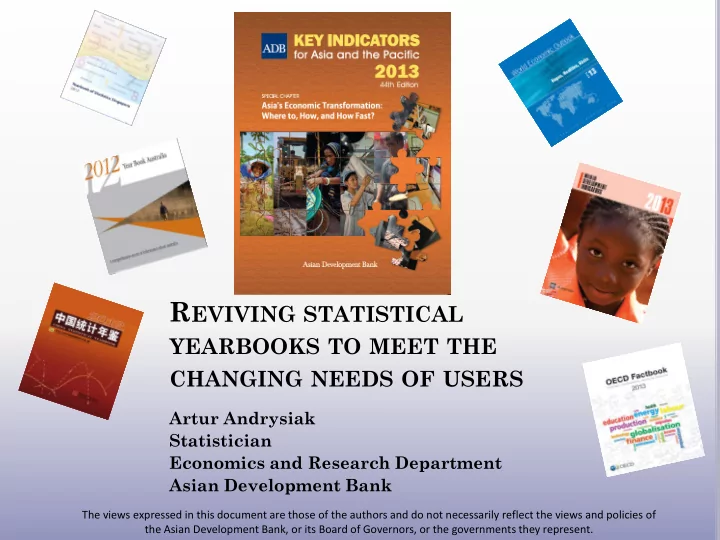
R EVIVING STATISTICAL YEARBOOKS TO MEET THE CHANGING NEEDS OF USERS Artur Andrysiak Statistician Economics and Research Department Asian Development Bank The views expressed in this document are those of the authors and do not necessarily


slide-1
SLIDE 1

REVIVING STATISTICAL

YEARBOOKS TO MEET THE CHANGING NEEDS OF USERS

Artur Andrysiak Statistician Economics and Research Department Asian Development Bank

The views expressed in this document are those of the authors and do not necessarily reflect the views and policies of the Asian Development Bank, or its Board of Governors, or the governments they represent.

slide-2
SLIDE 2

OVERVIEW

 Background  Content and presentation  Review of selected publications  General findings  Themes/domains/indicators  Aggregation methods  Review of aggregation methods of selected

international organizations

 Proposed approach  Why method selection matters  The way forward

2

slide-3
SLIDE 3

KEY INDICATORS FOR ASIA AND THE PACIFIC 2013

 ADB’s flagship annual statistical publication  Since 1969 (44th edition)  Most downloaded ADB research publication

(annually)

 Collaboration with regional NSOs, Central

Banks, MoFs, etc.

 Lasting impact  KI 2012 still in top 20 downloads for Q2 2013 (data

tables)

 Still receiving inquiries for KI 2010, other special

chapters

3

slide-4
SLIDE 4

BACKGROUND TO THE INITIATIVE

 The opportunity of the 45th issue (KI2014) is being used to

revive the publication

 To ensure continuous relevance to its key users  To ensure that it takes account of recent developments  Content and presentation revision/update  Review content of other international statistical publications,

  • ther relevant sources (both printed and on-line)

 Review content of key national yearbooks (both printed and

  • n-line)

 Consultation within ADB  Consultation with other user  Rationalize the content of the publication  Review of the country questionnaire (use of SDMX)  Review of the format, design, etc  Standardization of table presentation and

aggregation methods

4

slide-5
SLIDE 5

5

slide-6
SLIDE 6

REVIEW OF PUBLICATIONS

6

NATIONAL INTERNATIONAL

Statistical Yearbook, India 2013 UN ESCAP Statistical Yearbook for Asia and the Pacific 2011 Japan Statistical Yearbook 2013 Eurostat Yearbook 2011 and 2012 China Statistical Yearbook 2012 OECD Factbook 2013 Statistical Yearbook Kazakhstan in 2011 WB World Development Indicators 2013 Statistics Yearbook Malaysia 2011 IMF World Economic Outlook 2013** Netherlands Statistical Yearbook in 2011 Yearbook of Statistics Singapore 2012 2012 Year Book Australia New Zealand Official Yearbook 2010

**A Survey by the IMF staff usually published twice a year. It presents IMF staff economists' analyses

  • f global economic developments during the near and medium term. Contains an extensive statistical

appendix (IMF, 2013).

slide-7
SLIDE 7

SELECTED COVERS

7

slide-8
SLIDE 8

NUMBER OF PAGES

(EXCLUSIVE OF FRONT & BACK COVERS)

8 INTERNATIONAL PUBLICATIONS Total Number of Pages EUROSTAT 698 ADB KI 386 UN ESCAP 310 OECD Factbook 265 IMF WEO 203 WB WDI 143 NATIONAL PUBLICATIONS Total Number of Pages China Statistical Yearbook 2012 1061 2012 Year Book Australia 903 Japan Statistical Yearbook 2013 858 New Zealand Official Yearbook 2010 544 Statistics Yearbook Malaysia 2011 355 Yearbook of Statistics Singapore 2012 319 Netherlands Statistical Yearbook 2011 234 Kazakhstan in 2011 211

slide-9
SLIDE 9

NUMBER OF ECONOMIES AND YEARS COVERED

9

Publication Number of economies covered Span of years covered* ADB KIa 48 (Regional Member Economies) 21 Yrs. (1990 - earliest; 2012 - latest) EUROSTATb 27 (Member States of EU) 11 Yrs. (most tables start in 1999, some go back to 1960 – earliest; 2010 – latest), IMF WEOc 188 8 Yrs. (2005 – earliest; 2012 – latest) OECD Factbookd 40 12 Yrs. (most tables start in 1999 , some go back to 1970 – earliest; 2011 –latest) UN ESCAPe 58 (Regional Member States) 20 Yrs. (1990 – earliest; 2010 –latest) WB WDIf 214 23 Yrs. (1990– earliest; 2012 – latest)

a)Based on Regional Trends and Tables section; Includes Annual Data for 1990 (earliest); Annual Time Series Data from 1995 to 2011 (latest); Average Data for periods 1990-1995, 1995-2000, 2000-2005, 2005-2010, 1990-2000, 2000-2010; Annual Data with 5-year & 10-year intervals; Two Years Data (for Comparison) b)Annual Data for 1960, 1965, 1970, 1975, 1980, 1985, 1990, 1994-1995, 1997-2010; Average Data for period 2005-2009 c)Based on tables in Statistical Appendix Section; Annual Time Series Data from 2005 to 2012; Average Data for periods 1991-1998, 1995-2002, 1995-2004, 1997- 2006, 1999-2006, 2002-2004, 2003-2010, 2005-2014 d)Annual Data for 1970, 1971, 1976, 1980, 1985, 1990, 1995, 1998-11; Average annual growth rates for 1985-2010; Percentage Point Change for 1995-2009 e)Annual Data for 1990-1992, 1995-1997, 2000, 2002-2010 ; Average Data for periods 1985-1994, 1995-2004, 2005-2009 f)Annual Data for 2005, 2009 to 2012; Average Data for periods 2005-2011, 2007-2011, 2000-2010, 1990-2011; Growth Rate Data for periods 2000-2011, 2010-2011, 2011-2012 * From printed copy of the Statistical Yearbooks
slide-10
SLIDE 10

OTHER GENERAL OBSERVATIONS

10

STRUCT URE DESCRIPTION ADB UN ESCAP EUROST AT WB OECD IMF

Data Figures (graphs & maps ) Part of text analysis       Statistical Tables (indicators) Presented after the text analysis       Statistical Tables (indicators) Grouped & Presented by Theme       Special Chapter Adopts a specific theme every year  x x x  x MDGs Discusses MDGs and/or progress   x  x x References Section Presented at the end of major chapter/section  x x  x  Definitions Arranged by Theme/Subtopic   x   x

slide-11
SLIDE 11

ON-LINE/PDF VERSIONS – SOME GOOD PRACTICES

 Making the on-line/html/pdf versions more interactive –

without necessarily changing the content

 Making chapters/tables more self-contained - remembering

that users might be accessing only a particular section/chapter without necessarily looking at the rest of the publication - (abbreviations and acronyms, symbols, links, etc)

 Linking data presented in the tables with the corresponding

data in the on-line database – providing users with the

  • pportunity to easily access complete/updated time series

 Linking charts/figures with the specific tables in the

publication

 Using hyperlinks in the table of content – permitting easy

navigation

 Providing links in text permitting users to go directly to the

referred materials

 Including links and/or addresses to the organizations which

contributed data and other materials

11

slide-12
SLIDE 12

THEMES/DOMAINS COVERED

12

ADB MDGs People Economy & Output Money, Finance & Prices Globalization Transport, Electricity & Communications Energy & Environment Government & Governance UN ESCAP People

  • MDG

Environment

  • MDG

Economy

  • MDG

Connectivity WB World View

  • MDGs

People Environment Economy States & Markets Global Links EUROSTAT Economy & Finance Population Health Education & Training Labor Market Living Conditions & Social Protection Industry, Trade & Services Agriculture, Forestry & Fisheries International Trade Transport Environment Energy Science & Technology OECD Population & Migration Production & Productivity Household Income & Wealth Globalization Prices Energy & Transportation Labor Science & Technology Environment Education Government Health

slide-13
SLIDE 13

THEMES/DOMAINS COVERED

13

KAZAKHSTAN General Survey Socio-demographic Indicators Living Standards Labor Market & Remuneration Prices National Economy Real Sector of Economy Financial System SINGAPORE Key Indicators External Trade Climate & Air Quality Transport and Communications Population Tourism Labor & Productivity Finance National Income & Balance of Payments Public Finance Research & Development Prices The Corporate Sector Education Companies & Businesses Health Agriculture, Animal Production and Fisheries Hawkers and Food Establishments Manufacturing Community Services Construction and Real Estate Culture & Recreation Services Miscellaneous

AUSTRALIA

Geography And Climate Agriculture Environment Forestry & Fishing Aboriginal And Torres Strait Islander Peoples Mining Government Energy International Relations Manufacturing Defense Construction Population Services Industries Labor Tourism Income & Welfare Transport Housing Information And Communication Technology Health Research & Innovation Education & Training Financial System Crime & Justice Government Finance Culture & Recreation Prices Industry Structure & Performance National Accounts International Accounts & Trade

slide-14
SLIDE 14

THEMES/DOMAINS COVERED

14

CHINA

General Survey National Accounts Population Employment & Wages Investment In Fixed Assets Foreign Trade & Economic Cooperation Energy Government Finance Price Indices People’s Living Conditions General Survey Of Cities Resources & Environment Agriculture Industry Construction Transport, Postal & Telecommunication Services Wholesale & Retail Trades Hotels, Catering Services & Tourism Financial Intermediation Education, Science & Technology Public Health & Social Services Culture & Sports Public Management, Social Security & Others

INDIA

Area & Population Banks National Product & Related Aggregates Insurance Balance Of Payments Tourism National Finance Hotels Direct & Indirect Taxes Housing Five Year Plans Education Agriculture Health & Family Welfare Horticulture Post & Communication Livestock & Fisheries Labour & Employment Sericulture Environment & Forest Irrigation Rainfall Economic Census Rural & Urban Development Industry Newspapers & Periodicals Mining Crime Energy Accident Trade Prices Indian Railways Exchange, Coinage & Currency Motor Vehicles Trade Unions Roads Local Bodies Shipping Electoral Statistics Civil Aviation Cooperative Societies Companies

MALAYSIA

Area Climate Population & Vital Statistics Labor Force Statistics Education Welfare Services Health Public Safety Prices Household Income, Household Expenditure & Incidence Poverty External Trade Agriculture Manufacturing, Construction, Mining & Quarrying, Electricity And Index Of Industrial Production Services Transport & Communications Finance National Accounts Balance Of Payments Foreign Tourists Environment

slide-15
SLIDE 15

THEMES/DOMAINS COVERED

15

JAPAN

Land & Climate Population & Households National Accounts Currency & Flow of Funds Public Finance Business Activities Agriculture, Forestry & Fisheries Mining and Manufacturing Construction Energy & Water Information & Communication Transport & Tourism Domestic Trade & Services Finance & Insurance Foreign Trade, BOPs & International Cooperation Labour & Wages Prices Housing & Estate Family Income & Expenditure Social Security Health & Sanitation Education Culture Government Employees & Elections Justice & Police Environment, Disasters & Accidents

NETHERLANDS

Fewer Birds On Farm Land Retiring At 70? (Retirement) Has Anyone Got A Car? Agriculture Construction & Housing Education Enterprises Financial & Business Services Government Health & Welfare Income & Spending International Trade Labor & Social Security Leisure & Culture Macroeconomics Manufacturing & Energy Nature & Environment Prices Population Security & Justice Trade, Hotels & Restaurant Traffic & Transport

NEW ZEALAND

Geography Labor Market History Science & Technology Government Land & Environment International Relations & Defense National Economy Population Agriculture Social Framework Forestry & Fishing Social Development Energy & Minerals Health And Safety Manufacturing Justice And Law Housing & Construction Education Transport Communications Commerce & Services Arts & Cultural Heritage Overseas Trade Leisure & Tourism Banking & Money Public Sector Finance

slide-16
SLIDE 16

EXAMPLES OF CONSIDERED CHANGES

16

LABOR PRODUCTIVIT Y

WAGES & LABOR COST HOUSING RESEARCH & INNOVATION DEFENSE EXPENDITUR E BANKING/ FINANCIAL SYSTEMS

BUSINESS ENTERPRISES/ ESTABLISHME NTS ELECTRICITY & GASOLINE PRICES

Based on the review

  • f

publications

slide-17
SLIDE 17

EXAMPLES OF CONSIDERED CHANGES

17

TRANSPORT

ENERGY WATER SOCIAL PROTECTION FINANCIAL SYSTEMS URBANIZATION

Responding to ADB Needs

slide-18
SLIDE 18

18

slide-19
SLIDE 19

Presentation and aggregation practices are not fully consistent across the different tables

 Developing Member Economies

 Central and West Asia  East Asia  South Asia  Southeast Asia  The Pacific

 Developed Member Economies

presented in most tables but aggregates in selected only

 Developing Member Economies

presented in selected tables only

 Regional Members

presented in selected tables only

 World

presented in a subset of selected tables only

19

Country data

Aggregates

STANDARDIZATION OF TABLE PRESENTATION

AND AGGREGATION PRACTICES

slide-20
SLIDE 20

VALUE ADDED OF COMPILING AGGREGATES

Value added of compiling aggregates

Improved quality of the commentary

Increased chances that the same aggregates are quoted across different products Assurance that aggregates were compiled using sound, consistent and transparent methodology

Minimizing the confusion among users Saving time, knowledge and resources needed to compile such aggregates Allowing better comparison and analysis:

  • Contribution
  • Performance

20

slide-21
SLIDE 21

AGGREGATION PRACTICES OF INT. ORGANIZATIONS

Total/ World Subregio n/ region Level of developm ent Level of income Populati

  • n size

Geo- political and economic Other ADB Key Indicators (2013 issue) Selected T Selected T Selected T N N N N Statistical Database (SDBS) KI T only KI T only KI T only N N N N World Bank World development report (2012 ) Y Y Y Y N N N Online database Y Y Y Y N Y Y IMF World Economic Outlook (Apr 2012) Y Y Y N N Y N World Economic Outlook Databases Y Y Y N N Y Y UNSD UN Statistical Yearbook (2012) Most T Most T N N N N N UNdata Global Indicator Database Y Y N N N N N UN ESCAP Statistical Yearbook (2011 edition) Y Y Y Y Y Y Y Online statistical database Y Y Y Y Y Y Y OECD OECD Factbook 2011-2012 Selected T Selected T N N N Selected T N Online database Selected T Selected T N N N Selected T N Eurostat Eurostat yearbook 2011 Y N N N N Y N On-line database Y N N N N Y N Inter-American Development Bank 2012 Macroeconomic Report Y N N N N N N Macro Watch Data Tool Y Y N N N N N

slide-22
SLIDE 22

AGGREGATION PRACTICES OF INT. ORGANIZATIONS

Required number of

  • bservations

Imputation of missing values Consistency across periods Specific methods ADB Key Indicators No ADB Asian Development Outlook (2012) Consistent sum Growth rates - computed using weights derived from levels of GNI in current US$ following Atlas method World Bank World Development Report (2012)

  • sums – 2/3
  • ratios - 2/3
  • growth rates – ½
  • medians – ½ of countries

with population >1m

  • group and world

totals – yes

  • sums – no
  • ratios – yes

Consistent set of economies

  • Ratios - denominator used as weight
  • Growth rates – weighted average

IMF World Economic Outlook (October 2012) 90% or more of the share of group weights is represented Arithmetically weighted averages are used for all data for the emerging market and developing economies group except inflation and money growth, for which geometric averages are used. OECD Economic Outlook (November 2012)

  • 2/3 for the zone in terms of

base-year GDP

  • Aggregates are compiled

below 2/3 but published as “OECD estimates” Yes

  • The weighting method used in is broadly

consistent with current National Accounts practices and is a chain-linked method

  • Ratios - the denominator of the variable to be

aggregated

  • Growth rates –depends on the particular nature of

the variable to be aggregated UN Statistical Yearbook (55th issue) aggregates compiled from statistical publications and databases of the United Nations and the specialized agencies and are based on the methods of organizations from which the statistics are sourced UNESCAP Statistical Yearbook for Asia and the Pacific (2011)

  • 2/3 of the population for

social indicators

  • 2/3 of the GDP for economic

indicators

  • For data not expected to be

available for every country – 2/3 of countries for which data are expected to be non- missing Yes, for most indicators Sum of the total of all country-level data within each aggregation group

  • Ratios - denominators are used as weights
  • Ratios, growth rates - weighted average of all

data within each aggregation group

  • Growth rates, other - weights determined by

ESCAP Eurostat Europe in Figures (2011) all of the countries, or imputed for missing information Yes latest membership applied retrospectively

slide-23
SLIDE 23

PROPOSAL

23

2009 2010 2011 Developing Member Economies Central and West Asia B B B Afghanistan a a a Armenia a a a Azerbaijan a a a Georgia a a a Kazakhstan a a a Kyrgyz Republic a a a Pakistan a a a Tajikistan a a a Turkmenistan a a a Uzbekistan a a a East Asia B B B China, People's Rep. of a a a Hong Kong, China a a a Korea, Rep. of a a a Mongolia a a a Taipei,China a a a South Asia B B B Bangladesh a a a Bhutan a a a India a a a Maldives a a a Nepal a a a Sri Lanka a a a Southeast Asia B B B Brunei Darussalama a a a Cambodia a a a Indonesia a a a Lao PDR a a a Malaysia a a a Myanmar a a a Philippines a a a Singapore a a a Thailand a a a Viet Nam a a a The Pacific B B B Cook Islands a a a Fiji a a a Kiribati a a a Marshall Islands a a a Micronesia, Fed. States of a a a Nauru a a a Palau a a a Papua New Guinea a a a Samoa a a a Solomon Islands a a a Timor-Lesteb a a a Tonga a a a Tuvalu a a a Vanuatu a a a Developed Member Economies Australia a a a Japan a a a New Zealand a a a DEVELOPING MEMBER ECONOMIES B B B DEVELOPED MEMBER ECONOMIES B B B REGIONAL MEMBERS B B B WORLD (Presented in Selected Tables only)

 Presentation of statistics is standardized as

much as possible across all the statistical tables

 Where possible, statistics are shown for all

48 regional members, with countries classified/grouped by level of development (classification 1) and subregion (classification 2)

 With the exception of a few tables where

aggregation is not possible or appropriate, aggregates are compiled for the following sub-totals and totals:

Central and West Asia

East Asia

South Asia

Southeast Asia

The Pacific

Developing Member Economies

Developed Member Economies

Regional Members

slide-24
SLIDE 24

REQUIRED NUMBER OF OBSERVATIONS

FOR AGGREGATION

24

Type of statistics Minimum number of observations required for compilation of aggregates Economic (most) 2/3 of the GDP (constant, US$ prices, most recent year for which statistics for all countries are available) of countries for which statistics are available (Rule A) Social (most) 2/3 of the population ( for most recent year for which statistics for all countries are available) of countries for which statistics are available (Rule B) Environmental Expert decision either rule A or B or if these are not appropriate: 2/3 of the share

  • f group weights represented (Rule C)

Pacific Expert decision: either rule A, B or C or 2/3

  • f number of countries (Rule D)

Other, including selected (if any) economic and social statistics for which rules A and B might not be suitable Expert decision: either rule A, B, C or D

slide-25
SLIDE 25

CONSISTENCY ACROSS PERIODS AND

IMPUTATION OF MISSING VALUES

 Consistency  Aggregates to be compiled (both sums and weighted

averages) on the basis of a consistent set of economies

 Imputation  only be done to permit the compilation of aggregates,

with no imputed values published

 All aggregates compiled using imputed values will be

footnoted accordingly, informing the users of the methods employed

 Expert opinion be used concerning the most suitable

methodology with the overall aim of minimizing the possible risk of imputed values incorrectly affecting the aggregates

25

slide-26
SLIDE 26

SPECIFIC AGGREGATION METHODS FOR DIFFERENT TYPES OF STATISTICS

 Sums: by deriving the total of all country–level

data for each aggregation group in accordance with the “consistent set of economies” rule

 Ratios: by using, where appropriate, the

denominator as the weight to compute the weighted average

 Growth rates, averages, medians, other: by

using an expert opinion and “best fit” approach to select the most suitable weights

26

slide-27
SLIDE 27

WHY METHOD SELECTION MATTERS

27

Indicator Approach 1 Approach 2 Inflation (% per year) (period averages) GNI in current $US following the WB Atlas method Household (private) consumption expenditure component

  • f the GDP

Current account balance (%

  • f GDP) (current prices in

US$) GNI in current $US following the WB Atlas method GDP valued at current prices (same as denominator)

slide-28
SLIDE 28

WHY METHOD SELECTION MATTERS

28

Current account balance (% of GDP) (current prices in US$) 2008 2009 2010 2011 Approach 1 (GNI Cur) 5.6 4.0 3.0 2.2 Approach 2 (GDP Cur) 5.5 3.9 3.0 2.3 Inflation (% per year) (period averages) 2008 2009 2010 2011 Approach 1 (GNI Cur) 7.1 2.3 5.0 6.0 Approach 2 (HFCE, data gaps, Pacific) 7.7 3.2 5.6 6.1 Share of total GNI China 50.7 53.0 52.3 54.6 India 13.6 14.4 15.0 13.9 HFCE* (data gaps, Pacific) China 38.6 41.0 40.6 43.7 India 17.1 18.1 18.7 18.3

slide-29
SLIDE 29

INFLATION (% PER YEAR) (PERIOD AVERAGES)

29

Current account balance (% of GDP) (current prices in US$)

1.0 2.0 3.0 4.0 5.0 6.0 7.0 8.0 2008 2009 2010 2011 Approach 1 (GNI Cur) Approach 2 (HFCE, data gaps, Pacific) 1.0 2.0 3.0 4.0 5.0 6.0 7.0 8.0 2008 2009 2010 2011 Approach 1 (GNI Cur) Approach 2 (GDP Cur)

WHY METHOD SELECTION MATTERS

slide-30
SLIDE 30

CHALLENGES AND LIMITATION OF AGGREGATION

 Educating users of the limitations  Ensuring transparency in methods and practices  Understanding, being able to justify, and where

possible addressing differences in methods and practices across different products within the

  • rganization

 Quality of data  Availability of data

30

slide-31
SLIDE 31

THE WAY FORWARD

 Seek feedback from ADB colleagues and other

users

 Based on the comments received, revise:

 content  presentation including presentation of

statistical tables

 aggregation methods and practices

 Redesign the systems to introduce the changes  Implement changes in time for Key Indicators

2014

31

slide-32
SLIDE 32

THE WAY FORWARD

 Seek feedback from ADB colleagues and other

users

 Based on the comments received, revise:

 content  presentation including presentation of

statistical tables

 aggregation methods and practices

 Redesign the systems to introduce the changes  Implement changes in time for Key Indicators

2014

32

slide-33
SLIDE 33

33