SLIDE 1
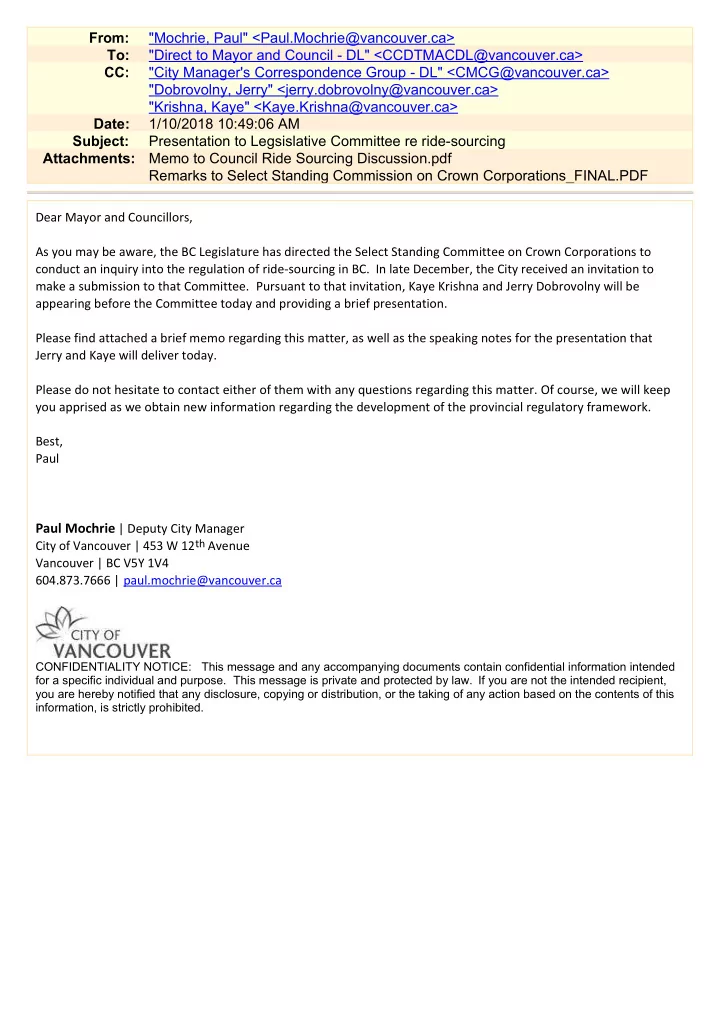
From: "Mochrie, Paul" <Paul.Mochrie@vancouver.ca> To: "Direct to Mayor and Council - DL" <CCDTMACDL@vancouver.ca> CC: "City Manager's Correspondence Group - DL" <CMCG@vancouver.ca> "Dobrovolny, Jerry" <jerry.dobrovolny@vancouver.ca> "Krishna, Kaye" <Kaye.Krishna@vancouver.ca> Date: 1/10/2018 10:49:06 AM Subject: Presentation to Legsislative Committee re ride-sourcing Attachments: Memo to Council Ride Sourcing Discussion.pdf Remarks to Select Standing Commission on Crown Corporations_FINAL.PDF
Dear Mayor and Councillors, As you may be aware, the BC Legislature has directed the Select Standing Committee on Crown Corporations to conduct an inquiry into the regulation of ride-sourcing in BC. In late December, the City received an invitation to make a submission to that Committee. Pursuant to that invitation, Kaye Krishna and Jerry Dobrovolny will be appearing before the Committee today and providing a brief presentation. Please find attached a brief memo regarding this matter, as well as the speaking notes for the presentation that Jerry and Kaye will deliver today. Please do not hesitate to contact either of them with any questions regarding this matter. Of course, we will keep you apprised as we obtain new information regarding the development of the provincial regulatory framework. Best, Paul
Paul Mochrie | Deputy City Manager
City of Vancouver | 453 W 12th Avenue Vancouver | BC V5Y 1V4 604.873.7666 | paul.mochrie@vancouver.ca
CONFIDENTIALITY NOTICE: This message and any accompanying documents contain confidential information intended for a specific individual and purpose. This message is private and protected by law. If you are not the intended recipient, you are hereby notified that any disclosure, copying or distribution, or the taking of any action based on the contents of this information, is strictly prohibited.
SLIDE 2
SLIDE 3
SLIDE 4 Select Standing Committee on Crown Corporations Wosk Centre for Dialogue Wednesday January 10, 2016 City of Vancouver Remarks 11:00 – 11:45 pm PST
Good morning. Thank you Chairperson Ma for your introduction and thank you to the Committee members for extending an invitation to the City of Vancouver to participate in your special study on ride-hailing in British Columbia. My name is Jerry Dobrovolny and I am the General Manager of Engineering Services and I am accompanied by Kaye Krishna, General Manager of Development, Buildings & Licensing. We are pleased to speak to you on behalf of the City of Vancouver regarding the importance of safe, strategic and consistent ride hailing policies in BC. We encourage the province to continue to consult municipalities as ride hailing policies and regulations are developed to ensure we are advancing the shared desired
- utcomes outlined in this presentation.
As you know, the City of Vancouver takes a key role in transportation planning and vehicle for hire licensing and enforcement. This includes
Page 1 of 12
SLIDE 5 expanding our multi-modal transportation network, setting policies to meet
- ur Greenest City sustainability goals, enacting and enforcing bylaws for
traffic and street use, and enacting and enforcing additional licensing requirements for enhanced vehicle and driver conditions. As a municipality, our mandate is to protect the safety of our citizens, support local jobs and businesses, maintain a fair and level regulatory environment, and enable accessibility for all. We appreciate having the opportunity to help shape the policy framework for taxis and ride hailing, but we also acknowledge that the questions you are contemplating this week are truly regional in nature and require a clear and consistent policy framework from the Provincial government. We are reassured that you are moving forward and are pleased to share our perspectives on the key desired outcomes and the potential opportunities and risks of a ride hailing policy framework custom for BC. As the most populated city and economic centre within BC’s largest metropolitan region, Vancouver will be significantly impacted by ride hailing
Page 2 of 12
SLIDE 6
- services. It is critical that ride-hailing policies fit within our larger
transportation plan in three key areas: (1) minimizing increases in traffic volumes and congestion, (2) mitigating carbon emissions, and (3) complimenting sustainable multi-modal transit. (1) Increased vehicle travel and congestion –
- 1. Ride hailing has the potential to reverse the City’s current trend of
decreasing vehicle kilometers travelled per capita and increase congestion overall, particularly during peak times. Additionally, the frequent pick-up and drop-off activity generated by ride hailing may lead to increased congestion caused by illegal stopping in travel lanes, bike lanes, and transit stops. Among other impacts, increased congestion impedes transit service, increases carbon emissions, and slows the movement of goods. In Vancouver this is of particular concern during peak times when the metro core is already experiencing congestion and competition for curbside is
Page 3 of 12
SLIDE 7 already in high demand from other services such as transit, tour buses, taxis and local delivery services. To help cities mitigate these impacts to
- ur streets, it will be important that ride-hailing vehicles be subject to city
by-laws regulating streets, traffic and parking. Also, we would like to ensure municipalities are assured access to ride hailing company/app data for traffic management and policy and planning
- purposes. Access to ride hailing app data will allow municipalities to better
manage ongoing and evolving traffic impacts and regulations such as passenger zones to meet the needs of all road users including app based ride hailing customers. In addition, the data will provide insight to better understand user trips including their origin and destination. In short, ensuring that the City has access to ride hailing data will allow us to continue to do strategic transportation planning and design to ensure we continue to achieve our goals related to both sustainable transportation and congestion management.
Page 4 of 12
SLIDE 8 (2) Mitigating Carbon Emissions – Reduction in private vehicles - Ride hailing complements the growing suite of shared mobility options in Vancouver (both carshare and bikeshare), further reducing the need for private vehicle ownership, reducing parking demand and contributing to a broader shared mobility
- future. Encouraging ride hailing companies and drivers to use electric or
hybrid vehicles will also ensure these vehicles contribute to reduced carbon emissions where the City’s goal is to be completely dependent on only renewable sources before 2050. (3) Complimenting sustainable multi-modal transit - For certain trips and times of day, Ride-hailing has the potential to replace walking, cycling and transit, particularly local bus trips. Recent research out
- f UC Davis, California found that across seven major US cities, the
introduction of ride-hailing reduced transit use by an average of 6%. However, if well-planned and coordinated, ride-hailing has the opportunity to increase transportation choice during high demand times for taxis and car share vehicles.
Page 5 of 12
SLIDE 9 Ride hailing also can be a new mobility that is well integrated with transit, complementing late night transit service and improving first/last mile access for transit trips. Further, ride-hailing may provide more mobility options for those who can’t drive and increases the range of fully accessible transportation options during peak demand, especially on weekends. In summary, as ride hailing is ultimately introducing another mobility option for making vehicle trips, it is important that we continue to contribute to sustainable transportation through
- Continuing to prioritizing investments in walking, cycling and transit,
including,
- Exploring a per trip levy (or equivalent) on ride hailing that can be
further directed back towards transit and active transportation
- improvements. This could be considered as part of a larger mobility
pricing framework within the region. A recent example of this The City
- f Chicago who just introduced a new fee on ride hailing trips to help
fund their public transit.
Page 6 of 12
SLIDE 10 <Switch speakers to Kaye Krishna> In addition to fitting within our transportation plan and regulations, it will be important for a ride-hailing policy framework to (1) protect the safety of our citizens, (2) support the local economy, (3) maintain a fair and level regulatory environment, and (4) enable accessibility and mobility for all. (1) Safety is of the utmost importance. Without safety standards and accountability, passenger safety could be compromised and vehicle related accidents could increase. Current regulations at both the Provincial and municipal level establish minimum standards for vehicle mechanical conditions, driver training requirements, and driver background checks, all
- f which help to mitigate safety risks to both passengers and drivers.
While many ride-hailing apps have built-in mechanisms to manage driver performance, it is our understanding that none of them provide the level of review and safety checks of the current regulatory regime in Vancouver (and BC). We believe the Province should carefully consider this and seek to maintain these safety standards for all vehicles in a future ride-hailinging policy framework.
Page 7 of 12
SLIDE 11 (2) The ride hailing industry is important to the Vancouver economy. The current vehicle for hire organizations are primarily local businesses, they provide local jobs with protections and benefits, and the industry serves not
- nly residents from across the region but underpins the City’s significant
tourism industry. Ride hailing companies offer transportation services similar to those offered by taxis and other vehicles for hire, such as limousines. If the local vehicle for hire industry is to remain viable, regulation of taxi and ride sourcing services must either be harmonized to the extent that both services can compete for the same customer base, or sufficiently distinguished so that consumers are choosing between two different kinds of service. We believe it is important to establish a Provincial ride-hailing regulatory framework that creates equal opportunity and sustains economic livelihood for the local vehicle for hire companies. (3) The City of Vancouver holds vehicles for hire to a higher standard than taxis in other municipalities across British Columbia. These standards
Page 8 of 12
SLIDE 12 include increased driver training, such as for handicap assistance, and increased quality standards for vehicles. Further, the City licenses the taxi companies and the car/drivers, which enables the city to hold both the companies and the drivers accountable for following rules, establishing consistent protocols (such as issue resolution), reporting data or other status to the City, etc. Overall, the City believes it is important to establish a level playing field across regulations for all vehicles for hire, particularly at a regional level. Generally speaking, the City has attempted to ‘raise the bar’ on the quality
- f service in Vancouver and would like to see high quality and consistent
regulations established across all vehicles and companies in the regional ride sourcing market. Further, as part of supporting a fair and level playing field in the ride- sourcing industry, it will be important to put into place effective enforcement mechanisms and sufficient enforcement resources. Under the current regulatory regime, the City receives many complaints about taxi drivers not licensed for Vancouver operating within the city boundaries and
Page 9 of 12
SLIDE 13 enforcement of rules remains challenging. Vancouver sees an opportunity to work with the Province, the regional authorities, and other Lower Mainland municipalities to strengthen enforcement functions and believes it is important to establish a regulatory framework that facilitates enforcement
- f all types of vehicles for hire.
(4) Finally, it will be very important to ensure any new frameworks enable accessibility and mobility for all. As they currently operate elsewhere, ride-hailing apps and private vehicles are not necessarily accessible to all citizens, particularly those with disabilities or those who may not have access to technology or credit cards. British Columbia currently has high wheelchair accessibility standards and Vancouver City Council places a high priority on ensuring that the local fleet of cars maintains high levels of accessibility. For example, of the 175 new taxis added to the fleet last year, approximately 15% (or 26) were required to be wheelchair accessible. Vehicles for hire – whether hired through an app, hailed, or called – should continue to provide a similar level
- f wheelchair accessibility options for Vancouverites.
Page 10 of 12
SLIDE 14
Further, the current vehicle for hire system provides transportation options for many low income residents who do not have access to a car, a smart phone, or credit cards (which is required by most ride-hailing companies to enable the app). In other words, people can hail or call taxis and they can pay in cash. Any new policy framework should consider how to ensure these alternatives are supported in the future. Thank you again for the opportunity to speak with you today. In addition to presenting to this Committee, Vancouver City staff contributed to the previous Provincial stakeholder round table and engagement process in 2015 and 2016. We also recently provided feedback to Hara Associates for their current work on Modernizing Passenger Directed Services. As Mr. Dobrovolny mentioned, following this week’s Committee hearing, we will also submit a written memo to you summarizing our presentation today. We recognize that the Province faces significant and complex considerations in establishing a “made in BC” ride-hailing model. We hope that there will be future opportunities for municipalities and transportation
Page 11 of 12
SLIDE 15
authorities to collaborate with the Province on the implementation of the ride-hailing policy framework. Thanks again and we look forward to addressing any questions from the Committee.
Page 12 of 12