SLIDE 1
Quiz
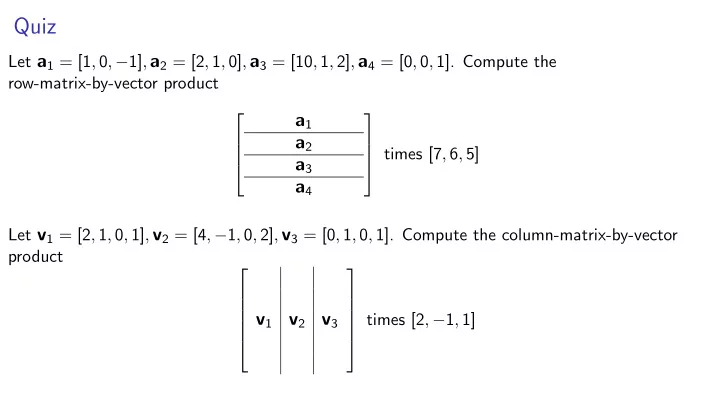
Let a1 = [1, 0, −1], a2 = [2, 1, 0], a3 = [10, 1, 2], a4 = [0, 0, 1]. Compute the row-matrix-by-vector product
a1 a2 a3 a4
times [7, 6, 5] Let v1 = [2, 1, 0, 1], v2 = [4, −1, 0, 2], v3 = [0, 1, 0, 1]. Compute the column-matrix-by-vector product
v1 v2 v3
times [2, −1, 1]
SLIDE 2
The Matrix
[3] The Matrix
Neo: What is the Matrix? Trinity: The answer is out there, Neo, and it’s looking for you, and it will find you if you want it to. The Matrix, 1999
SLIDE 3
Two views of same process
Row-matrix-by-vector multiplication and column-matrix-by-vector multiplication are same! a1 a2 . . . am b1 b2 . . . bm c1 c2 . . . cm times [x1, x2, x3] = x1 a1 a2 . . . am + x2 b1 b2 . . . bm + x3 c1 c2 . . . cm = x1a1 x1a2 . . . x1am + x2b1 x2b2 . . . x2bm + x3c1 x3c2 . . . x3cm
SLIDE 4
Two views of same process
Row-matrix-by-vector multiplication and column-matrix-by-vector multiplication are same! = x1 a1 a2 . . . am + x2 b1 b2 . . . bm + x3 c1 c2 . . . cm = x1a1 x1a2 . . . x1am + x2b1 x2b2 . . . x2bm + x3c1 x3c2 . . . x3cm = x1a1 + x2b1 + x3c1 x1a2 + x2b2 + x3c2 . . . x1am + x2bm + x3cm
SLIDE 5
Two views of same process
Row-matrix-by-vector multiplication and column-matrix-by-vector multiplication are same! = x1a1 x1a2 . . . x1am + x2b1 x2b2 . . . x2bm + x3c1 x3c2 . . . x3cm = x1a1 + x2b1 + x3c1 x1a2 + x2b2 + x3c2 . . . x1am + x2bm + x3cm
SLIDE 6
Two views of same process
= x1a1 + x2b1 + x3c1 x1a2 + x2b2 + x3c2 . . . x1am + x2bm + x3cm = (a1, b1, c1) · (x1, x2, x3) (a2, b2, c2) · (x1, x2, x3) . . . (am, bm, cm) · (x1, x2, x3) = [a1, b1, c1] [a2, b2, c2] . . . [am, bm, cm] times [x1, x2, x3]
SLIDE 7
Two views of same process
We showed a1 a2 . . . am b1 b2 . . . bm c1 c2 . . . cm times [x1, x2, x3] = [a1, b1, c1] [a2, b2, c2] . . . [am, bm, cm] times [x1, x2, x3] so a1 a2 . . . am b1 b2 . . . bm c1 c2 . . . cm is same as [a1, b1, c1] [a2, b2, c2] . . . [am, bm, cm]
SLIDE 8 Row matrix and column matrix are same
Example: 1 2 3 4 5 6 7 8 9 10 11 12 same as 1 2 3 4 5 6 7 8 9 10 11 12 Same underlying math’l object, different representations
◮ column-list representation ◮ row-list representation
One operation, matrix-vector multiplication, with two interpretations:
◮ dot-product interpretation: output vector entries are dot-products of rows with input vector ◮ linear-combinations interpretation: output vector is linear combination of columns where
coeff’s are input vector entries You must memorize which is which.
SLIDE 9 The Matrix
Traditional notion of a matrix: two-dimensional array. 1 2 3 10 20 30
- ◮ Two rows: [1, 2, 3] and [10, 20, 30].
◮ Three columns: [1, 10], [2, 20], and [3, 30]. ◮ A 2 × 3 matrix.
For a matrix A, the i, j element of A
◮ is the element in row i, column j ◮ is traditionally written Ai,j ◮ but we will use A[i, j]
SLIDE 10 List of row-lists, list of column-lists
◮ One obvious Python representation for a matrix: a list of row-lists:
1 2 3 10 20 30
- represented by [[1,2,3],[10,20,30]].
◮ Another: a list of column-lists:
1 2 3 10 20 30
- represented by [[1,10],[2,20],[3,30]].
SLIDE 11 List of row-lists, list of column-lists
Ungraded “Quiz”: Write a nested comprehension whose value is list-of-row-list representation
- f a 3 × 4 matrix all of whose elements are zero:
Hint: first write a comprehension for a typical row, then use that expression in a comprehension for the list of lists. Answer: >>> [[0 for j in range(4)] for i in range(3)] [[0, 0, 0, 0], [0, 0, 0, 0], [0, 0, 0, 0]]
SLIDE 12 The matrix revealed
The Matrix Revisited (excerpt) http://xkcd.com/566/ Definition: For finite sets R and C, an R × C matrix over F is a function from R × C to F. @ # ? a 1 2 3 b 10 20 30
◮ R = {a, b} and C = {@, #, ?}. ◮ R is set of row labels ◮ C is set of column labels
In Python, the function is represented by a dictionary: {(’a’,’@’):1, (’a’,’#’):2, (’a’, ’?’):3, (’b’, ’@’):10, (’b’, ’#’):20, (’b’,’?’):30}
SLIDE 13 Rows, columns, and entries
@ # ? a 1 2 3 b 10 20 30 Rows and columns are vectors, e.g.
◮ Row ’a’ is the vector Vec({’@’, ’#’, ’?’}, {’@’:1, ’#’:2, ’?’:3}) ◮ Column ’#’ is the vector Vec({’a’,’b’}, {’a’:2, ’b’:20})
SLIDE 14
Dict-of-rows/dict-of-columns representations
@ # ? a 1 2 3 b 10 20 30 One representation: dictionary of rows: {’a’: Vec({’#’, ’@’, ’?’}, {’@’:1, ’#’:2, ’?’:3}), ’b’: Vec({’#’, ’@’, ’?’}, {’@’:10, ’#’:20, ’?’:30})} Another representation: dictionary of columns: {’@’: Vec({’a’,’b’}, {’a’:1, ’b’:10}), ’#’: Vec({’a’,’b’}, {’a’:2, ’b’:20}), ’?’: Vec({’a’,’b’}, {’a’:3, ’b’:30})}
SLIDE 15 Our Python implementation
@ # ? a 1 2 3 b 10 20 30 >>> M=Mat(({’a’,’b’}, {’@’, ’#’, ’?’}), {(’a’,’@’):1, (’a’,’#’):2,(’a’,’?’):3, (’b’,’@’):10, (’b’,’#’):20, (’b’,’?’):30}) A class with two fields:
◮ D, a pair (R, C) of sets. ◮ f, a dictionary representing a function
that maps pairs (r, c) ∈ R × C to field elements. class Mat: def __init__(self, labels, function): self.D = labels self.f = function We will later add lots of matrix
Example: For a Mat M, M[r, c] is the entry in row r, column c.
SLIDE 16 Identity matrix
For any domain D, there is a matrix that represents the D-to-D identity function f (x) = x a b c
| 1 0 0 b | 0 1 0 c | 0 0 1 Definition: D × D identity matrix is the matrix 1D such that 1D[k, k] = 1 for all k ∈ D and zero elsewhere. Usually we omit the subscript when D is clear from the context. Often letter I (for “identity”) is used instead of 1 Mat(({’a’,’b’,’c’},{’a’,’b’,’c’}),{(’a’,’a’):1,(’b’,’b’):1,(’c’,’c’):1}) Quiz: Write procedure identity(D) that returns the D × D identity matrix over R represented as an instance of Mat. Answer: def identity(D): return Mat((D,D), (k,k):1 for k in D)
SLIDE 17
Converting between representations
Converting an instance of Mat to a column-dictionary representation: @ # ? a 1 2 3 b 10 20 30 Mat(({’a’,’b’}, {’@’, ’#’, ’?’}), {(’a’,’@’):1, (’a’,’#’):2, (’a’,’?’):3, (’b’,’@’):10, (’b’,’#’):20, (’b’,’?’):30}) ⇒ {’@’: Vec({’a’,’b’}, {’a’:1, ’b’:10}), ’#’: Vec({’a’,’b’}, {’a’:2, ’b’:20}), ’?’: Vec({’a’,’b’}, {’a’:3, ’b’:30})} Quiz: Write the procedure mat2coldict(A) that, given an instance of Mat, returns the column-dictionary representation of the same matrix. Answer: def mat2coldict(A): return {c:Vec(A.D[0],{r:A[r,c] for r in A.D[0]}) for c in A.D[1]}
SLIDE 18 Module matutil
We provide a module, matutil, that defines several conversion routines:
◮ mat2coldict(A): from a Mat to a dictionary of columns
represented as Vecs)
◮ mat2rowdict(A): from a Mat to a dictionary of rows
represented as Vecs
◮ coldict2mat(coldict) from a dictionary of columns (or a list of columns) to a Mat ◮ rowdict2mat(rowdict): from a dictionary of rows (or a list of rows) to a Mat ◮ listlist2mat(L): from a list of list of field elements to a Mat
the inner lists turn into rows and also:
◮ identity(D, one): produce a Mat representing the D × D identity matrix
SLIDE 19 The Mat class
We gave the definition of a rudimentary matrix class: class Mat: def __init__(self, labels, function): self.D = labels self.f = function The more elaborate class definition allows for more concise vector code, e.g. >>> M[’a’, ’B’] = 1.0 >>> b = M*v >>> B = M*A >>> print(B) More elaborate version of this class definition allows
- perator overloading for element access, matrix-vector
multiplication, etc.
syntax Matrix addition and subtraction A+B and A-B Matrix negative
Scalar-matrix multiplication alpha*A Matrix equality test A == B Matrix transpose A.transpose() Getting a matrix entry A[r,c] Matrix-vector multiplication A*v Matrix-matrix multiplication A*B You will code this class starting from a template we provide.
SLIDE 20
Using Mat
You will write the bodies of named procedures such as setitem(M, k, val) and matrix vector mul(M, v) and transpose(M). In using Mats in other code, you must use operators and methods instead of named procedures, e.g. >>> M[’a’, ’b’] = 1.0 >>> v = M*u >>> b_parallel = Q*Q.transpose()*b instead of >>> setitem(M, (’a’,’B’), 1.0) >>> v = matrix_vector_mul(M, u) >>> b_parallel = matrix_vector_mul(matrix_matrix_mul(Q, transpose(Q)), b) In code outside the mat module that uses Mat, you will import just Mat from the mat module: from mat import Mat so named procedures will not be imported into the namespace. In short: Use the operators [ ], +, *, - and the method .transpose() when working with Mats
SLIDE 21
Assertions in Mat
For each procedure you write, we will provide the stub of the procedure, e.g. for matrix vector mul(M, v), we provide the stub def matrix_vector_mul(M, v): "Returns the product of matrix M and vector v" assert M.D[1] == v.D pass You are supposed to replace the pass statement with code for the procedure. The first line in the body is a documentation string. The second line is an assertion. It asserts that the second element of the pair M.D, the set of column-labels of M, must be equal to the domain of the vector v. If the procedure is called with arguments that violate this, Python reports an error. The assertion is there to remind us of a rule about matrix-vector multiplication. Please keep the assertions in your mat code while using it for this course.
SLIDE 22
Testing Mat with doctests
Because you will use Mat a lot, making sure your implementation is correct will save you from lots of pain later. Akin to Vec, we have provided doctests def getitem(M, k): """ Returns value of entry k in M >>> M = Mat(({1,3,5}, {’a’}), {(1,’a’):4, (5,’a’): 2}) >>> M[1,’a’] 4 """ pass You can test using copy-paste: >>> from vec import Mat >>> M = Mat(({1,3,5}, {’a’}), ... >>> M[1,’a’] 4 You can also run all the tests at once from the console (outside the Python interpreter) using the following command: python3 -m doctest mat.py